Current Archive
Magazines: 15 Issues: 219 Articles: 5354
Beautiful Bondage 9 issues

Beautiful Bondage is a highly specialized early-1960s Japanese bondage publication built almost entirely around photography rather than prose. In the February 1964 issue, the magazine functions less like a conventional SM periodical and more like a photographic catalog of rope restraint. There are no substantial essays, stories, reader letters, or formal table of contents. Instead, the issue moves page by page through a dense sequence of black-and-white bondage photographs, usually arranged several to a page and accompanied by short vertical captions identifying poses, restraints, or visual effects.
Its central subject is the visual vocabulary of Japanese rope bondage. The photographs show women in a wide variety of configurations: arms bound behind the back, chest and torso harnesses, overhead wrist restraints, ankle and wrist ties, neck ropes, crotch ropes, pillar ties, floor bondage, chair bondage, and dense upper-body wrapping. Gags are common, and the settings alternate among tatami rooms, studio-like interiors, domestic spaces, and occasional outdoor locations. Clothing ranges from dresses and sailor-style outfits to underwear, partial nudity, and full nudity.
1964 2 issues
Fuzoku Kitan 19 issues
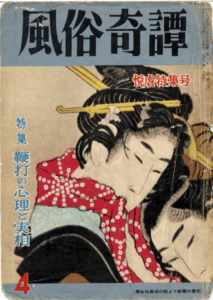
Fūzoku Kitan was a Japanese magazine devoted to sexual customs, erotic subcultures, fetishism, and unconventional desire. Its issues combined essays, fiction, reader confessions, historical anecdotes, pseudo-scientific commentary, illustrations, and staged photography. Recurring subjects included bondage, sadism and masochism, corporal punishment, female dominance, occult sexuality, prostitution, sexual folklore, and unusual practices from Japan and abroad.
For researchers, the magazine offers a vivid record of how postwar Japanese popular publishing interpreted sexuality through overlapping lenses of entertainment, anthropology, psychology, history, and sensational journalism. Its mixture of serious inquiry and theatrical fantasy makes it especially valuable for studying the development of modern Japanese fetish culture and the visual and literary history of kinbaku.
1960 7 issues
- April April 1960: Special Issue on the Psychology and Reality of Whipping Open Reader
- May May 1960: Special Issue on Homosexuality and Pleasurable Humiliation Open Reader
- June June 1960 Sadism and Intoxication Special Issue Open Reader
- August August 1960: Special Issue on the Fantastic, Supernatural, Strange, and Cruel Open Reader
- October October 1960 Open Reader
- November November 1960: Special Issue on Merciless Humiliation Open Reader
- December December 1960 Open Reader
1961 12 issues
- January January 1961: Special Issue on Sodomy and Lesbianism Open Reader
- February February 1961 Open Reader
- March March 1961 Open Reader
- April April 1961: Special Issue on the Pleasure of Cruelty Open Reader
- May May 1961: Special Issue on Men and Women Possessed by the Whip Open Reader
- June June 1961 Open Reader
- July July 1961 Open Reader
- August August 1961 Open Reader
- September September 1961 Open Reader
- October October 1961 Open Reader
- November November 1961 Special Issue Open Reader
- December December 1961 Special Issue Open Reader
Fuzoku Soshi 14 issues
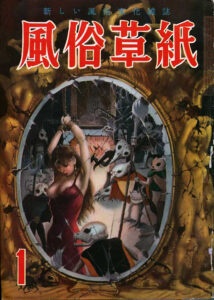
Fūzoku Sōshi was a short-lived but influential Japanese magazine devoted to erotic customs, sadomasochism, bondage, fetishism, and other forms of sexual nonconformity. Published in the early 1950s, it combined fiction, essays, illustrations, photographs, reader letters, and personal testimony, creating a space where writers, artists, and readers could explore desires largely excluded from respectable postwar culture.
Compared with more cautious contemporary publications, Fūzoku Sōshi often adopted a more provocative and experimental tone. Its pages reveal not only the development of early postwar SM imagery and vocabulary, but also the formation of a dispersed erotic community connected through correspondence, shared fantasies, and debate. Although the magazine lasted only seventeen issues, it offers a rare record of how Japanese SM culture was being imagined, discussed, and organized before the emergence of later specialist magazines.
1953 8 issues
Gaho Fuzoku Kitan 17 issues
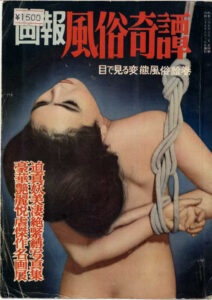
Gahō Fūzoku Kitan was a Japanese pictorial magazine devoted to erotic customs, bondage, sadomasochistic fantasy, sexual folklore, crime, and historical curiosities. Its issues combined staged photography, original illustrations, reproductions of Japanese and Western erotic art, sensational fiction, confession, and short essays on unusual sexual practices.
The magazine placed exceptional emphasis on visual material. Extended gravure sequences presented rope bondage, restraint devices, punishment scenes, and theatricalized suffering in domestic, outdoor, and imagined settings. These were often paired with historical prints, foreign illustrations, and drawings of torture or captivity, creating a cross-cultural archive of erotic spectacle.
For researchers, Gahō Fūzoku Kitan documents the visual language of postwar Japanese fetish publishing and the development of kinbaku as a photographic and illustrative genre. Its mixture of art history, pseudo-sexology, folklore, crime narrative, and erotic fantasy offers valuable evidence of how sexuality, cruelty, and transgression were packaged for popular audiences in mid-twentieth-century Japan.
1961 10 issues
- January January 1961 Open Reader
- February February 1961 Open Reader
- March March 1961 Open Reader
- April April 1961 Open Reader
- May May 1961 Open Reader
- June June 1961 Open Reader
- July July 1961 Open Reader
- August August 1961 Open Reader
- September Gaho Fuzoku Kitan, September 1961 Open Reader
- October Gaho Fuzoku Kitan, October 1961 Open Reader
Geijutsu Shincho 1 issue
1995 1 issue
Kitan Club 92 issues
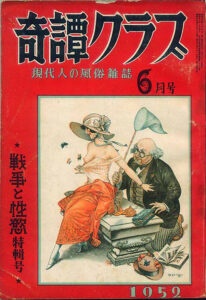
Kitan Club was one of the most important magazines in the formation of postwar Japanese SM culture. Founded in the late 1940s, it began as a broad “curiosity” magazine combining erotic fiction, crime, medicine, humor, popular science, confession, social observation, and accounts of supposedly abnormal sexuality. Over the course of the early 1950s, however, bondage, sadism, masochism, fetishism, punishment imagery, and reader correspondence became increasingly central. The magazine did not simply document an existing SM community. Through recurring terminology, serialized fiction, illustrations, photographs, technical discussion, and letters from readers, it helped create the cultural field in which Japanese SM could become recognizable as a shared body of desires, practices, and ideas.
1953 12 issues
- January Kitan Club, January 1953 New Year Issue Open Reader
- February February 1953 Open Reader
- March March 1953 Open Reader
- April April 1953 Open Reader
- May May 1953 Open Reader
- June June 1953 Open Reader
- July July 1953 Open Reader
- August August 1953 Open Reader
- September September 1953 Open Reader
- October October 1953 Open Reader
- November November 1953 Open Reader
- December December 1953 Open Reader
1954 12 issues
- January January 1954 Open Reader
- February February 1954 Open Reader
- March March 1954 Open Reader
- April Apri 1954 Open Reader
- May May 1954 Open Reader
- June June 1954 Open Reader
- July July 1954 Open Reader
- August August 1954 Open Reader
- September September 1954 Open Reader
- October October 1954 Open Reader
- November November 1954 Open Reader
- December December 1954 Open Reader
1955 7 issues
- January Kitan Club, January 1955 New Year Special Issue Open Reader
- February Kitan Club, February 1955 Special Enlarged Issue Open Reader
- March Kitan Club, March 1955 Special Expanded Issue Open Reader
- April Kitan Club, April 1955 Special Expanded Issue Open Reader
- May Kitan Club, May 1955 Special Expanded Issue Open Reader
- October Kitan Club, October 1955 Issue Open Reader
- November Kitan Club, November 1955 Issue Open Reader
1956 8 issues
- April Kitan Club, April 1956 Issue Open Reader
- May Kitan Club, May 1956: Masterpiece Fiction Special Issue Open Reader
- June Kitan Club, June 1956 Open Reader
- July Kitan Club, July 1956 Open Reader
- August Kitan Club, August 1956 Open Reader
- September Kitan Club, September 1956 Open Reader
- October Kitan Club, October 1956 Open Reader
- December Kitan Club, December 1956 Open Reader
1958 1 issue
1960 1 issue
1962 9 issues
- February Kitan Club, February 1962 Open Reader
- April Kitan Club, April 1962 Open Reader
- May May Extra-Large Issue Open Reader
- June June 1962 Issue Open Reader
- July July 1962 Issue Open Reader
- August Kitan Club, August–September 1962 Open Reader
- October October 1962 Issue Open Reader
- November November 1962 Issue Open Reader
- December December 1962 Issue Open Reader
1963 12 issues
- January 1963 New Year Issue Open Reader
- February February 1963 Issue Open Reader
- March March 1963 Issue Open Reader
- April April 1963 Issue Open Reader
- May May 1963 Issue Open Reader
- June June 1963 Issue Open Reader
- July July 1963 Issue Open Reader
- August August 1963 Issue Open Reader
- September September 1963 Issue Open Reader
- October October 1963 Issue Open Reader
- November Confessions, Experiences, and Memoirs Special Issue Open Reader
- December December 1963 Issue Open Reader
1964 1 issue
1974 12 issues
- January Kitan Club, January 1974 Open Reader
- February Kitan Club, February 1974 Open Reader
- March Kitan Club, March 1974 Open Reader
- April Kitan Club, April 1974 Open Reader
- May Kitan Club: May Issue Open Reader
- June Kitan Club, June 1974 Open Reader
- July Kitan Club, July 1974 Open Reader
- August Kitan Club, August 1974 Open Reader
- September September 1974 Issue Open Reader
- October Kitan Club, October 1974 Open Reader
- November Kitan Club, November 1974 Open Reader
- December December 1974 Issue Open Reader
KK Correspondence 19 issues
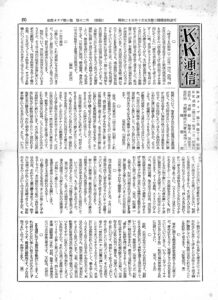
KK Correspondence was a reader-centered supplement associated with Kitan Club that placed communication, rather than fiction or illustration, at the heart of the publication. Its pages gathered personal confessions, advice, theoretical debate, requests for introductions, proposals for meetings and excursions, editorial responses, and appeals from readers seeking others with similar desires. For people who could not safely discuss sadism, masochism, homosexuality, fetishism, or other stigmatized interests in ordinary life, the publication offered a rare space in which private feelings could become publicly legible. Readers did not merely describe what they desired. They asked who else felt the same way, what kind of relationship might make those desires possible, and how erotic cruelty could be distinguished from unwanted harm.
1953 12 issues
- January KK 1953 1 Open Reader
- February February 1953 Open Reader
- March March 1953 Open Reader
- April April 1953 Open Reader
- May May 1953 Open Reader
- June June 1953 Open Reader
- July July 1953 Open Reader
- August August 1953 Open Reader
- September September 1953 Open Reader
- October October 1953 Open Reader
- November November 1953 Open Reader
- December December 1953 Open Reader
SM Collector 2 issues
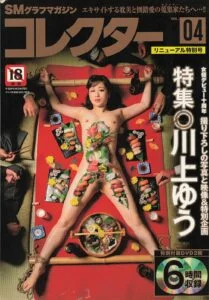
SM Collector (SMグラフマガジンコレクター, SM Graphic Magazine Collector) was a Japanese SM magazine published by Sanwa Publishing beginning in March 2013. Reviving the “Collector” name associated with an earlier generation of Japanese SM publishing, the magazine combined glossy photographic features, kinbaku and SM imagery, interviews and themed editorial material, with each issue also including substantial DVD video content. The series featured prominent contemporary performers and rope artists, including Akira Naka and Yuu Kawakami, and presented itself as a high-quality continuation of Japan’s long tradition of specialist SM print culture at a time when such magazines were rapidly disappearing. At least five volumes were published between March 2013 and November 2014, with Volume 1 released on March 30, 2013 and Volume 5 on November 29, 2014.
SM Mania 1 issue

SM Mania (SMマニア) was a Japanese SM magazine founded in July 1982 and published first by Sanwa Publishing, later by MyWay Publishing. It belonged to the generation of specialist magazines that carried the postwar Japanese SM press into the 1980s and beyond, combining bondage photography, erotic illustration, fiction, personal testimony, and material aimed specifically at readers interested in sadomasochism and kinbaku. Its early 1980s issues are particularly important for the history of Japanese bondage photography: model Hiromi Saotome, for example, appeared in an SM Mania shoot in 1983, at the beginning of a career that would make her a significant figure in the visual culture of Japanese SM. SM Mania therefore represents an important bridge between the older literary and reader-submission traditions of magazines such as Kitan Club and the increasingly photographic, model-centered SM publishing culture of the 1980s and 1990s.
2007 1 issue
SM Play 1 issue
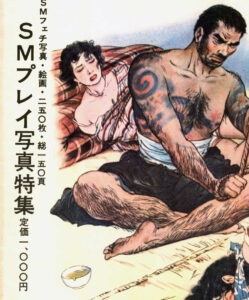
SMプレイ (SM Play) is a Japanese specialist magazine devoted to sadomasochistic sexuality, bondage, fetish practices, and the broader culture surrounding SM. Its contents combine staged photography, illustrated material, personal accounts, practical or descriptive discussions of play, and features on particular fetishes and forms of domination or submission. Rather than treating SM only as pornography, the magazine presents it as a recognizable subculture with its own techniques, aesthetics, terminology, fantasies, and community practices.
Visually, SM Play places strong emphasis on bondage and restraint, including rope work, immobilization, punishment scenarios, fetish clothing, and staged dominant-submissive encounters. Depending on the issue, this material may range from relatively documentary photographs of techniques and poses to highly theatrical scenes constructed around captivity, humiliation, discipline, or physical ordeal. Prose features similarly move between fantasy and quasi-instructional or testimonial modes, giving readers both erotic scenarios and accounts of how particular forms of SM are understood or practiced.
1972 1 issue
SM Sniper 2 issues

SM Sniper (S&M Sniper) was one of Japan’s most influential modern SM magazines, launched in September 1979 by Million Publishing under founding editor Masafumi Sudo. Emerging at a moment when Japanese SM publishing was moving beyond the literary and illustration-centered traditions of earlier magazines, SM Sniper developed a highly visual, contemporary style that combined kinbaku photography with fetish fashion, underground culture, interviews, essays, comics, reviews, reportage, and experimental erotic imagery. Rather than relying exclusively on established professional kinbakushi, its editorial staff often conceived and directed bondage scenes themselves, while professional styling, makeup, costume, and photography gave the magazine a distinctive “new wave” aesthetic closely connected to the art, fashion, music, and subcultural worlds of the 1980s and 1990s. Over its long publication history, SM Sniper featured or documented figures including Dan Oniroku, Nobuyoshi Araki, Masami Akita, and numerous photographers, performers, writers, models, and practitioners who shaped contemporary Japanese SM culture. First published by Million Publishing and later associated with Wailea Publishing, the magazine became an important bridge between the postwar SM-magazine tradition and the increasingly diverse, media-driven BDSM culture of late twentieth-century Japan.
2008 1 issue
Specialty S&M 3 issues

Specialty S&M was a Japanese SM magazine built around a blend of erotic photography, first-person testimony, practical bondage instruction, serialized fiction, and reader participation. Judging from the January 1981 issue, its editorial identity was less that of a conventional erotic magazine than a small subcultural forum, one where fantasy, technique, personal experience, and community exchange constantly overlapped.
Visually, the magazine devoted substantial space to staged SM photography. Bondage, suspension, humiliation, fetish clothing, punishment scenarios, and role-play appeared not simply as illustrations for articles but as independent photographic features. Some portfolios emphasized theatrical fantasy, while others were presented as reader submissions or documentation of actual play. The result is an interesting ambiguity between performance and record: photographs could function simultaneously as erotic spectacle, evidence of personal practice, and demonstrations of technique
1981 1 issue
Sun & Moon 6 issues
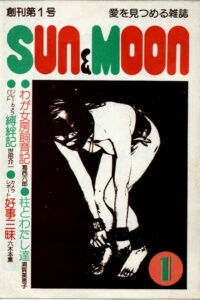
Sun & Moon was a Japanese SM magazine combining bondage photography, erotic illustration, fiction, and fetish-oriented features. Its pages present kinbaku as both spectacle and narrative, placing the bound body within scenes of capture, punishment, submission, humiliation, and theatrical suffering. Rather than treating rope only as a technique, the magazine uses setting, costume, expression, and sequential imagery to create miniature dramas shaped by fantasy and emotional tension.
The magazine also reflects the increasingly visual character of Japanese SM publishing, in which carefully composed photographs and illustrated scenarios became central to the presentation of bondage. Sun & Moon offers a revealing glimpse into the aesthetics, recurring fantasies, and publishing conventions through which kinbaku and sadomasochistic culture were circulated among Japanese readers.
Uramado 29 issues
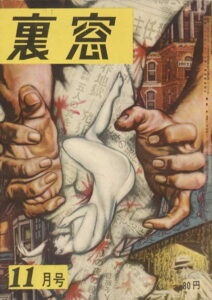
Uramado (“Rear Window”) was an influential Japanese SM and erotic-literary magazine published from the mid-1950s into the mid-1960s. It began in January 1956 under the title Kappa as a successor to Amatoria, then adopted the name Uramado with the September 1956 issue. Under the editorial direction of Suma Toshiyuki, better known as Minomura Kō, the magazine gradually shifted from true-story material toward the more literary, visually ambitious form he favored. Nureki Chimuo later became editor-in-chief in 1961.
The magazine occupied an important bridge between the first generation of postwar “abnormal” publications and the more explicitly SM-focused magazines that followed. Its pages combined erotic fiction, bondage illustration, photography, essays, confession, crime and punishment imagery, and experimental visual narratives. It published important Japanese artists including Muku Yōji, Harukawa Namio, and Ishizuka Yoshiyuki, while also giving unusual prominence to Western fetish art. Beginning around 1961, its “Published in Magazines Overseas” feature introduced readers to work associated with artists such as Gene Bilbrew, Eric Stanton, John Willie, Ruiz, and Jim of Switzerland. This made Uramado a particularly important site of exchange between Japanese kinbaku imagery and international fetish culture.
1956 1 issue
1957 1 issue
1959 5 issues
- April April 1959: Special Feature on Obscene Cults Open Reader
- May May 1959 Open Reader
- July July 1959: Special Issue on Terrifying Unusual Sensations Open Reader
- August August 1959 Special Issue: Curses, Magic, and Illusion Open Reader
- September September 1959 Special Issue: Secret History of the Ōoku and Inner Palace Open Reader
1963 1 issue
Yomikiri Romance 4 issues
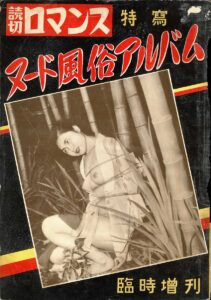
Yomikiri Romance was an early postwar Japanese popular magazine that gradually shifted from general erotic and romantic entertainment toward more specialized material involving bondage, cruelty, fetishism, and sadomasochistic fantasy. Although much of its content remained broadly erotic rather than exclusively SM, the magazine became an important transitional publication in the development of Japan’s postwar bondage press.
Itō Seiu was central to this transformation. The magazine published and promoted his historical research, drawings, staged photographs, and reconstructions of punishment and restraint, presenting him not merely as an illustrator but as an authority on the visual history of cruelty. In 1953 he supervised a photographic supplement devoted largely to kinbaku imagery, often identified as Graphic Depiction of Ecstasy in Pleasure and Pain. His work gave the magazine a distinctive connection to older Japanese punishment imagery while helping translate that imagery into the emerging language of modern erotic bondage.