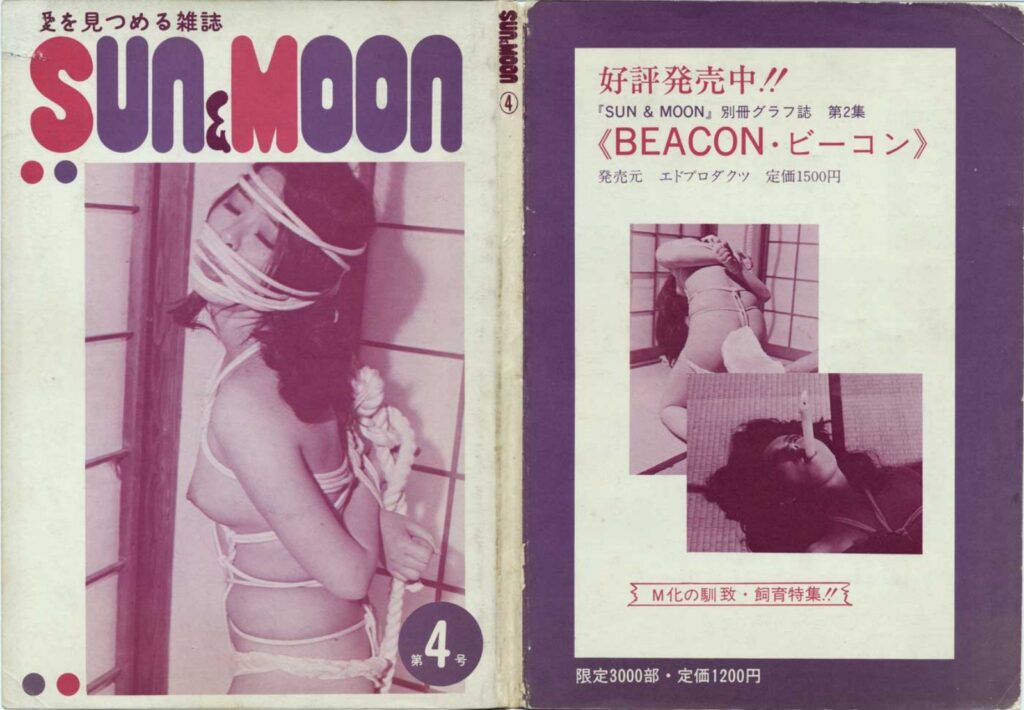
Sun & Moon
October 1977
← Back to magazine archive
Issue Details
- PDF pages
- 118
Summary
The October 1977 issue is the most self-consciously historical and reflective of the three. Its opening photography still emphasizes restraint as spectacle, but the issue devotes substantial attention to the history of SM publishing, the archive of older photographs, the development of rope styles, and the relation between modern amateur practice and the legacy of Kitan Club.
Read full summary Close full summary
Table of Contents 23 items
-
The Image of Discipline
Summary
A photographic feature presents staged scenes of women undergoing elaborate rope restraint, blindfolding, suspension, and disciplined poses in domestic and studio-like settings.
-
M-Woman T Living in the West
Summary
A visual feature centered on M-woman T presents her bound and blindfolded body in staged erotic scenes associated with submissive identity and restraint.
-
The Three Bagworms: A Roundtable
Summary
A long-form roundtable brings together SM writers, editors, and participants to discuss personal experience, bondage practice, erotic photography, publishing, changing sexual culture, and the future of specialist magazines.
-
Beloved Wife Bondage Diary
Summary
A husband records a domestic bondage diary describing the progressive tying, positioning, blindfolding, gagging, and photographing of his wife in consensual marital SM scenes.
-
An Abnormal Sex Life
Summary
An extended erotic reportage follows a woman’s “abnormal” SM relationship, detailing staged sessions involving submission, restraint, punishment, specialized equipment, and photographic documentation.
-
Collector of Humiliation: A Record of Solitary Pleasure
Summary
Moriyama Shūichi surveys the development of postwar Japanese SM magazines and image culture through memories of collecting publications, models, photographs, and bondage materials, linking archival preservation to changing tastes in humiliation and restraint.
-
I Am the Bachelor King
Summary
Katsura Keiki presents a first-person erotic memoir about his relationships, domestic life, encounters with SM enthusiasts, and experiments involving bondage, discipline, and partner exchange, framed by reflections on SM magazines and changing sexual cultures.
-
Altar: My First SM Swap Experience
Summary
A photographic feature documenting an introductory SM swap experience, showing a restrained participant and staged scenes of bondage, sensory restriction, and sexualized role exchange.
-
Secret Mania Photograph Collection
Summary
A photographic collection depicting staged scenes of a nude woman subjected to rope bondage, blindfolding, gagging, and controlled positioning by a male partner.
-
Love Slave
Summary
This photographic feature presents a woman as a “love slave” in a series of staged rope-bound scenes involving blindfolding, exposure, and submissive poses.
-
M-Woman T Living in the West, Part Two
Summary
Part two of the M-Woman T series follows a Western-resident submissive woman through staged photographs of rope bondage, blindfolding, and varied restrained positions on beds and furniture.
-
Shibuya Album, Part One
Summary
A photographic portfolio presenting a woman in varied rope-bound positions, primarily on a bed, as part of a Shibuya-themed kinbaku album.
-
Special Training Sequence
Summary
Y.Y.’s staged photographic sequence depicts a woman undergoing a stylized bondage and discipline routine through successive rope-bound positions, including standing and floor-based restraints.
-
Reader-Submitted Photographs
Summary
A reader-submitted photographic feature by Ichinose Sōshi showing a woman in several staged rope- and chain-bound poses, including restrained and gagged compositions.
-
Scramble
Summary
A photographic feature presenting staged scenes of a blindfolded and harnessed woman subjected to varied bondage and restraint poses.
-
Dazzling Menstrual Belt
Summary
A historical and cultural account of menstrual belts, tracing their development from earlier Japanese practices through modern commercial products and their adoption in erotic and fetish contexts.
-
Continuing to Dream, Now…
Summary
A mixed photographic narrative follows Chieko’s progression from an encounter with the photographer through increasingly controlled posing, nudity, rope restraint, commands, and submission-oriented performance.
-
The Beauty of Rope and Leather
Summary
An essay compares the aesthetic and cultural qualities of rope and leather in Japanese and Western SM, emphasizing natural materials, traditional kinbaku, and the symbolic meanings of restraint, accompanied by illustrative bondage photographs.
-
Training Beautiful Things in Submission
Summary
A staged erotic reportage follows the coercive training of a female submissive through repeated sessions involving rope restraint, blindfolding, positional bondage, sensory control, and commanded movement, with detailed descriptions of techniques and interactions.
-
Fortune Is Unpredictable
Summary
An interview-style erotic feature explores unpredictable encounters, the formation of M-submissive identities, and the dynamics of training, authority, and erotic negotiation between partners, illustrated with staged bondage and submission photographs.
-
My SM Play Technique
Summary
An illustrated practical guide to rope bondage describes suspension setups, tying points, body positioning, equipment, weight distribution, and safety considerations for staged SM photography and play.
-
Sun & Moon Correspondence: Reader Opinions, Fantasies, and Photo-Exchange Requests
Summary
A substantial correspondence and community section presents readers’ opinions, fantasies, personal experiences, photo-exchange requests, submissions, and notices concerning Sun & Moon and related SM publications.
-
Transformed Arousal
Summary
A full-page erotic illustration depicts a coercive bondage fantasy in which bound and restrained women are confronted by an armed male figure.
Highlights
- “Images of Discipline” opens with women restrained against shōji, alcoves, walls, and furniture, making Japanese domestic architecture part of the composition (PDF pp. 3–6).
- The opening sequence includes floor restraint, standing ties, inversion, spread positions, and suspension-like arrangements (PDF pp. 3–6).
- “Three Families of Parasitic Insects” presents a comic humiliation roundtable built from participants’ experiences and competing SM temperaments (PDF pp. 8–15).
- “Beloved Wife Bondage Record” begins a husband’s account of tying and photographing his wife (PDF pp. 17–22).
- The accompanying images show behind-the-back ties, standing restraint, outdoor posing, and the gradual transition from clothing to exposure (PDF pp. 18–22).
- “One Abnormal Sex Life” uses autobiography to trace the formation of an SM identity across memory, marriage, and practice (PDF pp. 23–32).
- “The Collector of Humiliation” surveys older SM albums, rare photographs, and the collecting culture surrounding early kinbaku material (PDF pp. 33–44).
- Reproduced pages and covers connect the issue directly to Kitan Club and earlier bondage publications (PDF pp. 34–41).
- The archival essay compares models, rope arrangements, publication formats, and visual conventions across decades (PDF pp. 35–44).
- “My Den Is Toxic Shocking” combines stockings, garters, leather, straps, and imported fetish style in a private playroom (PDF pp. 45–52).
- Several drawings and photographs place contemporary Japanese rope beside Western-style fetish equipment, producing a hybrid visual language (PDF pp. 45–54).
- “SM Swap: First Experience” documents a participant’s introduction to partner exchange or a new play arrangement (PDF pp. 55–56).
- The issue includes a “Mania Secret Photo Collection” and several amateur portfolios featuring mature women, wives, reader models, and domestic restraint (PDF pp. 57–69).
- A “special training” portfolio uses shōji rooms, floor bondage, compact leg ties, gags, and improvised equipment (PDF pp. 65–66).
- By placing historical collecting beside new reader submissions, the issue presents SM culture as both an inherited archive and an expanding field of contemporary practice (throughout PDF pp. 33–118).
Contributors
Named contributors represented in this issue: