Fuzoku Kitan
June 1961
← Back to magazine archive
Issue Details
- PDF pages
- 20
Summary
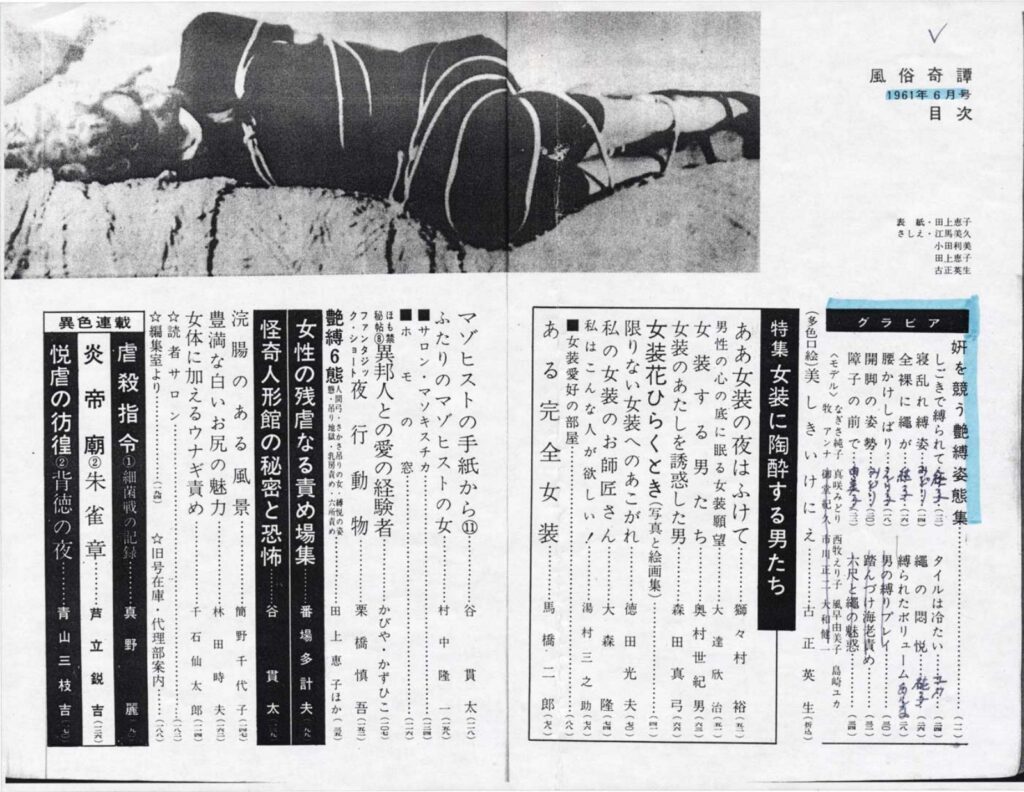
The surviving June 1961 material from Fuzoku Kitan opens with a formal contents page that presents a characteristically broad issue combining bondage photography, cross-dressing, sadomasochistic fiction, sexual confession, horror and curiosity writing, and illustrated erotic features. The contents give particular prominence to a special feature on men intoxicated by female dress, with articles examining male desire to dress as women, encounters conducted while cross-dressed, admiration of women’s clothing, and the social world of male cross-dressers. Other listed features range from sadistic fiction and accounts of sexual cruelty to strange-person museums, foreign sexual experience, and magazine correspondence.
Read full summary Close full summary
Table of Contents 10 items
-
Competing in Beauty: Collection of Elegant Bondage Poses
Summary
A photographic portfolio presents a succession of stylized rope-bound poses, moving between kneeling, seated, reclining, and standing arrangements and emphasizing the visual composition of restrained bodies.
-
Bound with a Shigoki Sash
Summary
This opening bondage feature shows a model restrained with a broad shigoki-style sash or rope arrangement across the torso and limbs in a series of carefully composed poses.
-
Disheveled Bondage
Summary
A photographic sequence titled “Disheveled Bondage” depicts a model in disordered, exposed rope bindings as she is posed reclining, kneeling, and on the floor, stressing the contrast between elegant presentation and physical constraint.
-
Rope on the Completely Nude Body
Summary
A photographic feature presents a completely nude woman bound with rope in tightly constrained seated and folded poses, emphasizing the rope’s placement across the body.
-
Seated Bondage
Summary
This photographic feature documents seated bondage configurations, including a spread-leg posture in which the bound model is positioned on a low stool and restrained through the torso and limbs.
-
Open-Legged Pose
Summary
A photographic sequence shows a bound woman in open-legged standing and seated poses, using rope to limit movement while highlighting the posture and bodily strain.
-
Before the Shōji
Summary
A photographic bondage feature depicting a woman tied in several positions before a shōji screen, emphasizing rope arrangements, immobilization, and posed presentation.
-
The Tile Is Cold
Summary
A photographic sequence shows a woman restrained with rope on a cold tiled floor and against bathroom-like surfaces, moving through kneeling, seated, and reclined poses.
-
Ecstasy of Rope
Summary
A photographic portfolio presents a model bound with rope in seated and reclining poses, focusing on the visual display of restraint and the subject’s staged emotional response.
-
Bound Volume
Summary
A photographic feature presents model Anna bound with coiled rope around the chest, waist, arms, and legs in several seated and kneeling positions, emphasizing the visual form and technique of Japanese rope restraint.
Highlights
- The formal contents page identifies a major special feature on men who become intoxicated by cross-dressing, accompanied by numerous articles on male desire for women's clothing and cross-dressed social or erotic experience. (PDF p. 1).
- The opening bondage gravure begins with kimono-based restraint, using loosened clothing and the exposure of the body as part of the visual progression toward more explicit rope bondage. (PDF pp. 2–6).
- Zenra ni Nawa ga shifts the sequence into explicit nude bondage, with the caption emphasizing rope pressing into the neck, chest, arms, torso, and thighs. (PDF pp. 7–8).
- Koshi-kake Shibari incorporates a small stool directly into the restraint, combining seated posture, tied ankles, bound arms, and torso rope in a carefully staged composition. (PDF pp. 9–10).
- Kaikyaku no Shisei presents the open-legged posture as a distinct bondage pose and pairs frontal and side views to emphasize how the same tie alters the body's appearance from different angles. (PDF pp. 11–12).
- Shōji no Mae de uses the traditional Japanese interior and shōji screens as a visual frame for kneeling bondage, integrating domestic architecture with erotic restraint. (PDF pp. 13–14).
- The bathroom sequence places the nude bound model against tiled walls and a washbasin, moving the bondage imagery from the tatami-room setting into a more modern domestic environment. (PDF pp. 15–16).
- Nawa no Kōetsu and Shibarareta Boryūmu close the gravure by emphasizing the physical pressure of rope against the body and the sculptural effect of multiple rope turns. (PDF pp. 17–20).