Kitan Club
September 1953
← Back to magazine archive
Issue Details
- PDF pages
- 177
Summary
The September 1953 issue of Kitan Club combines bondage photography, historical illustration, serialized confession, fetish essays, punishment imagery, queer material, women’s testimony, fiction, and an unusually explicit roundtable centered on women who had modeled while bound. The issue’s strongest historical contribution is its treatment of the bound woman as both image and speaking participant. Photography still objectifies and classifies the body, but later pages also attempt to create a female conversational space around the experience of being photographed in restraint.
Read full summary Close full summary
Table of Contents 30 items
-
Bondage and Punishment Images from Earlier Issues
Summary
A retrospective collage reproduces bondage and punishment illustrations from earlier issues, including erotic scenes of women restrained, disciplined, or placed in submissive positions. The page identifies selected source issues and artists while presenting the images as an archival feature.
-
Illustrated Scenes of Female Punishment and Restraint
Summary
This illustrated feature presents a sequence of erotic drawings depicting women subjected to restraint, binding, and coercive sexual encounters, often involving male partners or captors. The scenes combine explicit domination imagery with period Japanese clothing, interiors, props, and ukiyo-e-inspired compositions.
-
The Beauty of a Bound Woman
Summary
A photographic feature presenting posed scenes of a woman bound with rope, accompanied by commentary on the visual appeal, staging, and methods of female bondage. The sequence emphasizes restrained poses, enforced submission, and the aestheticization of captivity.
-
Whipped Foreign Girls
Summary
A translated, letter-based feature discussing corporal punishment of girls and women in foreign—especially European—domestic, educational, and workplace settings. Anecdotes, commentary, and historical illustrations frame whipping as a form of discipline while emphasizing humiliation, pain, and submissive behavior.
-
Blood and Other Matters
Summary
An essay on the depiction and staging of bloodletting and abdominal disembowelment in kabuki, discussing famous scenes, theatrical techniques, props, simulated blood, and the audience’s response to these grisly effects.
-
Black High Heels
Summary
A psychologically charged erotic fiction about a troubled adolescent whose encounter with a woman’s black high heels develops into an obsessive, dreamlike fixation. The story blends sexual awakening, fantasy, and disturbing encounters with women and death.
-
Seppuku Desire and Female Psychology
Summary
This essay examines women’s alleged desire for or fascination with seppuku and abdominal wounding through a strongly psychoanalytic account of female sexuality. It connects womb and abdominal symbolism with masochism, self-injury, inferiority, and gendered sexual psychology, drawing on historical, theatrical, and anecdotal examples to argue that the phenomenon merits further study.
-
Long Sentence: A Prostitute’s Confession
Summary
A first-person confession by a woman serving a long prison sentence recounts how her husband subjected her to increasingly severe bondage, sexual coercion, humiliation, and bodily punishment. Presented as an illustrated episodic narrative, the account follows her escalating confinement and endurance through repeated restraints, forced poses, deprivation, and psychological submission.
-
To Kawabata Tanako
Summary
A first-person erotic confession describes a marriage organized around the wife’s authority, with the narrator embracing domestic service, strict commands, humiliation, punishment, and ritualized female dominance. The account presents masochistic submission and fetishized household discipline as sources of intimacy and personal fulfillment.
-
The Song of the Painted Signboard
Summary
An illustrated essay surveys painted signboards used to advertise kabuki, popular theater, and cinema in Meiji- and early Shōwa-era Japan. It contrasts Tokyo and Osaka traditions, discusses signboard painters and their techniques, and laments the decline of this distinctive popular visual art under changing entertainment and commercial practices.
-
My Confession: The Severed Chapter, Part Four
Summary
An autobiographical confession about bodily anxiety, self-administered treatments, erotic obsessions, and the pursuit of unusual forms of sexual pleasure. The later pages develop a sadistic and masochistic fantasy of sexual control, pain, and staged performance.
-
The Self-Portrait of Punishment
Summary
A memoir of Japanese women in wartime Shanghai, describing terrorism, insecurity, military and police surveillance, and the vulnerability of expatriate civilians. It recounts separate cases involving a Japanese waitress and a married woman, emphasizing violence, coercion, and the precariousness of daily life under occupation and political unrest.
-
Women’s Ordeal
Summary
A detailed account of Japanese women subjected to abduction, confinement, intimidation, and sexual violence in Shanghai. Presented through survivor testimony, the article follows several women’s encounters with groups of men, their attempts to resist or escape, and the lasting fear and distress caused by the assaults.
-
Amphibious Animal, Part One: A Tale of Male Love
Summary
The first part of a literary tale follows Mukoyama, a married company employee whose concealed attraction to men leads him into relationships marked by secrecy, longing, jealousy, and social risk. Set amid urban parks, hotels, offices, and nightlife, the narrative explores the conflict between same-sex desire, conventional domestic life, and public respectability; it concludes with an encounter that revives memories of a former male lover.
-
Why Do I Draw Punishment Pictures?
Summary
In this autobiographical essay, Minamikawa Kazuko recounts wartime experiences in North Borneo, including military occupation, imprisonment, invasive examinations, and sexualized violence, and connects these memories to her practice of drawing punishment and torture scenes. She reflects on the relationship between trauma, erotic imagination, gendered desire, and the artistic representation of “abnormal” or socially forbidden sexuality.
-
From a Masochist’s Notebook, Part Four
Summary
An essayistic installment examining masochism through female authority, erotic punishment, bondage, whipping, and related fantasies. It combines personal and literary examples with discussion of Japanese and foreign terminology, the history of corporal punishment, and the psychological role of humiliation and sensory stimulation.
-
A Woman’s Experience in an Orphanage
Summary
A first-person autobiographical account tracing the author’s masochistic imagination to childhood experiences of poverty, parental violence, humiliation, and bodily restraint. Recollections of beatings, binding, forced exposure, and later eroticized memories are accompanied by visual representations of degradation and self-image.
-
Kyōko’s Life and Opinions
Summary
An autobiographical essay in which Kyōko reflects on her marriage, sexuality, bodily experiences, pregnancy, and changing self-image. She discusses unconventional sexual practices, bodily control and experimentation, artistic and literary representations of women, and the tension between social propriety, private desire, and personal freedom.
-
Readers’ Exchange and Notices
Summary
A reader-facing notices and listings section combining agency information with announcements of photographic collections, special selections, and recent or forthcoming magazine contents. It functions as a circulation and community guide for readers interested in illustrated fetish, bondage, and sexual-culture materials.
-
Bondage Photograph Collection
Summary
A four-part photographic collage titled “A Parade of the Beauty of Bondage,” presenting numerous staged images of people restrained with ropes, garments, and furniture in varied indoor poses. The feature emphasizes visual variety and composition within bondage photography rather than providing explanatory text.
-
Reader Correspondence
Summary
A reader-facing index of recent Kitan Club issues, listing article and photographic-feature titles alongside contributors and translators. It functions primarily as magazine navigation and an overview of the publication’s serialized and recurring content.
-
White-Powder Hell
Summary
A first-person erotic narrative about an isolated young man whose encounters with Eiko develop into coercive bondage, beatings, and other forms of sadomasochistic abuse. The story combines adolescent sexual awakening with escalating domination and psychological cruelty.
-
The Confession of Happy Servitude
Summary
A first-person erotic confession recounting a woman’s experiences of willing submission, bondage, humiliation, and physical domination in relationships with men. The narrative presents servitude and pain as intertwined with desire, emotional dependence, shame, and conflicted memories of marriage, family, and work.
-
Love and Hatred
Summary
This installment of the erotic serial follows Sayuri and the people around Murayama, Matsue, Kifune, and Yusaku as jealousy, deception, money, and pearl jewelry drive shifting alliances. The narrative culminates in scenes of captivity and ritualized bondage, with a woman bound and gagged while the characters negotiate desire, cruelty, and possible escape.
-
Fire, Part Nine
Summary
The ninth installment of a Japanese erotic-romantic serial follows Yūsaku and Kunihiko as they question one another about a mysterious woman, a business card, and suspected intimate connections. The dialogue emphasizes jealousy, concealed relationships, and the social maneuvering surrounding an adulterous affair.
-
The Sweet Surrender of Alice, Part Two
Summary
The second installment of a translated erotic serial depicting Alice’s escalating submission to a dominant partner through coercive commands, restraint, and ritualized humiliation. The narrative emphasizes psychological surrender and the eroticization of bondage and control.
-
Morning Glory of the Eastern Land: The Ōtō Rebellion and the Shinpūren
Summary
A historical fiction serial centered on the Ōtō Rebellion and the Shinpūren, combining samurai-era conflict with scenes of domestic tension, travel, and village life. The installment uses dramatic dialogue and illustrated episodes to evoke social upheaval and ideals of resistance in nineteenth-century Japan.
-
A Roundtable of Women Who Were Bound
Summary
A women-only roundtable, chaired by Kawabata Tanako, in which several participants discuss their experiences of being bound, including rope techniques, bodily sensations, pain, posture, endurance, and emotional responses. The conversation also considers bondage modeling, staged photography, dance, and the differing expectations and reactions of men and women.
-
Love Slave, Part Nine
Summary
The ninth installment of a melodramatic erotic serial centered on Harumi and several men entangled in affairs, deception, financial schemes, confinement, and violent confrontations. The narrative unfolds through extended dialogue and shifting revelations about sexual betrayal, coercion, and the characters’ attempts to escape or control one another.
-
Publication Notices and Advertisements
Summary
A cluster of publication and reader-service notices, including subscription and back-issue information, reader recruitment, editorial policies, manuscript-submission instructions, and publisher details. The notices also promote reader participation and explain changes to the magazine’s distribution and contents.
Highlights
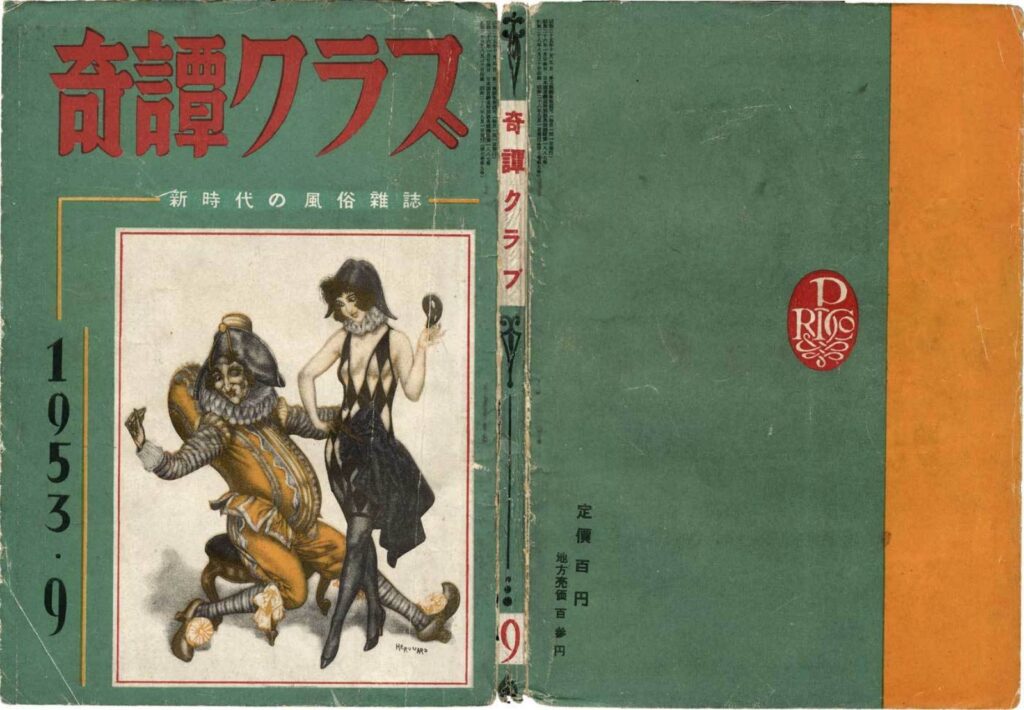
- The cover creates female authority through height, costume, and control of a kneeling male figure, making hierarchy visible before rope appears (PDF p. 1).
- The opening retrospective reproduces bondage images from earlier issues, showing that Kitan Club had begun to treat its own visual history as an archive (PDF p. 3).
- The illustrated punishment plates arrange restraint, suspension, exposure, and interrogation into a comparative catalogue of female vulnerability (PDF pp. 5–9).
- The Beauty of a Bound Woman uses two models, overlapping limbs, and mirrored floor positions to turn rope into a study of bodily symmetry and compression (PDF pp. 10–13).
- Whipped Foreign Girls uses an imported setting to provide historical and cultural distance for fictional coercion (PDF pp. 15–20).
- Blood and Other Matters treats theatrical blood as a visual technology through which audiences interpret suffering, danger, and emotional intensity (PDF pp. 21–22).
- Black High Heels makes footwear the organizing fetish of an extended narrative, linking sound, posture, authority, and humiliation (PDF pp. 23–30).
- Seppuku Desire and Female Psychology places erotic fascination with ritual death inside a speculative sexological framework (PDF pp. 31–32).
- Long Sentence uses prison confession, illustration, and institutional control to create the appearance of documentary testimony around a coerced female subject (PDF pp. 33–45).
- Itō Seiu’s The Song of the Painted Signboard locates eroticized suffering within popular commercial and theatrical image culture rather than specialist publication alone (PDF pp. 51–55).
- The Self-Portrait of Punishment collapses the distance between artist and fantasy by presenting the punishment image as a form of self-representation (PDF pp. 61–65).
- Amphibious Animal uses a metaphor of divided or double existence to explore male same-sex desire within the magazine’s wider queer archive (PDF pp. 73–80).
- The bondage grids on PDF pages 110–113 turn numerous restrained bodies into a visual database of posture, rope placement, clothing, and expression.
- The Confession of Happy Servitude gives submission a language of fulfillment rather than treating it only as pathology or degradation (PDF pp. 123–128).
- A Roundtable of Women Who Were Bound shifts women from silent photographic subjects toward collective speakers, even though the degree of editorial staging remains unknown (PDF pp. 159–167).
Contributors
Named contributors represented in this issue:
- chaired by Kawabata Tanako
- composition by Tsujimura Takashi
- composition by Tsujimura Takashi; photography by Tsukamoto Tetsuzō
- Furukawa Yūko; illustrations by Sanjō Haruhiko
- Hamura Kyōko
- Himenomiya Shirō
- Horikoshi Fujiko
- Itō Seiu
- Kitō Kōichirō
- Koshino Yoshio
- Matsui Kōko
- Minamikawa Kazuko
- Miyauchi Yoshio
- Nakagawa Hideo
- Nakayasu Kōdō
- Nasu Fujio; illustrations by Mori Yorio
- Nonomura Yukio
- Numa Shōzō
- Okada Mashirō; illustrations by Kiuchi Kōji
- Sudō Tsuneo
- translated by Azuma Minoru
- translated by Samukawa Midori
- Yoshino Mayumi