Uramado
May 1961
← Back to magazine archive
Issue Details
- PDF pages
- 8
Summary
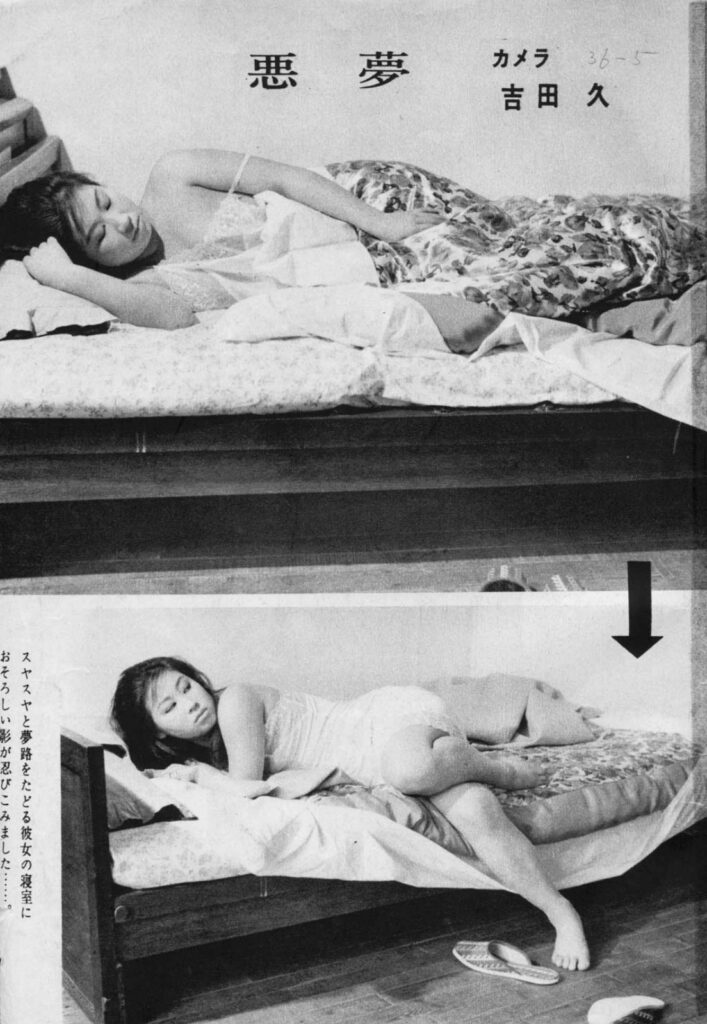
The surviving May 1961 Uramado material is an eight-page photographic narrative titled Nightmare, credited to photographer Yoshida Hisashi. Rather than presenting a mixture of articles and departments, the sequence functions as a self-contained erotic pictorial built around a simple dream scenario. A woman is first shown asleep in a bedroom, dressed in a light nightgown or slip. The opening caption establishes the premise by describing an ominous presence entering her bedroom while she sleeps.
Read full summary Close full summary
Loading PDF…
Highlights
- Nightmare opens with a woman asleep on a bed and introduces the pictorial's dream premise; photographer Yoshida Hisashi is credited prominently on the opening page. (PDF p. 1).
- The second page uses overlapping photographs and large arrows to turn the static bedroom scene into a sequential visual narrative as the sleeper suddenly reacts to an unseen threat. (PDF p. 2).
- The central sequence shows the woman restrained with her arms behind her back, marking the transition from uneasy awakening to explicit bondage. (PDF pp. 3–4).
- A caption announcing that her undergarments have been torn accompanies a close portrait of the restrained woman, making clothing disruption part of the escalating nightmare scenario. (PDF p. 5).
- Later photographs emphasize rope restraint, disordered sleepwear, and the woman's prone and reclining positions on the bed. (PDF pp. 6–7).
- The final page returns to the original sleeping pose and explicitly reveals that the bondage sequence was a dream, completing the pictorial's circular narrative. (PDF p. 8).