Uramado

March 1961

← Back to magazine archive
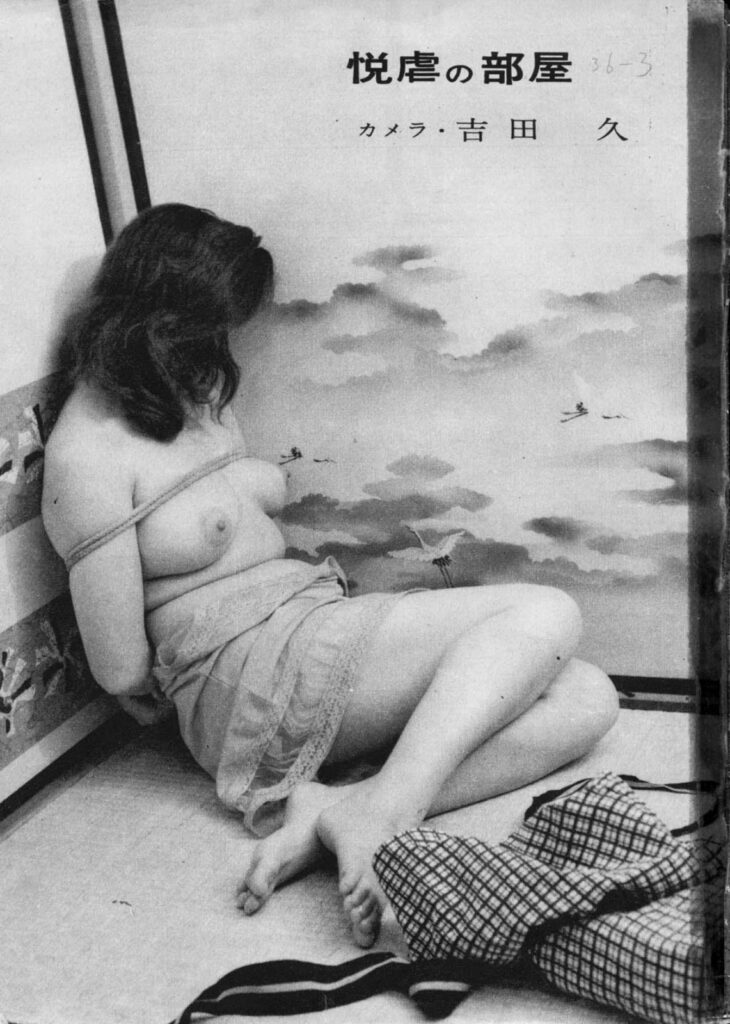
Cover of Uramado, March 1961

Issue Details

PDF pages
8

Summary

This March 1961 Uramado segment consists entirely of the photographic feature Room of Pleasurable Torment, with photography credited to Yoshida Hisashi. The sequence presents a woman bound in a Japanese-style interior furnished with tatami, sliding screens, painted panels, bedding, a mirror, and scattered clothing. Rather than functioning as a technical demonstration of rope patterns, the portfolio emphasizes atmosphere, bodily posture, and the implied narrative of private captivity.

Read full summary Close full summary

The opening image establishes the feature’s visual vocabulary. The model is seated on the tatami with her arms secured behind her back and rope passing around her upper torso. Her clothing has been partly displaced, while abandoned garments lie in the foreground. The decorative painted screen behind her contrasts with the stark physical restraint. Subsequent photographs move progressively deeper into the room and vary the model’s posture without introducing explanatory captions. She kneels, sits with her legs folded or extended, turns toward the adjoining room, lies across the bedding, and curls into more compressed positions while remaining restrained behind the back.

The setting becomes an active part of the composition. Sliding-door frames, mirrors, curtains, bedding, tatami lines, and household objects repeatedly divide the image into geometric planes. On several pages the photographer shoots through doorframes or incorporates reflections, making the viewer appear to observe the bound woman from outside or from another part of the room. The mirror on PDF page 5 doubles part of the scene, while the later bed photographs shift the mood from formal posing toward an implied aftermath or struggle.

The feature is notable for its relative visual restraint. There are no extended captions, diagrams, implements, or explicit narrative text beyond the title and camera credit. Instead, Yoshida Hisashi builds the sequence through changes of posture, partial undress, domestic space, and the woman’s increasingly reclined and contorted positions. As a photographic portfolio, Room of Pleasurable Torment exemplifies Uramado’s early-1960s use of kinbaku imagery as interior erotic composition, combining rope, female nudity, domestic architecture, and voyeuristic framing into a sustained visual study.

Loading PDF…

Highlights

  • The opening page identifies the feature as Room of Pleasurable Torment and credits photography to Yoshida Hisashi, establishing a restrained woman against a decorative Japanese interior screen. (PDF p. 1).
  • The first three photographs concentrate on seated and kneeling bondage poses, with the model's arms held behind her back and rope crossing the upper torso while displaced clothing suggests an unfolding captivity scenario. (PDF pp. 1–3).
  • The portfolio repeatedly uses sliding-door frames and adjacent rooms to create a voyeuristic point of view, making the model appear observed from outside the immediate space. (PDF pp. 3–7).
  • A bed sequence changes the visual register from formal seated posing to reclined and curled positions, emphasizing bodily compression, disordered bedding, and implied struggle. (PDF pp. 4,6–8).
  • The mirror on PDF page 5 introduces reflected space into the composition, visually doubling the interior and strengthening the sense of an intimate private room being observed. (PDF p. 5).
  • The final images place the restrained model partly or fully on the bedding in increasingly compressed positions, closing the sequence without captions or narrative resolution. (PDF pp. 6–8).