Gaho Fuzoku Kitan
April 1961
← Back to magazine archive
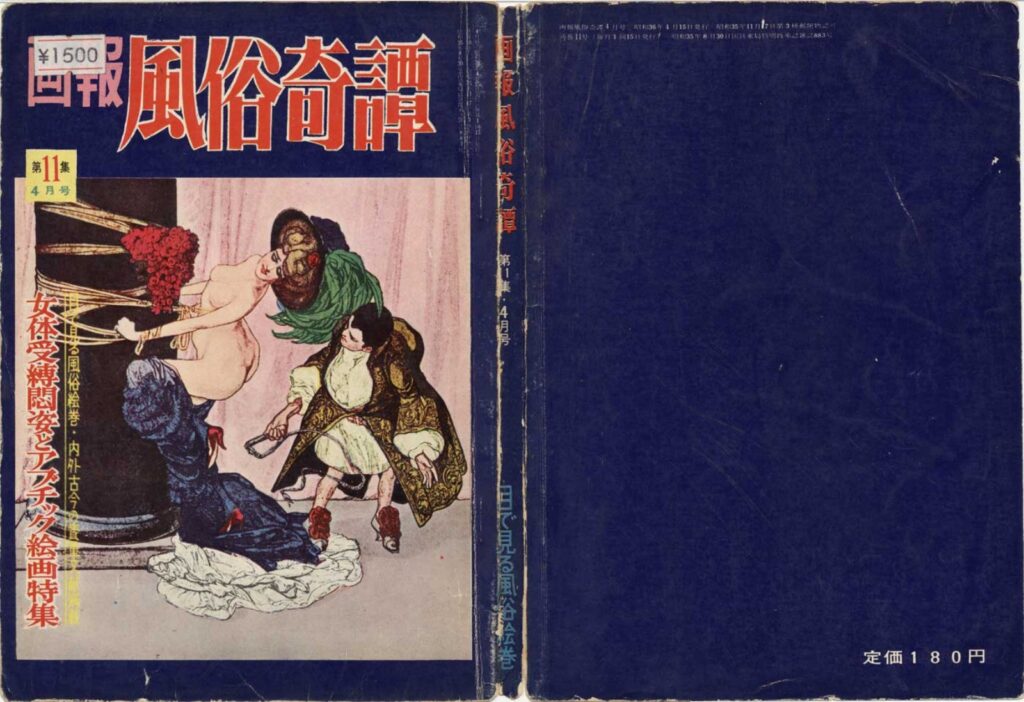
Issue Details
- Issue
- 11
- PDF pages
- 96
Summary
The April 1961 issue of Gaho Fuzoku Kitan is organized around an extensive sequence of staged bondage photography, followed by illustrated torment fantasies, foreign-derived erotic art, fiction and reportage, reader correspondence, and a substantial commercial back section. Its editorial identity combines documentary-looking photographic presentation with theatrical captions and overtly fictional scenarios. Rural landscapes, shrine grounds, tatami rooms, industrial machinery, an empty cinema, a warehouse, and narrow domestic spaces are repeatedly transformed into settings for restraint.
Read full summary Close full summary
Table of Contents 29 items
-
Four Outdoor Bondage Poses
Summary
A photographic feature presents four staged outdoor rope-bondage poses, showing models restrained against trees, a shrine structure, a haystack, and a stone setting.
-
Stone-Lantern Binding
Summary
This photographic feature depicts a model bound to a stone lantern in an outdoor shrine setting, with accompanying text describing the restrictive pose and its visual effect.
-
Butterfly Binding
Summary
A photographic feature presents “butterfly binding,” positioning a model with her arms spread and tied between stone lanterns, accompanied by text comparing the pose to a butterfly specimen.
-
A Humiliating Posture
Summary
A photographic feature presents a woman bound in rope and made to hold a series of crouching, folded, and otherwise deliberately humiliating postures.
-
Tied to a Tree
Summary
An outdoor photographic feature depicts a woman tied against a tree in several rope-bound standing and reclining positions amid woodland scenery.
-
Neck-Suspension Pose
Summary
A photographic feature explores neck-suspension bondage poses, showing a woman restrained by ropes around the neck and body in standing and floor-based scenes.
-
Quiet Bondage
Summary
A photographic feature presents a woman bound with rope in a series of quiet seated, kneeling, and curled poses against an indoor curtain backdrop.
-
Bound Reclining Pose
Summary
A photographic sequence depicts a woman rope-bound and reclining on grass in varied outdoor poses, emphasizing stillness and constrained posture.
-
Bound to a Lattice Door
Summary
A photographic feature shows a woman tied upright to a wooden lattice door, with rope securing her torso and limbs in several standing poses.
-
Shrimp Tie
Summary
A photographic feature depicting a woman secured in a painful “shrimp tie” position, with her limbs folded and bound tightly against her body.
-
Beside the Machinery
Summary
A staged bondage photographic feature showing a woman restrained in several positions beside industrial machinery, emphasizing the contrast between erotic captivity and a mechanical setting.
-
A Shameless Posture
Summary
A photographic sequence presents a woman bound with her legs forced apart, her hands restrained behind her, and her mouth gagged, framing her discomfort, shame, and helplessness as erotic spectacle.
-
Cruel Erotic Picture Scroll
Summary
A photographic feature presents a sequence of elaborately bound women posed in theatrical, painful-looking positions, framed as a cruel and erotic picture scroll.
-
In an Empty Cinema
Summary
This visual feature stages the solitary discovery of a bound nude woman in an empty cinema, using rows of vacant seats and varied rope-bound poses to create an atmosphere of secrecy and spectatorship.
-
Tormented with a Rod
Summary
A photographic sequence depicts a restrained woman being tormented with a long rod, accompanied by text describing the rod’s use against the breasts, abdomen, limbs, and other sensitive areas to produce intense pain and erotic submission.
-
Caught in Black Cord
Summary
A photographic bondage feature shows a woman wrapped and immobilized with black cord in several floor-bound poses.
-
The Bound Woman in the Warehouse
Summary
This staged photographic feature places a bound woman among stacks of material in a cluttered warehouse, documenting several restrained poses and viewpoints.
-
Bondage, Front and Back
Summary
A photographic sequence presents a woman bound with rope in front and rear views, emphasizing the changing expressions and body positions produced by restraint.
-
Eight States of a Woman Cruelly Tormented
Summary
An illustrated catalogue presents eight scenes of a woman being cruelly tormented through chains, ropes, mechanical restraints, fire, water, and forced bodily positions.
-
Flower of Ecstatic Cruelty
Summary
A photographic portfolio depicts women bound in a series of elaborate rope configurations and uncomfortable positions, including paired and slatted-floor arrangements, emphasizing staged ordeal and spectatorship.
-
Sacrifice to Wild Passion
Summary
A staged photographic vignette presents a restrained woman as a sacrificial figure in a muddy or wet setting, combining captivity imagery with an atmosphere of eroticized ordeal.
-
What Does a Woman Think?
Summary
An illustrated essay examines women’s sexuality and same-sex desire through historical, psychological, and cultural examples, accompanied by depictions of women in erotic and socially transgressive roles.
-
Nutrix Gallery
Summary
The Nutrix Gallery presents imported erotic illustrations depicting women in dominant, disciplinary, and bondage-oriented scenes, with captions linking the images to serialized fetish narratives.
-
Women’s Homosexual Love Club
Summary
This serialized erotic narrative follows members of a women’s homosexual love club whose school and domestic encounters develop into explicit same-sex relationships, erotic experimentation, and disciplinary power dynamics.
-
Rope and Whip Play
Summary
Henmi Keiichirō presents staged photographs and commentary on sadomasochistic play involving a German woman, rope restraint, whipping, positional bondage, and related role-playing scenes.
-
Readers’ Salon
Summary
The Readers’ Salon collects reader submissions, personal requests, photographic-model notices, and editorial responses concerning erotic posing, bondage, punishment, fetish interests, and desired future features.
-
Regional Tales of Torment
Summary
This illustrated catalog advertises back issues and special editions of Gaho Fuzoku Kitan, listing their photographs, stories, bondage scenarios, punishment themes, fetish subjects, and ordering information.
-
Agency Department Notices
Summary
Agency-department notices advertise mail-order erotic publications, photographs, and model-related sets, with listings organized by themes such as bondage, nudity, punishment, and staged SM scenes.
-
Another World
Summary
A photographic feature presents staged sadomasochistic tableaux and historical fetish images, including costumed female performers and scenes of restraint, while describing the circulation of such imagery in Germany before the twentieth century.
Highlights
- A formal contents spread organizes the issue into outdoor color photography, a long gravure sequence, tinted illustrated features, translated or adapted foreign material, fiction, practical demonstrations, reader departments, and commercial back matter. (PDF p. 8).
- The opening color portfolio presents four outdoor bondage poses staged among trees, a shrine building, a wooded bank, and a haystack, with each model and location identified in captions. (PDF pp. 3–6).
- The main gravure turns stone lanterns, trees, lattice doors, tatami rooms, machinery, cinema seats, bamboo poles, black straps, and warehouse stock into restraining environments. (PDF pp. 10–41).
- The shrine-ground sequence uses stone lanterns and architectural fixtures to create a visually distinctive outdoor stretching and pillar-binding tableau. (PDF pp. 10–12).
- Industrial and commercial interiors appear in the factory-machine, empty-cinema, and warehouse sequences, expanding kinbaku imagery beyond domestic and rural settings. (PDF pp. 27–28, 33–34, 39–40).
- “Eight States of a Woman Cruelly Tormented” is an extended blue-tinted illustration portfolio combining chains, whips, rods, suspension, fire, water, weights, and elaborate rope structures. (PDF pp. 42–49).
- “Flower of Ecstatic Cruelty” returns to intimate photographic bondage and culminates in a two-model rope composition. (PDF pp. 50–56).
- “What Does a Woman Think?” and the Nutrix Gallery juxtapose Japanese commentary on female erotic fantasy with imported Western cartoons of punishment, fighting, and mechanized captivity. (PDF pp. 59–72).
- John Carlisle’s “Women’s Homosexual Love Club,” illustrated by Tanoue Keiko, introduces female same-sex erotic fiction as a substantial prose feature. (PDF pp. 73–78).
- The final pages combine reader and commercial departments with “Another World,” a theatrical photographic punishment-room sequence featuring masked attendants. (PDF pp. 83–96).
Contributors
Named contributors represented in this issue: