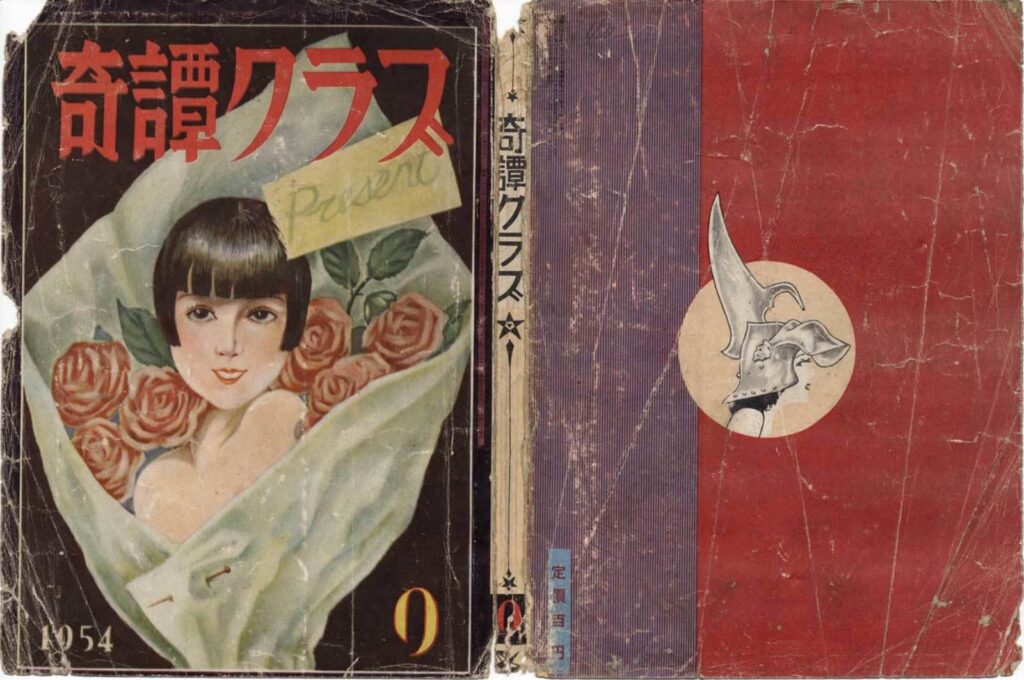
Kitan Club
September 1954
← Back to magazine archive
Issue Details
- PDF pages
- 221
Summary
The September 1954 issue of Kitan Club combines illustrated restraint, staged outdoor bondage photography, female domination, masochistic confession, sexual and literary criticism, body-part fetish studies, seppuku research, cross-dressing testimony, reader correspondence, and several major narratives in the issue’s previously hidden final third.
Read full summary Close full summary
Table of Contents 46 items
-
Women’s Wrestling
Summary
An illustrated feature depicting women engaged in dramatic wrestling holds and falls, emphasizing physical struggle and eroticized competition.
-
September Field Scene
Summary
A September-themed illustrated scene presents women wrestling outdoors in a stylized, eroticized composition accompanied by seasonal literary text.
-
Pasture Story
Summary
A serialized erotic narrative follows Susan at a rural pasture as conflicts with her employers and their associates lead to coercion, captivity, bondage, humiliation, attempted escape, and violent sexual domination.
-
Woman Cast into a Rocky Stream
Summary
A photographic scene depicts a woman lying among rocks in a rushing mountain stream, with a caption describing her being tied supine to a log spanning the water.
-
Record of Outdoor Binding: Sun-Drying on a Pine Trunk
Summary
This photographic record presents a woman bound against the trunk of a pine tree in an outdoor setting, emphasizing public exposure and rope restraint.
-
Please Do Not Torment Me Too Much, My Lady
Summary
A staged photographic feature presents rope-play scenes involving two women, including close physical handling and a suggested upside-down suspension pose, framed as a playful appeal not to be tormented too much.
-
Tightening the Hands Behind the Back
Summary
A staged photograph shows one woman using her leg for leverage while tightening another woman’s wrists behind her back in a carefully secured rope restraint.
-
Newlywed Autumn Game: Nut Gathering
Summary
This staged outdoor bondage photograph presents a “newlywed” in a nylon raincoat restrained with her hands behind her back amid autumn garden grasses and flowers.
-
Newlywed Autumn Game: Continuing Rain
Summary
A continuation of the autumn newlywed vignette depicts the restrained woman seated in falling rain with her raincoat hood pulled deeply over her eyes and her waist cord tied behind her.
-
Single-Leg Suspension and Chest Restraint
Summary
A photographic feature demonstrating a woman bound across the chest and suspended by one leg, presented as a rope-restraint pose by Murata Tamiko.
-
Shrimp Binding and Hands-Behind Binding
Summary
A photographic feature presenting two rope-binding configurations: shrimp binding and a hands-behind-the-back binding in which the rope is visually concealed.
-
Trampling
Summary
A staged photographic scene of a woman trampling a prone male model, accompanied by text describing female domination, male submission, and the possibility of distress during the ordeal.
-
Punishment of a Male Servant
Summary
A staged photograph and caption depict a male servant bound and subjected to corrective beating as punishment for perceived disobedience or failure.
-
Fantasy of a Deformed Old Man
Summary
Sugihara Nijiko’s illustration presents an eroticized fantasy involving a deformed elderly man, nude women, chains, and an atmosphere of coercion and grotesquerie.
-
I Accuse: As a Victim of Sadistic Punishment
Summary
This extended polemical essay examines sadism, sexual crime, juvenile delinquency, pornography, and postwar sexual repression through psychological theories, sexological writing, crime statistics, social case material, and literary and visual examples. It argues that such conduct cannot be explained solely by individual perversity, while criticizing censorship, moral panic, and simplistic social or medical judgments about sexual behavior.
-
Two-Sided Mirror of the Painted Soul
Summary
A historical erotic fiction piece drawn from kusazōshi imagery, depicting a woman’s ritualized abdominal cutting amid melodramatic conflict, secrecy, and impending violence.
-
On Female Beauty, Especially the Buttocks
Summary
An illustrated essay examines ideals of female beauty with particular emphasis on the buttocks, comparing bodily proportions, posing, clothing, and aesthetic preferences while presenting a sequence of nude photographs.
-
Department-Store Mannequin
Summary
A serialized erotic crime narrative follows a department-store mannequin and the people drawn into its orbit, combining commercial display culture with voyeurism, captivity, rope restraint, and the discovery of a bound or murdered woman.
-
Curious Meditations
Summary
An essay reflecting on the discovery, circulation, and cultural value of unusual erotic books, while considering how readers’ interests and psychological types relate to occupations, publishing, and literary taste.
-
Sexual Fluids
Summary
A historically framed erotic narrative set around performers and entertainment districts, depicting gender ambiguity, sexual encounters, and the binding and restraint of a woman in a staged domestic setting.
-
Desire to Be Crushed
Summary
A first-person erotic confession describes an intense desire to be crushed or killed, with scenes of restraint, humiliation, sadistic control, and escalating fantasies of bodily danger and death.
-
Yumi Woman, Continued
Summary
The author describes recreating an erotic pose from a French film with his wife, detailing the tied and suspended positions, staging, and bodily responses involved in the scene.
-
Confession of a Girl with Exhibitionist Desires
Summary
A young woman confesses her growing desire to expose her body, recounting exhibitionist fantasies and experiences in public places, on trains, and during encounters with men who observe or approach her.
-
The Secret of the Beautiful Boy, Part Three
Summary
This serialized erotic narrative follows the beautiful boy Yukio as older men manipulate, train, restrain, and sexually exploit him in domestic, athletic, and outdoor settings while his secret life remains hidden from others.
-
Joys and Sorrows of Being Tormented
Summary
A first-person account of the pleasures and suffering associated with being bound, beaten, disciplined, and otherwise subjected to torment, reflecting on the narrator’s physical sensations and emotional responses.
-
Seppuku Research Night Talk, Part Six: Its History and Influence on Literature
Summary
A historical study of seppuku that traces its ritual and social development and examines how suicide, execution, and related scenes influenced Meiji and earlier Japanese fiction, drama, and illustration.
-
Cruel Women
Summary
A translated and contextualized selection from a 1901 German illustrated work portraying cruel women who punish, torture, humiliate, and sometimes kill men and enslaved or subordinate figures.
-
Red-Tag Prisoner
Summary
A first-person confession recounts imprisonment under female guards, describing regimented scoring, physical punishment, humiliation, restraint, and the narrator’s fear and submission.
-
Cruelty in Modern Literature
Summary
This illustrated survey examines scenes of punishment, bondage, humiliation, and sexualized cruelty appearing in modern Japanese literature, reproducing literary excerpts alongside interpretive commentary.
-
Abnormal Dream: Following the Snake-Shaped Spring Sun
Summary
A surreal erotic dream narrative follows a male protagonist who is repeatedly bound, disciplined, and tormented by women in elaborate rope and restraint scenarios, accompanied by fetish illustrations.
-
Longing for Acrobatics
Summary
Ōji Tarō offers a first-person account of his lifelong fascination with acrobatic contortions, describing childhood encounters with performers, strenuous self-training, bodily pain, and the sensual gratification he derives from extreme flexibility.
-
The Woman Who Burns Her Body
Summary
This fictional narrative follows Maki and her male companion through an unstable relationship of seduction, jealousy, bondage, physical punishment, and alternating control, culminating in increasingly coercive scenes of restraint and torment.
-
An Experiment in Being Tormented While Cross-Dressed
Summary
Kishimoto Seiryū documents an erotic experiment in which a man is dressed as a woman and subjected to elaborate binding, suspension, and corporal punishment, accompanied by staged photographic illustrations and references to earlier Japanese restraint imagery.
-
From a Masochist’s Notebook
Summary
An autobiographical-style masochist’s notebook combines anecdotes about domestic servants and elite households with reflections on masochistic desire, bodily impurity, discipline, and the psychological conditioning of obedience.
-
White Blade
Summary
An eroticized narrative of ritual suicide and abdominal cutting presents a group’s military-style seppuku performance in graphic, sequential detail, emphasizing the spectacle, discipline, and bodily violence of the drawn blade.
-
Jealousy’s Manipulated Torment
Summary
A first-person erotic confession recounts two sisters’ emotionally charged same-sex relationship, the use of men and social situations to provoke jealousy, and escalating group sexual games involving secrecy, manipulation, and fetishized clothing.
-
Contemporary Masochism Art Criticism: Masochism in Film and Publishing
Summary
An art criticism essay examines masochistic imagery and themes in films, including historical and contemporary cinematic representations, while also discussing related erotic publishing and visual culture.
-
The Smile of the Male Flower: A Record of Captivity
Summary
A first-person captivity narrative follows Pierre, a male model subjected to binding, nudity, humiliation, and coercive artistic direction, with repeated attention to the erotic staging and photographing of his body.
-
The Woman Called Me
Summary
A woman recounts her sexual and emotional development from adolescence through intimate relationships, marriage, and domestic life, presenting a personal confession shaped by secrecy, desire, and changing gender expectations.
-
Women of Sadism
Summary
A first-person essay examines women with sadistic tendencies through encounters with an intimidating, verbally abusive female tax-office worker whose dominance and cruelty fascinate the narrator.
-
Types of the Abnormal Seen Through Reader Letters
Summary
The editorial department surveys reader letters describing varied sexual interests and fantasies—including bondage, sadism, fetishism, cross-dressing, medicalized practices, and bodily scenarios—while presenting them as evidence of the magazine’s participatory reader culture.
-
Humiliation in a Railway Car
Summary
An illustrated erotic narrative depicts a woman being overpowered, stripped, and publicly humiliated by men in and around a railway carriage, emphasizing coercion, captivity, and voyeuristic spectacle.
-
Record of Outdoor Binding
Summary
A photo-report documenting an outdoor rope-bondage session, with models tied and suspended among trees, rocks, streams, and waterfalls; the text also discusses pose planning, equipment, weather, and photographic staging.
-
Illustrated Bondage Arrangements
Summary
An illustrated feature presenting several imaginative bondage arrangements, including women restrained to furniture, overhead structures, and other settings in staged poses.
-
Sentimental Education, Final Installment
Summary
The concluding installment of Azuma Shin’s serialized erotic novel follows wartime and postwar separations, reunions, jealousy, marital tensions, and coercive bondage encounters involving its central characters.
-
Editorial and Publication Information
Summary
A reader-communications and editorial-information section presents correspondence, editorial replies, submission guidance, and notices about forthcoming issues and requested contributions.
Highlights
- Pasture Story uses horses, riding crops, rural labor, and bodily discipline to turn equestrian life into an extended metaphor for hierarchy (PDF pp. 7–18).
- The outdoor photographs on PDF pages 19–20 place restrained bodies in streams, against fallen timber, and upright against a pine tree, making landscape part of the composition.
- The autumn newlywed illustrations use rain, kimono, rope, and seasonal foliage to create explicitly seasonal bondage tableaux (PDF pp. 23–24).
- I Accuse is an ambitious polemic about sadism, criminal responsibility, psychiatric classification, and the distinction between fantasy and violence (PDF pp. 31–46).
- On Female Beauty, Especially the Buttocks combines photography, bodily measurement, posture, and aesthetic judgment in a quasi-scientific fetish study (PDF pp. 49–54).
- Department-Store Mannequin links erotic objectification with postwar retail culture and the artificial female body displayed as merchandise (PDF pp. 55–62).
- Confession of a Girl with Exhibitionist Desires gives the desire to be watched a female autobiographical voice grounded in school, crowds, clothing, and shame (PDF pp. 81–85).
- The Secret of the Beautiful Boy continues one of the magazine’s important homoerotic serials and gives male beauty a sustained narrative role (PDF pp. 86–92).
- Seppuku Research Night Talk turns abdominal-cutting fascination into archival work through historical cases, fiction, theater, and reproduced illustrations (PDF pp. 101–108).
- Cruelty in Modern Literature teaches readers to identify punishment and humiliation as recurring literary motifs rather than isolated sensational scenes (PDF pp. 121–126).
- An Experiment in Being Tormented While Cross-Dressed combines clothing, outdoor staging, gender transformation, and vulnerability in a first-person account (PDF pp. 144–146).
- White Blade confirms that the issue continues well beyond page 150 and uses seppuku to explore friendship, martial identity, fear, and ritual performance (PDF pp. 156–160).
- Contemporary Masochism Art Criticism treats film technique, suspense, color, and bodily suffering as subjects of serious aesthetic evaluation (PDF pp. 167–170).
- Types of the Abnormal Seen Through Reader Letters makes the readership itself into an archive, classifying fantasies submitted from across Japan (PDF pp. 185–190).
- Sentimental Education, Final Installment is the true conclusion of the issue, continuing through PDF page 220 before the final publication page (PDF pp. 203–221).
Contributors
Named contributors represented in this issue:
- Aoba Fūichi, romanization uncertain
- Azuma Shin
- contributor credit unclear
- Editorial Department
- Hara Tadamasa
- Haruhi Rumi and Itabuki Makiko
- Haruhi Rumi and Itō Masako
- Haruhi Rumi and Koike Masami
- Haruhi Rumi and supporting model
- Itō Seiu
- Kaiji Kazuhisa, credit reading uncertain
- Kari Rei, romanization uncertain
- Kasuga Rumi
- Kawai Itsuko
- Kishimoto Seiryū
- Kuki-mura Sato, credit reading uncertain
- Magane Kanjirō
- Matsui Kagoko, romanization uncertain
- Mikihara Jirō
- Murata Seiichi
- Murata Tamiko
- Nakafuji Tamiko and Itō Mieko
- Nakayasu Hiromichi
- Numa Shōzō
- Ōji Tarō
- Okada Yoshio
- Ōshima Hajime
- Sai Shōgo
- Saji Kōsuke
- Shibazaki Riko
- Shinohara Sakue
- Shirogane Tanjirō
- Sudō Ritsuo
- Sugihara Nijiko
- Sumi Akiko
- Taki Reiko
- translated and explained by Morimoto Aizō
- Tsujimura Takashi
- Tsujimura Takashi; model Itō Masako
- Yamaguchi Kōichi