Geijutsu Shincho
April 1995
← Back to magazine archive
Issue Details
- Volume
- 46
- Issue
- 4
- PDF pages
- 148
Summary
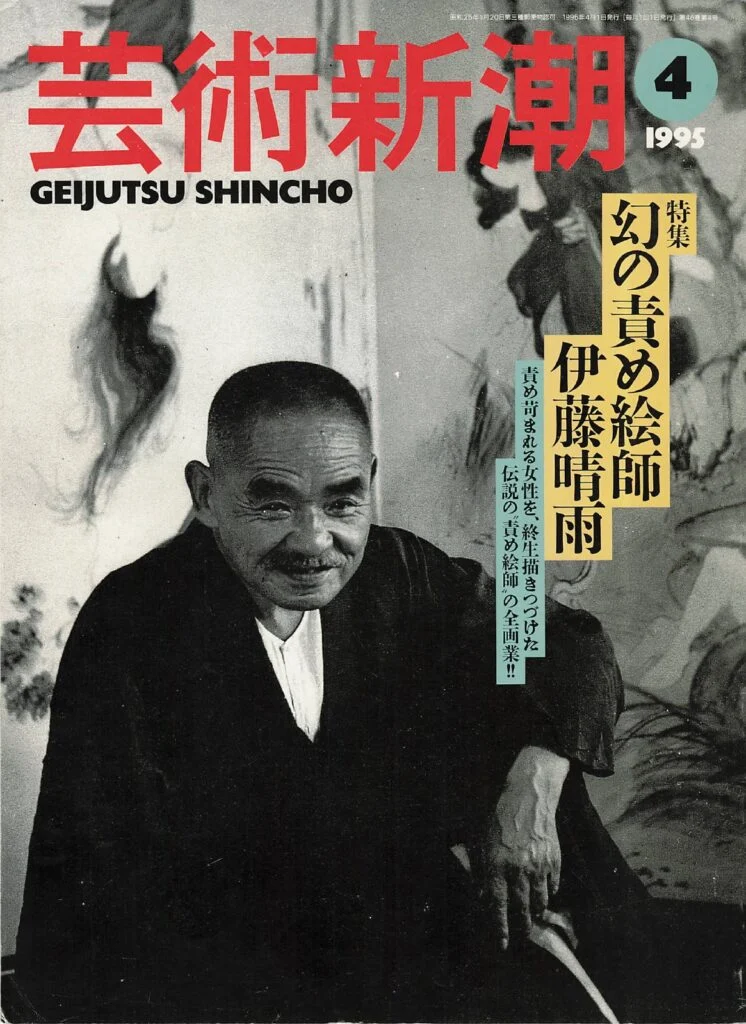
The April 1995 issue of Geijutsu Shincho is organized around an extensive special feature on Itō Seiu, the historically marginal and controversial artist associated with 責め絵, eroticized restraint, grotesque imagery, and popular visual culture. The opening contents pages announce a sequence of reproductions, photographic archives, autobiographical materials, family testimony, collecting memoirs, and visual histories. Across the first two-thirds of the issue, Seiu appears not simply as an erotic artist but as a complex figure situated among ukiyo-e traditions, journalism, theater, private collecting, studio photography, folklore, and the everyday visual culture of late Edo and Meiji Japan.
Read full summary Close full summary
Table of Contents 20 items
-
A Bound Model—In Seiu’s Studio
Summary
A full-page historical photograph introduces the Seiu feature through a posed bound model in the artist’s studio. The image establishes the issue’s concern with the relationship between erotic representation, studio practice, and visual documentation.
-
Gravure: Selected Masterworks by Seiu
Summary
A gravure sequence presents selected Seiu-related images and photographic material, establishing the artist’s recurring motifs of posed bodies, elaborate costume, hair, restraint, and theatrical composition.
-
The Forbidden Photo Album
Summary
This visual archive juxtaposes staged photographs of models, Seiu at work, private photographic records, drawings, and paintings. Its accompanying prose frames the photographs as records of artistic experiments and historical erotic imagery rather than ordinary portraits.
-
An Autobiography in Self-Portraits
Summary
Seiu’s own autobiographical record traces his childhood, education, poverty, entry into newspaper work, artistic formation, marriage, professional struggles, binding practice, illness, and old age. Drawings, photographs, newspaper imagery, and studio scenes make the memoir both a personal narrative and a visual archive.
-
About My Father, Seiu
Summary
Itō Kiku offers a daughter’s account of Seiu’s personality, household life, artistic work, marriage, and family tensions. The contribution shifts the feature from self-narration to domestic testimony and the preservation of a difficult artistic legacy.
-
The True Character of Seiu, the Seme-e Artist
Summary
This visual and cultural-history section presents Seiu’s drawings and collected observations of peddlers, charms, superstitions, shop signs, lanterns, street life, erotic imagery, and sideshow culture. It portrays the artist as an observer of vernacular customs and unofficial social history as well as a maker of erotic images.
-
Seiu and Me
Summary
Mochizuki recounts discovering Seiu’s work in a secondhand bookstore and reflects on collecting, private looking, embarrassment, fascination, and the power of disturbing erotic images. Reproductions of Seiu-related works accompany the personal art-critical narrative.
-
Seiu’s One Hundred Ghost Stories
Summary
A largely visual portfolio of ghostly, grotesque, supernatural, and uncanny imagery associated with Seiu and related collections. It includes long-format paintings, ghost pictures, monsters, spirits, theatrical scenes, and a collection attributed to the rakugo performer Yanagiya Kosan.
-
My Investigation into Itō Seiu
Summary
Fukutomi reconstructs Seiu’s career and afterlife through encounters with collectors, dealers, publishers, artists, and surviving works. The essay examines private archives, the circulation of erotic and supernatural imagery, and the effort to restore Seiu to Japanese art history.
-
Guide to Upcoming Exhibitions, Recommended CDs, Books, Films, and More
Summary
A service-oriented page supplies references connected with the issue’s art-historical material and announces exhibitions and cultural offerings. It functions as documentary and community-facing editorial back matter rather than a single authored essay.
-
Super Artist: Yanase Masamu’s Busy Forty-Five Years
Summary
This richly illustrated retrospective follows Yanase from childhood talent through avant-garde painting, proletarian art, graphic design, manga, stage work, political illustration, wartime activity, arrest, and repression. Reproduced paintings, posters, cartoons, stage designs, and photographs demonstrate the breadth of his practice.
-
Come Back to Life! Okinawa’s Glittering Gold Figures
Summary
The feature introduces Ryūkyū royal portraiture and court culture, explaining Chinese-derived dress and rank systems, maritime exchange, wartime destruction, and the reconstruction of lost cultural heritage from surviving images and prewar records.
-
Fifty Postwar Years Surveyed through Book Design
Summary
A retrospective exhibition surveys Japanese book covers, bindings, typography, materials, and publishing culture from 1946 to 1995. The feature treats book design as a visual record of changing social periods and cultural movements.
-
What a Curiosity! Sakai Hōitsu’s Rare Folding-Screen Masterpiece
Summary
A visual presentation of a rare folding screen attributed to Sakai Hōitsu focuses on autumn grasses, flowers, vines, a rabbit, surface texture, and Rimpa atmosphere. Additional works and collection history place the screen within the exhibition and preservation of the Mitsui family holdings.
-
Do You Know the Kōshin Belief?
Summary
This illustrated cultural history explains Kōshin observance, the three worms that report human wrongdoing, longevity beliefs, communal night gatherings, temples, talismans, statues, and regional devotional practice. Historical images are set beside contemporary photographs of worshippers and sites.
-
Stardust, World Art, and International Exhibition News
Summary
A multi-item news department surveys exhibitions, design, fashion, photography, film, contemporary art, political art, collecting, and museum activity in Japan and abroad. It includes short notices on Meiji imperial holdings, Scandinavian design, contemporary Asian art, Frank Lloyd Wright, street fashion, war photography, and international auctions.
-
An Artist’s Happy Home, No. 47: Jim Dine
Summary
Minamikawa profiles Jim Dine through photographs and commentary on his home, studio, furniture, books, ceramics, collections, and working environment. The domestic setting is presented as an extension of Dine’s artistic imagination and transatlantic cultural references.
-
A Plainspoken History of Japanese Art, 21: Tōdai-ji’s Great South Gate
Summary
Hashimoto revisits Tōdai-ji’s Nandaimon through personal memory and close observation of architecture, weathered materials, reconstruction, scale, and Buddhist guardian figures. The essay questions detached academic categorization in favor of embodied aesthetic experience.
-
Walking through the Autumn Fields—The Life of Aizu Yaichi, Part 3
Summary
Kudō traces Aizu Yaichi’s family origins, the Aizu inn and pleasure-quarter environment, Niigata’s urban history, education, literature, and cultural formation. Maps, ukiyo-e, family photographs, documents, and genealogy connect individual biography with late-Edo and Meiji social change.
-
Serial: Visiting Thousand-Year-Old Hot Springs, No. 11—The Kaga Hot-Spring District
Summary
This travel and photo essay moves through Awazu, Katayamazu, Yamanaka, and Yamashiro, combining hot springs, Buddhist monuments, sacred Mount Hakusan, historic inns, local streets, food, tourism, and Yamanaka lacquerware. It presents regional heritage as a living but changing relationship among pilgrimage, hospitality, craft, landscape, and modern leisure.
Highlights
- The issue’s central feature reconstructs the life, work, visual world, and cultural afterlife of Itō Seiu through paintings, drawings, photographs, autobiography, family testimony, and collecting history. (PDF pp. 1–68).
- The Forbidden Photo Album juxtaposes staged models, studio documentation, contact-sheet-like records, drawings, and paintings to examine the relationship between photographic evidence and erotic performance. (PDF pp. 6–14).
- Seiu’s illustrated memoir covers childhood, newspaper work, artistic labor, marriage, family conflict, binding performance, illness, and old age. (PDF pp. 22–36).
- The Seiu visual archive treats charms, superstitions, lanterns, shop signs, peddlers, sideshows, and unofficial history as evidence of everyday Edo and Meiji culture. (PDF pp. 40–51).
- Fukutomi Tarō’s investigation follows the circulation, collection, preservation, and rediscovery of Seiu’s erotic, supernatural, and historical works. (PDF pp. 64–68).
- The Yanase Masamu feature presents a career spanning avant-garde painting, proletarian art, manga, stage design, political graphics, and state repression. (PDF pp. 73–81).
- Hashimoto Osamu’s essay on Tōdai-ji’s Nandaimon contrasts embodied aesthetic response with detached academic art history. (PDF pp. 108–113).
- The Kaga travel feature combines hot springs, Buddhist monuments, sacred mountains, historic inns, lacquerware, food, tourism, and extensive regional photography. (PDF pp. 124–132).
Contributors
Named contributors represented in this issue: