Kitan Club
February 1953
← Back to magazine archive
Issue Details
- PDF pages
- 173
Summary
The February 1953 issue of Kitan Club combines staged bondage photography, erotic illustration, serialized fiction, fetish and sexological essays, queer history, prison and execution narratives, material framed as confession, translated Western case literature, and reader-oriented commentary. Taken as a whole, the issue shows the magazine refining a characteristic editorial formula: desire is presented not merely as fantasy, but as something that can be photographed, historicized, classified, confessed, debated, and shared.
Read full summary Close full summary
Table of Contents 27 items
-
A Woman Driven Mad by Rope
Summary
A staged photographic narrative follows a jealous young man who abducts, gags, and binds a woman believed to be leaving him for another man, subjecting her to violent punishment before wavering between resentment and affection. The woman’s unspoken remorse and professed love remain largely internal as the conflicted man finally abandons her.
-
Demon Flower
Summary
An erotic psychological tale follows a married woman whose affair with the narrator develops into an obsessive and increasingly violent relationship. Their encounters, her pregnancy and domestic unhappiness, and the narrator’s fantasies of bondage and lethal revenge culminate in a carefully planned fatal act and its aftermath.
-
Letter from a Madman
Summary
A distressed reader describes being sexually humiliated and exploited in domestic and medical-service settings, seeking guidance about his troubling desires and circumstances. The editorial response treats the letter as a problem of abnormal sexuality and personal conduct while continuing the magazine’s advice-oriented correspondence format.
-
Scattering Young Leaves
Summary
An illustrated historical erotic tale follows two beautiful male youths, Ukyo and Uname, whose mutual love develops within a samurai household but is obstructed by family obligations and social expectations. Their attempt to preserve the relationship ends in a tragic shared death, framed as a story of male-male passion and fatal devotion.
-
Love Slave, Part Two
Summary
Part two of Kitō Kōichirō’s serialized erotic narrative follows the narrator’s increasingly coercive and humiliating sexual encounters with Harumi and Ōtsuki, including beach sand play, physical domination, and voyeuristic games. The later chapters broaden the account into reflections on marriage, money, education, social status, and the changing emotional dynamics between the participants.
-
Questions and Answers on Perversion, Part Three
Summary
The third installment of a conversational sexology feature examines changing sexual attitudes through an extended discussion among the participants. It considers erotic performance and popular entertainment, including stage and film depictions, audience reactions, fetishistic practices, and the psychological and social meanings attached to sexual display.
-
The Nun’s Awakening
Summary
A historical erotic fiction set around a Buddhist convent near Nara during the Great Buddha’s eye-opening ceremony. The story follows Kiku’s life among nuns, her encounters with men, and her gradual emotional and sexual awakening amid temple ritual, gossip, and social constraint.
-
Phosphorescence
Summary
A psychologically charged modern fiction centered on Yoshiko, a young woman working in an urban entertainment house and exposed to successive male customers, exploitation, illness, and coercive desires. Phosphorescent light and mirror imagery underscore her conflicted fantasies, loneliness, and longing for escape.
-
Flower Light
Summary
An erotic psychological fiction follows Yoshiko through coercive bondage, sexual violence, and an unsettling transformation of fear into confused desire. The narrative moves between abusive encounters, dreamlike recollections, and domestic scenes, emphasizing the lasting psychological impact of domination and repressed erotic feeling.
-
Urine Worship and Totemism
Summary
Mise Seirō surveys the religious and folkloric veneration of urine, comparing sacred, medicinal, magical, and ritual uses across cultures including India, Egypt, and Japan. The essay relates urine worship to totemism, purification, fertility beliefs, exorcism, and broader systems of taboo and sacred symbolism.
-
In Reply to Kuroi Chinpei
Summary
Itō Seiu responds to Kuroi Chinpei’s criticism of his paintings, defending artistic freedom and arguing that judgments of beauty should not be confined to conventional Japanese styles or contemporary taste. He discusses Japanese hairstyles, historical painting traditions, and the role of criticism and personal experience in evaluating erotic or unconventional imagery.
-
A History of Religious Inquisition
Summary
Urushijima Michihei surveys the historical relationship between virgin worship, priestesses, sacred sexuality, and religious prostitution across ancient and modern cultures. Using examples associated with Mary, Isis, Vestal Virgins, and other religious traditions, the article argues that sexual regulation and the authority of religious institutions shaped changing ideals of female purity and sexual practice.
-
A Female Prisoner’s Prison Diary
Summary
A first-person prison memoir recounting a woman’s incarceration, forced labor, hunger, illness, bodily punishments, strict surveillance, and degrading living conditions. The account also describes prison routines, fellow inmates, guards, and the psychological effects of prolonged confinement.
-
The Torments of Sadism
Summary
An essay on sadism that combines personal erotic narrative with reflections on sexual desire, beauty, art, appetite, and cultural life. It presents scenes of consensual erotic domination, restraint, humiliation, and role-play before arguing that sensuality and aesthetic experience are interconnected aspects of human culture.
-
Glass Toilet
Summary
An erotic-grotesque first-person fantasy follows a man whose encounter with a mysterious woman at a railway-station lavatory develops into an obsessive journey through voyeurism, bodily functions, and dreamlike distortions of reality. The recurring glass toilet and elusive female figure become emblems of shame, desire, and uncanny fixation.
-
The Pleasure of Being Oppressed
Summary
A first-person narrative combines postwar rural life and grassroots political organizing with an increasingly explicit account of male sexual submission. The narrator describes ideological disputes, village elections, marriage, and escalating humiliation, bondage, and physical punishment as sources of conflicted fear and pleasure.
-
History of Christian Persecution
Summary
A historical account of Christian persecution, emphasizing the harsh suppression of missionaries and converts through imprisonment, torture, execution, and forced renunciation. The narrative describes major episodes of persecution in Japan, including mass punishment and the brutal treatment of believers and suspected sympathizers.
-
Film and Sadism
Summary
An essay examining how cinema produces sadistic and erotic fascination through images of female vulnerability, restraint, bodily exposure, and physical punishment. It discusses the visual and dramatic techniques used in films to create sensual tension and references international and Japanese film examples.
-
Strange Tales of Executions
Summary
An illustrated historical essay surveys capital punishment in Japan, contrasting Edo-period executions with modern procedures and discussing prison routines, death-row inmates, execution methods, and the legal and social rationale for the death penalty. It also recounts unusual cases and the practical arrangements surrounding executions.
-
A Warrior’s Sorrowful History
Summary
A serialized wartime narrative follows Japanese military personnel during an overseas operation, focusing on their movement through a South Pacific setting, military hierarchy, encounters with local women, and the disquieting emotional and erotic tensions of occupied territory. The accompanying illustrations reinforce the story’s adventure, military, and sexualized atmosphere.
-
The Torn Diary
Summary
A reflective diary narrative about revisiting and tearing up an old diary, prompted by embarrassment, painful memories, and the wish to distance oneself from an earlier self. Subsequent entries recount ordinary domestic routines, travel, social encounters, and changing moods in an intimate autobiographical voice.
-
Various Types of Woman-Haters
Summary
An essay categorizes different kinds of women-haters, attributing them variously to sexual indifference, excessive sexual preoccupation, personal circumstances, intellectual theories, self-conceit, and related psychological or social causes. It supports the classifications with examples from literature, history, contemporary life, and gender relations.
-
The Women of Ryūkyū
Summary
A melodramatic narrative set around the Coral bar follows Okinawan-born women, their romantic entanglements, jealousy, violence, and eventual personal reckonings. Alongside the fiction, it presents detailed descriptions of Ryukyuan women’s beauty, clothing, social experience, and classical dance and music, culminating in a staged Okinawan performance.
-
Eternal Male Beauty and Female Beauty
Summary
Matoba Michi’s essay considers male and female beauty through the relationship between natural bodily form, physical maturation, heredity, health, and cultural ideals. It contrasts bodily and spiritual beauty, discusses historical and social variation in gendered standards, and argues for recognizing distinctive forms of male and female beauty rather than imposing artificial uniformity.
-
Fire, Part Two
Summary
The second installment of Matsui Kōko’s erotic fiction follows Sayuri, a married woman whose recollections of childhood sexual games and bondage merge with her troubled adult desires. Encounters involving her husband, male acquaintances, and other household figures develop themes of jealousy, coercion, voyeurism, and marital infidelity.
-
Alexina’s Diary
Summary
A humorous fictional tale follows Nakai, an enthusiastic radio-quiz participant whose prize from an Oriental Spinning quiz leads to a chain of awkward romantic misunderstandings with Michiko. The melodramatic confusion eventually resolves in domestic happiness, with the prize—pink women’s underwear—serving as the story’s recurring comic symbol.
-
The Island That Opens at Night
Summary
An erotic literary narrative centered on Eikai, an older, cultured man, and his encounters with younger men in cafés, homes, and urban nightlife. Through shifting conversations and relationships, the story explores same-sex desire, social status, physical beauty, aging, jealousy, and emotional vulnerability.
Highlights
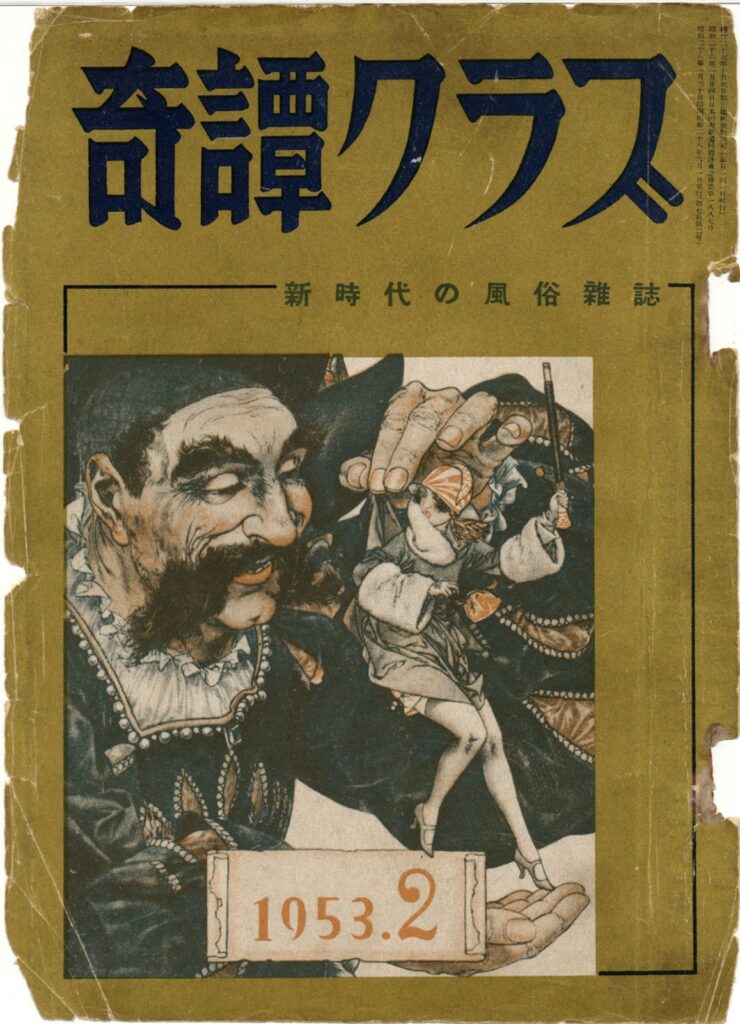
- The cover uses impossible scale rather than rope to represent domination, reducing the woman to an object held within the male figure’s hand (PDF p. 1).
- The opening European prison image frames suffering as historical evidence and prepares the reader to view coercion through antiquarian distance (PDF p. 2).
- The illustrated collection on PDF page 5 operates as a taxonomy of domination, voyeurism, and submission rather than a single continuous scene (PDF p. 5).
- A Woman Driven Mad by Rope shifts bondage photography from the January issue’s domestic studio into an outdoor pursuit narrative structured by woods, isolation, and discovery (PDF pp. 6–13).
- The photographic feature uses kimono, rope, scattered possessions, and changes in camera distance to make a staged fantasy resemble visual reportage (PDF pp. 7–13).
- Demon Flower employs psychological and bodily language to place erotic danger inside an apparently diagnostic framework (PDF pp. 15–26).
- Letter from a Madman uses a purported personal document to transform unstable desire into a voice that appears immediate and authentic (PDF pp. 27–28).
- Scattering Young Leaves locates male same-sex desire within the historical culture of the wakashū, giving queer experience a specifically Japanese precedent (PDF pp. 29–34).
- Love Slave, Part Two demonstrates how serialization converts private erotic confession into an ongoing relationship between narrator, magazine, and reader (PDF pp. 35–44).
- The question-and-answer material treats unusual desires as topics that can be named and discussed, helping transform isolated readers into a dispersed interpretive community (PDF pp. 45–52).
- Urine Worship and Totemism gives a highly specific fetish an expansive symbolic or anthropological frame rather than dismissing it as a passing curiosity (PDF pp. 75–76).
- Itō Seiu’s response to Kuroi Chinpei reveals contributors speaking across issues, allowing the magazine to function as an extended conversation rather than a pile of unrelated articles (PDF pp. 77–78).
- A Female Prisoner’s Prison Diary uses confinement and purported testimony to merge historical authority, erotic spectatorship, and the narrative of female vulnerability (PDF pp. 83–89).
- The cluster comprising The Women of Ryūkyū, Eternal Male Beauty and Female Beauty, and Alexina’s Diary broadens the issue’s exploration of gender, sexuality, and bodily difference (PDF pp. 127–142, 155–158).
- The complete scan shows that Fire, Part Two is followed by Alexina’s Diary and the lengthy The Island That Opens at Night, giving the issue a full literary conclusion through PDF page 173 (PDF pp. 143–173).
Contributors
Named contributors represented in this issue:
- composition by Tsujimura Takashi; photography by Tsukamoto Tetsuzō
- Hamura Hiroshi
- Hamura Kyōko
- Hano Mayumi
- Hayashida Sumiko
- Hisamatsu Shunsuke
- Itō Seiu
- Kawabata Tana
- Kinoshita Hakuran
- Kitō Kōichirō
- Komachi Ukon
- Kumoi Kawayō
- Matoba Michi
- Matsui Kōko
- Mise Seirō
- Mogi Yoshihisa
- Moriyama Miyaka
- Okada Satsuko
- Sasada Ei
- Torigami Ryōichi
- Tozaki Heima
- Ukiya Takasaburō
- Urushijima Michihei
- Yoshii Kagehiro