Beautiful Bondage
November 1966
← Back to magazine archive
Issue Details
- Issue
- 11
- PDF pages
- 32
Summary
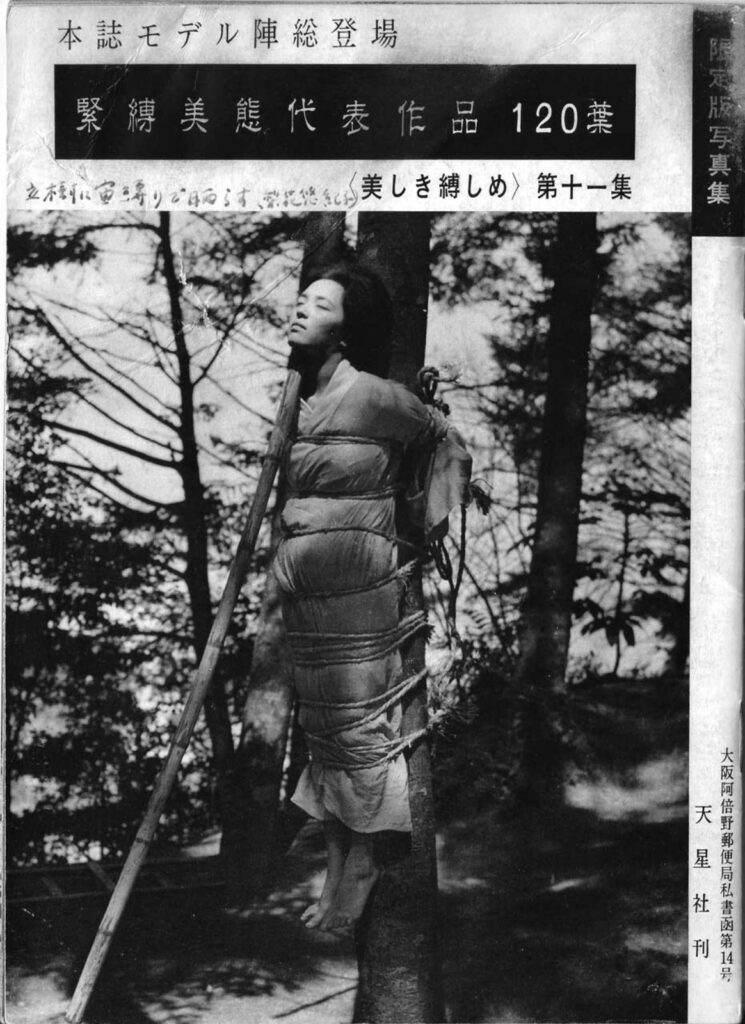
The November 1966 installment of Beautiful Bondage identifies itself as the eleventh collection of 美しき縛しめ and announces on its cover that the magazine’s model roster appears together in a selection of 120 representative images of bondage beauty. Unlike several preceding volumes, which organize themselves around a single extended scenario or thematic contrast, this issue functions as a retrospective anthology. It assembles many women, rope styles, garments, settings, gags, suspension methods, and restraint configurations into a dense visual survey of the series’ photographic vocabulary.
Read full summary Close full summary
Loading PDF…
Highlights
- The cover presents Collection 11 as an anthology featuring the magazine's model roster and advertising 120 representative images of bondage beauty, establishing a retrospective rather than single-scenario format. (PDF p. 1).
- The opening pages immediately demonstrate the anthology's range through gags, black and white rope, chest harnesses, rear-arm restraint, inverted leg ties, kneeling bondage, and models with markedly different body types and clothing. (PDF pp. 2–6).
- Handwritten annotations appear beside many photographs throughout the issue, often describing a tying method, pose, visual effect, or model, giving the collection the character of a curated photographic notebook rather than an uncaptioned album. (PDF pp. 2–31).
- The collection repeatedly juxtaposes domestic restraint with outdoor photography, moving among tatami rooms, beds, baths, pillars, gardens, wooded settings, and muddy ground while retaining rope bondage as the unifying subject. (PDF pp. 4–10, 13, 19, 21, 24, 28–29).
- Several pages explore suspension and elevated restraint, including wrists secured overhead, a leg drawn upward independently, inverted leg bondage, chain-supported wrists, and other configurations that move beyond simple floor or seated ties. (PDF pp. 5, 9, 13, 25, 29).
- A broad middle sequence emphasizes gagging through patterned cloth, broad white fabric, dark material, and rope-associated facial restraint, frequently combining the gag with dense chest or upper-arm binding. (PDF pp. 11, 13–16, 20–21, 23–24, 27, 29–31).
- The anthology incorporates more theatrical or apparatus-oriented images alongside ordinary rope bondage, including a concrete block placed across a kneeling model, an abdominal board-like restraint, a chair-based scene, chains, and a rough wooden A-frame. (PDF pp. 15, 24, 26, 29).
- Several later images revisit the rustic punishment aesthetic associated with the Japanese-style punishment collection, including the A-frame restraint and outdoor mud-covered bondage, suggesting deliberate reuse of notable imagery from earlier Beautiful Bondage portfolios. (PDF pp. 26, 28–29).
- The final pages continue the anthology approach with sailor-style clothing, elaborate chest bondage, cloth gags, compact kneeling poses, and close views of rope crossing the torso and securing the arms behind the back. (PDF pp. 30–32).
- The final page carries the Tenseisya imprint from Abeno, Osaka, identifies the publication with the shorthand 美11, states that it is not sold through bookstores, and gives the limited-edition price as 1,000 yen. (PDF p. 32).