Kitan Club
June 1953
← Back to magazine archive
Issue Details
- PDF pages
- 172
Summary
The June 1953 issue of Kitan Club combines translated European fiction, serialized erotic confession, punishment history, prison narrative, masochistic testimony, queer fiction, staged bondage photography, medicalized discussion of bodily difference, and essays attempting to trace the cultural roots of torture and sexual “perversion.” Its editorial architecture repeatedly moves between fantasy and explanation: a scene of suffering is followed by history, psychology, purported testimony, or taxonomy, giving specialized desire the appearance of a field that can be studied as well as imagined.
Read full summary Close full summary
Table of Contents 23 items
-
O-Sayo Night Storm
Summary
An illustrated historical erotic narrative in which O-Sayo is captured and subjected to escalating restraint, gagging, humiliation, and coercive sexual domination. The sequential scenes emphasize her helplessness as her captor binds and controls her in a traditional Japanese setting.
-
The Sufferings of Christine
Summary
An unfinished translated serialized narrative in which Christine recounts her troubled upbringing, her father’s financial collapse, and pressure to marry the wealthy Paul. Her resistance leads to threats, abduction, physical restraint, and escalating coercive encounters.
-
Steps of the Rainbow
Summary
A serialized erotic narrative follows a narrator and companions through encounters in Ginza that develop into voyeuristic and coercive scenes involving a woman being stripped, tied, restrained, and displayed. The story emphasizes eroticized observation, humiliation, and the staging of bondage scenes.
-
Prison
Summary
A first-person captivity narrative recounts a young man’s arrest, imprisonment, transfer, forced nudity, binding, and humiliating treatment by guards and other observers. After his release, the account continues to connect institutional confinement with eroticized restraint and exhibitionistic humiliation.
-
Searching for the Roots of Torture and Perversion
Summary
An extended essay investigates the psychological and social roots of torture, sadism, and sexual perversion. Drawing on personal anecdotes, historical Japanese and Western punishment practices, legal cases, literature, and contemporary SM culture, it considers how cruelty, erotic desire, pain, domination, and transgression become connected.
-
Love Slave, Part Six
Summary
The sixth installment of Kitō Kōichirō’s serialized erotic narrative follows a psychologically tormented man whose relationship with Harumi becomes entangled with jealousy, humiliation, sexual coercion, and fantasies of domination. Dreamlike and staged encounters blur imagined and remembered events as the narrator struggles with Harumi’s apparent sexual power and his own submissive impulses.
-
The Criminal History of the Tyrant Ivan, Part Two
Summary
The second installment of Takatori Nagaharu’s historical account of Ivan the Terrible depicts the tsar’s reign through episodes of torture, arbitrary punishment, executions, massacres, and repression. It emphasizes the cruelty of Ivan and his agents toward nobles, religious figures, townspeople, and entire communities, in a dramatic and sensational narrative style.
-
Yukiko’s Punishment
Summary
A first-person erotic narrative recounts Yukiko’s increasingly elaborate punishment sessions with an older woman, moving from rope bondage and sensory restriction to staged execution scenarios involving a scaffold, decapitation apparatus, and confinement in a box. The story emphasizes the psychological tension, ritualized preparation, and bodily sensations of these consensual or fantasy-driven scenes.
-
From a Masochist’s Notebook
Summary
A first-person masochist’s notebook that presents erotic fantasies and reflections through a series of themed episodes involving drinking vessels, scent, the tongue, harnessing, and other forms of service, domination, restraint, and punishment. The essay blends personal confession with sexological speculation about masochism, gendered power, domestic service, and the psychological meaning of submission.
-
Aphrodite Fantasy
Summary
An erotic fantasy narrative in which a female narrator becomes entangled with a novelist and his associates, leading to repeated scenes of rope bondage, restraint, coercion, and humiliation. Presented in serialized chapters with accompanying erotic illustrations, the story blends literary self-reference with staged captivity scenarios.
-
My Painful Sunday
Summary
A first-person confessional account traces the narrator’s developing fascination with eroticized violence, bodily vulnerability, and abdominal cutting, linking personal memories with readings, theatrical imagery, and reflections on sexual psychology. The piece presents these interests as troubling but persistent elements of the narrator’s private erotic imagination.
-
Green Moss
Summary
A serialized erotic narrative follows tangled relationships among married and unmarried adults as jealousy, sexual coercion, humiliation, and domestic control intensify. Its later episodes depict women subjected to extended bondage, restraint, forced nudity, breast-focused fetishism, and sadistic sexual scenarios within private homes.
-
After the Quiet Theater: Memories of Shanghai, Part Two
Summary
Himeumi Shirō continues his memoir of Shanghai with a visit to a theater after many years away, describing the audience, tea-house customs, backstage atmosphere, performers, and a staged erotic drama. The account recounts scenes of coercion, undressing, bodily inspection, binding, and sexualized domination while comparing Chinese theatrical conventions with Japanese erotic performance culture.
-
Bound Expressions
Summary
A photographic feature demonstrates how rope bondage produces different bodily positions and facial expressions. Accompanying commentary discusses the model’s reactions, cooperation and resistance, while presenting several tied poses as staged visual studies.
-
Gathering Around Ms. Kago
Summary
A reader roundtable gathers around Matsui Kago to discuss her bondage fiction, creative motivations, literary methods, and depictions of women being tied. Participants also reflect on the realism, psychology, illustrations, readership, and practical details of rope restraint represented in her work.
-
Execution of a Vamp Woman
Summary
A historical survey of Japanese “vamp” actresses and their screen careers, discussing performers such as Mine Ginko, Date Satoko, Irie Takako, and others. It emphasizes their glamorous or sexually charged screen images, physical presentation, memorable roles, and place in the development of erotic and sensational Japanese cinema.
-
On Female Circumcision
Summary
A historical account of women’s self-disembowelment as a form of suicide, drawing on reported cases and older cultural narratives to examine the act’s social, sexual, and sensational meanings. The surrounding discussion places such imagery within the period’s theatrical and popular representations of female suffering and bodily violence.
-
Depictions of Perversion in Literature
Summary
An essay examines depictions of ritual suicide by disembowelment (seppuku) in Japanese literature, tracing the motif from historical and military narratives through modern novels and drama. It compares authors’ graphic descriptions of wounds, bodily sensation, emotional states, honor, despair, and the aesthetic or psychological impact of these scenes.
-
The Lamp and Its Shadow
Summary
A historical erotic narrative set in an Edo-period licensed quarter, where courtesans and other figures become entangled in betrayal, flight, captivity, and violent punishment. The story combines melodramatic suspense with scenes of coercion, humiliation, and physical restraint.
-
A New-Style Execution Ground
Summary
A dark erotic fiction centered on a brutal punishment scene in which bound women are subjected to intimidation, beating, and degrading treatment by a sadistic captor. Its imagery and narrative frame punishment as a theatrical, execution-like spectacle.
-
Wakashū Bushidō
Summary
A historical erotic tale set in the Edo-period samurai world, following the beautiful young wakashū Sh之丞, his patron Toda Yasuhiro, and their circle through jealousy, secret desire, betrayal, and violent retribution. The narrative combines same-sex erotic tension with swordplay, honor, service, and tragic self-sacrifice.
-
Fire, Part Six
Summary
The sixth installment of a serialized erotic novel follows Ichirō’s increasingly obsessive pursuit of Junko and the violent sexual tensions surrounding their circle. The episode centers on coercive restraint, humiliation, and threatened violence as the characters’ desires and jealousies escalate.
-
Publication Notices and Advertisements
Summary
A miscellany of magazine notices and advertisements announces submission guidelines, editorial policies, back issues, subscriptions, reader recruitment, and the publisher’s contact information. It also promotes the magazine’s role as a specialist erotic publication and reader-supported community.
Highlights
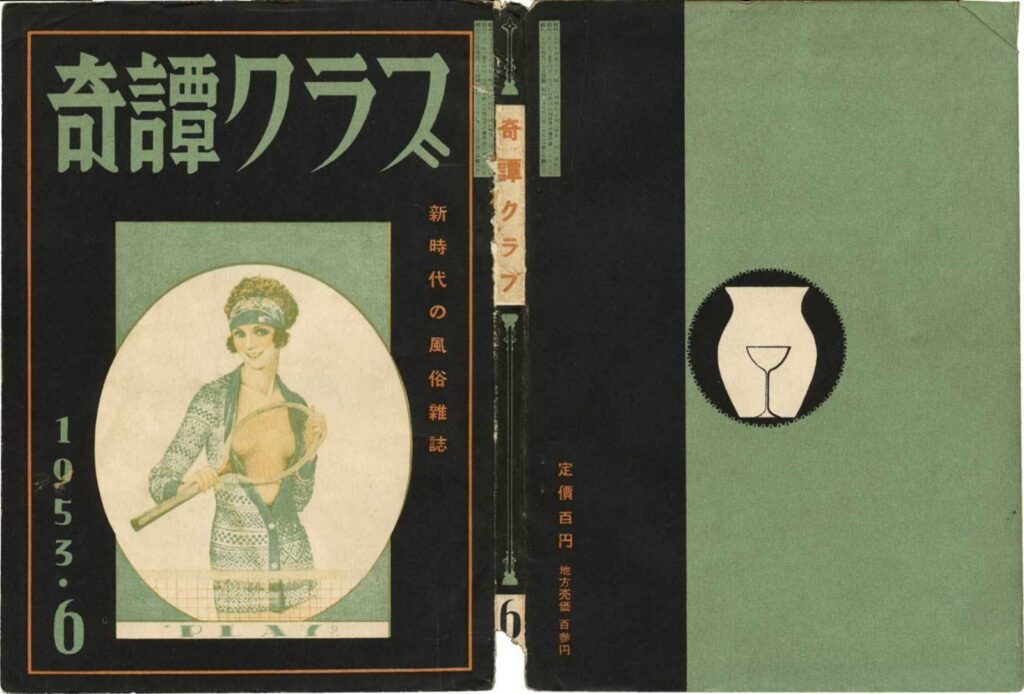
- The cover replaces explicit restraint with stylized femininity, using costume, framing, and a reduced bodily emblem to establish the issue’s interest in erotic types (PDF p. 1).
- O-Sayo Night Storm combines handwritten narration, costume, rope, and domestic objects into an illustrated captivity tale resembling an erotic picture scroll (PDF pp. 5–8).
- The Sufferings of Christine uses translated European fiction to provide Japanese readers with an international literary genealogy of submission and suffering (PDF pp. 10–21).
- Steps of the Rainbow connects voyeurism, architecture, and psychological descent, making thresholds and concealed looking part of its erotic structure (PDF pp. 22–26).
- Prison uses confinement, surveillance, and enforced hierarchy as both institutional reality and a narrative model of domination (PDF pp. 27–31).
- Searching for the Roots of Torture and Perversion attempts to organize punishment, religion, history, and abnormal desire into a speculative genealogy (PDF pp. 32–37).
- Love Slave, Part Six continues the recurring diary identity through which apparent private confession becomes part of a sustained reader relationship (PDF pp. 38–46).
- The Criminal History of the Tyrant Ivan uses political biography to place sadistic power at a historical distance while preserving its erotic spectacle (PDF pp. 47–53).
- From a Masochist’s Notebook allows masochistic desire to speak in an apparently first-person form, though the degree of editorial reconstruction cannot be determined (PDF pp. 62–71).
- Aphrodite Fantasy draws on classical and foreign imagery to connect mythic femininity with punishment, desire, and modern erotic spectatorship (PDF pp. 72–81).
- Bound Expressions isolates the kneeling body against a plain background, using rope, posture, facial direction, and camera angle to compare manufactured visual affects (PDF pp. 105–108).
- Gathering Around Ms. Kago distributes authority among multiple contributors, making the magazine resemble a symposium and social meeting place in print (PDF pp. 110–121).
- On Female Circumcision adopts an ethnographic or medical tone, but its bodily classifications should be read as historically situated sexological discourse rather than reliable clinical evidence (PDF pp. 126–131).
- Itō Seiu’s A New-Style Execution Ground transforms punishment into conscious visual and conceptual design, linking historical genealogy with modern erotic staging (PDF pp. 152–155).
- Wakashū Bushidō gives male same-sex desire a historical Japanese frame before Fire, Part Six supplies the issue’s extended literary conclusion (PDF pp. 156–171).
Contributors
Named contributors represented in this issue: