Modern kinbaku is often described as though rope gradually detached itself from older systems of restraint and became an autonomous erotic art. That account captures part of the story, but it misses an important intermediate category: 刑罰, keibatsu, punishment in a formal or penal sense. Keibatsu is not identical to 拷問, gōmon, torture, nor to 責め, seme, torment. It belongs to the language of law, discipline, criminality, and sanctioned punishment. In the work of Itō Seiu, however, keibatsu became more than subject matter. It gave the restrained body a historical framework and a form of cultural legitimacy.
Seiu did not simply draw women tied with rope. He repeatedly placed bound women within systems of punishment, surrounded by posts, beams, weights, vessels, fire, water, architecture, costume, and the material apparatus of discipline. His broader interest in Edo-period customs, crime, punishment, theater, and folklore allowed restraint to appear as part of an antiquarian and historical project. The woman in such imagery is not presented merely as an abstract erotic figure. She is ostensibly there because a punishment is being demonstrated, reconstructed, or remembered.
A bound woman could be erotic, but a bound woman presented as an example of an old punishment could also be read as historical evidence, visual reconstruction, or cultural study. The erotic charge did not disappear. Instead, it was mediated by a framework that changed how the image could be classified, circulated, and viewed.
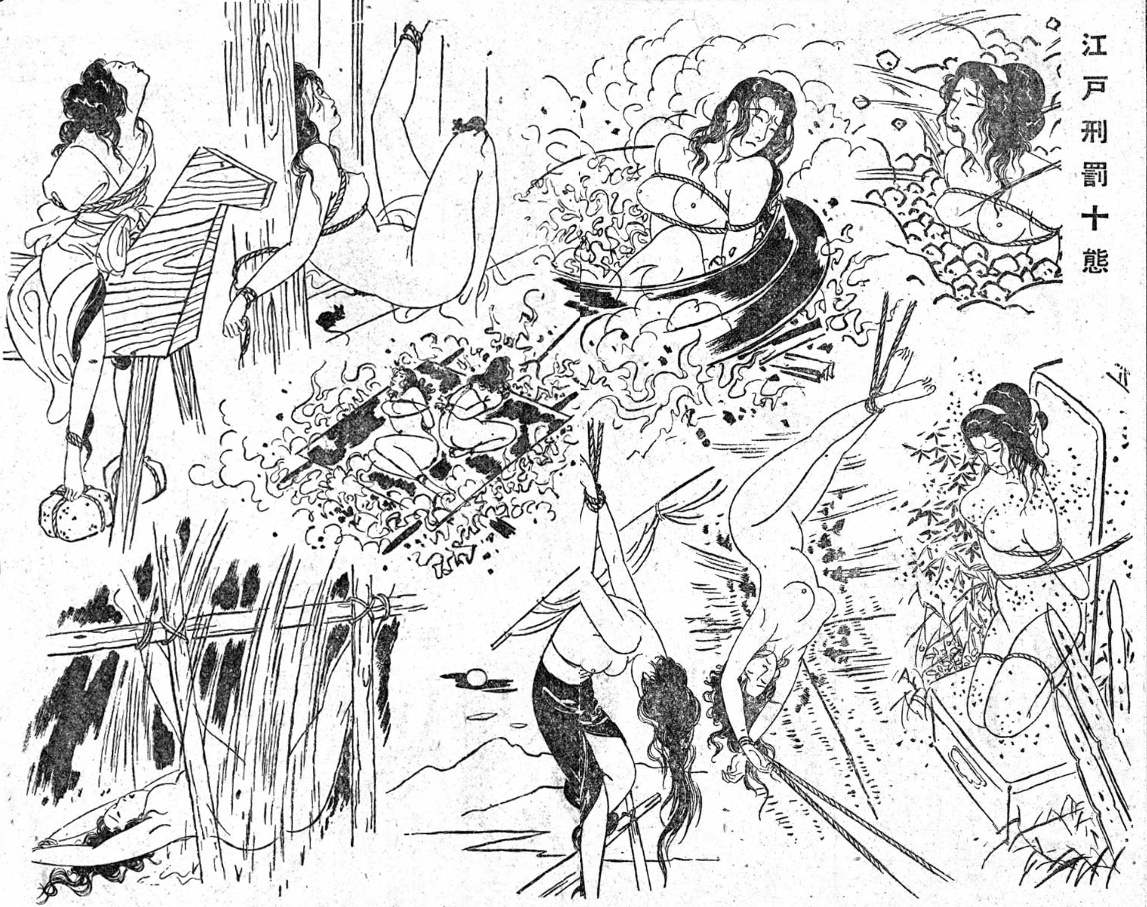
This is why the word keibatsu carries such weight. In a title such as 江戸刑罰十態, Edo Keibatsu Jittai, “Ten Forms of Edo Punishment,” the historical framing tells the viewer how to read the images. They are presented not simply as scenes of suffering but as examples of punishment from the past. Yet the visual emphasis often falls less on legal procedure than on the body itself: exposed skin, disordered clothing, strained posture, suspension, rope, helplessness, and the theatrical spectacle of suffering. Historical punishment and erotic looking occupy the same image without being reducible to one another.
Nihon Keibatsu Fūzoku Zushi
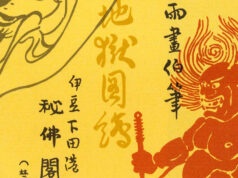
The clearest expression of this relationship is Nihon Keibatsu Fūzoku Zushi, the three-volume illustrated history of Japanese punishment customs produced by Fujisawa Morihiko and Itō Seiu between 1948 and 1951. The work is important not merely because it contains Seiu’s punishment imagery, but because its structure reveals a much broader cultural trajectory. It begins with regulation and inspection, moves through punishment and torment, and ends with theatrical and literary representations of suffering. In other words, the work itself charts a movement from the administration of bodies to the representation of bodies.
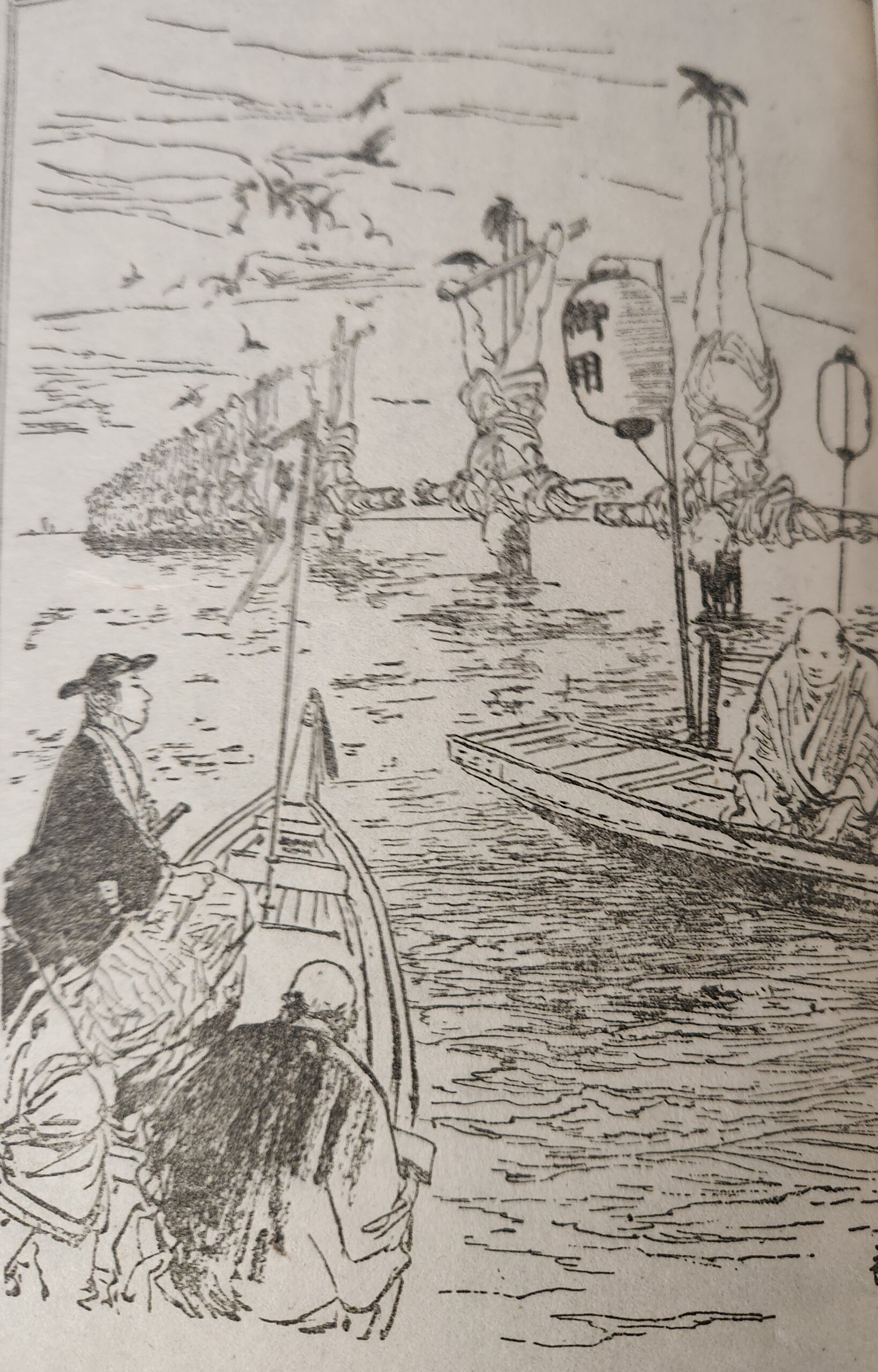
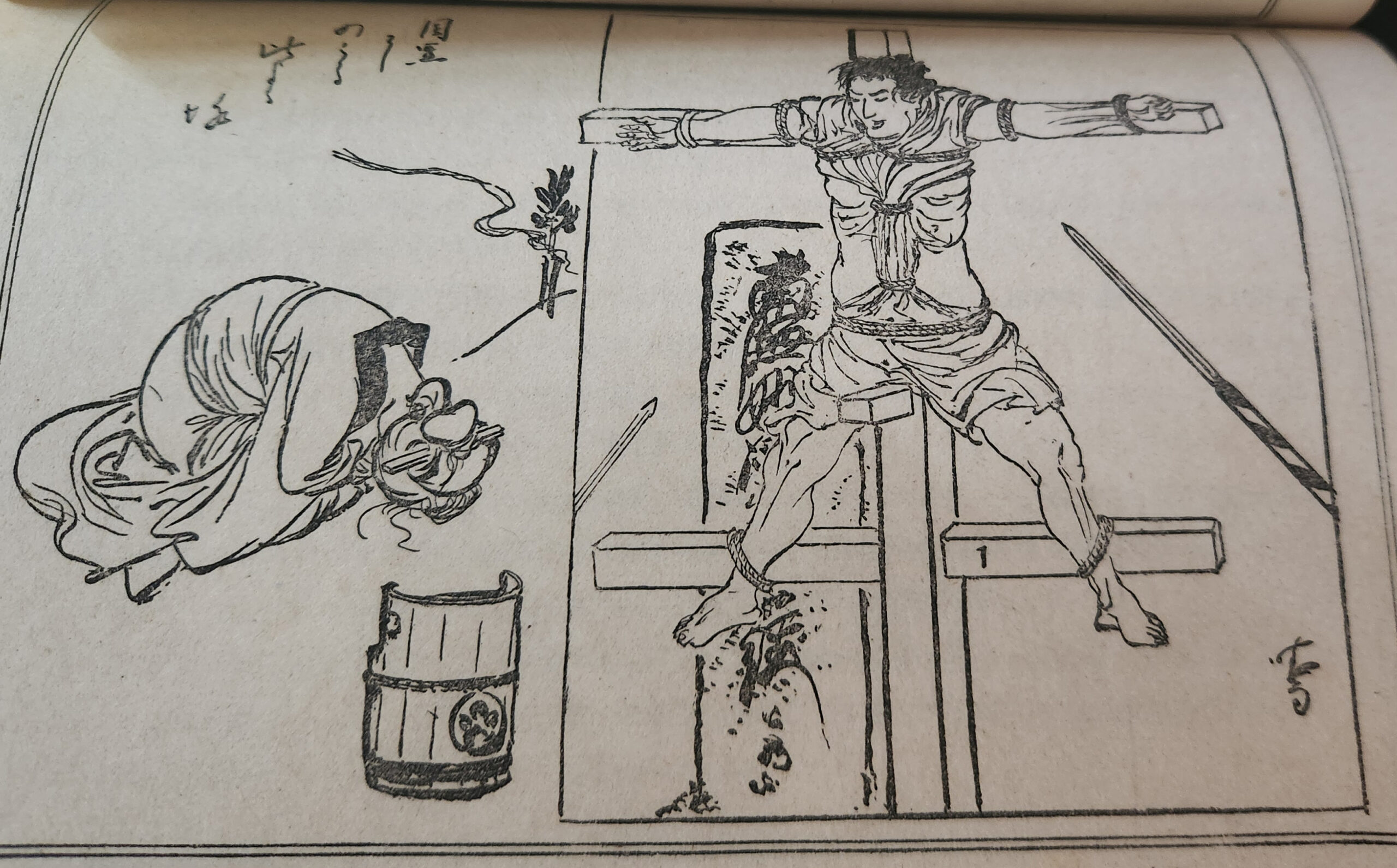
The first volume is concerned heavily with the body under authority. It opens with checkpoints, women’s travel permits, the examination of women, clandestine passage, checkpoint violations, and methods of arrest before turning to crucifixion, punishment by fire, water torment, snow torment, and related penal customs. This is not bondage as an autonomous erotic practice. Rope belongs to an apparatus of control. Bodies are stopped, examined, captured, positioned, and punished. Restraint is procedural.
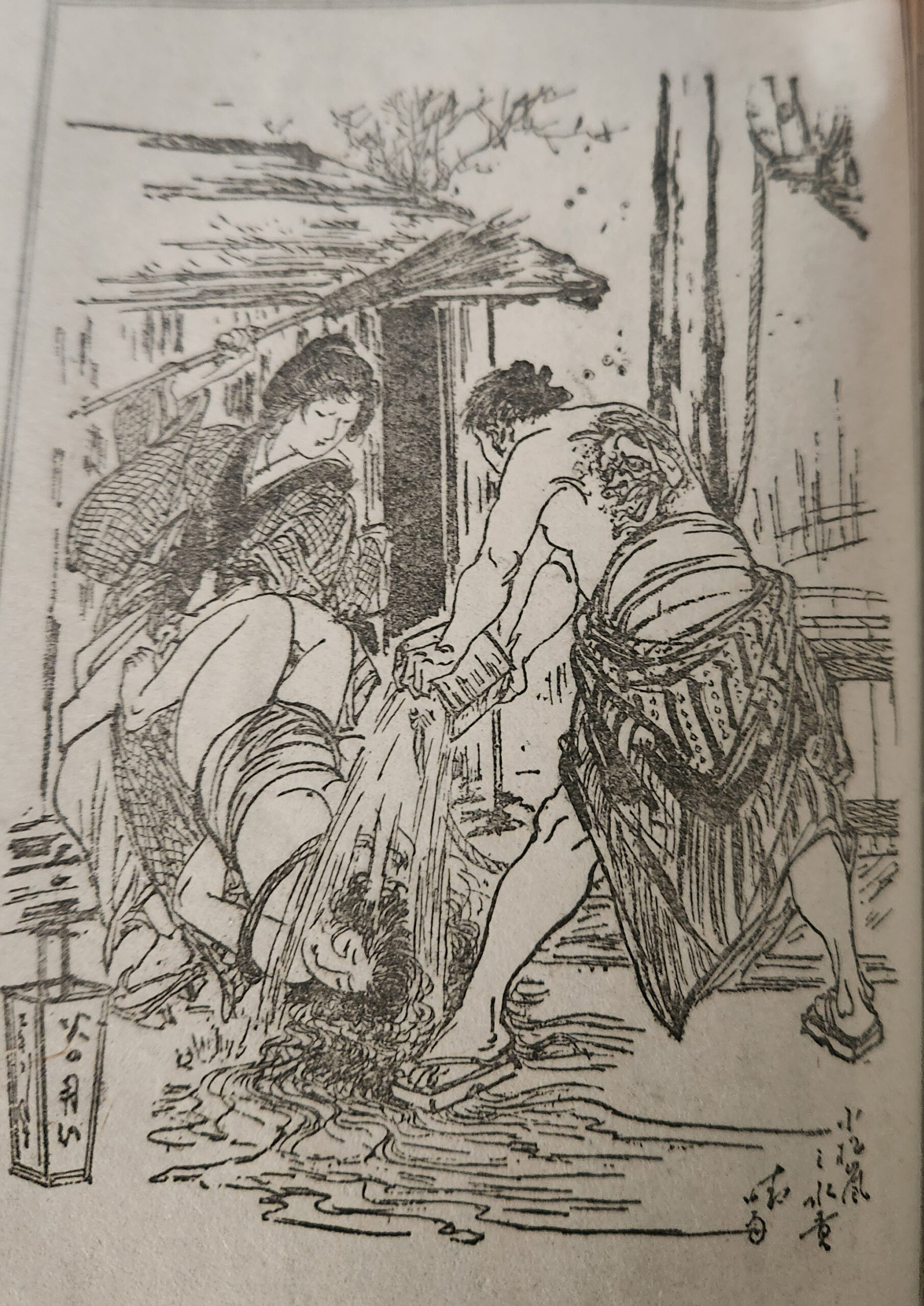
The second volume widens the field. It includes religious misconduct, gambling, the women of the Ōoku, exile, Edo punishment, and a series of increasingly spectacular forms of torment such as snake torment, nail cages, gourd torment, and smoke punishment. Here the vocabulary begins to shift. Keibatsu remains present, but 責め, seme, torment, appears alongside it. This is significant because the book no longer confines itself to punishments that fit neatly within a modern legal category. Judicial discipline, quasi-judicial punishment, folklore, anecdote, and spectacular torment begin to inhabit the same representational space.
The third volume makes the transition even clearer. It moves through famous punishment cases, vengeance, execution narratives, private punishment, and the history of torture before turning explicitly to 責場, semeba, scenes of torment represented in theater. Kabuki, jōruri, Shinpa, ghost stories, and popular fiction become part of the genealogy of suffering. At this point the central question is no longer simply how people were punished. It is how the spectacle of punishment and torment was staged, narrated, and looked at.
Nihon Keibatsu Fūzoku Zushi shows that the history leading toward kinbaku does not move directly from judicial rope to erotic rope. It passes through representation. Punishment becomes custom, custom becomes story, story becomes spectacle, and spectacle makes the restrained body available for increasingly autonomous erotic contemplation.
From Punishment to Representation: Images from Nihon Keibatsu Fūzoku Zushi
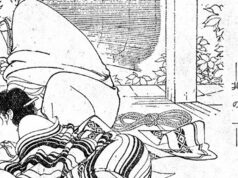
The illustrations in Nihon Keibatsu Fūzoku Zushi make visible the transition described in the text. Some emphasize punishment as public procedure: bodies are transported, displayed, suspended, or fixed within elaborate apparatuses. Others increasingly isolate the restrained body as a visual object. Read sequentially, the images show why the genealogy of kinbaku cannot be reduced to the inheritance of particular knots. What survives is a broader visual grammar of restraint, forced posture, exposure, helplessness, and spectatorship.
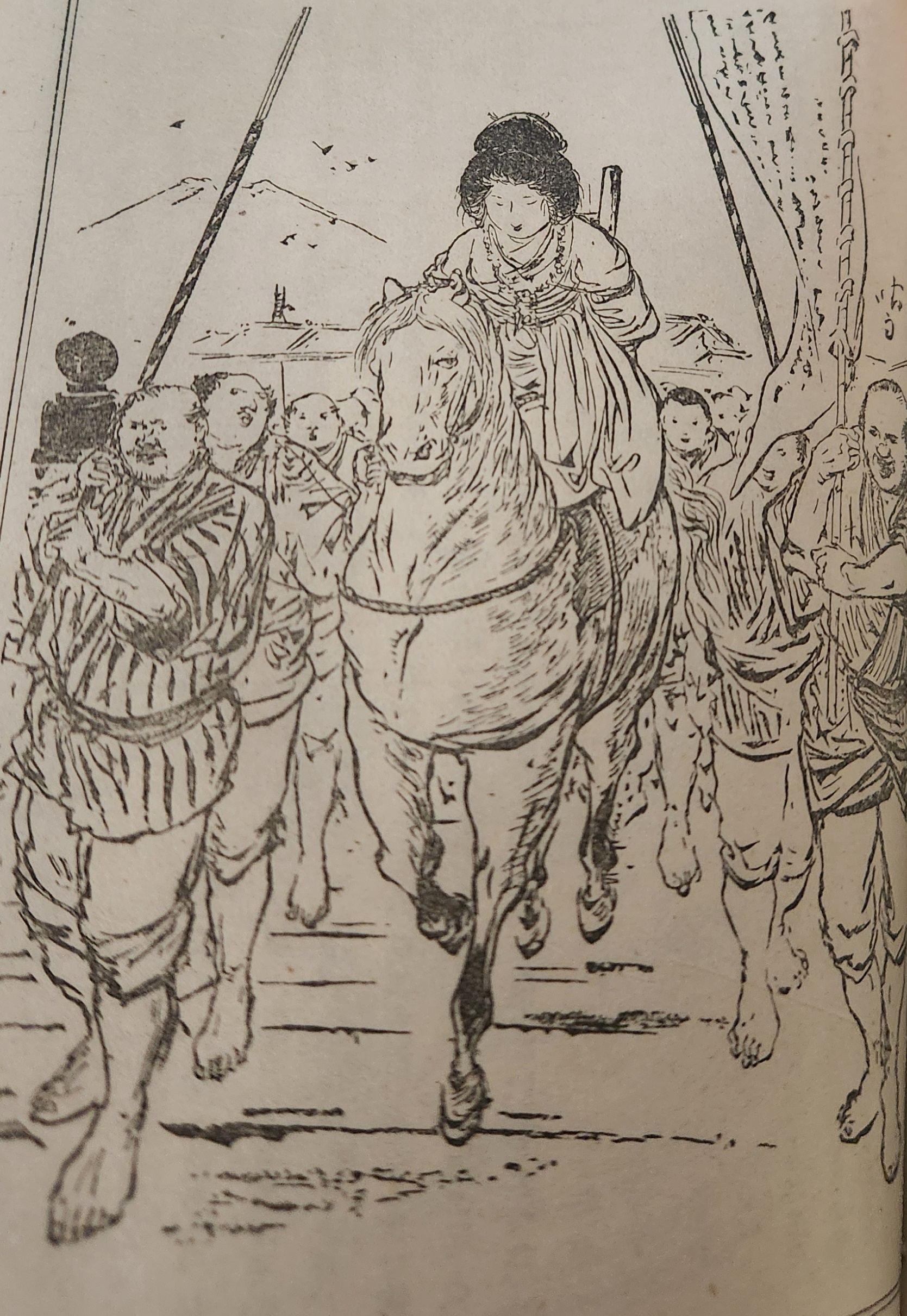
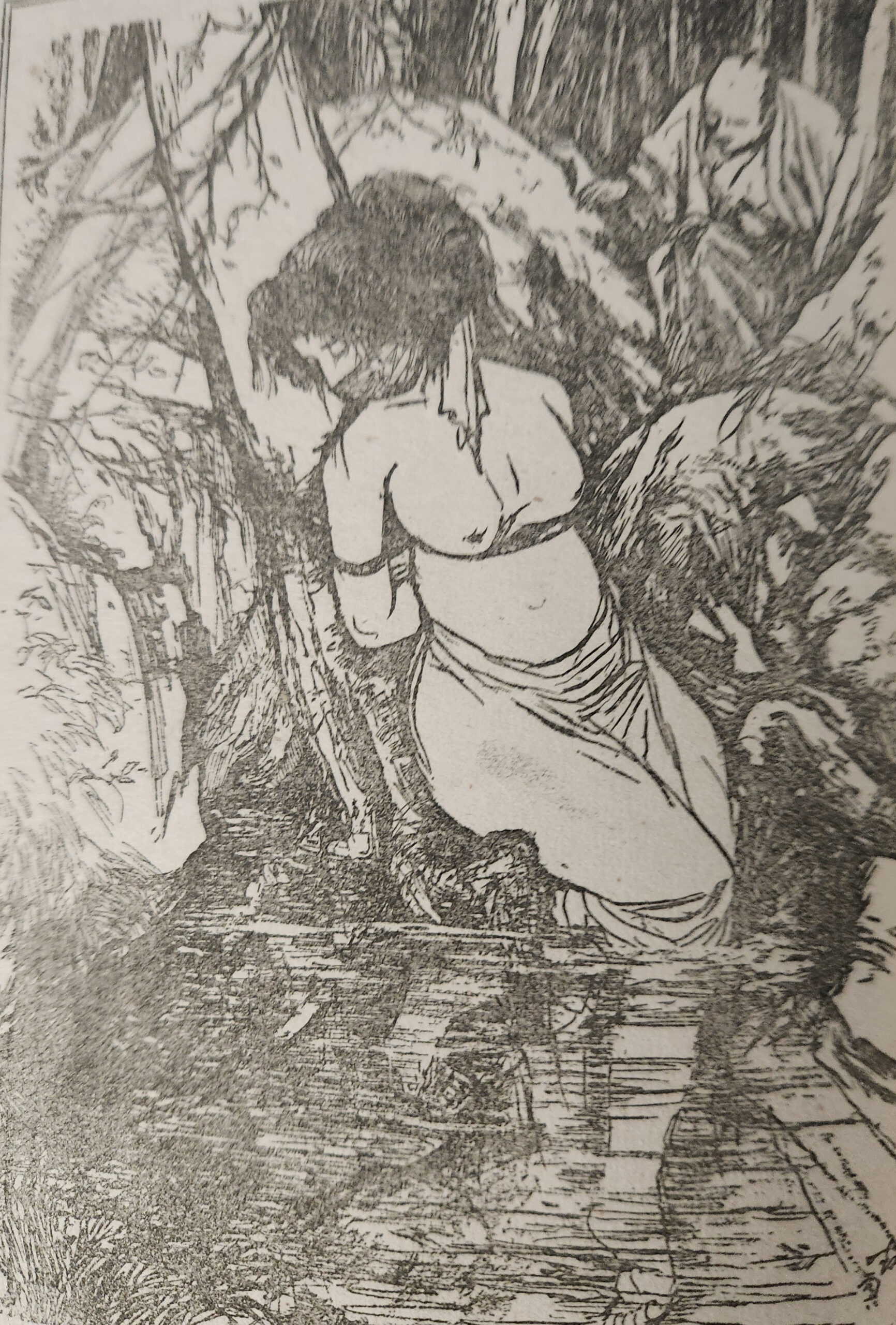
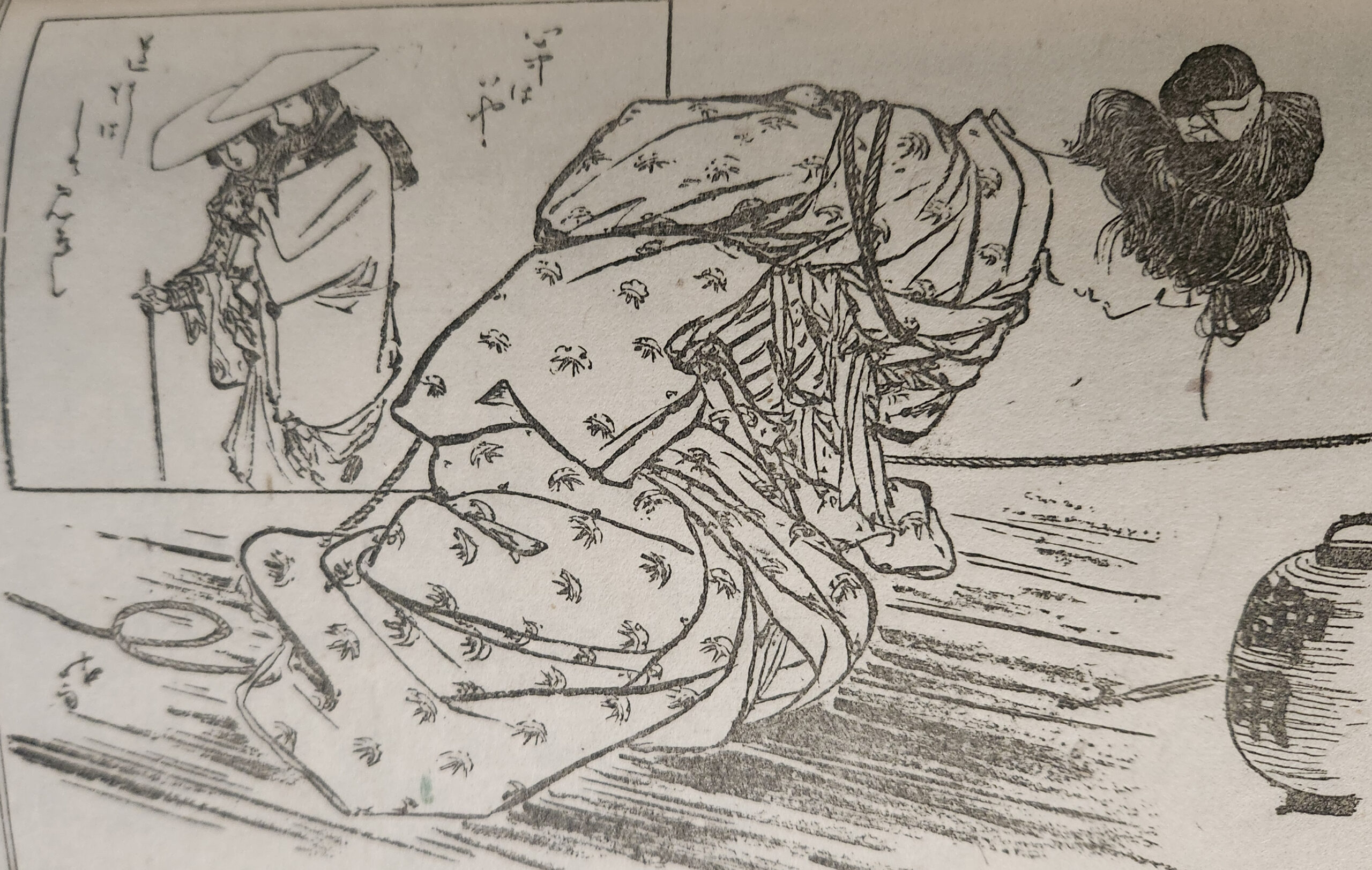
What changes over the following decade is not simply the rope technique. It is the explanatory burden placed upon the image. In keibatsu, restraint is justified by punishment. In seme, torment itself becomes erotically intelligible. In kinbaku, rope can finally become sufficient reason for the body to be bound.
Hentai Seiyoku
This also complicates any simple claim that Seiu merely took historical torture and eroticized it. Japanese punishment already possessed a long representational history in theater, folklore, popular literature, and visual culture. Punishments became legends; legends became plays; plays developed conventional torment scenes; those scenes organized the suffering body aesthetically. Seiu inherited, researched, illustrated, and intensified that tradition. His contribution lies partly in making the visual language of punishment sufficiently compelling that it could later survive the disappearance of punishment as its primary explanation.
This historical process unfolded alongside another important transformation in Japanese sexual discourse: the emergence of 変態性欲, hentai seiyoku, “abnormal sexual desire.” In the late Meiji and Taishō periods, hentai did not yet carry its later popular meaning. It referred broadly to deviation or abnormality, and in sexual discourse it became a classificatory term for desires considered outside the norm. Sadism, masochism, fetishism, same-sex desire, cross-dressing, voyeurism, and other erotic tendencies could all be named, grouped, and explained within this framework.
That taxonomy transformed private acts into recognizable categories of desire. Once a sexual tendency had a name, it could become the subject of an article, a case study, a reader confession, an illustration, or a correspondence column. By the early postwar period, magazines such as Fuzoku Soshi and Kitan Club were assembling precisely this kind of material. A single issue might place bondage, masochism, homosexuality, body fetishism, erotic folklore, historical punishment, sexual advice, and pseudo-medical explanation side by side. To modern readers these may look like distinct genres, but within the editorial logic of the early 1950s they could all be gathered under the broad heading of abnormal sexuality.
This was the environment in which Seiu’s punishment imagery became newly visible. A drawing framed as historical keibatsu could now be consumed by readers increasingly interested in sadism, masochism, restraint, and fetishistic imagery as sexual categories in their own right. The historical punishment plate and the sexological case study belonged to the same publishing ecology. Both made erotic material discussable by surrounding it with explanation, classification, and historical or scientific context.
Censorship and Article 175
Censorship made that framing especially important. Erotic publishing in modern Japan existed under legal and institutional pressure, most notably through Article 175 of the Penal Code, which prohibited the distribution of obscene material. The practical boundary between obscenity and legitimate art, scholarship, history, or education was never perfectly fixed, but publishers nevertheless had strong incentives to present sexually charged material within categories that carried recognized cultural value. History, medicine, psychology, folklore, social custom, crime, and anthropology all provided such categories.
Historical framing therefore did more than conceal eroticism. It altered the cultural status of the image. A nude or bound woman presented without context might be vulnerable to classification as obscene, while the same visual vocabulary embedded in a discussion of Edo punishment, criminal custom, folklore, or sexual science could claim documentary, educational, or antiquarian value. The distinction was never absolute, but it created room in which erotic imagery could circulate.
The term 風俗, fūzoku, is equally important here. Historically, fūzoku meant customs, manners, or social practices. It was broad enough to encompass prostitution, erotic entertainment, punishment, fetishism, nudity, unusual relationships, and sexual behavior while still presenting itself as a form of social observation. This made fūzoku especially useful in postwar publishing. Material that might otherwise appear merely prurient could be presented as evidence about human customs, historical practices, or unusual forms of sexuality.
Nihon Keibatsu Fūzoku Zushi brings these ideas together directly: punishment, custom, and illustrated history. Its significance lies in showing how the restrained body could move between categories without losing its visual force. A scene could be legal history, folklore, theatrical convention, or erotic spectacle at different moments, sometimes all at once.
The postwar SM magazine inherited this logic but gradually transformed it. In Seiu’s punishment imagery, rope usually belongs to an apparatus. It restrains the body so that some further punishment can occur. The post, beam, weight, flame, vessel, or execution device remains important because it explains the scene. In later SM illustration and photography, much of that apparatus begins to disappear. Rope itself becomes increasingly central.
This transition is especially clear when Seiu is compared with postwar artists such as Kita Reiko. In Seiu, a woman may be tied because the image is ostensibly documenting a punishment. In Kita Reiko’s Twelve Months, a woman can be tied because the story itself is about erotic restraint. Moonlight, flowers, posture, and exposed skin create atmosphere rather than historical justification. The difference is not that Seiu was historical while later artists were erotic. Seiu’s work was often intensely erotic. The shift is that later magazine culture required less historical explanation for bondage to be intelligible as a sexual subject in its own right.
The Importance of Seme
The intermediate category of seme was crucial in this transformation. Seme is broader and more flexible than keibatsu. It can mean torment, attack, pressure, punishment, or eroticized suffering. Within SM culture, it increasingly becomes a way of describing the pleasurable infliction or endurance of torment. A posture that might first appear in a historical punishment illustration could be detached from its legal or historical setting and reappear as seme. From there, the same visual vocabulary could move still further toward kinbaku.
The physical forms did not necessarily change first. The meanings around them did. Suspension, forced posture, disordered kimono, exposed breasts and thighs, rope across the torso, and the spectacle of helplessness all existed within punishment imagery before they became central to modern bondage aesthetics. What changed was the question the image invited the viewer to ask. In keibatsu imagery, the question is often: what punishment is being administered? In later kinbaku imagery, the question becomes: how is the body being transformed by rope?
This is why the history of kinbaku is not simply a history of knots or techniques. It is also a history of cultural intelligibility. Keibatsu made the restrained body visible as history. The discourse of hentai seiyoku made unusual desire visible as sexuality. Postwar SM magazines made those desires visible as a shared cultural field by gathering readers, writers, artists, and correspondents around them. Over time, kinbaku could emerge as a distinct practice in which rope no longer required the prison, execution ground, historical anecdote, or pseudo-medical explanation to justify its presence.
There is an important irony in this history. The language of hentai seiyoku was a language of abnormality, designed to classify certain desires as deviant. Yet the magazines that circulated those classifications also allowed readers to discover that others shared them. A fetish could become a correspondence topic. A masochistic fantasy could become a roundtable discussion. A historical punishment image could be recognized as erotic material. What began as taxonomy became audience, and audience became culture.
Conclusion
Seen from this perspective, Seiu’s importance lies not only in the images he produced but in the cultural bridge his work helped construct. He helped preserve a visual vocabulary of restraint as punishment moved from legal procedure to historical custom, from custom to representation, and from representation to erotic spectacle. The historical apparatus could gradually fall away, but the rope, posture, exposure, helplessness, suspension, and aestheticization of suffering remained. Those elements became part of the visual language from which modern kinbaku developed.
Keibatsu gave erotic restraint a historical framework. Representation turned punishment into spectacle. Hentai discourse gave that spectacle a sexual vocabulary. The postwar SM magazine gave it a public. Kinbaku eventually made the rope itself the subject.