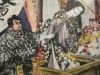

by Itoh Seiu
I first decided I wanted to draw scenes of women being punished when I was just seventeen. To put it bluntly, it was the time when my sexual desires were first awakening. At the time, I was an apprentice sculptor earning twenty sen a month. Since I couldn’t build a collection of female bondage illustrations to my heart’s content, I would steal moments from my work to trace illustrations from the Tokyo Asahi Shimbun, adding ropes to the women’s bodies and taking secret pleasure in them, until my fellow apprentices discovered me, causing me to blush with embarrassment.
Later, once I was able to make a living with my brush, I can still not forget the joy I felt when I tied up my young, newlywed wife (who, incidentally, was not a beauty) with a sash and sketched her. Later, believing that theater was the only way to study women’s bondage, I began frequenting theater dressing rooms.
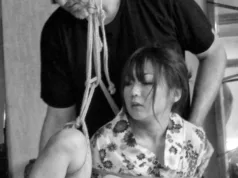
While tying up female actors and sketching or taking photographs of them, I came to be labeled a sexual pervert by those who didn’t understand me. But I paid no heed to such remarks, I remained completely unfazed. Call it research, call it a hobby, for over forty years, I’ve stuck to women’s bondage as my sole focus, right up to the present day.
It was by no means because I had any foresight, nor was it for material gain. It was simply that, for some reason, I couldn’t get enough of “women’s scenes of torment,” so I became completely absorbed in my artistic work and just painted and painted relentlessly. It’s exactly the same as when fishing enthusiasts search for a good spot, there’s no deep reasoning behind it other than the fact that I found it interesting and ventured into uncharted territory.
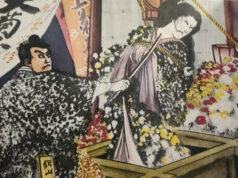
Therefore, I believe my state of mind when drawing “women’s torture scenes” is the same as that of Uta when he was drawing shunga. “Women’s torture scenes” are not shunga, but I believe they are consistent with shunga in the sense of transforming ugliness into beauty. The fact that “Kitan Club,” a magazine specializing in punishment scenes, was born in Kansai rather than Tokyo demonstrates the ingenuity of the Kansai people, or, to put it another way, the keen commercial acumen of those living in a commercial metropolis.
Looking at the paintings of a woman named Reiko Kita, one sees a certain kindness, yet there is also a weakness unique to women. The fact that Tokyo magazine publishers and certain connoisseurs, intrigued by the mere fact that she is a female painter, are trying to exploit this newly emerging female artist, who is still neither fish nor fowl, is tantamount to utterly ruining the reputation of Reiko Kita.
Whether among modern businesspeople or publishers, there is a widespread bad habit of overvaluing established figures while failing to recognize the importance of nurturing those with potential. It will likely take at least the next ten years to fully educate Reiko Kita and nurture her into a remarkable individual.
Having never properly completed elementary school, I remain a mere amateur when it comes to painting. One cannot hope to depict active figures in scenes of torment without first mastering the composition through sketching the nude form. Only when one has thoroughly ingrained the human body into one’s mind, enabling the free and masterful arrangement of compositions for scenes of torment, can one truly be considered a professional. Beyond that, it becomes a matter of sheer skill. The depiction of women in scenes of torment is an art that likely requires the kind of long, arduous dedication described by Laozi, “After nine years, one attains the realm of supreme mastery.”