Translator’s Note: When we explore the history of Kinbaku and Japanese SM (the two are inseparable, in reality), we have a tendency to focus on the legends of bondage themselves. Names like Minomura Ko, Nureki Chimuo, Akechi Denki and many others.
But equally important are the models, both amateur and professional, that help shaped the content and the shape of the culture of Japanese SM. From Kitan Club to Roman videos, and to the modern era of Japanese AVs, each model provides a unique canvas in expression and feeling, and without them, Japanese SM may have never evolved out of primarily reader submission magazines.
Hiromi Saotome is a legendary model in the Japanese SM world. First staring in adult films in 1983, she participated in one of her first magazine shoots in the same year, for a magazine called SM Mania. The production involved herself, Nureki Chimuo, and Sugiura Norio.
These are the translations of her blog, located here (https://note.com/saotome6) talking about her history with Nureki. It is my honor to have them published on Kinbaku Today.
By Hiromi Saotome
November 13, 2020
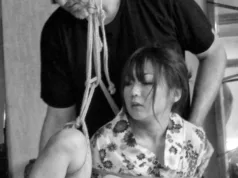
October 30, 2011. Filming for the trilogy produced by Tomoshibi has wrapped up. A water torture scene in the old bathroom of cinematographer Yamanouchi’s home. In reality, it was lukewarm water. Cornered against the weathered walls of the bathroom, the character Hiromi is mercilessly subjected to a water torture session while tightly gagged with a hand towel. As I wrote last time, I don’t dislike water torture. I like the sensation of being driven into the water. Though it’s not a form of torture, I also like being caught in the rain. Perhaps the sensation of getting wet feels good. Yet, despite that, I’m not good at swimming.
Looking back now, during bondage shoots, I used to be the one to suggest getting wet during filming. Snow, rivers, waterfalls. In shows, I’ve even done water torture using an acrylic bathtub. Is it the mixture of my desire to be close to water and my fear that stirs me up? So, when Nureki Sensei suggested a bathroom torture scene for this shoot, I was secretly delighted. “He’s going to push me to my limits,” I thought.
From Talking Theater Chapter 185, now that the shoot has wrapped up.
Saotome was not merely a model. During the shoot for “The Feel of Water,” she became a true artist. She didn’t undress, nor did she spread her legs.
An unfortunate, married woman who, while concealing fear, anger, resignation, sorrow, and endurance within herself, continues to resist fiercely in her heart despite being subjected to unreasonable constraints.
She remained, from start to finish, an actress who avoided exaggerated acting as much as possible and focused on expressing her inner world. (Come to think of it, Hiromi Saotome had long been a model with a strong sense of self and a distinct personality.)
I would like to take this opportunity to once again praise photographer Sachi Yamanouchi for the sharpness and depth of her SM sensibility
Generally speaking, Hiromi Saotome is a woman who usually lacks any particular allure. Yet, once placed in a unique situation, this seemingly unsexy woman instantly transforms into being imbued with a mysterious allure, as if she were a completely different person.
She exudes a ghostly, alluring eroticism throughout her entire body, something no other woman possesses.
From a certain moment onward, Hiromi Saotome metamorphoses into a woman with a dangerous body heat that inspires all manner of lewd fantasies in men.
The dark, eerily damp air inside the bathroom, the gag made from a hand towel, thick and heavy from having absorbed the water used in the water torture.
The rope digging tightly and firmly into her chest. Her wet clothes, her skirt.
Leaning against the wall, enduring her unjust misfortune and cursing the man, a delicate yet intense masochistic eroticism emanates and wells up from the body of this married woman.
Just looking intently at this single image alone, I find myself becoming entranced. Writing such things, however, would be far too cliched self-praise, and truly unbecoming.
But to tell the truth, Director Nakahara Rutsu is, deep down, even more entranced by the outcome of this soot than I am.
“It’s wonderful, it’s wonderful, I really took some great photos. Don’t you think, Sensei? Isn’t it amazing? Hey, hey, Sensei, photography is so much fun, isn’t it? It really is so much fun!”
“That’s right, photography is fun. It’s fun, which is why I’ve been doing it for fifty years without getting bored.”
“I understand how you feel, Sensei. It’s so interesting, being able to take photos exactly the way you want them to be. It’s really interesting, incredibly interesting!”
Come to think of it, Director Nakahara was largely responsible for the on-site direction for this “The Feel of Water” project. She was constantly raising her voice and running around, managing and coordinating the proceedings on set.
I was just playing the role of a somewhat sleazy loan shark named Tamaru.
Director Nakahara was more than just a director, this time, she took on the role of general director from the very beginning. She paid attention to every single detail, stood tall and confident, and gave us strong, loud instructions and orders.
For example, like this, “Sensei, that won’t do. Tamaru isn’t radiating energy from head to toe. You’re slacking off somewhere. When you grab the married woman Hiromi’s arm, grab her more roughly and violently, grip her tight. Harder, harder. Why are you holding back? You have to take this more seriously!”
I just obediently replied, “Yes, ma’am,” and meekly followed the director’s orders.
Since this director’s creative vision matches mine down to the finest details, I have nothing to worry about. I can simply move as she instructs with complete peace of mind.
Even so, being the timid person I am, I couldn’t quite pull off the role of a rough loan shark. As I fumbled around, she flew over to me, looking impatient, and said, “Take this more seriously and put some power into it, Sensei! We won’t get any good photos like this!”
Her big eyes darted about, and she said it just as if she were scolding a child. However, thanks to that, this shoot went incredibly smoothly, without a moment’s hesitation or delay, progressing rhythmically in an intense atmosphere, and the results turned out to be far more substantial than I had anticipated.
Well, now that we’ve finished shooting enough material for three albums, it’s time to start editing. Let’s edit these three cute, beautiful photo books with even more passion than we put into the shoot itself.
I’m counting on you, Director Nakahara and Photographer Yamanouchi.
After a year of meetings like these, we’d finally wrapped up all the shoots where we’d worked as a united team. I thought the next two volumes would be released just as the booklet “The Sunset Room” had been. However, Director Nakahara and Photographer Yamanouchi were physically swamped with work. Their editing process, a back-and-forth of progress and stagnation, just wouldn’t move forward. The number of photos taken in a single shoot exceeded 400. Even carefully selecting the best ones from this collection would be a challenge. Furthermore, both of them are deeply committed to this project. It won’t move forward easily. And besides, this isn’t a commercial publication. After all, it’s a photo book created strictly from the perspective of enthusiasts.
Since then, the four of us have met frequently. However, we deliberately avoid talking about the photo book. We know that rushing things won’t produce good results. That’s why we’re each focusing on our current work.
But then, something unexpected happened. On August 17, 2013, Nureki Sensei didn’t show up for a meeting we’d all arranged, even though he’d never broken a promise or been late before. We all had a bad feeling, but none of us voiced it. A few days later, we learned that Nureki Sensei had been hospitalized. It seemed to be a problem with his lung function, and apparently, he could barely speak anymore. We had met on July 21. At that time, we hadn’t sensed anything amiss. Why did this happen so suddenly…? That summer was sweltering (as of July 19, 2013, “Talking Theater” had been written 215 times).
The next time I heard from an acquaintance was with the news of Nureki Sensei’s sudden passing. It happened on September 9. We, his friends, were simply stunned. It felt as if a chill had blown through us. Fortunately, however, Ms. A, the woman closest to Nureki Sensei, contacted us, saying she wanted to sort through his belongings. Nakahara-san, the director of the Sex Industry Museum, and I gladly volunteered to take on this task of organizing the materials. For about a month, with Nakahara-san taking the lead, Ms. A and I keeping watch, and friends connected to him coming and going in shifts, we sorted through Nureki Sensei’s valuable manuscripts, documents, and other materials. On the evening we finished organizing (for some reason, we had set a specific time to finish), the three of us women met at an izakaya in a nearby station building, where we drank beer together and reminisced.
I see. It’s already been seven years. Until now, I’ve found it difficult to write about Nureki Sensei. I suppose I’ve finally come to terms with it. I wanted to write about him, but I couldn’t find the words. I’ll leave this section here for now. I imagine I’ll write about Nureki Sensei again when I delve deeper into Kitan Club, but thank you very much for reading this section for so long.