Translator’s Note: When we explore the history of Kinbaku and Japanese SM (the two are inseparable, in reality), we have a tendency to focus on the legends of bondage themselves. Names like Minomura Ko, Nureki Chimuo, Akechi Denki and many others.
But equally important are the models, both amateur and professional, that help shaped the content and the shape of the culture of Japanese SM. From Kitan Club to Roman videos, and to the modern era of Japanese AVs, each model provides a unique canvas in expression and feeling, and without them, Japanese SM may have never evolved out of primarily reader submission magazines.
Hiromi Saotome is a legendary model in the Japanese SM world. First staring in adult films in 1983, she participated in one of her first magazine shoots in the same year, for a magazine called SM Mania. The production involved herself, Nureki Chimuo, and Sugiura Norio.
These are the translations of her blog, located here (https://note.com/saotome6) talking about her history with Nureki. It is my honor to have them published on Kinbaku Today.
By Hiromi Saotome
July 20, 2020
Even now, at over 70 years old, Sugiura-san continues to take bondage photographs, and his background is quite an aggressive one. After dropping out of the Japan Design School in 1963, he worked a variety of part-time jobs before ending up at the “Tokyo Theater,” a strip club in Asakusa. That location is now the Shochiku Engei Hall (though, of course, the building is different). He worked there as an MC and lighting technician, but when the venue burned down and he was left homeless and at a loss, his friend, the late comedian Tako Hachiro, reached out to him and introduced him to the late writer Oniroku Dan. This was around 1970.
At that time, Oniroku Dan’s novel, “Flower and Snake” was a huge hit. He ran his own production company and was writing screenplays for pink films as well as serving as a bondage consultant for photo books. It is said that Sugiura-san also worked there as an assistant director on pink films and as a lighting technician for the Tako Hachiro Troupe’s performances.
Sugiura: “That’s where I saw SM for the first time. It was incredibly fresh.”
Then, the SM magazine “SM King” was launched by “Oni Productions” (1972-1975, published by Taiyo Tosho).
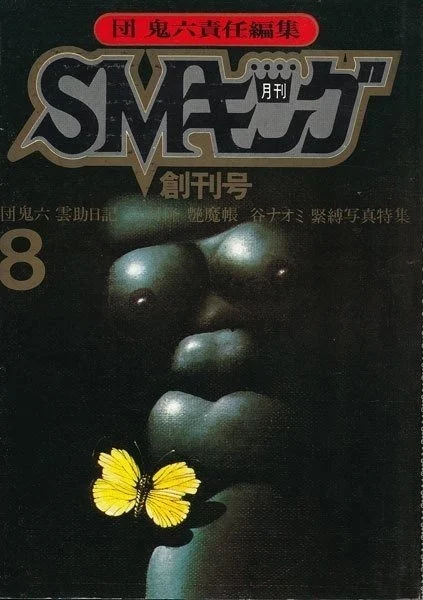
Sugiura began working on editing and photography. Since so-called “erotic magazines” typically have very few editors per title, he had to handle everything on his own. He must have gained a great deal of experience during this time. “SM King” ceased publication after only three years. This period marked the first golden age of SM magazines, and the abundance of competing titles was likely one of the reasons for its closure. While other editors moved to different companies to hone their editorial skills. Sugiura took a different path.
Sugiura: “I started finding photography interesting. So I went freelance and began taking photography seriously. I studied the styles and techniques of leading photographers in the magazines of that era entirely on my own.”
And that’s how the “Sugiura style,” characterized by a meticulous focus on light and shadow, came to be.
Sugiura: “I’m all about form. I want the irl to stand out more in relation to the background. I find it hard to shoot in pristine, pre-designed spaces like studios. That’s why I used to often shoot at run-down, traditional Japanese inns that looked like they were about to fall apart. The scent, the atmosphere, and sometimes even the presence of spirits (laughs) helped create my photos. But gradually, those kinds of places started disappearing… So now, out of necessity, I shoot in studio facilities, which makes me pay even more attention to props and backgrounds to build the atmosphere.”
A long time ago, there was a dilapidated wooden in in Ueno called “Atami Ryokan.” It must have been over 90 years old. It was run by a pair of charming elderly sisters (probably in their late 60s), but the first-floor bathhouse was already out of commission, and the second-floor hallway was slanted and creaked with every step. Before I knew it, this inn had turned into a “bondage photography studio.” It had traditional Japanese-style rooms: lintels, floor posts, and yellowed tatami mats. The sliding doors and glass were all just as they’d been in the old days. The photography crews saw this as a godsend. Word spread from one to the next like a game of telephone, and in the blink of an eye, it had become common knowledge throughout the industry. I, too, used to come here a few times a month. Since we’d tie ropes to the lintels and suspend people from them, rope marks were already etched into the wood. We’d also drip wax directly onto the floor, leaving faint traces behind. I wondered if regular guests ever came to this inn, but the owners told me it actually gets quite busy during exam season. Before it turned into this, it must have been a respectable inn in its own right. It seems it was even listed in guidebooks.
As an aside, I’ve heard that this Atami Ryokan is mentioned at the beginning of Ryu Murakami’s “Cock-a-Doodle-Do Blues” (1991).
A traditional Japanese-style room. Hot in summer, cold in winter. Of course, there’s no such thing as air conditioning. To create shadows in his photos, photographer Sugiura would shut the storm shutters completely, even in the middle of summer. The stifling heat and humidity left us drenched in sweat, teetering on the edge of heatstroke. Even under such conditions, everyone used this place as a shooting location. And I, too, loved it dearly. It had a unique atmosphere, as if something had taken hold of me and was pushing me forward. I truly believed that bondage photography just wouldn’t work anywhere else but here. This Atami Ryokan was demolished around 1987 or 1988, much to the regret of those in the industry. Since then, a place like that has never existed again.