Elsewhere I have written about the differences between aibunawa and semenawa, framed as two different contexts, pleasure and endurance.
Where Yukimura Haruki was the primary exponent of aibunawa, semenawa (or just seme more generally) has a much longer history that can be traced back to the eroticization of Edo-era torture ties among other things. It has a wide range of expression and different approaches to technique and results. Representative bakushi from the past include Itoh Seiu, Akechi Denki, and Nureki Chimuo and, in more contemporary times, Naka Akira, Akechi Kanna, Yagami Ren and others.
While there are a lot of different ways that aibunawa and seme can be expressed, one that I think deserves attention is the tightness of the rope. Both Yukimura sensei and Nureki sensei wrote about this topic and have very different points of view about what it means to tie “loose rope.”
More important, both saw the tightness of the rope as being directly related to the authenticity of erotic performance.
For Nureki, loose rope can compromise the authenticity of restraint. For Yukimura, loose rope can make an authentic erotic performance possible. That also strikes me as a core element in the distinction between aibunawa and semenawa as well.
Nureki Chimuo: Tight Rope and “Tying for Real”
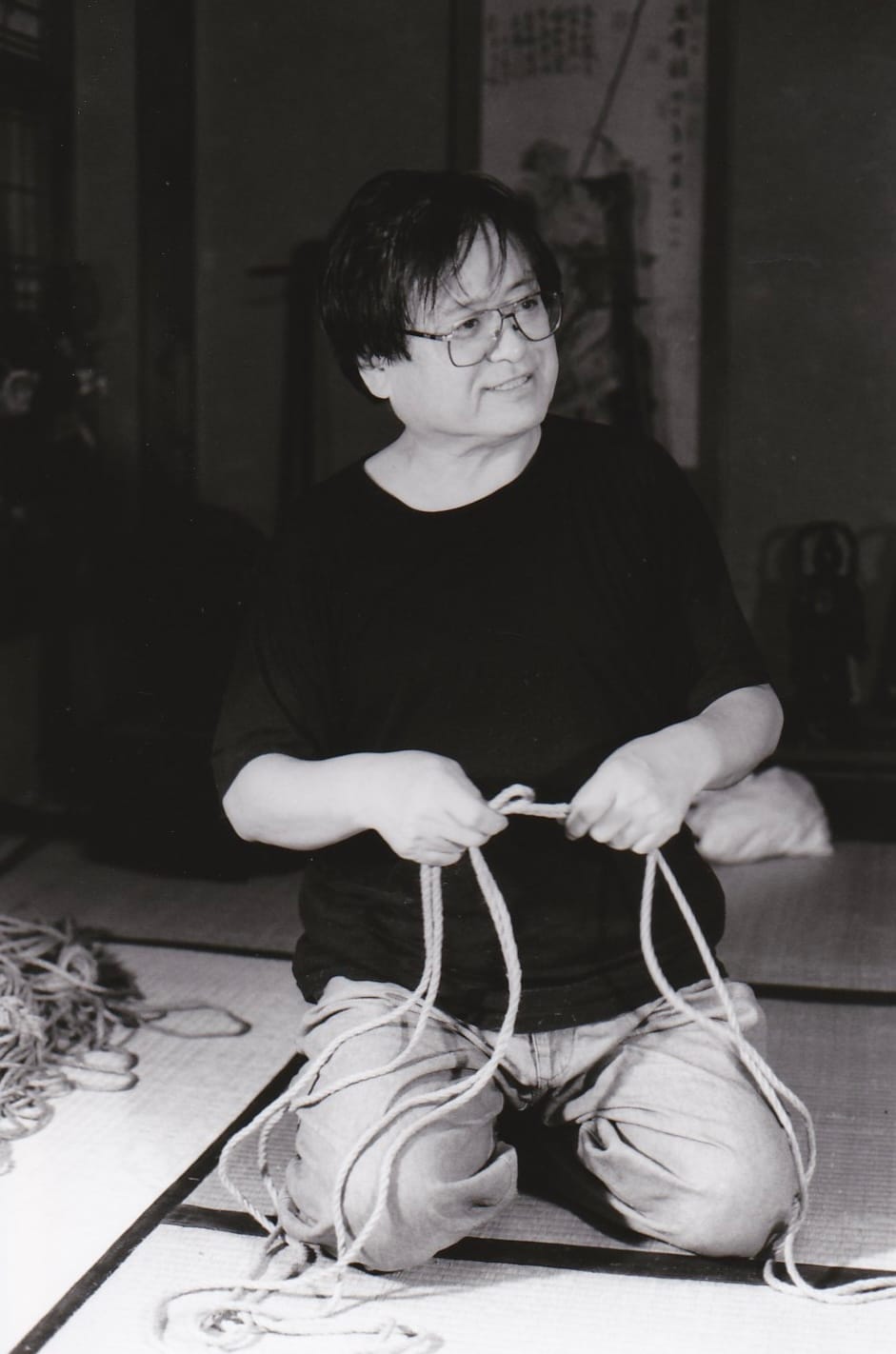
In one of his posts, “Farewell, Loose Bonds,” Nureki makes a distinction between kinbaku (緊縛) and what he calls kanbaku (緩縛). One translates to “tight binding” the other to “loose binding.”
His post reflects on his decades of commercial bondage work, including his Kinbiken productions, and the compromises imposed by photography and video. Although he defends the severity of his earlier work, he also questions whether much of what he had called kinbaku was actually a form of kanbaku.
In contrast, he sets a new goal for himself, “I want to try a binding so severe that within three minutes the model cries out, pleading with a tearful voice, “I can’t take this anymore, please untie me.””
This is not just about causing pain, it is about something deeper, reaching a level of authentic expression for the model. As he explains it:
The true beauty and eroticism of a bound woman’s masochism only reveals itself with this kind of rope. A masochistic woman who craves tight bondage will writhe and writhe in my ropes, moaning and crying, enduring while writhing, releasing an intense emotion I’ve never seen before. An unexpected pleasure born of pain.
This is what Nureki sees as an authentic space of semenawa. “It’s binding designed to be savored, to fully appreciate the expression and form of a woman writhing under the rope’s tension.”
This does not mean that Nureki rejected aesthetics or performance in favor of physical intensity alone. He explicitly insisted that even his most severe bondage must retain what he called the form of “beautiful bondage.” His concern was not that the ropes looked beautiful or that the model’s reactions were expressive. It was that the appearance of restraint could become disconnected from its physical reality. For Nureki, the aesthetic and erotic power of bondage depended, at least in part, on the intensity of the restraint beneath its beautiful appearance.
Nureki’s criticism is also strikingly autobiographical. He acknowledges that he spent decades developing ways of tying that would allow models to remain restrained during extended commercial productions. Indeed, he admits, “I have always considered my own ‘tight bondage’ to be ‘loose bondage.'” He describes a persistent sense of shame associated with that compromise. His criticism of kanbaku is therefore not simply a dismissal of other practitioners or a rejection of commercial bondage. It is also a reassessment of his own work and the distance between what he had produced and the erotic ideal he now hoped to realize.
While Nureki is somewhat disparaging of the idea of kanbaku, his critique is directed at himself and the industry that makes loose tying not only commonplace, but also necessary. He is writing in the context of considering reviving kinbiken in 2009, which he eventually did.
What is striking about Nureki’s argument is that looseness is not merely a technical compromise. It is an aesthetic and philosophical compromise as well. The restraint may look convincing, the model may perform beautifully, and the resulting images may be erotically compelling, but for Nureki something essential is missing.
Yukimura Haruki: Loose Rope and the Authenticity of Performance

Yukimura approached the question from almost the opposite direction. For him, looseness was not a deficiency or a concession to the demands of photography. It was a deliberate and essential element of his kinbaku. In The Affection of Kinbaku (Kinbaku no Jōai, 緊縛の情愛), he put it plainly:
“My rope is loose. It’s yurunawa (ゆる縄). But within that looseness, the woman performs.”
Where Nureki used kanbaku (緩縛) as a term of disparagement, Yukimura embraced yurunawa as the defining characteristic of his style. At the heart of aibunawa is communication and expression, and loose rope gives the person being tied room to communicate in ways that rope designed for restriction does not. That is not to say seme lacks communication, only that the possibilities differ. The two styles let the person tying and the person being tied say different things.
Yukimura explained this through a concept he called nawa no asobi (縄のあそび), “play in the rope”: “I call it ‘play in the rope.’ You know how a car’s steering wheel has some play in it? It’s the same thing. If you tie someone completely rigid, they can’t comfortably perform.”
A certain amount of play in a steering wheel allows movement before the steering mechanism fully engages. It is freedom within a system that still directs movement. Yukimura’s rope similarly established restraint without eliminating the space necessary for the person being tied to respond and express themselves.
This is closely tied to his understanding of shibai (芝居), which means theater, acting, or performance, as in a stage play. It can suggest pretending, but, in aibunawa, performance is not the opposite of authenticity. A person can consciously shape, dramatize, or amplify an experience without making it false. Yukimura’s model was not expected merely to produce involuntary reactions to what was done to her. She was given room to take part in creating the erotic encounter, and her movements and expressions could be deliberately theatrical while remaining grounded in real experience.
In his words: “The M wants to react. You might call it an innate theatrical instinct. The more variation and character she brings to it, the more interesting it becomes.”
“You have to give the M woman a stage on which she can be an M woman.”
Yukimura elaborated on this idea in his private lessons. He described the bakushi’s role as creating “a place for the masochist, a place where she can perform.” He explained that the person being tied brings their own imagination to the encounter, responding in ways that the bakushi cannot necessarily anticipate. He even described his role as helping them enjoy performing as a bound masochist. This is an important distinction. The performance is not simply something imposed upon the model, nor is it necessarily a simulation of an experience they are not having. It is something they participate in creating, drawing upon their own imagination, desires, and expressive abilities.
Yukimura also demonstrated how physical restraint and the experience of restraint could be deliberately separated. In his lessons, he sometimes instructed students to tighten the rope firmly and then loosen it, explaining, “Let her experience it first, then loosen it.” The model could experience the intensity of being tightly bound without necessarily remaining under that same physical pressure. Rather than compromising the erotic experience, loosening the rope could preserve its psychological significance while creating room for further expression.
This is particularly interesting in light of Nureki’s critique of loose binding. Where Nureki worried that reduced physical intensity could undermine authenticity, Yukimura treated the relationship between physical restraint and its psychological experience as something the bakushi could actively shape.
None of this means Yukimura’s ties were devoid of discomfort, or that he thought rope should always stay loose. He adjusted tension to the person:
“The strength of the binding and the degree of tightness. The right balance here is different for everyone. That’s why, when tying someone for the first time, I begin loosely… then gradually tighten while observing their reactions, interacting and negotiating through the exchange.”
This complicates a simple tight/loose binary. The degree of restraint was not fixed in advance but shifted through the exchange between the participants. His remark that “anyone can tie tightly, but tying loosely is difficult” points the same way.
Loose rope, for Yukimura, was not the absence of control but a different way of exercising it. It invited the model to help shape the emotional and erotic experience instead of relying on physical restriction to produce a reaction.
What Each Means by “Authentic”
This returns us to authenticity. For Nureki, it appears to depend upon the physical reality of restraint and the intensity of the reactions it produces, rather than simply their convincing appearance. He worries that rope might look restrictive without being so. For Yukimura, authenticity does not necessarily depend on severity. It emerges through the interaction between bakushi and model, including the model’s capacity to respond and perform within the space the rope allows.
There is something of a paradox here. Both men prized the model’s expressive reactions and saw them as central to the eroticism of kinbaku, yet they sought those reactions from different directions. Nureki looked for a physical intensity that would draw out what he regarded as an authentic response. Yukimura looked for conditions in which an authentic performance could emerge from the interplay of restraint and freedom. For one, looseness threatened to diminish the experience. For the other, it helped make the experience possible.
This may be one of the clearest philosophical differences between Yukimura’s aibunawa and Nureki’s understanding of semenawa. It is not simply pleasure versus endurance, or gentle versus severe restraint. It is a difference in how the bakushi understands the relationship between the rope and the person in it. In one approach, the intensity of restraint is central to the erotic experience. In the other, the space within that restraint allows the participants to create the experience together.
Interestingly, both men also found extraordinary erotic possibilities in relatively simple rope. Nureki wrote of the eroticism of a single rope, while Yukimura repeatedly emphasized that elaborate ties were unnecessary for the kind of interaction he sought. Their differences were not fundamentally about complexity or technical sophistication. They were concerned with what the rope was intended to accomplish.
Neither approach dismisses the model’s participation, but each gives it a different form. And neither physical intensity nor deliberate performance guarantees an authentic erotic experience. The reality of restraint and the sincerity of what the participants experience are related, but they are not necessarily the same thing.
The question is not simply how tightly the rope is tied, but what the rope is intended to make possible.