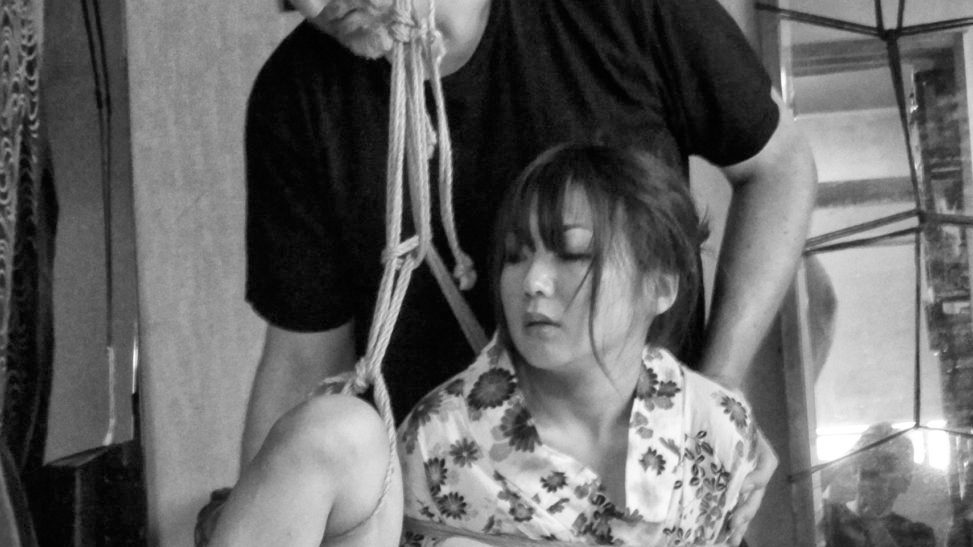
I’ve been teaching Japanese erotic rope bondage for well over a decade now, and one of the most common questions I get from people new to rope is, “How can I practice what I’ve learned if I don’t have a regular partner?”
My answer varies depending on what, exactly, they want to practice.
In my classes, I always make a distinction between tying rope and tying people, because those activities are, for me, completely different things. When we tie rope, the focus is on patterns and how the rope looks. When we tie people, the focus is on communication and how the rope feels.
There is something to the idea that good rope practice eventually relies on muscle memory, and that takes time and repetition. The tendency for people just starting out is to rush that process.
I don’t say that judgmentally. I felt that impulse when I started out as well.
When I first began tying, I asked a teacher in Japan how they practiced, and I remember the question being met with profound confusion. They didn’t know what it meant to “practice.” What they told me stayed with me. It short-circuited my impulse to separate tying rope from tying a person.
They explained that every time they tied, it was a scene or a session. There was nothing outside of that to practice. I didn’t really have the words to describe it at the time, and I remember being incredibly disappointed by the response.
At the time, I thought they were refusing to answer the practical question. Now I think they were challenging the premise behind it.
Like so many people starting in rope, I wanted to get good at it. And I wanted to get good fast.
What I hadn’t quite parsed yet was what I really wanted to get good at.
What they were telling me, I believe in retrospect, was this: Tie the person, not the rope.
I was lucky early on to have partners who helped me with that and let me “practice” on them without turning it into a clinical or disconnected activity. Those sessions were not always full scenes, but they were never merely drills either.
That meant that even while I was figuring out placement, tension, and patterns, I was also thinking about how I would use those things in a scene and how my partner was responding. I learned to pay attention to even the smallest changes in their reactions to my ties and techniques: what they sounded like, how they moved, when they shut their eyes, when their breathing changed.
The rope was part of that, of course, but it was a catalyst for response, not an end in itself.
I was practicing tying the person, not the rope.
So now, when new students ask whether I recommend getting a practice dummy or learning to tie inanimate objects, I always ask what they want to get out of the experience. Tying a chair is absolutely the best way to learn how to tie chairs. Likewise with mannequins, oversized teddy bears, and pillows.
That impulse makes perfect sense. Rope is awkward at first. It can make even capable adults feel clumsy, slow, and suddenly unsure of their own hands.
The problem is not that tying inanimate objects has no value. It can teach structure, sequence, and basic handling. The problem comes when that kind of practice becomes the model for tying people.
A chair does not breathe. A mannequin does not hesitate, soften, resist, or answer back. The rope may look beautiful. Your partner may feel pressure, friction, position, and restraint. But they may not feel you.
None of this means technique does not matter. It matters enormously. Bad rope, careless tension, and confused handling can make communication harder, not easier. There are things worth rehearsing: how to handle rope cleanly, how to maintain tension, how to move without panicking, and how to finish a structure safely.
But those things are not the whole art. They are grammar, not speech. They matter because they make communication possible.
A common assumption in rope is that technique comes first and communication comes later. First you get good at tying; then you add emotion, psychology, and connection.
I think that approach gets things backwards.
When you put communication first, your rope develops over time into something that increasingly communicates who you are. Your intentions, desires, and reactions become integrated into your technique rather than added to it afterward.
In my classes, I spend a lot of time focused on a single rope and the first few minutes of a rope scene. Intention, touch, movement, distance, and observation all matter. Maybe more than the rope.
One of the things that stayed with me from Yukimura Haruki’s teaching was how simple the beginning could be. In one of his first lessons, he had partners hold opposite ends of a length of rope without tying anything at all. The exercise was not about knots or patterns. It was about pulling, yielding, noticing, and responding.
One person would create a small movement through the rope, and the other would answer it. Even before bondage entered the picture, the rope was already doing what mattered most: carrying intention from one body to another.
If you can’t communicate with a single rope, why would adding a second, third, fourth, or fifth make anything better?
And once you can communicate with a single rope, things open up considerably. Your rope becomes a conversation. Your scene grows organically, and if you pay close enough attention, your partner will guide you toward exactly where you need to go.
This is the moment when you start tying the person and stop tying the rope.