Uramado
March 1962
← Back to magazine archive
Issue Details
- PDF pages
- 20
Summary
The March 1962 issue of Uramado is a compact photographic publication organized around four distinct black-and-white bondage portfolios. Its editorial identity is almost entirely visual: there are no substantial prose articles, fiction, correspondence columns, or conventional editorial sections. Instead, the issue develops through changes of model, setting, photographer, and photographic concept, using rope, furniture, clothing, bodily position, and facial expression to create miniature scenes of restraint and captivity.
Read full summary Close full summary
Loading PDF…
Highlights
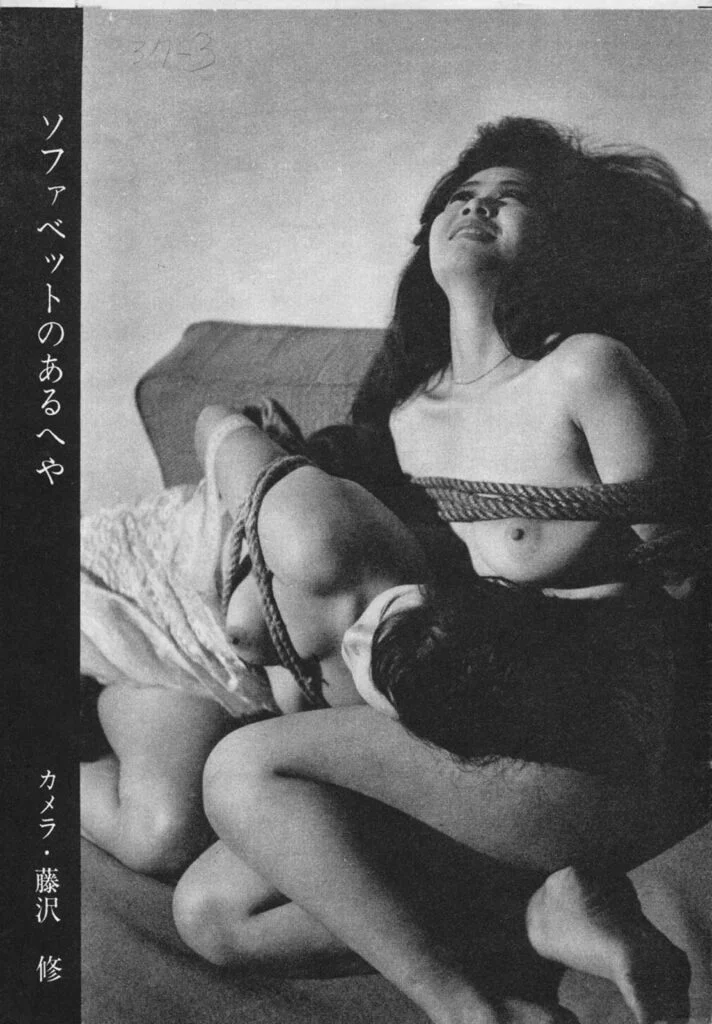
- Room with a Sofa Bed opens the issue with an extended two-model bondage sequence photographed by Fujisawa Osamu, using a sofa and domestic room as the principal setting. (PDF pp. 1–8).
- The opening sequence is notable for sustained interaction between two women rather than a solitary bound model, with compositions that combine restraint, bodily proximity, and alternating dominant and passive visual roles. (PDF pp. 1–4, 8).
- Several photographs isolate rope knots, wrists, and bindings at close range, emphasizing the construction and texture of the rope itself. (PDF pp. 5–7).
- White Background, photographed by Yoshida Hisashi, shifts to a deliberately sparse studio-like setting in which Takakura Mitsuko's body and bindings are isolated against an almost featureless pale field. (PDF pp. 9–13).
- The White Background sequence credits Takakura Mitsuko as model and Fujimi Kaoru as director, providing unusually explicit production attribution for the photographic staging. (PDF pp. 9, 12–13).
- Delicate Rope Marks returns to Fujisawa Osamu's photography and the upholstered interior, presenting Amagi Yuko in a short sequence emphasizing rope tension, restraint, and movement against the sofa. (PDF pp. 14–16).
- Silent Pose closes the issue with Yoshida Hisashi's tightly framed photographs of Takakura Mitsuko, combining upper-body rope bondage, hands secured behind the back, and a cloth gag. (PDF pp. 17–20).
- The final image makes the restraint spatially explicit by showing a rope extending outward from the model's bindings, turning the otherwise blank background into part of the implied captivity scenario. (PDF p. 20).