Kitan Club
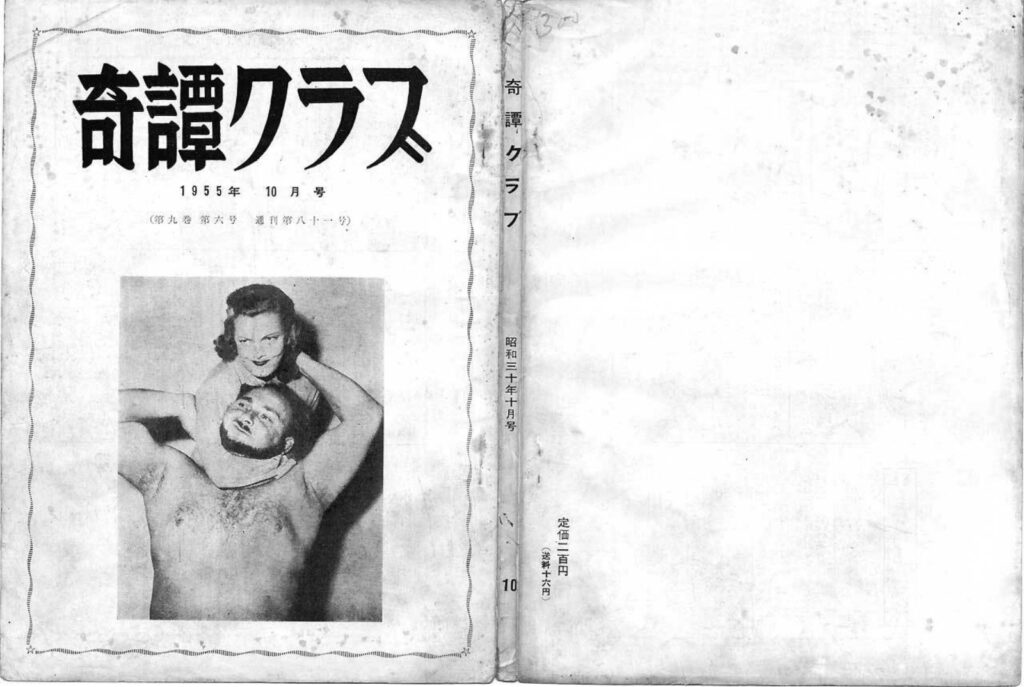
October 1955
← Back to magazine archive
Issue Details
- PDF pages
- 172
Summary
The October 1955 issue of Kitan Club is organized as a broad survey of bondage imagery, erotic fiction, confessional testimony, medical and sexological discussion, historical documentation, translated European material, reader correspondence, and publishing notices. Its editorial identity is established by the close proximity of staged photographs, illustrated fantasies, purported case histories, autobiographical writing, literary criticism, and articles presented as research. Rather than separating entertainment from inquiry, the issue repeatedly treats visual fantasy, historical anecdote, personal confession, and specialist discussion as complementary ways of documenting unconventional desire.
Read full summary Close full summary
Table of Contents 41 items
-
Beautiful Door
Summary
An erotic illustration depicts a woman posed in a doorway with her raised arms and body apparently secured by straps or restraints.
-
Two-Horse Carriage
Summary
An erotic illustration presents a commanding woman holding reins attached to two kneeling, collared men, emphasizing a spectacle of female control and male submission.
-
Woman in the Water
Summary
Two sensual illustrations portray topless women reclining and partially submerged in water amid floral motifs, patterned fabrics, and dreamlike aquatic surroundings.
-
Black News: Bondage
Summary
A photographic bondage feature presents women in black clothing restrained with bands and coverings, emphasizing tightly bound seated and reclining poses.
-
What Kind of Pose Will You Take?
Summary
A pose-focused photographic feature shows masked and restrained women adopting varied kneeling, crouching, and seated positions, with captions identifying the models.
-
Sideways Glance and Prone Pose
Summary
A photographic sequence contrasts a sideways glance with a prone pose, including outdoor and studio scenes of women bound with rope and cloth.
-
Bathed in the Morning Sun
Summary
A photographic scene shows a woman bound with rope while reclining outdoors in the morning sunlight.
-
Kimono
Summary
A photographic portrait presents a woman in kimono seated in a restrained pose, emphasizing traditional dress and rope bondage.
-
The Actress Bound on a Journey
Summary
This illustrated erotic narrative follows an actress traveling through rural Japan, performing and recounting staged bondage encounters involving rope restraint, theatrical performance, and relationships with spectators and companions.
-
Returning Spring Flower
Summary
A serialized historical erotic narrative set amid wartime mobilization, following soldiers and women through coercive encounters, captivity, and sexualized restraint.
-
Evil Habit, Part Two
Summary
A marital SM narrative in which a domineering wife subjects her husband to escalating humiliation, physical punishment, and coercive domestic discipline, illustrated through staged scenes.
-
How I Torture Him
Summary
An illustrated erotic account presenting a man’s methods of binding, controlling, and observing women, with detailed scenes of rope restraint, imposed poses, and voyeuristic display.
-
On Women's Underwear
Summary
An essay on women’s underwear examines the author’s fascination with garments such as corsets, girdles, stockings, and brassieres, combining personal fetish experience with observations on changing fashion, social attitudes, and erotic spectatorship.
-
Fallen Love
Summary
A serialized erotic narrative follows Yukari through coercive encounters involving domination, humiliation, punishment, bondage, and escalating sexual control by male characters, including scenes centered on an enema device.
-
Nipple Types and Classification
Summary
An illustrated pseudo-scientific feature classifies nipple shapes and types, drawing on purported research and newspaper coverage while presenting the female breast as an object of anatomical and erotic observation.
-
The Two-Section Enema
Summary
A clinical-style erotic episode follows a patient’s difficult visit to a hospital, where doctors and nurses administer a two-stage enema and discuss the procedure, bodily sensations, and its aftermath.
-
Complete Submission
Summary
A first-person literary narrative recalls a young woman’s encounter with an intimidating, physically powerful father figure, combining fascination and submission with violent horse-cart episodes, corporal discipline, and intimate domestic caregiving during illness.
-
A Sadist's Miscellaneous Thoughts
Summary
This reflective essay examines sadistic taste through the aesthetics of female bondage, considering restraint, bodily posture, clothing, exposure, and the difference between compelling visual tension and mere cruelty, alongside accompanying erotic illustrations.
-
Expecting the Next Bondage Again
Summary
Numa Shōzō responds to a woman critic’s condemnation of his masochistic writing, defending and debating its implications through arguments about gender, sexuality, psychology, and social theory. The piece functions as an extended polemic and correction of claims made in earlier reader correspondence.
-
Before the History of Female Labor
Summary
Nanahara Yōichirō presents a historical, partly autobiographical account of female textile workers, describing factory discipline, sexual exploitation, confinement, beatings, and other abuses suffered by young women in the prewar labor environment. Testimony and illustrative scenes are used to expose the violence behind the conventional history of women’s industrial labor.
-
The Female Belly-Cutting of Kurima Zubon
Summary
Kaji Sanshū combines sensational case histories of female factory workers subjected to binding, beating, and other punishments with an illustrated erotic narrative centered on a woman in riding breeches who cuts her abdomen. The feature links historical abuse reportage with violent, coercive fantasy and eroticized visual staging.
-
Women's Chastity Devices
Summary
A widow describes adopting a men's loincloth as a protective undergarment against sexual harassment, recounting how she wears and secures it and presenting practical details of its construction and use.
-
Juvenile Prison Experience: Gray
Summary
A first-person account of life in a juvenile prison describes regimented labor, exercise, surveillance, escape attempts, interrogation, and harsh physical discipline among incarcerated boys.
-
The Method of Male Self-Abuse
Summary
A personal and instructional account of male self-abuse describes erotic responses to loincloths and bodily exposure, along with rope bindings, inverted positioning, and other self-restraint techniques.
-
Collected Tales of Genital Mishaps
Summary
An editorial miscellany presents several sensational anecdotes involving genital injury, sexual mishaps, and related bodily embarrassment, framed as collected manuscript material.
-
Thirty Years of Pursuing Abnormality
Summary
Yamada Masami’s memoir reviews thirty years of pursuing “abnormality,” recalling fetishistic interests, especially women’s noses and faces, alongside observations on beauty, erotic psychology, marriage, illustrations, and the development of specialist erotic publishing.
-
Ten Months in Captivity
Summary
Haruta Ichirō recounts ten months of postwar imprisonment, describing prison hierarchy, labor assignments, discipline, meals, sanitation, inspections, fellow prisoners, and the routines and indignities of institutional confinement.
-
Foot Worship
Summary
A personal essay celebrates women’s feet and describes the author’s attempts to observe, photograph, and collect images of attractive feet in everyday and staged settings. The article is richly illustrated with foot photographs and discusses aesthetic appreciation, secrecy, and the social risks of the fetish.
-
A New Corset
Summary
An illustrated feature presents a new tightly laced corset, describing its construction, steel stays, restrictive fit, and effects on the wearer’s body and movement. It treats the garment both as clothing and as an erotic apparatus of bodily control.
-
From the Notebook of a Certain Masochist
Summary
This serialized masochist’s notebook presents a fictional domestic power relationship in which a submissive man is subjected to commands, humiliation, bodily discipline, servitude, and increasingly animalizing treatment by dominant women. The episodic narrative uses household scenes, coercive fantasy, and fetishized control to explore male submission and the loss of ordinary social identity.
-
My Theory of Debauchery
Summary
An essay develops a personal theory of enema eroticism, discussing the psychological formation of atypical desire, the conditions that encourage or inhibit it, and differences in how men and women may experience and express it.
-
A Masochist Seen in Film
Summary
A film-oriented essay examines masochistic and gendered erotic scenarios in several Japanese and foreign films, interpreting scenes of humiliation, domination, female power, and male vulnerability through cinematic spectatorship.
-
Acrobat Correspondence
Summary
A correspondence column combines editorial replies and reader reports about acrobatic performance, training, bodily flexibility, and eroticized acrobatic imagery, emphasizing readers’ participation in the magazine community.
-
Profile of a Nude Model
Summary
A profile of nude model Kaga Rieko, combining biographical commentary with staged studio and outdoor photographs depicting rope-bound, blindfolded, and otherwise restrained poses; a second model, Sugawa Reiko, is also presented in kinbaku scenes.
-
Notes on Meiji-Period Newspapers, Part Three
Summary
A documentary-style survey of Meiji-period newspaper reports concerning foreign settlements, prostitution, trafficking, domestic abuse, wife-selling, sexual exploitation, sensational crimes, and the era’s criminal punishments, with commentary on their historical significance.
-
Cruel Women
Summary
A translated and illustrated excerpt from Johannes R. Birlinger’s 1901 work on the cruel treatment of women, presenting historical and ethnographic examples of wife and servant abuse, flogging, confinement, forced labor, and patriarchal domination.
-
The Appearance of the Seven-Transformation Monk
Summary
A serialized Edo-period erotic fantasy follows the violent exploits of the transforming monk Shichibake Kozō and associated characters, featuring pursuit, abduction, deception, sexual coercion, and elaborate rope restraints and punishments. Illustrated scenes emphasize bound, gagged, suspended, and otherwise humiliated women within a sadistic adventure narrative.
-
Reader Correspondence
Summary
A substantial reader-mail section presents letters responding to the magazine’s fiction, illustrations, photographs, bondage and erotic features, while also recording requests, criticisms, personal disclosures, and suggestions for future issues and reader participation.
-
Latest Book Guide
Summary
A catalog-style guide advertises newly available erotic photograph and illustration booklets, especially works featuring female nudity, abdominal cutting imagery, bondage, restraint, punishment, and fetishized bodies, with titles, creators, formats, and prices.
-
Night Reflections
Summary
An editorial marking the magazine’s resumption discusses its interrupted publication, rising printing and distribution costs, circulation difficulties, and plans to sustain regular issues through reader support and improved editorial content.
-
Publication and Subscription Information
Summary
A publishing-information section lists the contents of earlier Kitan Club issues, invites readers to submit fiction, essays, reports, photographs, illustrations, and ideas, and provides subscription, back-issue, pricing, and publisher-distribution details.
Highlights
- The formal contents page lists the issue's pictorial features, fiction, prize-selected confessions, research essays, translation, recurring series, and reader departments. (PDF p. 2).
- The opening visual section combines chained-door imagery, female command, underwater captivity, gagging, mummy-like wrapping, outdoor restraint, and kimono bondage. (PDF pp. 5–12).
- The Actress Bound on a Journey is an illustrated period narrative combining travel, performance, abduction, and restraint. (PDF pp. 13–19).
- Returning Spring Flower develops a kimono-centered historical story of pursuit, capture, violence, and forced transport. (PDF pp. 20–28).
- Evil Habit, Part Two continues a prize-selected confession about compulsion, marital secrecy, humiliation, and erotic fixation. (PDF pp. 29–35).
- How I Blame Him presents female authority and male punishment through commentary, fantasy, and illustrated examples. (PDF pp. 36–43).
- The essay on women's underwear examines intimate garments through fetishism, fashion, bodily concealment, and cultural history. (PDF pp. 44–47).
- Fallen Love is a prize-selected melodrama involving jealousy, degradation, emotional dependency, and sexual domination. (PDF pp. 48–57).
- A specialist article classifies nipple forms and discusses their physiological and erotic significance. (PDF pp. 58–59).
- An enema narrative turns hospital treatment, bodily procedure, and embarrassment into a medicalized fetish account. (PDF pp. 60–61).
- Complete Submission is an extended prize-selected narrative of coercion, humiliation, dependency, and psychological surrender. (PDF pp. 62–67).
- A Sadist's Miscellaneous Thoughts presents a first-person reflection on domination, fantasy, and sadistic self-understanding. (PDF pp. 68–69).
- Expecting the Next Bondage Again considers anticipation, memory, and the repeated desire for restraint. (PDF pp. 70–73).
- Before the History of Female Labor examines women's work, exploitation, bodily discipline, and gendered dependency. (PDF pp. 74–81).
- The juvenile detention memoir describes confinement, institutional rules, punishment, violence, and survival. (PDF pp. 86–92).
- The Method of Male Self-Abuse discusses masturbation through behavioral, psychological, and bodily perspectives. (PDF pp. 93–94).
- Thirty Years of Pursuing Abnormality continues Yamada Masami's retrospective on female sexuality, visual representation, and sexual research. (PDF pp. 96–101).
- Ten Months in Captivity resumes its detailed account of imprisonment, labor, punishment, hierarchy, and institutional life. (PDF pp. 102–109).
- Foot Worship combines photographs, historical imagery, confession, and commentary on feet as fetish and devotional objects. (PDF pp. 110–114).
- From the Notebook of a Certain Masochist continues Numa Shōzō's blend of autobiography, history, and theoretical reflection. (PDF pp. 116–125).
- A Masochist Seen in Film examines the cinematic representation of submission, punishment, and erotic spectacle. (PDF pp. 128–129).
- The Profile of a Nude Model combines photographs, biography, working conditions, and discussion of posing. (PDF pp. 132–135).
- Notes on Meiji-Period Newspapers, Part Three gathers historical reports concerning crime, gender, sexuality, punishment, and unusual social practices. (PDF pp. 136–142).
- The translation of Das Grausame Weib surveys European historical and literary representations of cruel women. (PDF pp. 143–145).
- The Appearance of the Seven-Transformation Monk is a historical illustrated narrative involving disguise, pursuit, captivity, and punishment. (PDF pp. 146–156).
- The closing reader department contains letters, personal experiences, questions, contact requests, and editorial responses. (PDF pp. 158–167).
- Book lists, an editorial afterword, subscription information, and publication notices form the final back matter. (PDF pp. 168–172).
Contributors
Named contributors represented in this issue:
- Azuma Shin
- Editorial Department
- Enomoto Toshiko
- Fujiki Senji
- Hanamura Emiko
- Haruki Toshio
- Haruta Ichirō
- Johannes R. Birlinger
- Kaji Sanshū
- Kazuma Masao
- Kyūshū Kōjō
- Mikine Kōji
- Minakami Ryūtarō
- Miyako Mineko
- Muraoka Sukehiro
- Nanahara Yōichirō
- Numa Shōzō
- Okamura Fumio
- Sakata Shinji
- Sawai Kazuo
- Shirogane Kōji
- Takahara Masao
- Takarazuka Fumio
- Tanaka Aiko
- Tsuchiya Naniwa
- Tsuji Takashi
- Yamada Masami
- Yanagi Fusako
English Translations from This Issue
- Women’s Chastity Devices — Tanaka Aiko