Article Summary
A first-person contribution by Tanaka Aiko, presented as a thirty-two-year-old widow who works late hours at a ryōtei. After being accosted while walking home alone, she looks for a form of protection and, inspired by an earlier Kitan Club women’s-sumō illustration and instructions in the magazine’s “Sodomia Correspondence,” begins wearing her late husband’s rokushaku fundoshi. She then develops a modified etchū-style fundoshi that she considers more practical and resistant to assault. The piece is notable for combining everyday self-protection, cross-gender clothing practice, bodily pleasure in tight garments, and Kitan Club’s participatory reader culture, with the magazine itself directly shaping the writer’s experiment.
Translation
Women’s Chastity Devices
Tanaka Aiko
I am a thirty-two-year-old widow. To earn my living, I work every day at a ryōtei restaurant from around five in the afternoon and return home after midnight. Because I ordinarily wear kimono, I have never worn drawers. The road I take passes through a stretch where the rows of houses come to an end, and after midnight not another person is to be seen. It is truly a lonely road.
One evening, after seeing off the last drunken customer as usual, I was walking home alone along that deserted street when a young man who seemed to have followed me from the brightly lit area in front of the station suddenly quickened his pace and came up beside me. Saying, “Miss, why don’t we walk home together and be friendly?” he put his hand on my shoulder. Terrified, I shouted, “I’ll scream!” The man panicked and ran away. Even so, I hurried home with the feeling that he might come back at any moment. That night I realized very deeply how frightening it was to walk alone after dark. But because of my work I had no choice. I thought perhaps it would be better to wear drawers after all, but since I had never worn them before, I did not own any. I decided I would buy some the next day and went to bed.
The next day I meant to go buy a pair of drawers, but making a special trip seemed bothersome, and while I was lying around, the March issue of Kitan Club, which I read every month, was delivered from the neighborhood bookshop. I first looked through the frontispieces and photographs one after another, and the frontispiece showing women’s sumō caught my eye more than anything else.
I thought that even though I had no drawers, if I tied on a fundoshi as snugly as that, no man would be able to assault me. As I continued turning the pages, I came to page 32 and read the instructions for tying a fundoshi in the “Sodomia Correspondence” section.
My late husband had also been a regular wearer of a rokushaku fundoshi, so I took out one of his fundoshi that had been washed and tried tying it on myself just as a man would. Even ordinarily I like the sensation of my body being tightly bound. I do not feel comfortable unless even my obi and waist cords are tied firmly, so I tightened this fundoshi as snugly as I possibly could. It is embarrassing for me, as a woman, to tell the readers of Kitan Club that I wear a fundoshi in this way. Still, I thought that readers of Kitan Club would probably understand my desire to try something unusual like this, and so I had my experiment written up on this page.
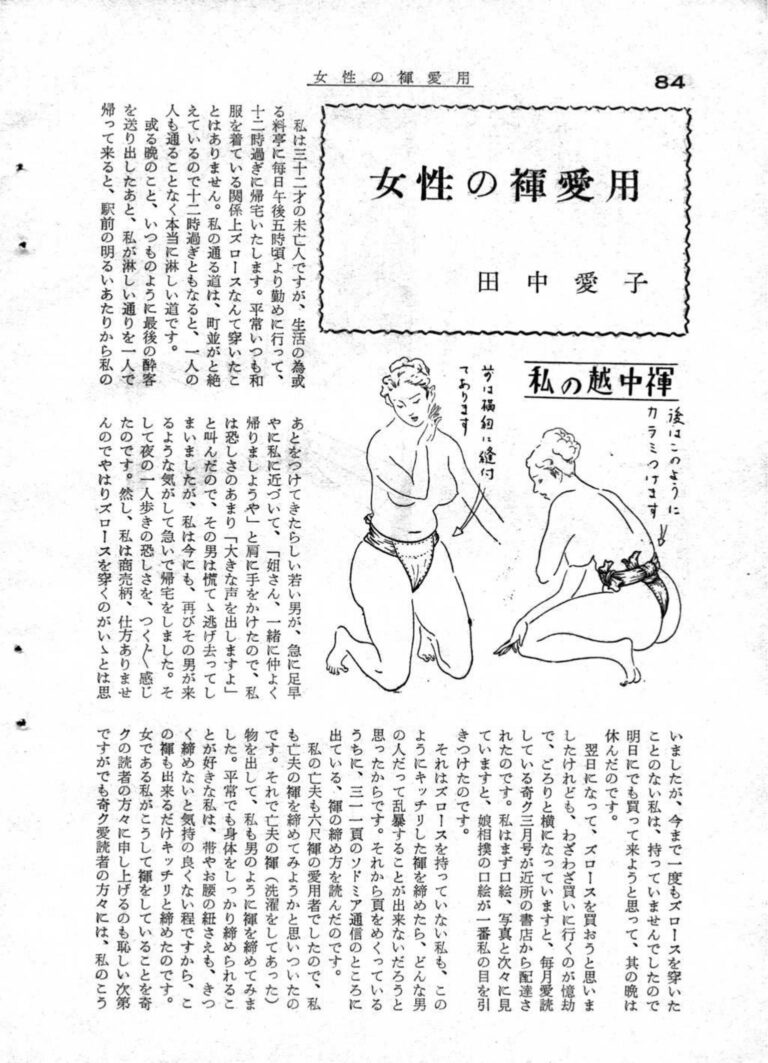
After that I kept wearing a fundoshi for about a week, thinking it was very useful for protecting a woman from an attacker when she had to walk alone at night. Using the toilet, however, was not as simple for me as it is for a man. After thinking over various possibilities, I now make mine in the style of an etchū fundoshi, sewing it to a thick cord. I place the sewn side at the front, tie the cord tightly around my waist, pass the long front end of the fundoshi between my legs and around to the back, pass it through the waist cord, pull it tight, and then wind it around the cord two or three times. The cloth between the legs is broad, rather like the fundoshi worn by a female stripper, so it does not dig into the crotch and feels very comfortable. To use the toilet I only need to loosen the back, so it is not inconvenient like a rokushaku fundoshi. I find it very good and wear it every day. Since it has no elastic, unlike drawers, I think even a violent attacker would be unable to do anything to me.
Please show not only men wearing fundoshi in the frontispieces and photographs of Kitan Club, but women wearing them too, and recommend a fundoshi like mine to everyone. (End)
[Illustration] My Etchū Fundoshi
At the back, wind it around like this.
[Uncertain caption] The side cord is sewn on.
Translation Notes
The printed Japanese title is 「女性の褌愛用」, literally something like “A Woman’s Fondness for Wearing a Fundoshi” or “Women’s Use of Fundoshi.” The supplied English catalog title “Women’s Chastity Devices” is therefore interpretive rather than literal. 褌 is translated as “fundoshi” throughout rather than as “chastity device,” because the garment described is a Japanese loincloth and the article explicitly discusses rokushaku and etchū styles. 六尺褌 (rokushaku fundoshi) is the long traditional style wrapped repeatedly around the waist and crotch; 越中褌 (etchū fundoshi) is a simpler style consisting of a cloth panel attached to a waist cord. ズロース refers to women’s drawers or bloomers, here contrasted with the fundoshi. 奇ク is an abbreviated in-house form of 奇譚クラブ, Kitan Club. ソドミア通信 is rendered “Sodomia Correspondence,” preserving the magazine’s section title. 娘相撲 refers to women’s sumō. 姐さん is an informal form of address meaning roughly “miss,” “ma’am,” or “older sister”; in this setting it likely addresses a woman working in food or entertainment service. 料亭 is retained conceptually as a traditional Japanese restaurant. The article’s claim that a tightly tied fundoshi would prevent sexual assault reflects the writer’s own belief and should not be read as a reliable safety claim. One short illustration label beside the front-view drawing is not fully secure in the scan.
Uncertain readings:
- PDF page 84 illustration: the label preceding 「横紐は縫付てあります」 is difficult to read. It appears to refer to the side cord of the illustrated etchū fundoshi, but the first word is not confidently legible.
- PDF page 84: the source prints 「町並がと絶えている」 or a very similar form; this appears to represent 「町並が途絶えている」, but the transcription preserves the visible wording rather than silently normalizing it.
- PDF page 85: 「丁度ストリッパーの女の褌の巾が広いので」 is legible in substance, but the exact nuance of the comparison to a stripper’s fundoshi/loincloth is period-specific and may warrant human review.
Missing or illegible text:
- PDF page 84 illustration: the first word of the caption ending 「横紐は縫付てあります」 cannot be read with full confidence from the scan.