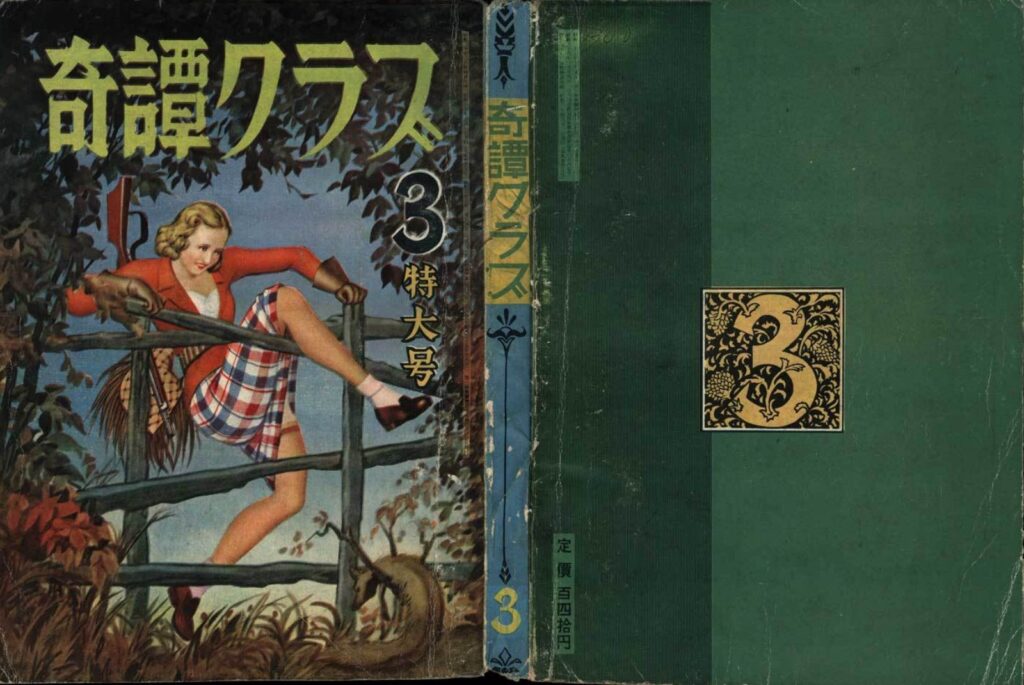
Kitan Club
March 1955
← Back to magazine archive
Issue Details
- Volume
- 9
- Issue
- 3
- PDF pages
- 309
Summary
Kitan Club’s March 1955 special expanded issue is a large, densely illustrated publication combining pictorial fetish culture, theoretical discussion of sexual abnormality, serialized and prize fiction, autobiographical confession, historical inquiry, and an extensive reader-community section. Its opening is strongly visual, with Japanese drawings and staged photographs of bondage, dominance, masochistic themes, wrestling, medicalized imagery, and imported erotic material. Work associated with Rudolf Hegemann and material from foreign magazines such as BIZARRE, Pigalle, and LAFF place Japanese postwar erotic culture in dialogue with international visual sources.
Read full summary Close full summary
Table of Contents 67 items
-
Kawayanagi Idea Ten Forms
Summary
A multi-panel illustrated feature presenting ten humorous and erotic tableaux, including couples engaged in restraint, punishment, submission, and fetishistic play.
-
Fire Wheel
Summary
Itō Seiu’s “Fire Wheel” is a dramatic erotic illustration of a bound figure secured to a large wheel-like apparatus, presenting a spectacular punishment and restraint tableau.
-
Foreign Literature Introduction: Bondage and Fetish Images
Summary
A visual introduction to foreign fetish literature presents images associated with the American magazine Bizarre, including glove-related restraint, veiling or facial covering, and staged scenes of women restraining men.
-
Girl Sumo
Summary
An illustrated feature presents a theatrical “girl sumo” spectacle in which women wrestle in staged bouts, with several scenes incorporating rope restraint, costumes, and sumo-related props and commentary.
-
Two Bondage Subjects
Summary
Two erotic illustrations depict women subjected to elaborate restraints: one is nearly suspended by a rope attached to her hair and made to move with it, while the other is forced into a protruding posture by a spiked collar, leather boots, and straps before corporal punishment.
-
Masochistic Photo
Summary
A two-page photographic feature depicts staged sadomasochistic scenes in which women dominate submissive men through foot-licking and whipping or striking with an implement, accompanied by brief provocative captions and model credits.
-
Bondage Photo Album
Summary
A photographic album presenting women posed in elaborate rope bondage, including seated and prone restraints, bound limbs, veiling, and other staged kinbaku compositions.
-
Outdoor Rope-Binding Sequence
Summary
A staged outdoor photographic sequence shows a woman progressively rope-bound beside a rustic bench and in surrounding vegetation, including restrained and incapacitated poses. The captions emphasize the binding process and the subject’s inability to move.
-
Two Dominant Women: Combination Photos
Summary
A staged photographic feature presents two women in a sadomasochistic role-play scenario, with one woman dominating, restraining, and punishing the other through bindings and forced positions. The images emphasize female authority, immobilization, and theatrical physical control.
-
A Cute Customer
Summary
Tsuzuki Mineko’s illustration “A Cute Customer” depicts a woman seated in a domestic swing or chair, partially wrapped and entangled in fabric and rope in a stylized bondage tableau.
-
The Fetishist's Dream
Summary
A full-page erotic illustration presents a reclining woman amid patterned garments and bedding, visualizing a fetishistic dream through an intimate, voyeuristic composition.
-
The Fetishist's Page
Summary
A photographic fetish feature depicts a male model subjected to nose clipping and pinching, rope binding that raises his lower body, and being knocked down.
-
Picture Album of Cruel Women: Hegemann Special
Summary
An illustrated album attributed to Rudolf Hegemann presents scenes of women exercising cruel or dominant power through restraint, punishment, humiliation, and captivity, with German captions identifying the imported artworks.
-
Female Slaves Being Sold
Summary
This illustrated feature depicts a white female slave displayed on an auction platform, chained and whipped for failing to comply while slave merchants inspect her body and watch her distress before choosing a purchaser.
-
Enema, Pinning Down, and Rooftop Photographs
Summary
A staged photographic feature depicts women administering an enema, pinning and pulling one another by the hair, and conducting a restrained nude scene on a rooftop using torn bedding and red vinyl cord.
-
Women's Wrestling
Summary
A photographic feature from the French magazine Pigalle presents staged scenes of women wrestling, including holds and bodily restraint.
-
The Husband's Place in the American Home
Summary
A humorous American magazine feature depicts a wife dominating and physically controlling her husband in a domestic setting, presenting the home as a site of female authority and male submission.
-
Morning Departure / After Dinner
Summary
Sugihara Kōji’s illustrated domestic vignettes show a wife restrained and humiliated during her husband’s morning departure and after-dinner routine, emphasizing coercive marital discipline and his sadistic gaze.
-
The Traitor
Summary
A crime-and-captivity story follows Hasegawa as he abducts and restrains Akiko, while Kyōji’s intervention exposes betrayal, jealousy, and violent erotic obsession.
-
On New Developments in Perversion Research
Summary
This theoretical essay surveys changing definitions of perversion, distinguishing normality, abnormality, sexual deviation, and same-sex desire while arguing that sexual behavior must be understood through psychology, biology, social norms, and historical context.
-
Drawing Bondage Pictures
Summary
An illustrated first-person account explains how the artist designs bondage pictures, discusses models, poses, ropes, clothing, composition, and expressive detail, and reflects on the relationship between erotic imagery and artistic practice.
-
Night Light Island, Part 6: An Unpleasant Promise
Summary
This installment of a serialized erotic thriller follows journalist Kenzaburō and others on Sado Island as an investigation into a suspicious marriage and a woman’s disappearance develops into coercion, captivity, escape attempts, and violent confrontation. Dramatic illustrations reinforce the story’s themes of pursuit, restraint, and sexualized danger.
-
The Ōtsu Incident and Its Aftermath, Part 2: Glory Being Eroded
Summary
This sensational historical narrative revisits the Ōtsu Incident and its aftermath, tracing the erosion of public glory and moral standing around the celebrated rescuers while connecting their later lives to obsession, sexual misconduct, criminality, and punishment.
-
Masochistic Boyhood, Part 8: Stirring Toward Masochism
Summary
In this autobiographical confession, the narrator recounts formative boyhood experiences of humiliation, beatings, forced exposure, restraint, and submission, explaining how repeated punishment and fear gradually became intertwined with masochistic pleasure.
-
On Sweat
Summary
A first-person erotic confession explores the writer’s intense fascination with his wife’s sweat, bodily scent, rubber garments, and sweat-producing situations within marriage and staged fantasy.
-
SAPPHO Japanese Edition: Cutting the Girl's Belly
Summary
An illustrated erotic narrative follows women drawn into rubber-clothing fetishism, bondage, exposure, and violent cutting fantasies, combining voyeuristic scenes with coercive and sadistic dramatization.
-
My Way of Tormenting: Punishment for Infidelity
Summary
Framed as a guide to the narrator’s methods, this episode depicts the elaborate punishment of an allegedly unfaithful woman through rope restraint, forced undressing, humiliation, and sustained sexualized torment.
-
The Shadow Flower
Summary
A serialized erotic crime narrative follows Tōe, a vulnerable woman drawn into coercion, captivity, medicalized abuse, and escalating sadistic domination by men and women. Its episodes combine psychological terror, bondage, humiliation, and illustrated sensational scenes.
-
Cruel Women
Summary
This translated historical account, based on a 1901 German source, surveys allegedly cruel women—especially female teachers and guardians—who inflict corporal punishment and derive authority from the suffering and humiliation of those under their control, accompanied by eroticized illustrations.
-
Diary of an Enema Maniac, Emiko: A Sad Monologue
Summary
Presented as Emiko’s first-person diary, this confessional account describes her compulsive fascination with enemas, bodily sensations, photographic display, and the psychological tension between shame, secrecy, pain, and sexual pleasure. The accompanying illustrations reinforce its staged and medicalized erotic presentation.
-
The Tide Wave
Summary
A period erotic narrative set around Itako follows encounters involving geisha, travel, seduction, and scenes of coercive restraint, accompanied by illustrations depicting bondage and domination.
-
My Image: The Operating Room, A Favorite Dream
Summary
A dreamlike first-person account set in a hospital imagines a wife undergoing increasingly elaborate surgical and nursing procedures, blending medical settings with eroticized control, vulnerability, and bodily transformation.
-
An Old Tale of O-Tengumatsu: The Origin of the Tengu Nose
Summary
This historical erotic tale explains the supposed origin of the tengu nose through an Edo-period story of sexual conflict, capture, restraint, humiliation, and violent punishment between a woman and a man.
-
The Blood-Stained Hair Rope, Part 3
Summary
A richly illustrated erotic feature exploring the fetishization of women’s hair through historical anecdotes, hair-rope bondage, violence, and staged scenes of restraint involving blood and humiliation.
-
Ten Months in Confinement
Summary
A first-person prison memoir recounting ten months of confinement, including cell life, forced labor, surveillance, discipline, prohibited smoking, fellow prisoners, and the routines of penal administration.
-
Confession: Cutting One's Own Belly
Summary
A disturbing first-person confession describing an attempted act of self-disembowelment, its preparation and execution, the sensations of pain and blood loss, and the subsequent medical aftermath.
-
My Experience
Summary
A first-person erotic confession by Nagase Akiko recounts the calculated domination, stripping, humiliation, and corporal punishment of a female companion in an escalating staged encounter.
-
Explanation of the Illustration Fire Wheel
Summary
Itō Seiu explains the historical spectacle “Fire Wheel,” describing its festival setting, pyrotechnic apparatus, fire effects, and dramatic figures as an example of an old Japanese sideshow.
-
Memoir: The Young Lady Who Was Catheterized
Summary
Tamura Jin’ichi presents a medicalized erotic memoir centered on a young woman undergoing catheterization, combining voyeuristic observation with detailed fascination with clinical examination and bodily control.
-
Local Report: Underwear Thief Captured
Summary
A sensational local crime report describes the arrest of a man who specialized in stealing women’s underwear, recounting his methods, disguises, victims, and police investigation.
-
Open Letter to the Editors
Summary
Sugawara Haruo’s open letter urges the editors to improve the magazine’s editorial policy, distribution, reader services, contributor relations, and regional organization while preserving confidentiality and strengthening participatory publishing.
-
On Hagi Chieko: Centering on the Frontispiece Photographs
Summary
Narumi Fumio evaluates Hagi Chieko’s frontispiece photographs and related bondage images, discussing their composition, realism, restraint arrangements, models, and the changing aesthetic of staged erotic photography.
-
Letter to the Editor: From a Reader
Summary
A reader writes to the editor about his intense emotional and sexual attraction to men, the shame and isolation it causes, and his desire for thoughtful guidance from the magazine.
-
One Night in Tokyo
Summary
This erotic fiction follows United Nations soldiers on leave in Tokyo as a night of bars, solicitation, and hotel-room encounters culminates in the discovery and coercive restraint of a young woman.
-
Venus's Heavy Stone
Summary
This serialized erotic SM fiction follows office manager Yamaguchi as an initially domineering relationship with employee Miyako is reversed through escalating coercion, bondage, humiliation, foot-focused fetishism, and female control, accompanied by erotic illustrations.
-
Experience in a Dormitory
Summary
A first-person erotic account of a young woman’s hospitalization for severe intestinal illness, focusing on invasive enemas, rectal treatments, examinations, undressing, restraint, and her conflicted humiliation and submission to the nurses and doctors.
-
Phallic Worship: A Confession from My Boyhood
Summary
A confessional autobiographical narrative tracing Mori Taichi’s boyhood fascination with medical examinations and male anatomy into an adult fixation on phallic imagery, medical devices, and penis enlargement.
-
From a Masochist's Notebook, No. 85: Confession of a Young Masochist
Summary
Numa Shōzō presents a purported young masochist’s confession alongside commentary on obscure erotic writings, examining masochistic desire, fetishistic fixation, humiliating sexual scenarios, and the evidentiary or literary value of such materials. The piece also considers sexual psychology and the preservation of specialist erotic publications.
-
Bondage Without Rope
Summary
This serialized erotic fiction follows Shizuko as she enters a household and exercises increasingly forceful psychological and physical control over its inhabitants through domestic authority, improvised restraints, humiliation, and sexual coercion. The narrative emphasizes female domination, bondage without conventional rope, and shifting power between women and men.
-
Record of My Half-Life
Summary
An autobiographical confession recounting the author’s sexual and aesthetic development through encounters with women, voyeuristic situations, erotic ukiyo-e and shunga, obi imagery, and fetishistic recollections from youth into adulthood.
-
Oda Nobunaga, Hero of Perversion
Summary
A historical-psychological essay interprets Oda Nobunaga’s legendary cruelty, military ambition, gender relations, erotic interests, and death through the lens of sexual abnormality and the violent culture of the Sengoku period.
-
Thirty Years of Pursuing the Abnormal
Summary
A thirty-year memoir of pursuing erotic and “abnormal” interests, centered especially on the author’s fascination with women’s noses, facial coverings, masks, body-part imagery, and their representation in photographs, films, theater, and popular culture.
-
The True Face of Bondage Models, Part 1
Summary
A behind-the-scenes profile of bondage models and staged photography sessions, describing the models’ personalities, working relationships, preparation, and experiences with rope restraint. The article is illustrated with photographs documenting several bondage poses and sessions.
-
Letter to M, First Letter
Summary
A personal letter from Shizuko Futamata to “M” reflecting on their correspondence, changing intimacy, literary sensibilities, and the relationship between private experience, sexual identity, and writing.
-
Recollections of Punishment Pictures
Summary
An essay recalling erotic and punishment illustrations, comparing scenes of women being restrained, captured, or displayed and discussing their composition, historical atmosphere, realism, and erotic impact.
-
Commentary on the Picture Album Cruel Women
Summary
A critical commentary on the picture album “Cruel Women” examines staged erotic scenes of women dominating, restraining, humiliating, and punishing men, while discussing the images’ composition, symbolism, and psychological effects.
-
Film and Magazine Correspondence
Summary
A film-and-magazine correspondence column surveys recent and forthcoming films, especially screen depictions of women being bound, captured, threatened, or subjected to violent spectacle, alongside related erotic-magazine imagery and production news.
-
Readers' Correspondence
Summary
A readers’ letters section presents personal bondage and fetish experiences, reactions to photographs and articles, requests for future coverage, and exchanges that sustain participation in the magazine’s specialist community.
-
Masochism Correspondence
Summary
A reader-correspondence column collecting masochistic fantasies and experiences, including submissive relations with dominant women, gender-role reversal, and related bodily or sexual fetishes.
-
Sadism Correspondence
Summary
A correspondence column on sadistic fantasies and bondage, including readers’ proposed scenarios, posed photographic compositions, and editorial discussion of restraint techniques and erotic presentation.
-
Seppuku Correspondence
Summary
Readers and editors discuss eroticized seppuku imagery and narratives, focusing on staged belly-cutting scenes, visual depictions, and requests or submissions involving photographs and drawings.
-
Agency Department Monthly Report
Summary
A monthly agency report advertises and describes available erotic photo sets and related materials, including rope bondage, enema scenes, forced restraint, and staged fetish tableaux.
-
Sodomy Correspondence
Summary
A reader-correspondence column discusses male same-sex interests, fundoshi and abdominal wrapping, personal sexual preferences, and requests for suitable photographs and editorial coverage.
-
Enema Correspondence
Summary
An enema-focused correspondence section presents reader requests, photo submissions, and editorial commentary on the staging and visual presentation of enema scenes and related medicalized equipment.
-
Next Issue Preview
Summary
A preview of the forthcoming April special issue lists planned fiction, memoirs, essays, visual material, contest entries, and other features, presenting the magazine’s upcoming editorial program.
-
Bondage Film Preview and Publication Notices
Summary
This notice previews planned bondage-film material, discusses reader interest and participation in a proposed actress-bondage production, and provides related film and publication information.
-
Calls for Manuscripts and Publication Information
Summary
The editorial department solicits submissions in multiple categories—including fiction, unusual-experience accounts, essays, letters, illustrations, personal statements, and local reports—and provides submission, reader-communication, and publication information.
Highlights
- The opening pictorial section combines Japanese drawings, staged photography, bondage imagery, dominance themes, wrestling, medicalized fetish material, and reproductions from foreign erotic magazines. (PDF pp. 5–33).
- Naruse Ryō's On New Developments in Perversion Research provides a substantial theoretical discussion of fetishism, inversion, same-sex desire, psychology, and the distinction between normal and abnormal sexuality. (PDF pp. 39–45).
- Naruyama Nōhei's Drawing Bondage Pictures examines the process of creating bondage art and connects artistic practice with erotic response and the representation of restraint. (PDF pp. 46–50).
- An Old Tale of O-Tengumatsu: The Origin of the Tengu Nose combines Edo-period gambling culture with bondage, punishment, humiliation, tattoo imagery, and bawdy historical fantasy. (PDF pp. 131–140).
- Itō Seiu's The Blood-Stained Hair Rope, Part 3 continues a historically oriented series connecting punishment imagery, recollection, and Seiu's distinctive visual and narrative vocabulary. (PDF pp. 141–146).
- Numa Shōzō's From a Masochist's Notebook, No. 85: Confession of a Young Masochist is one of the issue's longest first-person explorations of masochistic identity and desire. (PDF pp. 227–240).
- Tsujimura Takashi's The True Face of Bondage Models, Part 1 shifts attention from fantasy to the people and circumstances involved in producing bondage photography. (PDF pp. 273–280).
- The closing correspondence pages divide the readership into general correspondence and specialized interest sections, documenting the magazine's role in organizing a network of readers with distinct erotic and research interests. (PDF pp. 293–306).
Contributors
Named contributors represented in this issue:
- Azuma Shin
- Futamata Shizuko
- Hanamura Emiko
- Haruta Ichirō
- Itō Seiu
- Kasagi Toshirō
- Kataya Kaoru
- Kawai Itsuko
- Kitajima Kagetsu
- Masago Jūshirō
- Midori Takehiko
- Midorikawa Junko
- Mine Kōji
- Mizushima Mamoru
- Mori Taichi
- Morimoto Aizō
- Nagase Akiko
- Narumi Fumio
- Naruse Ryō
- Naruyama Nōhei
- Numa Shōzō
- Odawara Wataru
- R.G.S.
- Shima Takashi
- Shiraishi Minoru
- Shirogane Kōji
- Sudō Ritsuo
- Sugawara Haruo
- Sugihara Kōji
- Takarazuka Fumio
- Taketani Jūzō
- Tamura Jin'ichi
- Tsujimura Takashi
- Tsuzuki Mineko
- Yamada Masami
- Yoda Seiji
English Translations from This Issue
- An Old Tale of O-Tengumatsu: The Origin of the Tengu Nose — Midori Takehiko