Yomikiri Romance
January 1953
← Back to magazine archive
Issue Details
- PDF pages
- 66
Summary
This January 1953 special extra edition of Yomikiri Romance is a single-purpose photographic publication devoted almost entirely to staged images of women in bondage. Issued under the title Etsugyaku Kōkotsu-zu and supervised by Itō Seiu, it differs from a conventional magazine composed of essays, fiction, columns, and advertisements. After the cover, publication information, and title page, the issue unfolds as an extended visual portfolio in which rope, kimono, domestic interiors, outdoor locations, ritual objects, and specially constructed restraints are used to create a sequence of captivity and punishment tableaux.
Read full summary Close full summary
Loading PDF…
Visual Catalog 11 sequences
-
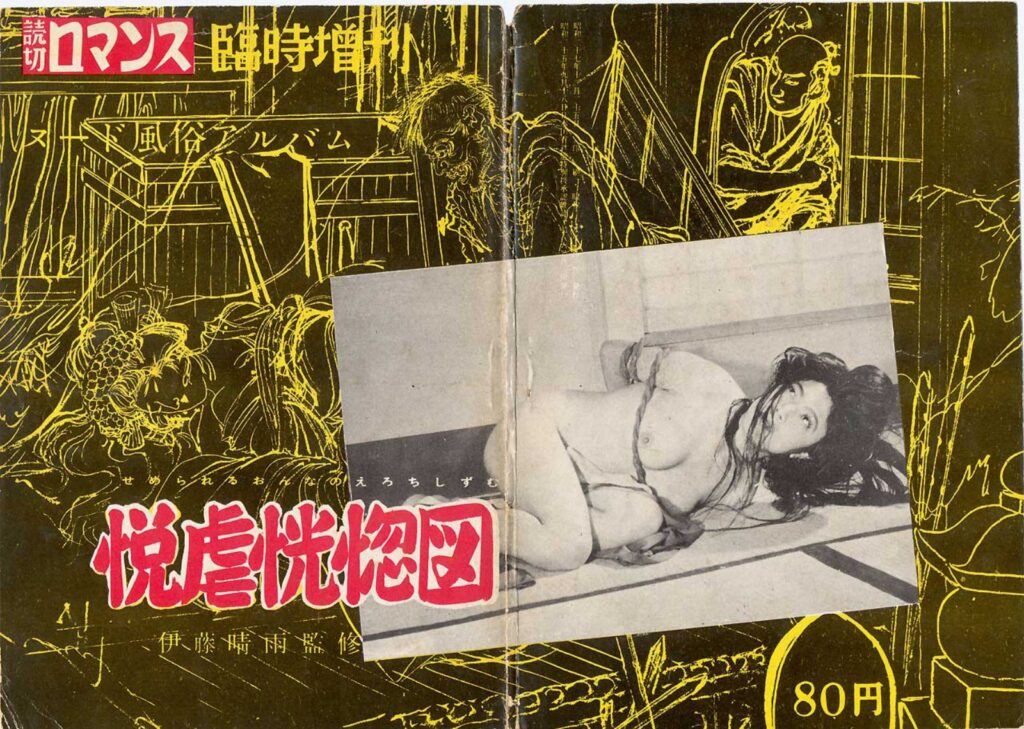
Front and inside-cover publication matter Cover Mechanical Front cover with illustrated background and photographic inset, followed by an inside-cover spread with two sepia-toned studio photographs and publication text.
-
悦虐悦惚圖 Archival title: Indoor tatami-and-rope photographic sequence Photographic Portfolio Fifteen consecutive monochrome photographs of one adult woman in a Japanese-style interior, moving among tatami, shoji, bedding, robe studies, torso and arm rope, a cloth gag, and a large rigid board or pole.
-
Outdoor stone-and-tree restraint pair Photographic Portfolio Two consecutive outdoor photographs of the same adult woman among trees, stone features, and upright markers, with rope visible across body and limbs.
-
Indoor portrait, mirror, and rope study Photographic Portfolio Twelve consecutive sepia or green-tinted photographs of one adult woman in a Japanese-style interior, alternating robe and body studies with rope restraint, shoji, bedding, and mirror compositions.
-
Outdoor wooded restraint sequence Photographic Portfolio Six consecutive green-tinted outdoor photographs of one adult woman among trees, foliage, stones, and marker-like structures, with rope around torso or limbs.
-
Dark-background body and rope study Photographic Portfolio Four consecutive green-tinted photographs against a dark background, beginning with a seated portrait and cropped leg studies and ending with thick torso-and-arm rope.
-
Wooden press-like apparatus pair Photographic Portfolio Two consecutive photographs of an adult woman folded or compressed across a heavy wooden block or press-like apparatus while rope secures torso and arms.
-
Floor-level wrist-restraint pair Photographic Portfolio Two adjacent photographs centered on extended or overhead-bound wrists and arms against a wooden floor.
-
Steep wooden-beam restraint sequence Photographic Portfolio Three consecutive photographs centered on a steep wooden beam or ladder-like structure, with an adult woman bound around torso, arms, or lower body.
-
Closing rope-and-apparatus photographic series Photographic Portfolio Ten consecutive photographs alternating Japanese-style interiors and an outdoor tree-and-stone setting, unified by the same adult woman, patterned robe, very thick striped rope, recurring wooden boards or poles, a low railing, and a recurring large rounded prop.
-
Closing indoor portrait sequence Photographic Portfolio Three consecutive monochrome photographs of one adult woman in a Japanese-style interior with patterned cloth, moving from kneeling and seated portraits to a final composition beside a large rounded object.
Highlights
- The cover combines a line-drawn punishment scene with a pasted bondage photograph and identifies the publication as a Yomikiri Romance special extra supervised by Itō Seiu. (PDF p. 1).
- The inside cover presents nude studies together with the publication date, price, publisher, editor, printer, and other production information. (PDF p. 2).
- The photographic title page introduces the issue as Etsugyaku Kōkotsu-zu and shows a woman bent forward with her arms tied behind her. (PDF p. 3).
- The first indoor portfolio follows a kimono-clad woman through gagging, torso bondage, kneeling restraint, partial undressing, and the use of wooden slats. (PDF pp. 3–17).
- An early outdoor scene places the restrained subject beside a carved wooden marker, introducing the issue's cemetery and garden imagery. (PDF pp. 18–19).
- A sepia-toned sequence alternates interior bondage, devotional furnishings, exposed-kimono poses, and additional outdoor restraint. (PDF pp. 19–29).
- A bedroom and mirror sequence contrasts unbound nude posing with renewed rope restraint and private domestic display. (PDF pp. 30–35).
- The cemetery and woodland portfolio shows women lying among grave markers, bound to trees, concealed in foliage, and restrained against rough outdoor structures. (PDF pp. 36–41).
- A green-tinted studio sequence uses close cropping, floor-level restraint, and isolated views of legs, wrists, and rope. (PDF pp. 42–45).
- A woman is compressed within a heavy wooden apparatus, producing the issue's most mechanically elaborate restraint tableau. (PDF pp. 46–47).
- Later photographs introduce stretched limb positions, bindings to architectural supports, and tightly framed studies of bodily tension. (PDF pp. 48–53).
- A recurring oversized theatrical mask appears beside bound women in both interior and outdoor scenes, adding a grotesque ritual quality. (PDF pp. 54, 60, 66).
- The late portfolio combines tree bondage, wooden boards, kneeling restraint, standing immobilization, and return visits to domestic interiors. (PDF pp. 55–63).
- The closing photographs show women partially released or adjusting their robes, while the final mask-centered image preserves the issue's atmosphere of staged punishment. (PDF pp. 64–66).