Harukawa Namio is now so closely associated with a mature visual language of female dominance, exaggerated bodies, and male submission that it can be easy to forget how early that vocabulary began to take shape. The five images gathered here, drawn from Kitan Club between 1962 and 1966, offer a glimpse of Harukawa before that style had fully crystallized. Seen together, they are especially revealing: recurring themes of dominant women, humiliation, subordination, and theatrical imbalance are already present, but the compositions still feel exploratory, sometimes more indebted to the broader visual culture of postwar Japanese SM magazines than to the unmistakable Harukawa idiom that would emerge later. Rather than presenting these works as his “first” images, this selection offers five early examples from the archive that help trace the formation of one of the most distinctive visual imaginations in Japanese erotic art.
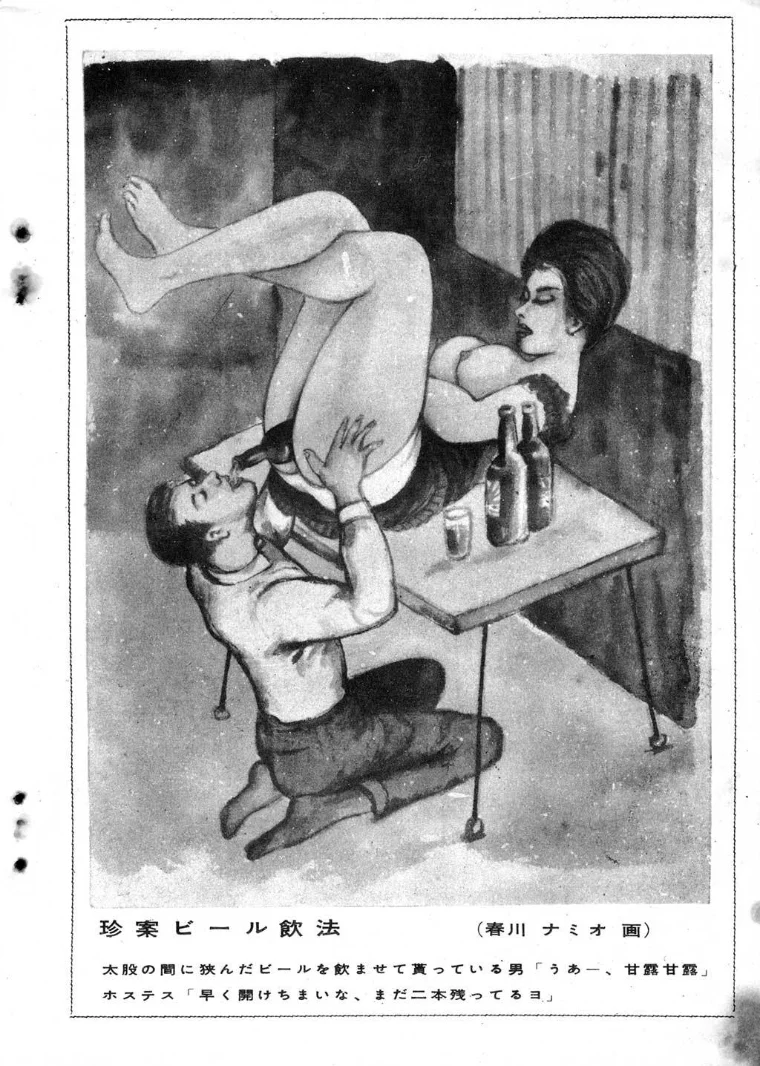
1An Ingenious Way to Drink Beer
Kitan Club, February 1962
A man is being allowed to drink beer held between her thighs: “Aah, nectar, nectar!”
Hostess: “Hurry up and open it. There are still two bottles left!”
In this image much of Harukawa’s later visual language is already present in compressed form. The woman dominates the composition physically, occupying the table and controlling the scene, while the man is pushed downward into a kneeling, servicing position beneath her. The humor is broad and almost cartoonish, but the underlying structure is serious: scale, posture, and spatial hierarchy all reinforce female authority and male submission. At the same time, the drawing still feels looser and less monumental than Harukawa’s mature work. The female figure is powerful but not yet transformed into the exaggerated, overwhelming presence that would later become one of his signatures. Seen from the vantage point of his later career, An Ingenious Way to Drink Beer is valuable precisely because it shows the basic grammar already in place: erotic humiliation, comic inversion, bodily control, and a fascination with the dominant woman as the visual and psychological center of the scene.
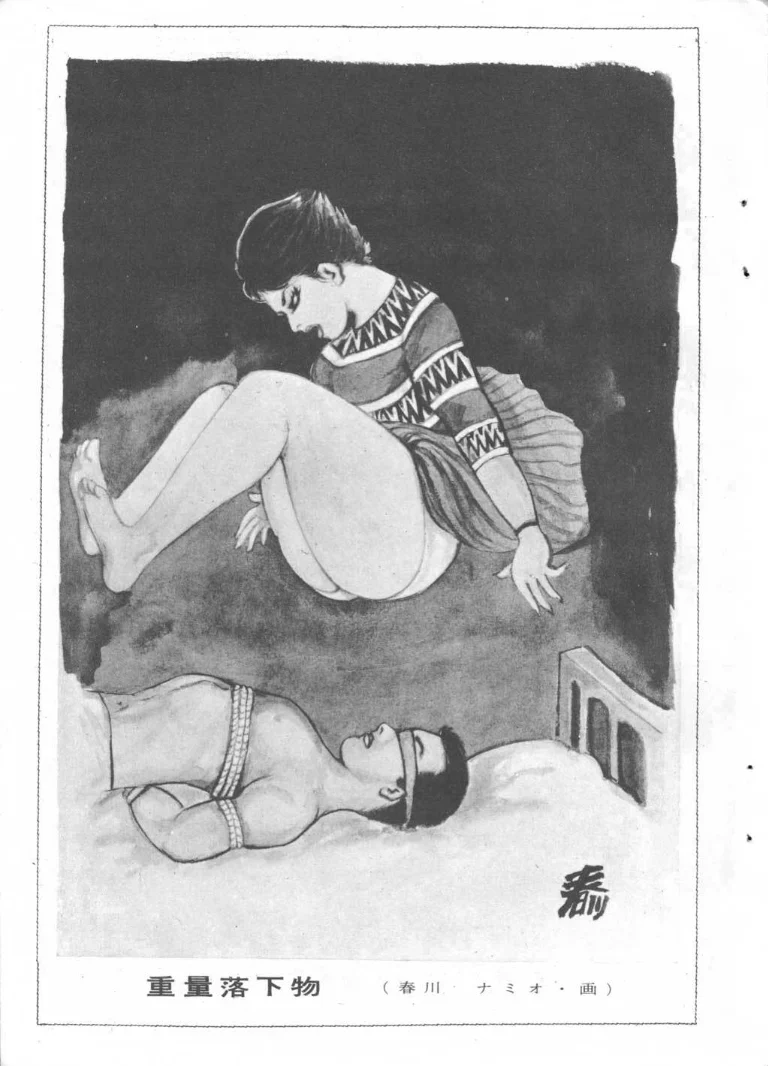
2Under a Falling Weight
Kitan Club, April 1962
Under a Falling Weight (重量落下物), illustration by Harukawa Namio.
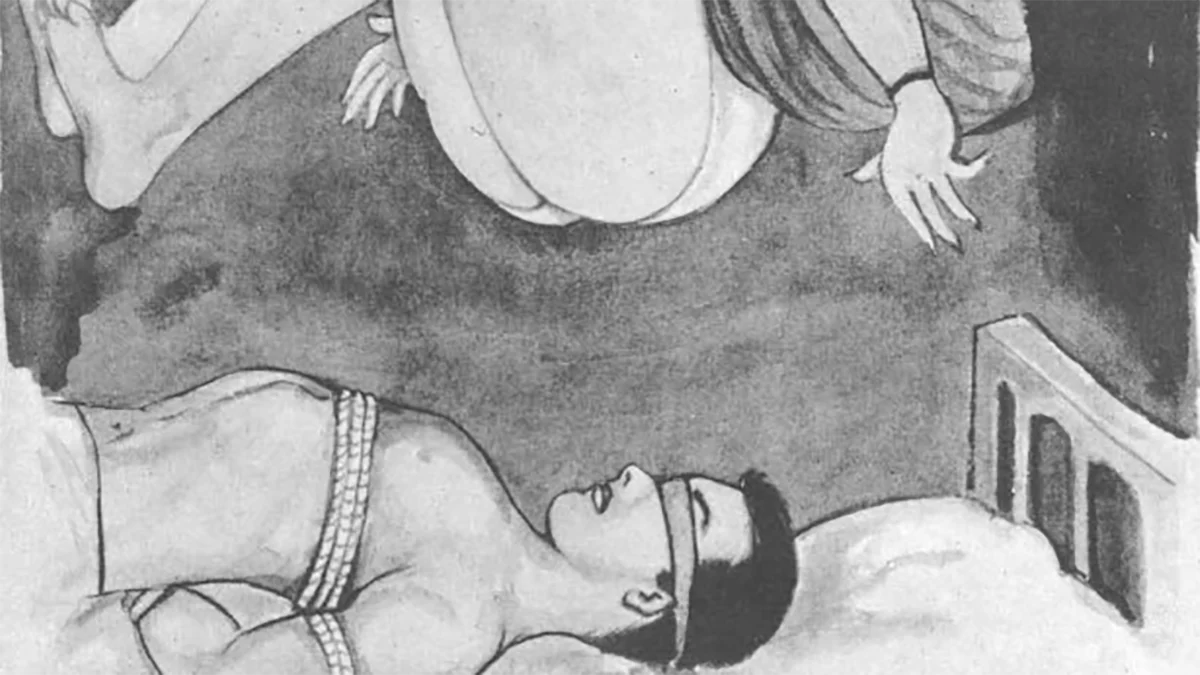
This drawing is especially revealing because Harukawa turns female dominance into a visual joke about weight, anticipation, and helplessness. The bound and blindfolded man lies almost completely immobilized at the bottom of the composition, while the woman appears suspended directly above him, her body poised to become the “falling weight” named in the title. Rather than depicting domination through overt action, Harukawa builds the scene around expectation. The man cannot see what is coming and has no ability to prevent it, while the woman’s calm posture gives the situation an almost playful inevitability.
The composition also anticipates an important feature of Harukawa’s mature work: the dominant woman’s body itself becomes the principal instrument of control. Her thighs and hips occupy the visual center, while the male figure is pushed toward the lower edge and reduced to a passive surface beneath her. The proportions remain comparatively restrained, and the scene retains the light absurdity characteristic of these very early drawings, but the underlying fantasy is already distinctly Harukawa. Female bodily presence is transformed into power, male immobility into submission, and physical hierarchy into the organizing principle of the entire image.
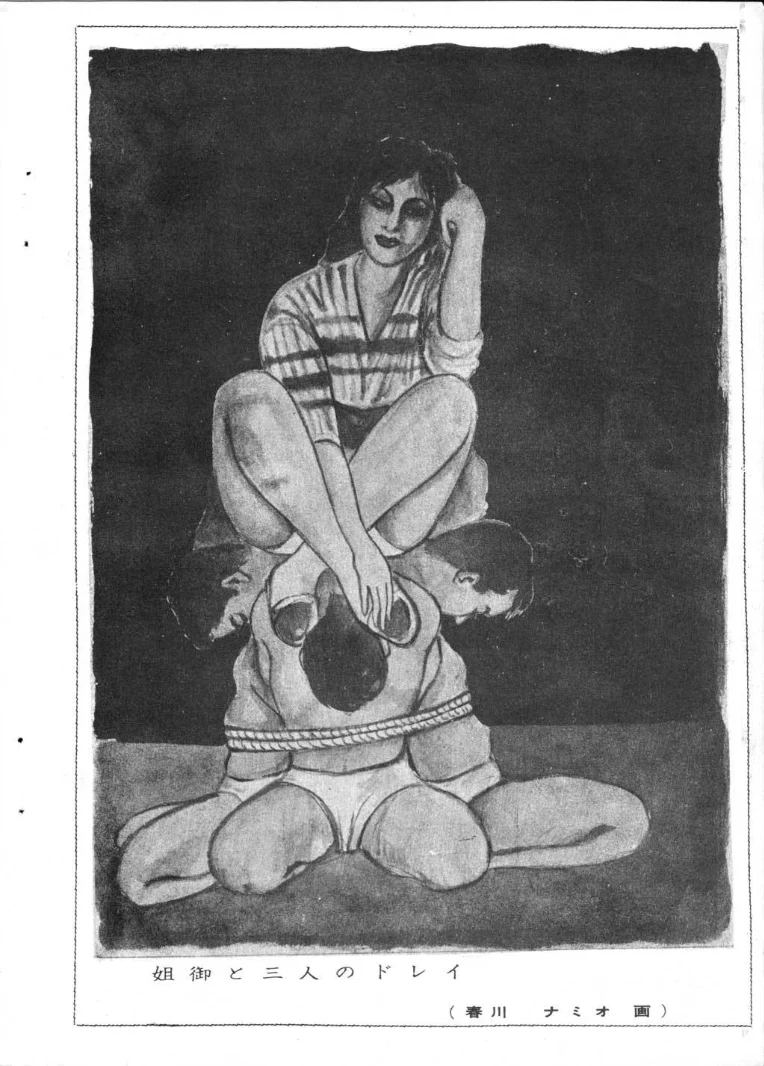
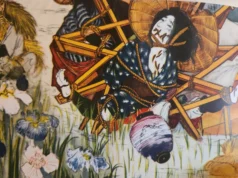
3The Boss Woman and Three Slaves
Kitan Club, May 1962
The Boss Woman and Three Slaves (姐御と三人のドレイ), illustration by Harukawa Namio.
This image pushes Harukawa’s emerging visual language much further toward the form that would later become unmistakably his. The woman occupies the highest point in the composition, literally enthroned on the bodies of three male slaves, while their bound and compressed postures turn them into part of the structure supporting her. The hierarchy is almost architectural: she is upright, composed, and psychologically detached, while the men are reduced to weight-bearing bodies beneath her.
Compared with An Ingenious Way to Drink Beer, the humor is darker and the power imbalance more absolute. The female figure is still not as physically exaggerated as in Harukawa’s mature work, but the essential logic is already clear: domination is expressed not simply through action, but through scale, placement, posture, and the conversion of the submissive male body into an object of use. The Boss Woman and Three Slaves is therefore especially important as an early example of Harukawa moving from comic erotic inversion toward the more systematic visual world of female supremacy and male abasement that would define his later art.
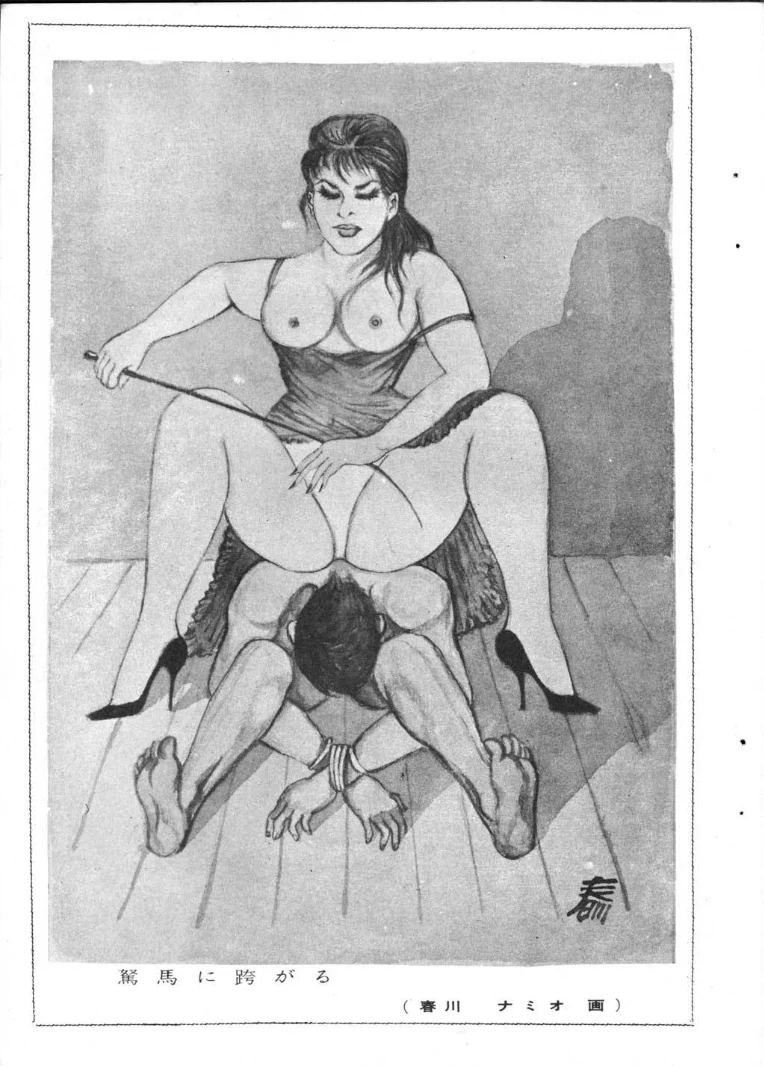
4Mounted on a Startled Horse
Kitan Club, May 1962
Mounted on a Startled Horse (驚馬に跨がる), illustration by Harukawa Namio.
This image brings several of Harukawa’s emerging themes into sharper focus. The woman dominates the composition both physically and psychologically, seated above the man with her legs spread wide while he is compressed beneath her into a low, bound posture. The riding crop makes the equestrian metaphor explicit, turning the submissive male body into something to be mounted, controlled, and disciplined. Unlike the more playful absurdity of An Ingenious Way to Drink Beer, the hierarchy here is more severe and more deliberately eroticized.
What is especially significant is how close the image comes to the visual grammar that would later define Harukawa’s mature work. The woman’s thighs, hips, and seated weight already command most of the picture plane, while the man’s body is fragmented and subordinated beneath her. She is not merely the active partner in the scene; she becomes the structural center of it, with his body arranged around her authority. The female figure is still less exaggerated than in Harukawa’s later drawings, but the central fantasy is unmistakable: male submission expressed through physical positioning, objectification, and the overwhelming presence of the dominant woman.
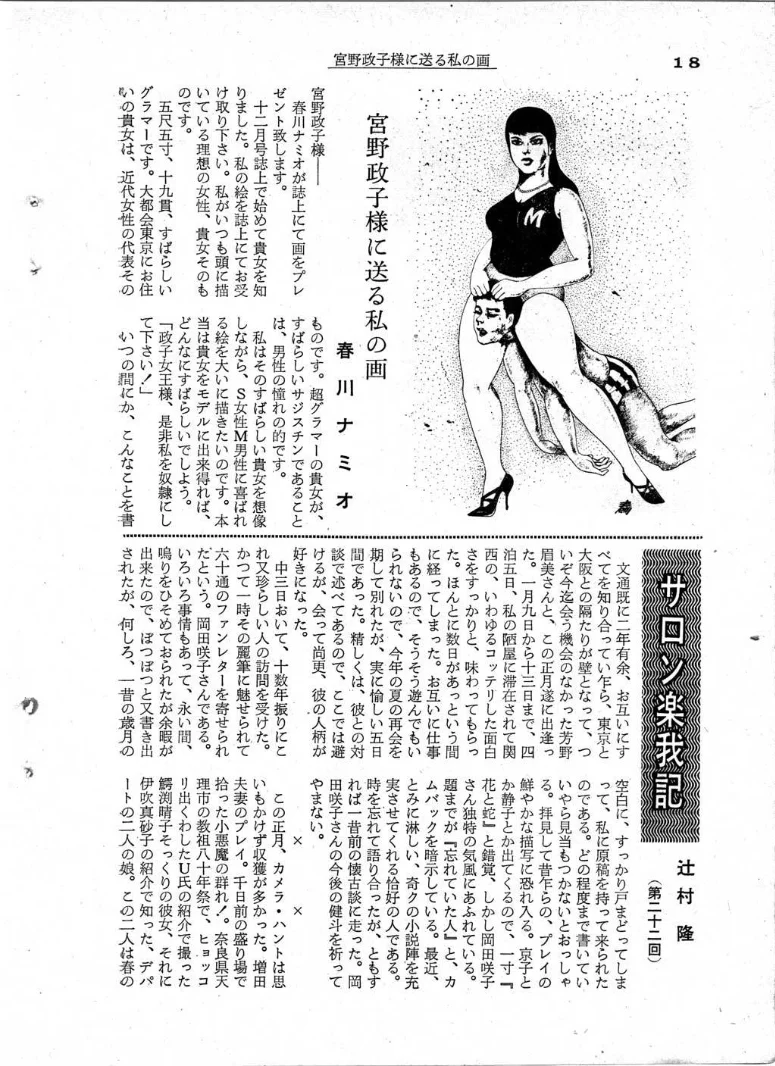
5My Pictures Sent to Masako Miyano
Kitan Club, April 1966
My Pictures Sent to Masako Miyano (宮野政子様に送る私の画), by Harukawa Namio.
This page is particularly valuable because it places Harukawa’s drawing within a more explicitly personal and textual context. Rather than presenting the image as an isolated fantasy, the accompanying text addresses Masako Miyano directly and frames the work as something created and sent to a particular woman. Visually, however, the familiar Harukawa hierarchy is unmistakable. The woman stands upright and self-possessed, while the man is reduced to a crawling position between her legs, his body functioning almost as an extension of her stance. By 1966, the tentative quality visible in the 1962 drawings has largely disappeared. The female figure has become cleaner, more iconic, and more commanding, while the man’s submissive position is rendered with greater economy and confidence.
As the latest image in this group, it makes an effective endpoint because it shows how quickly Harukawa’s visual vocabulary had consolidated. The emphasis is no longer simply on an unusual situation or comic reversal. Female dominance has become the organizing principle of the image itself. The woman is composed, vertical, and visually complete; the man is bent, lowered, and defined through his relationship to her. What was still exploratory in the early 1962 works has, by 1966, become recognizably Harukawa.
Translation: My Drawing for Masako Miyano
Harukawa Namio
Ms. Masako Miyano,
Harukawa Namio would like to present you with a drawing here in the pages of this magazine.
I first learned of you in the December issue. Please accept my drawing here in the magazine. You are the very image of the ideal woman I am always picturing in my mind.
Five shaku five sun tall, nineteen kan in weight, with a magnificent figure. Living in the great metropolis of Tokyo, you are the very embodiment of the modern woman.
That a woman as extraordinarily glamorous as you is also such a splendid sadist makes you an object of admiration and desire for men.
Imagining the wonderful woman that you are, I want to draw many pictures that will give pleasure to sadistic women and masochistic men. If only I could actually have you model for me, how wonderful that would be.
“Queen Masako, please, by all means, make me your slave!”
Before I knew it, I had started writing such things…
Taken together, these five images show that Harukawa Namio’s mature visual world did not appear all at once, but neither did it emerge from nowhere. By the early 1960s, many of its central ideas were already visible: the dominant woman placed at the compositional center, the male body lowered, bound, ridden, sat upon, or otherwise converted into something functional, and a persistent use of humor to sharpen rather than soften the imbalance of power. What changes across these early works is less the underlying fantasy than the confidence with which Harukawa organizes it.
That makes these images especially valuable. They let us see the transition from playful erotic inversion toward a much more coherent visual system in which female bodily presence itself becomes a form of authority. The proportions are not yet as exaggerated, the women not yet as monumental, and the scenes not yet as immediately recognizable as the Harukawa of later decades, but the architecture is already there. Seen in sequence, these drawings are not merely curiosities from the beginning of a career. They are evidence of an artist discovering, almost in real time, the visual grammar that would eventually make his work so distinctive.
Also of interest: Namio Harukawa Gallery: SM Kitan 1975