Translator’s Note: When we explore the history of Kinbaku and Japanese SM (the two are inseparable, in reality), we have a tendency to focus on the legends of bondage themselves. Names like Minomura Ko, Nureki Chimuo, Akechi Denki and many others.
But equally important are the models, both amateur and professional, that help shaped the content and the shape of the culture of Japanese SM. From Kitan Club to Roman videos, and to the modern era of Japanese AVs, each model provides a unique canvas in expression and feeling, and without them, Japanese SM may have never evolved out of primarily reader submission magazines.
Hiromi Saotome is a legendary model in the Japanese SM world. First staring in adult films in 1983, she participated in one of her first magazine shoots in the same year, for a magazine called SM Mania. The production involved herself, Nureki Chimuo, and Sugiura Norio.
These are the translations of her blog, located here (https://note.com/saotome6) talking about her history with Nureki. It is my honor to have them published on Kinbaku Today.
By Hiromi Saotome
November 7, 2020
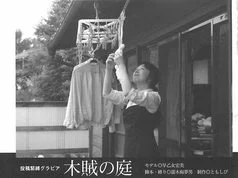
With filming for Tomoshibi Productions’ “The Horsetail Garden” now complete, I was so moved by Nureki Sensei’s essay in Talking Theater that I wrote a review. It was published in Chapter 175. Although I’ve forgotten the exact words I wrote at the time, reading this has brought those feelings vividly back to me.
From Talking Theater Chapter 175
(Saotome’s) sincere feelings are clearly expressed, and I believe this will be an interesting read for anyone with even the slightest interest in such topics. Therefore, I have omitted any potentially sensitive passages and present them below.
Nureki Sensei, this is another masterpiece… no, it’s a passionate, intense piece!
It really brings back memories of touch it was to be drug around.
I think this is exactly what you meant when you said I enjoy being tied up during the Tomoshibi project.
Back in the heyday of SM magazines, when there were so many photo shoots, I certainly did my best to meet the photographers’ demands, and I always felt a sense of accomplishment afterward.
However, as the years went by, it became harder on my stamina and strength, and I started to wonder if I actually preferred just being walked on a rope, maybe I wasn’t really into bondage after all.
What I attempted in Tomoshibi was the inevitable bondage that arises from being in a situation where one is forced to be bound.
It was while shooting the first installment, “The Sunset Room,” that I remembered.
Yes, my preference had always been for scenarios that emphasized the question, “Why am I being bound?” Even during glamour shoots, I was always thinking up fictional scenarios in my head.
Without a scenario, neither my mind nor my body would move.
It is precisely because there is a sense of inevitability that my body reacts to the restraints and I can cry.
I am truly glad that I was able to create a work to commemorate the launch of Tomoshibi.
Nakahara Rutso and Sachi Yamanouchi, both of them have completely transcended the confines of being women and are true comrades. I have confirmed that.
I hear you are currently writing your third work, titled, “The Feel of Water.”
I’m looking forward to it.
I wonder what will become of Tamaru, the loan shark, and Hiromi, the married woman.
As she continues to be tormented by Tamaru, how will Hiromi’s heart change?
I’m eagerly awaiting Hiromi’s story as if it were someone else’s, even though it’s my own. And since the title includes the word “water,” a water torture scene is bound to follow. This, too, was because the bathroom at the Yamanouchi residence was filled with nostalgia. Even in old single-family homes these days, the bathrooms have been renovated and are, at most, tiled. But this house was just as it had been in the past, with that concrete-like finish. My parents’ house was like that, too. It was this sense of nostalgia that made everyone exclaim, “This is great!”
Water torture. I’ve been subjected to numerous water torture sessions by Nureki Sensei so far. Mostly during the Kinbaku Beauty Research Society sessions. It’s come from the end of a hose connected to a faucet, from a tub, from water Nureki Sensei held in his mouth, and even during shoots at the beach. So even when I’m tied up during water torture, I can accept it with peace of mind. And personally, I don’t mind water torture. Of course, it depends on the extent. I certainly can’t handle the kind of water torture that’s like actual torture. It’s only possible if the premise is that, even while tied up, I can still breathe, that this is all just a performance. The reason I don’t mind water torture is that it holds a certain fear. I have this fantasy: “If this keeps up, I might actually die.” In other words, I’m being pushed to the limit. My mind is pushed to the absolute limit. Being driven to the very edge of my emotions eventually turns into a source of pleasure. And Nureki Sensei’s feelings regarding water torture are described in Talking Theater Chapter 178.
To put it simply, I like water torture. Or rather, I don’t dislike it.
What I do dislike is striking or beating a woman’s body to inflict pain.
In short, I dislike anything that actually leaves marks on a woman’s skin.
I simply cannot bring myself to like a woman unless her skin is always smooth, silky, and clean, free of any scars.
Water torture, as long as she endures the cold, has a visually intense, almost ruthless impact.
No matter how much water is poured on her, it does not actually harm her skin.
The sight of her body drenched from head to toe, with water droplets dripping from the tips of her hair, has a particularly gruesome and brutal realism when the woman’s body is bound.
Yet, the delicate, fluid reflections of the water evoke a sense of dramatic poetry.
It is cruel yet glamorous, and when captured skillfully by a photographer, it becomes an image that stirs the viewer’s heart.
The movement of the flowing water and the female body reacting to it possess a dramatic quality that makes me feel elated just watching it. That’s why I love it.
However, when it comes to water torture, the method of binding requires a bit of skill.
As long as you keep that in mind, the female body will not be injured.
To explain in detail, the ropes absorb water and harden, tightening as they do so and digging deeply into the woman’s body, making them difficult to untie.
Depending on the type of rope, it can harden like metal and become impossible to untie.
You must measure in advance the degree to which it shrinks when it absorbs water and tie it with great care.
Therefore, it is safer for those without experience not to attempt this.
Visually, it has a realistic intensity and appears cruel, but when untying, you must use a method where the rope slips easily off the woman’s body, even if it has become hard and shrunk from being wet.
It confirmed what I’d vaguely suspected. These are the kinds of things that are hard to ask about face-to-face. When it comes to bondage techniques, there’s simply an overwhelming difference in experience. I’ve never once felt anxiety or pain during Nureki Sensei’s bondage water torture.
Based on Nureki Sensei’s script, Director Nakahara and photographer Yamanouchi-san discussed it and wrote up the final notes. Talking Theater Chapter 181.
Tomoshibi Filming, Episode 3: “The Feel of Water” (Supplementary Notes from the Filming Locations from Nakahara and Yamanouchi)
I want to add some variety to the opening scene.
I want to create a thrilling and unsettling opening that is unique to “The Feel of Water” and different from the first two sessions we’ve filmed so far.
The inherent constraints of the narrative. Clearly define the characteristics of each story as part of this trilogy. Carefully and thoroughly capture the rich imagery and dramatic, intense rope-bondage narrative through the psychological tug-of-war between the married woman Hiromi and her blackmailer, Tamaru, revealing their contrasting expressions and emotions.
This time, I want to avoid using money as a prop.
To ensure that the water torture serves a clear purpose, not merely Tamaru’s “mere anger,” but the “coercion of a confession,” the prop for this scene will be a letter from Hiromi’s husband.
—Scene 1: Outside the house
The beginning of “The Feel of Water.”
The moment of “capture” and “silencing.”
Unlike the situations of “being captured” and “having one’s voice silenced” that I’ve filmed with various expressions up to now, in this third work, I want to capture the tension and thrill of “that very moment.”
Hiromi returns from shopping. An atmosphere of modest daily life, as if she knows nothing.
Tamaru lies in wait for Hiromi behind cover (a propane tank). Tamaru has taken a letter from the mailbox without permission (it is a letter from Hiromi’s husband).
Tamaru suddenly emerges.
Hiromi is startled.
Hiromi instinctively turns her back and tries to run away.
At that moment, he pins Hiromi in a bear hug (or grabs her arm as she turns to flee) and forces a hand over her mouth (the moment she is captured).
He then drags Hiromi toward the door. He must make her unlock the door and enter the house.
He makes Hiromi unlock the door. Since they are outside and neighbors might see, she cannot make a scene. Hiromi remains solemn, suppressing her fear and revulsion.
At this point, Tamaru must not let go of Hiromi’s arm (or wrist).
She isn’t physically bound with rope, but Hiromi’s hands are restrained by psychological coercion.
“Here you go,” is of course, not an option.
“Twisting her arm.” That’s not it either. It’s the quiet act of “having her hand held,” an action that foreshadows what comes next.
The image of fear creeping up on her, little by little.
—Scene 2: Entering the house.
A scene where the two of them talk.
Make sure to capture Tamaru’s anger, which leads to the water torture that follows, and Hiromi’s expression, which amplifies it.
As soon as they enter the house, Hiromi brushes Tamaru’s hand away.
Tamaru holds a letter from her husband that was in the mailbox (Hiromi does not know about this yet).
Enraged by Hiromi’s attitude, Tamaru drags her toward a pillar and ties her up.
(This time, he ties her arms behind the pillar)
This is not to leave her there, as in “The Sunset Room.”
She is being tied up to be threatened (to make her confess her husband’s hiding place).
(Her husband’s name is on the back of the mailed envelope, but no address is written)
I want to create a cruel atmosphere where the act of tying her up itself, rather than doing something to her after tying her up, serves as a form of torture to force a confession from Hiromi.
Tamaru takes out the letter he was holding and waves it in front of her. Hiromi is startled.
I don’t want anyone to read this. It’s a precious letter.
She wants it back. Hiromi struggles, driven by that desire.
“You’re a stubborn woman,” says Tamaru.
Hiromi’s look of contempt toward Tamaru.
If he were just threatening her as before, demanding she “tell me where you’re staying,” it would be enough to simply tie her to the pillar and torment her relentlessly.
However, at this point, a “rage” arises within Hiromi that cannot be appeased by mere threats against Tamaru. To force a confession, Tamaru says, “I’ll punish you even more!” (This leads to water torture)
Hiromi’s cold, contemptuous gaze toward the man is enough to make him think this.
—Scene 3: Bathroom (Water Torture)
This is not a place where Hiromi is dragged to be confined or imprisoned for an extended period, but rather to be subjected to water torture.
As she is dragged along, Hiromi’s fear of what is about to happen mixes with her anger toward Tamaru and her determination to protect her husband’s hiding place, and she struggles against it.
Her resistance is in vain, and Hiromi is tied to the faucet with a rope.
“This is what happens when you won’t tell the truth. If you don’t confess soon, things will get much worse for you,” says Tamaru as the water torture begins.
October 30, 2011. The shooting day for “The Feel of Water,” the final installment of the trilogy. Director Nakahara, who was now also serving as the director, had prepared the script for us. As I’ve said many times, this is a photo book we’re creating as like-minded enthusiasts. It’s not a commercial publication. The four of us poured too much passion into this trilogy (at least in hindsight. Back then, we were completely absorbed in it).
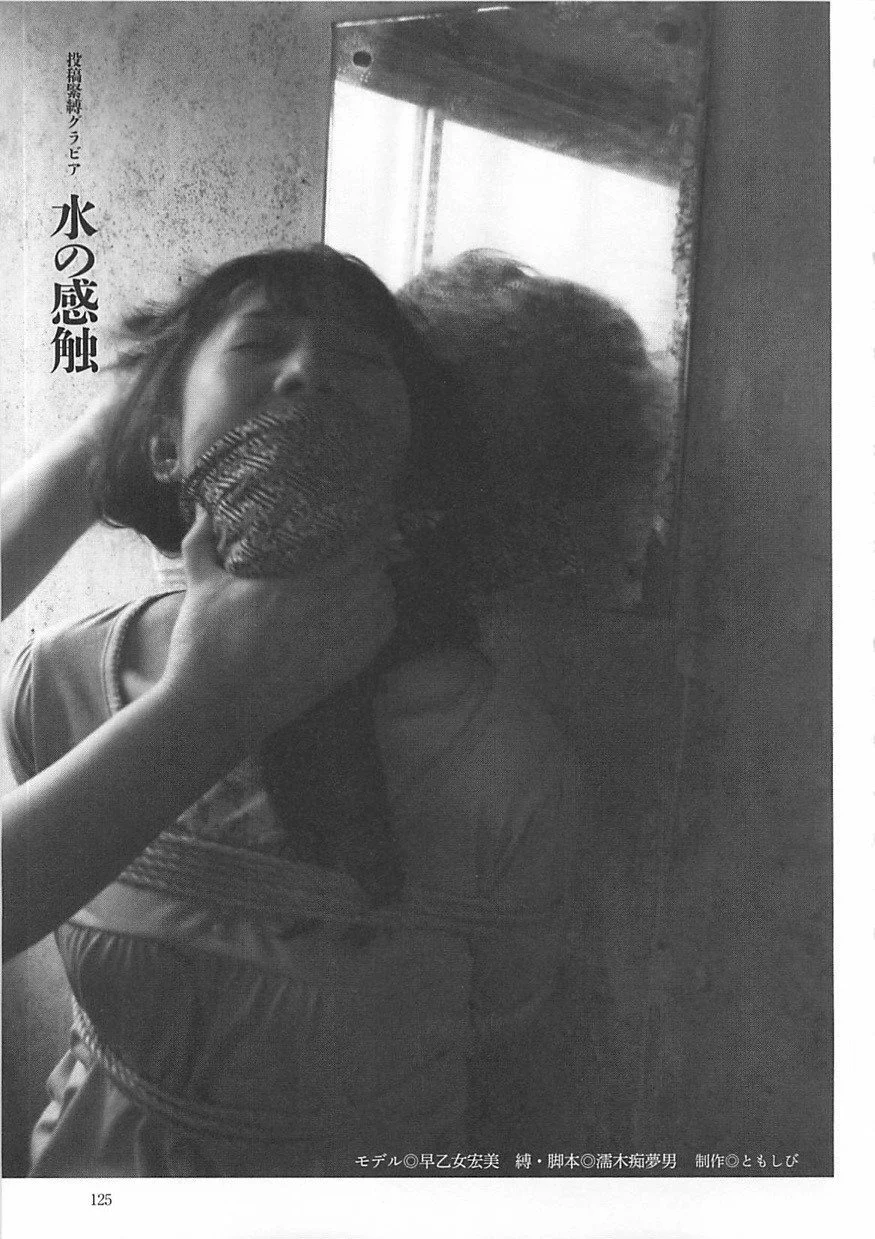
(Photo courtesy of “Mania Club,” Sanwa Publishing)