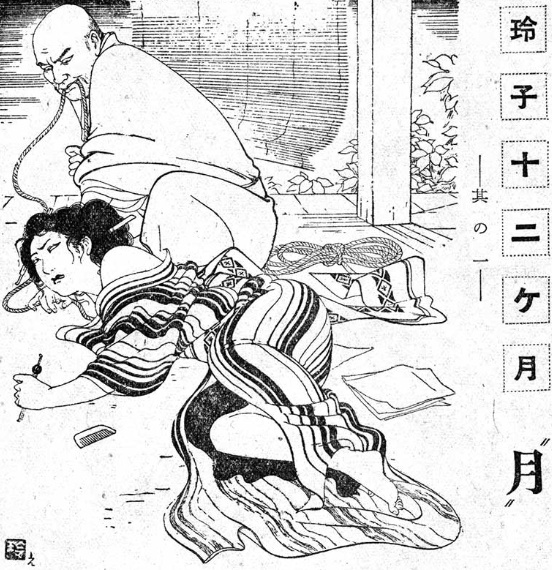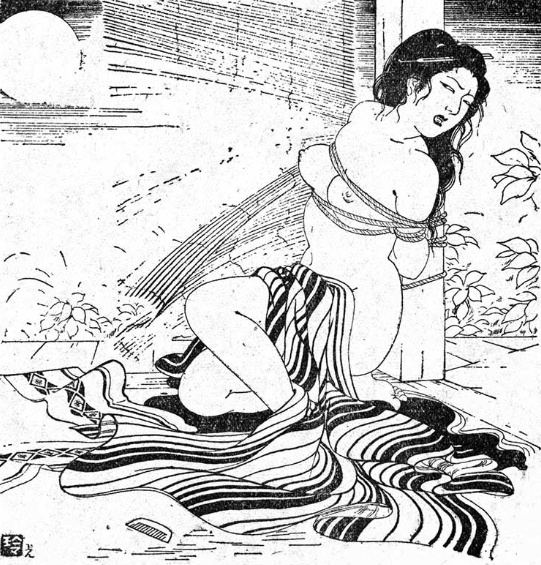
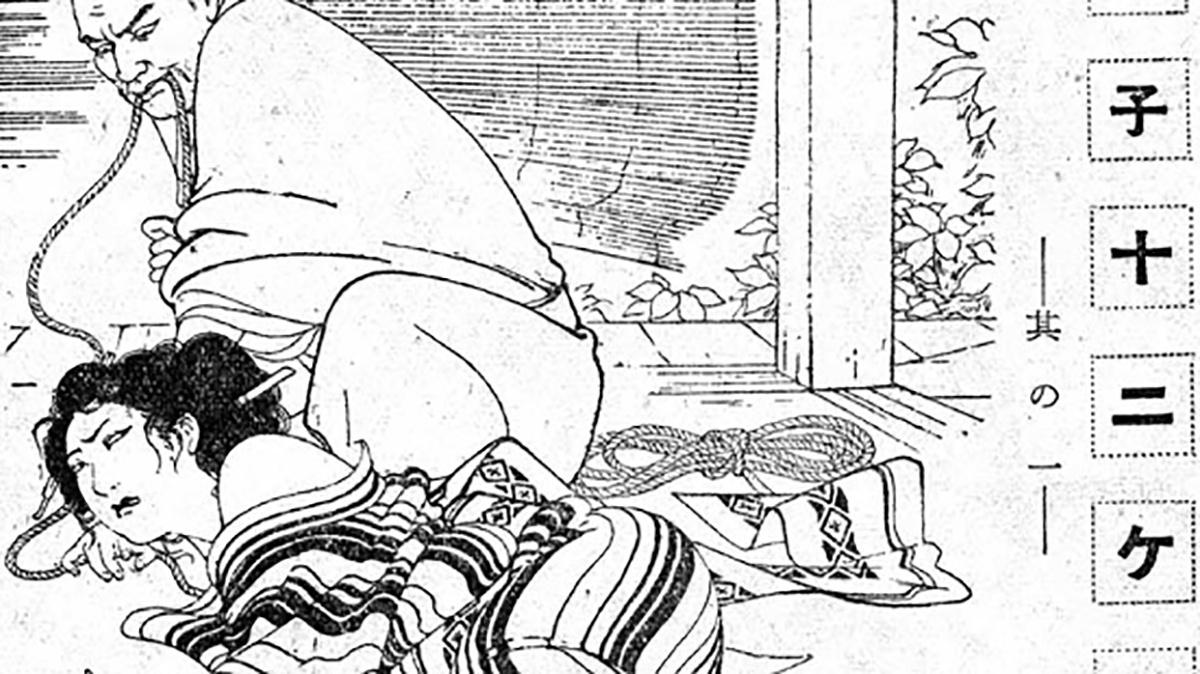
A new translation is now available in the Kinbaku Today archive: Kita Reiko’s “Reiko’s Twelve Months, Part One: ‘Moon,’” originally published in the September 1953 issue of Fuzoku Soshi.
The series is especially interesting when placed beside Itō Seiu’s earlier twelve-month punishment cycle. Seiu used the calendar to organize scenes of historical or quasi-historical punishment, tying each month to season, custom, place, and specific methods of torment. January might become freezing-water torture; February might be structured around an Inari observance, a drum, and plum blossoms. The month helps explain why the punishment takes the form it does.
Kita Reiko adopts the same basic calendar device, but transforms its purpose. In Reiko’s Twelve Months, the seasonal motif becomes less a historical framework than an erotic one. “Moon,” for example, uses moonlight to shape the mood of a bondage scene: rope, exposed skin, resistance, shadow, and nocturnal atmosphere all become part of the composition. In the next installment, “Chrysanthemum,” flowers similarly function as an aesthetic element surrounding the bound body.
That difference makes Kita Reiko’s series valuable for understanding the transition from Seiu’s seme-e and historical punishment imagery toward the more self-consciously erotic bondage illustration of the postwar SM magazine. Seiu often gives the viewer a reason to look at bondage because a punishment or historical incident is being represented. Kita increasingly assumes that bondage itself is already the subject.
Put another way: Seiu uses the seasons to historicize punishment; Kita Reiko uses them to aestheticize bondage.
The newly available translation of “Moon” includes the complete text, Kita Reiko’s illustrations, and notes on her use of hemp rope, colloquial language, and religious and sexual wordplay.
Read “Reiko’s Twelve Months, Part One: Moon” now in the Kinbaku Today archive.