Article Summary
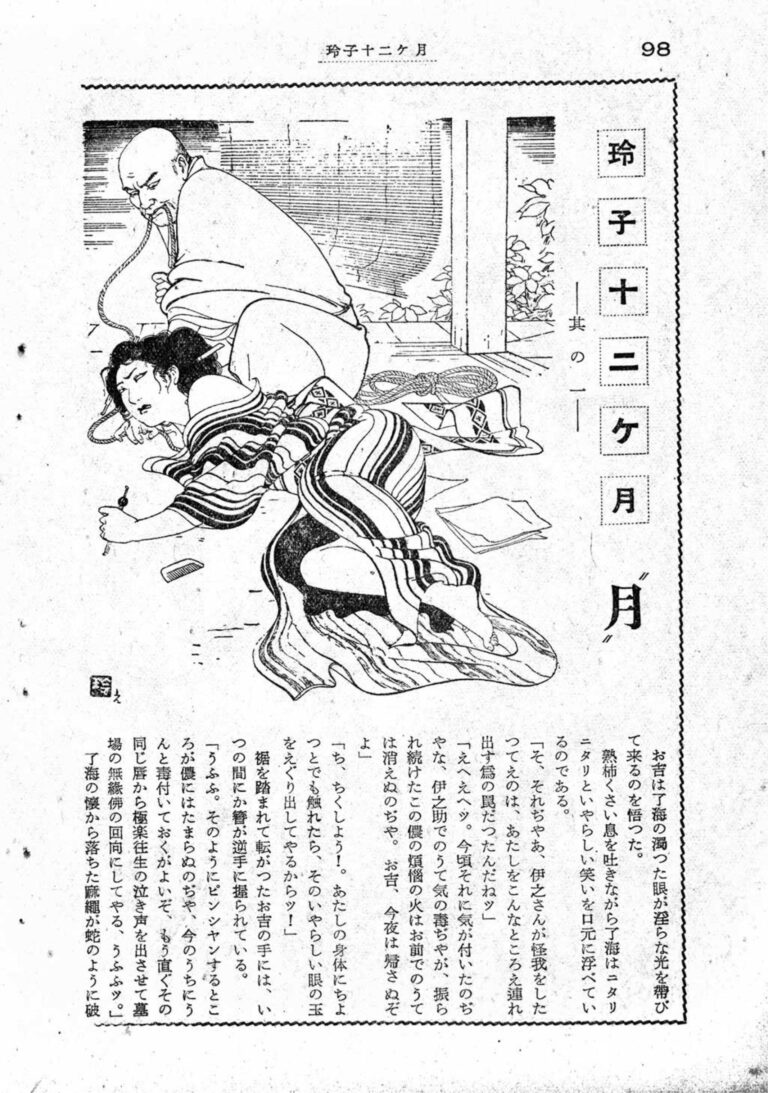
This two-page illustrated episode is the first installment of Kita Reiko’s Reiko’s Twelve Months, organized around the theme of the moon. Okichi is lured to an isolated place by the false report that Inosuke has been injured. Chōkai reveals that the deception was intended to put her in his power after repeated romantic rejection. Okichi resists with a hairpin, but Chōkai uses hemp rope to restrain her, strips her, and ties her to a pillar before leaving momentarily to fetch sake. The accompanying illustrations visualize the progression from struggle to bondage under moonlight. The piece combines short-form erotic fiction with sequential illustration, colloquial dialogue, religious wordplay, and explicit attention to hemp-rope restraint, making it a notable example of the illustrated bondage material appearing in early-1950s Fuzoku Soshi.
Translation
Reiko’s Twelve Months
Part One: Moon
Okichi realized that a lewd light was beginning to gleam in Chōkai’s clouded eyes.
Breathing out the smell of overripe persimmons, Chōkai wore a filthy, smirking grin.
“S-so when you said Ino-san had been hurt, that was just a trap to lure me out to a place like this!”
“Heh-heh-heh. So you’ve finally figured it out. Too bad it isn’t Inosuke, but the fire of worldly desire in this old man, after being rejected again and again, can’t be put out by anyone but you. Okichi, you’re not going home tonight.”
“Y-you bastard! If you so much as touch my body, I’ll gouge those filthy eyes right out of your head!”
Her hem had been stepped on and she had fallen, but somehow a hairpin was already clenched in Okichi’s hand in a reverse grip.
“Heh-heh. That spirited way you carry on is exactly what I can’t resist. Curse me as much as you like while you still can. Before long, I’ll make those same lips cry out as though you were entering paradise, enough to serve as a memorial offering for the forsaken dead in the graveyard. Heh-heh!”
A hemp rope dropped from inside Chōkai’s robe. Like a snake, it crawled across the torn tatami and in an instant wound itself around Okichi’s body.
“Ah!”
The hairpin knocked from her hand shone deathly pale in the moonlight.
“Damn you!”
Chōkai pressed her back down with his knee, and Okichi desperately twisted and struggled.
As the front of her clothing was gradually pulled apart, her white bare skin seemed almost fragrant even in the darkness, inflaming Chōkai’s lust. The rope marks bit tightly into her flesh, and every single turn of rope seemed filled with the resentment of Chōkai’s unrequited love.
“Ah, Ino-san!”
In the bitter frustration of having her freedom taken from her, Okichi called Inosuke’s name.
“Now that I’ve got you like this, there’s no need to hurry. Heh-heh. I think I’ll enjoy some sake and indulge in a little moon-viewing with a living woman.”
After leaving those spiteful words behind, Chōkai got up to fetch the sake. Stripped naked and tied to a pillar, Okichi writhed like a mermaid in the pale blue moonlight, the oily sweat of shame and anguish glittering over her like scales.
Art and text by Kita Reiko
Translation Notes
The page heading reads 玲子十二ヶ月, 其の一, 「月」, literally Reiko’s Twelve Months, Part One, Moon. Kita Reiko is explicitly credited at the conclusion with 画と文, meaning both art and text. 麻縄 is specifically hemp rope, not merely rope. 丁海 is rendered provisionally as Chōkai; the pronunciation of the name is not supplied on these pages. 伊之さん is a familiar shortened form of 伊之助, rendered Ino-san in dialogue and Inosuke when the full name appears in narration. 熟柿くさい literally means smelling like an overripe persimmon and characterizes Chōkai’s breath. 般若湯, literally prajna water, is a traditional jocular euphemism for sake associated with Buddhist clerical speech. 極楽往生 literally means rebirth in the Pure Land or attaining paradise; here it is used as sexual and religious wordplay. 無縁佛の回向 refers to prayers or merit dedicated to the repose of dead people who have no relatives to perform memorial rites. The dialectal expression 今頃それに気が付いたのらやな is visually clear in most of the line but its exact dialectal form is unusual and has been translated by sense.
Uncertain readings:
- 丁海 is clearly printed as the male character’s name, but its pronunciation is not given; Chōkai is a provisional romanization.
- The dialectal phrase 今頃それに気が付いたのらやな is unusual; the visible text supports this reading, but the precise dialectal morphology may merit human review.