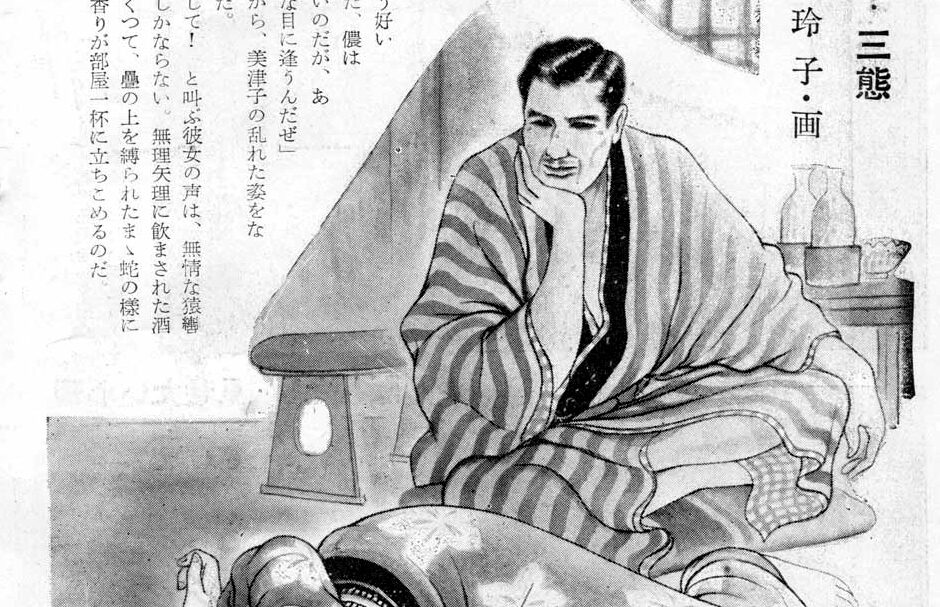
The three episodes are unmistakably nonconsensual fantasies. Their erotic charge depends on abduction, false accusation, confinement, intoxication, coercion, and the victim’s inability to escape. The women do not agree to participate and are not secretly framed as willing partners. Their protests, fear, shame, and helplessness are the central dramatic machinery.
That does not mean the magazine was presenting literal assault as an ethical model. Rather, it treated coercion as a fantasy structure that removed ordinary social restraints. Consent negotiation, mutual planning, and voluntary role-play would have weakened the period melodrama. These stories therefore create an imaginary world in which desire can appear only after respectable identity has been forcibly stripped away. The woman remains “innocent” because she never chooses the situation, while the reader is invited to eroticize precisely what she rejects.
This was extremely common in Japanese SM publishing of the 1950s. By the early part of that decade, magazines such as Kitan Club had substantially increased their publication of sadomasochistic fiction, illustrations, confessions, and bondage photography. A 1952 issue placed a photograph of a bound nude woman immediately inside the cover, and the next issue reportedly included more than twenty bondage photographs. Kitan Club’s shift toward explicitly SM material around 1952 helped establish a recognizable postwar genre built from bondage, punishment, captivity, interrogation, forced exposure, and cruel historical tableaux.
Several factors made it useful:
It preserved female respectability. A heroine could undergo erotic exposure without being represented as sexually experienced or openly desirous. Her coercion functioned as an alibi.
It converted social power into erotic spectacle. Employers, policemen, teachers, gangsters, doctors, masters, and prison officials supplied instantly legible hierarchies where control and domination could be eroticized as an extension of everyday life.
It connected SM to older popular genres. Edo-period punishment imagery, detective fiction, ero-guro, captivity melodrama, war stories, and tales of cruel magistrates already offered ready-made scenarios of danger and restraint. These illustrations and stories would tap into narrative constructions already well established with the magazine’s audience.
It evaded the need to describe consensual subculture directly. In the early 1950s, editors were still building a readership whose members often described themselves as isolated, ashamed, or unable to find partners. Fantasy could be explicit about violence while remaining evasive about how real adults actually negotiated SM. Violations of consent in these stories were always descriptive, rather than prescriptive, and frequently relied on historical events as cover.
There is also an important contradiction. The magazines themselves sometimes functioned as embryonic communities where readers sought recognition, correspondence, and compatible partners. Scholarship on Kitan Club emphasizes its role in bringing together people interested in sadism, masochism, fetishism, homosexuality, and cross-dressing. Yet the fictional content rarely represented that emerging community through mutually negotiated play. The letters could ask, “How can people like us meet?” while the illustrations answered with kidnapping, torture chambers, and helpless victims.
That gap matters. These magazines were helping readers understand SM as an identity and social world, but their most powerful images still belonged to a fantasy vocabulary of violation rather than consent. Modern readers should therefore avoid retroactively describing the scenes as consensual role-play when nothing in the text supports that reading. At the same time, fantasy content alone cannot tell us that readers wanted to commit real violence. What it shows is that the period’s erotic imagination relied heavily on coercion as a theatrical device.
Kita Reiko’s “Three Visions of a Woman Under Torment” is particularly revealing because it condenses the formula into three miniature archetypes: the intoxicated modern woman, the abducted women of historical melodrama, and the servant trapped by a false accusation. In each, nonconsent is not incidental. It is precisely what turns ordinary femininity into erotic spectacle.