Uramado
December 1958
← Back to magazine archive
Issue Details
- Volume
- 3
- Issue
- 15
- PDF pages
- 293
Summary
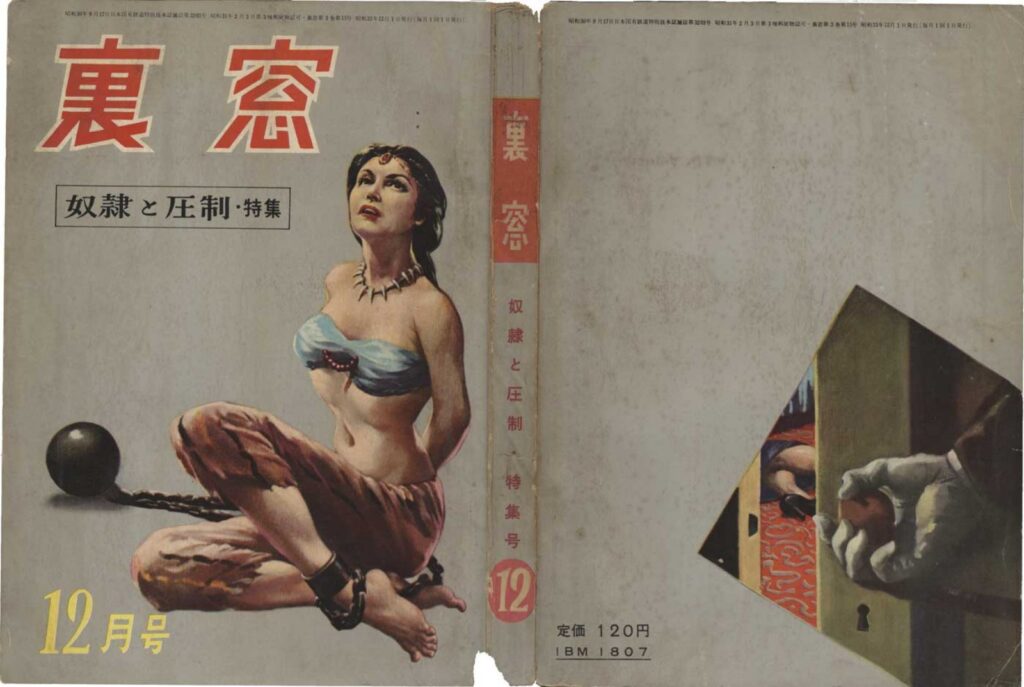
The December 1958 issue of Uramado is a large illustrated fiction anthology built around a special feature on slavery, oppression, captivity, and coercive authority. Its contents range from modern crime melodrama and foreign-set adventure to historical fiction, grotesque fantasy, psychological suspense, and serial period narrative. The cover presents a shackled woman beside a heavy iron ball, while the formal contents spread frames bondage, servitude, imprisonment, forced labor, and escape as the issue’s governing motifs.
Read full summary Close full summary
Table of Contents 26 items
-
Strange Tale of Nude-Woman Island
Summary
An illustrated historical erotic adventure recounts the capture and coercive exploitation of women on a mysterious “Nude-Woman Island,” combining narrated episodes with staged scenes of captivity, restraint, and domination.
-
Young Nude
Summary
A photographic nude feature presents a young female model in a series of posed studio images emphasizing the body, posture, and visual spectacle of nudity.
-
The Scarlet Crape-Paper Tale
Summary
An illustrated historical erotic tale follows the abduction and subjugation of a woman through elaborate rope and cloth restraints, coercive encounters, and the fantasies of captors and servants.
-
The Price of a Virgin
Summary
A serialized erotic crime narrative follows gangster Renjiro’s pursuit and coercive domination of the young woman Yoko amid abduction, violence, sexualized punishment, and police investigation, accompanied by dramatic illustrations.
-
Palace of Troubled Slaves
Summary
An illustrated historical erotic serial follows Natsu, a woman captured and sold into slavery, as she endures coercive restraint, humiliation, punishment, and attempted escape amid slave-market and palace intrigue.
-
The Cage of Hell
Summary
A serialized SM fiction narrative set around a theatrical troupe, in which actresses and other women are subjected to coercive bondage, punishment, humiliation, and sexualized backstage domination by men who stage and observe their suffering. The story emphasizes theatrical spectacle, escalating restraint, and the transformation of abuse into erotic performance.
-
Prostitution Slave Street
Summary
A serialized erotic crime narrative follows men who abduct, confine, and sexually exploit women in a prostitution district, depicting coercion, captivity, violence, and the circulation of enslaved women through organized brothels. The story uses dramatic dialogue and staged photographic or illustrative scenes to intensify its depiction of domination and oppression.
-
Tragic Wish at Hatchōbori
Summary
A historically set, illustrated crime narrative follows samurai and townspeople through coercion, betrayal, pursuit, and violent retribution in Edo-period Hatchōbori. Its melodramatic plot combines forbidden desire with captivity and murder.
-
Strange Suicides
Summary
A sensational illustrated report presents a series of unusual suicides, including deaths by hanging, gas, drowning, firearms, and other carefully described methods, accompanied by staged photographic scenes and explanatory commentary.
-
Prostitute Rain
Summary
A serialized erotic horror narrative follows high-school student Ayako as her encounters with teachers escalate into coercive sexual abuse, pursuit, humiliation, and violent domination amid persistent rain and threatening supernatural imagery.
-
Jar Hell
Summary
A serialized supernatural erotic-horror tale in which a mysterious woman and predatory men become entangled in confinement, bodily transformation, hallucination, and violent domination associated with an uncanny jar or vessel.
-
Calendar of Fragrant Skin
Summary
An Edo-period erotic serial follows the beautiful Otama as she is drawn into a world of sexual coercion, captivity, voyeuristic display, and power struggles within elite households and pleasure settings.
-
White Flame
Summary
A first-person erotic narrative portrays an intense and secretive sexual relationship between two men, framed through longing, reunion, physical intimacy, and emotional dependence.
-
An Eerie Notebook: Do Not Open That Box
Summary
A fictional found notebook recounts bizarre and terrifying incidents involving a mysterious sealed box, supernatural events, violence, and the efforts to uncover the truth behind them.
-
Female Slaves in Foreign Magazines
Summary
This illustrated survey of foreign erotic magazines examines depictions of female slavery, bondage, captivity, and coercion through imported photographs, staged scenes, and magazine commentary.
-
The Ivory Throne
Summary
A serialized adventure fantasy follows expeditions, African rulers and soldiers, enslaved people, and violent struggles surrounding the fabled Ivory Throne, emphasizing captivity, coercion, and rescue.
-
Bubble Hell
Summary
A serialized erotic narrative follows Ginji and Junko through an increasingly coercive relationship involving restraint, physical punishment, humiliation, domestic scenes, and conflicted marital desire.
-
The Captive Beauty
Summary
A historical erotic serial set amid Sengoku-era warfare depicts samurai and soldiers capturing, humiliating, restraining, and exploiting women, while following the resistance and escape efforts of the central characters.
-
Hebiko Island
Summary
This fictional narrative follows Shigeru and other boys confined in a remote juvenile institution, where they endure hunger, beatings, forced labor, harsh discipline, and attempted escapes while struggling against institutional oppression.
-
The Poisonous Yellow Moth
Summary
A dark erotic-fantasy narrative follows a man’s encounter with a mysterious woman whose attraction, bodily transformation, and eventual moth-like identity are linked to poisonous yellow moth powder and occult experimentation.
-
The Slave-Ship Incident
Summary
A historical account of the Maria Luz slave-ship incident recounts the abuse and attempted escape of Chinese contract laborers, the Japanese legal intervention that freed them, and the ensuing diplomatic dispute over slavery, human rights, and extraterritorial jurisdiction.
-
The Female Slave’s Jewel
Summary
A historical erotic adventure set in the Mongol world follows enslaved women subjected to captivity, coercive service, rope restraint, punishment, and pursuit amid rivalries over a precious jewel.
-
Earless Grass
Summary
A literary narrative follows a young woman with severe hearing loss through hospitalization, surgery, family concern, and an emotionally complex relationship with a nurse as she hopes to regain hearing and independence.
-
The Bodhisattva of the Cellar
Summary
An Edo-period erotic captivity tale in which the painter Sōtatsu abducts O-Mitsu, binds and confines her in a cellar, and subjects her to escalating threats, humiliation, and sexual coercion before the narrative’s violent climax.
-
The Incarnated Ecstatic Female Buddha
Summary
A surreal erotic narrative in which an artist’s encounter with a young woman becomes an obsessive dream of bodily transformation, mystical female sexuality, and the merging of devotional imagery with desire.
-
Skull Lantern
Summary
This serialized historical erotic adventure follows samurai, attendants, and other characters through abduction, interrogation, violent captivity, escape attempts, and conspiratorial pursuit in an Edo-period setting, accompanied by dramatic bondage and torture illustrations. Rope restraint, blindfolding, needles, beatings, and executionary menace recur as both narrative devices and visual motifs.
Highlights
- The formal contents spread organizes the issue as a special feature on slavery and oppression, combining twenty-six substantive works across photography, crime fiction, historical melodrama, foreign adventure, and supernatural narrative. (PDF p. 4).
- “Strange Tale of Nude-Woman Island” opens with a highly illustrated fantasy of abduction, underground passages, masked captors, ritualized violence, and a hidden community of imprisoned women. (PDF pp. 6–13).
- Fujisawa Osamu’s “Young Nude” is an extended studio portfolio using black backgrounds, contorted poses, and tightly framed limbs to emphasize the body as an abstract sculptural form. (PDF pp. 14–19).
- “The Price of a Virgin” combines organized crime, murder, narcotics, sexual manipulation, and a threatened woman in a noir-style narrative illustrated with photographic collage and drawings. (PDF pp. 29–42).
- “Palace of Troubled Slaves” begins the principal special feature with a woman purchased in a slave market, transported to a fortified compound, restrained, punished, and forced to entertain her captors. (PDF pp. 43–54).
- “Prostitution Slave Street” develops the theme through a modern urban setting of commercial sexual exploitation, coercive control, and the social machinery surrounding prostitution. (PDF pp. 69–84).
- “The Foreign Magazine’s Female Slaves” surveys representations of female bondage and servitude in overseas periodicals, providing a rare comparative and documentary feature within the fiction-heavy issue. (PDF pp. 156–163).
- “The Ivory Throne” and “The Poisonous Yellow Moth” form a substantial late-middle sequence of foreign adventure, dangerous rulers, captivity, intrigue, and political violence. (PDF pp. 164–219).
- “The Slave-Ship Incident” and “The Female Slave’s Jewel” center forced transport, confinement aboard ship, contested ownership, rebellion, and the circulation of enslaved women as valuable property. (PDF pp. 220–244).
- The concluding “Skull Lantern” installment sustains an Edo-period atmosphere of abduction, punishment, criminal pursuit, bodily peril, and rescue before the publication and editorial back matter. (PDF pp. 271–292).
Contributors
Named contributors represented in this issue:
- Dan Tatsuji
- Enjōji Tatsu
- Erigaki Zan
- Fujimi Miyako
- Fujisawa Osamu
- Gamage Kazumi
- Hada Hikaru
- Hashizume Hikoshichi
- Iida Toyokichi
- Iwahori Hikaru
- Kanbe Yūichi
- Kawaguchi Naoki
- Kōno Haruo
- Magaki Shin
- Matsui Yoriko
- Mizorogi Jakushi
- Nakajima Kimi
- Natsumoto Keinosuke
- Odagiri Sō
- Sasaki Chikara
- Sasamoto Tōru
- Shima Fuji
- Shimamoto Haruo
- Tachibana Shintarō
- Tōge Kōsuke
- Umeda Kusuo