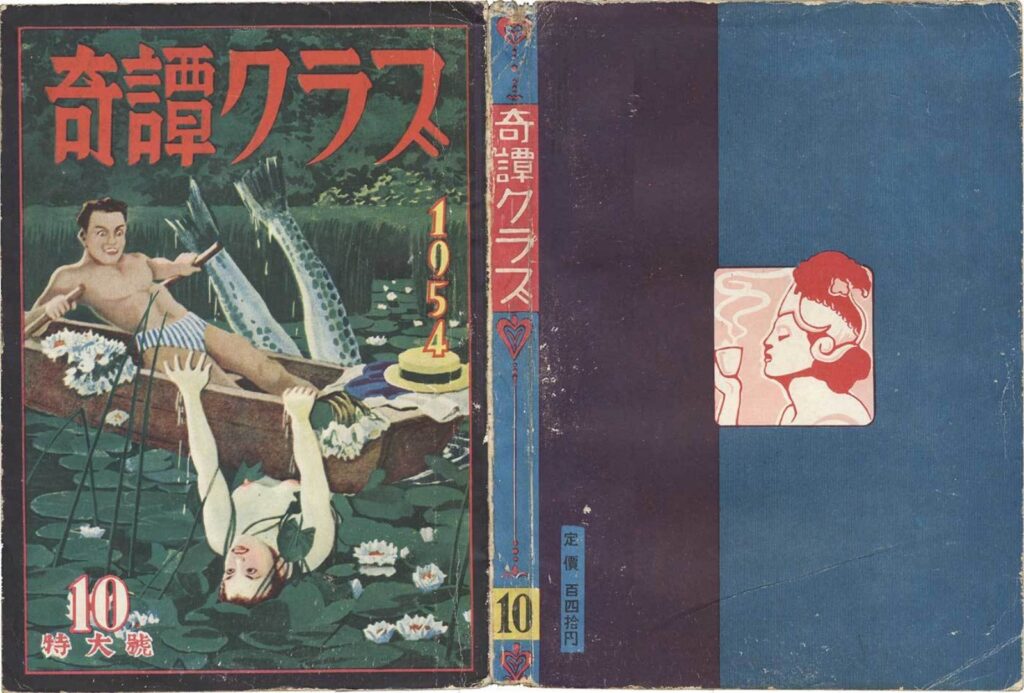
Kitan Club
October 1954
← Back to magazine archive
Issue Details
- PDF pages
- 305
Summary
The October 1954 issue is one of the largest Kitan Club issues in this sequence. Its opening visual portfolio combines diagrams of improvised restraint, historical punishment illustration, staged female domination, beach and outdoor bondage photography, gag studies, traditional-costume imagery, wrestling, foot worship, and female-on-female physical control. The prose section then expands into fiction, masochistic memoir, queer and gender-variant testimony, body-part fetish studies, literary criticism, seppuku narratives, reader correspondence, and extended serials.
Read full summary Close full summary
Table of Contents 68 items
-
mprovised Restraint Positions Using Furniture and Frames
Summary
A visual feature presents women placed in improvised restraint positions using chairs, frames, poles, carts, and other household or outdoor structures, with brief Japanese labels identifying the setups.
-
October Punishment Scene
Summary
Itō Seiu’s October illustration depicts a crowded historical marketplace or fairground scene centered on a bound and punished woman, combining spectatorship, public display, and institutionalized violence.
-
The Two Men Pursuing Her
Summary
This twelve-part illustrated erotic narrative follows a woman pursued by three men through encounters at the seaside, on a train, and in domestic or theatrical settings, escalating into deception, captivity, binding, and threatened punishment before a final confrontation or removal of the woman.
-
Monkey Game
Summary
A staged bondage sequence titled “Monkey Game” depicts women restraining one another and using a cloth gag in an intimate role-play scenario.
-
Variant Hands-Behind Binding
Summary
A photographic practical feature demonstrates a variant hands-behind binding, using rope arrangements that secure the arms and body in a modified rear-restraint position.
-
Scattered Blossoms at the Water’s Edge
Summary
This photographic portfolio stages rope-bound scenes with model Nakafuji Tamiko on a beach, showing several outdoor restraint positions at the water’s edge and on the shore.
-
The Queen’s Daily Routine: Washing Her Face
Summary
In this staged episode of the Queen’s morning routine, a subordinate must remain behind her while she washes, taking care not to spill the cup of water and facing punishment for even a minor failure.
-
The Queen’s Daily Routine: Foot Service and Release
Summary
A kneeling male servant greets the smoking Queen by attending to and kissing her feet, after which the routine culminates in his release from service.
-
Footstool
Summary
The male subordinate is used as the Queen’s footstool and must continue supporting her feet while she finishes reading the letters delivered to her.
-
Dog Training
Summary
A staged photographic feature depicts a woman training another person as an obedient “dog” through collaring, handling, and command-oriented physical discipline.
-
Outdoor Female Wrestling
Summary
A photographic sequence presents outdoor wrestling and grappling between women, framed as playful but coercive domination and punishment without ropes.
-
Erotic-Print Fantasies
Summary
This illustrated feature surveys erotic ukiyo-e-inspired fantasies, including scenes of sexual submission, supernatural snake imagery, and imaginative encounters drawn from historical Japanese print culture.
-
Commemorative Photography
Summary
A staged photograph depicts a man preparing to tie his newlywed wife to a chair outdoors for a deliberately strange commemorative portrait.
-
Newlywed Autumn Game
Summary
An illustrated erotic scenario presents a newlywed woman in autumn dress and traditional settings undergoing playful restraint and display, accompanied by dialogue and changing poses.
-
Traditional-Costume Play
Summary
A multi-page illustrated feature portrays women in elaborate traditional Japanese costumes being tied, posed, and restrained in theatrical indoor and outdoor scenes.
-
Warning Against Violence
Summary
A cautionary illustrated feature depicts a woman bound and urges women to learn judo as a means of protecting themselves from violent attack.
-
Gags and New Women’s Shoes
Summary
A visual feature presents a gagging device for a “talkative woman” alongside photographs of a new style of women’s shoe.
-
Secret Photographic Album: Rope Poses, Part One
Summary
A photographic album presents staged rope-binding poses of women, including standing, seated, and floor positions, as the first installment of a bondage portfolio.
-
Secret Photographic Album: Rope Poses, Part Two
Summary
A photographic portfolio presents multiple models in rope-bound poses, including blindfolded and tightly restrained configurations, as a continuation of a secret album.
-
Fantasy of Rope and Whips
Summary
A staged erotic photograph depicts a woman subjected to rope restraint amid whip imagery, presenting bondage as a fantasy tableau.
-
Nightmare
Summary
An illustrated scene from the picture story “Nightmare” portrays a distressed woman in a threatening restraint scenario, framing coercion and fear through erotic narrative imagery.
-
Male Beauty and Abused-Masochist Poses
Summary
A visual feature juxtaposes an idealized portrait of youthful male beauty with a photograph of a consensual bondage scene in which a male participant is tied by the hands and ankles and subjected to an endurance-oriented prop-based pose.
-
After the Bath and Women’s Bathhouse Imagery
Summary
This feature presents a woman relaxing in a yukata after bathing alongside eroticized bathhouse and moxibustion-room imagery drawn from historical visual culture.
-
Illustrated Floor Restraint Studies
Summary
An illustrated “Reiko tying-method classroom” experiments with floor-bound female figures in varied costumes and poses, presenting multiple rope-binding arrangements as stylized restraint studies.
-
Female Seppuku Studies
Summary
A staged photographic study of female seppuku presents a woman posing with a blade at her abdomen, including scenes of simulated cutting and blood for an extreme erotic death fantasy.
-
A Feminist’s Page: Feet and Clothing
Summary
This illustrated fetish feature focuses on the erotic display and handling of women’s feet, hands, and clothing, including images of a woman wiping a foot.
-
Submission and Overthrow
Summary
A staged photographic sequence depicts a woman physically overpowering and subduing a prone man in a scene centered on domination and submission.
-
The Wisteria Woman
Summary
A serialized erotic narrative follows a woman whose life is marked by wartime displacement, exploitation, captivity, and coercive sexual encounters, combining personal tragedy with bondage imagery.
-
Collection: From My Scrapbook
Summary
A scrapbook-style collection presents and comments on erotic clippings and illustrations involving bondage, sexual scenarios, and an intense fascination with particular bodily features such as hair, mouths, and armpits.
-
Record of the Demon Insect
Summary
This supernatural erotic narrative depicts the intertwined exploits of Madame, Ruri, and other characters amid transformation, domination, restraint, sexual violence, and grotesque insect imagery.
-
On Female Armpit Mania
Summary
An essay examines erotic fascination with women’s armpits, discussing the visual and tactile qualities attributed to the body part and its place within fetishistic desire.
-
From a Masochist’s Notebook
Summary
A first-person masochist’s notebook presents fantasies and episodes of female authority, humiliation, bondage, domestic submission, and eroticized discipline, accompanied by staged illustrations.
-
On the Beauty of Boys
Summary
An essay explores the beauty and erotic appeal of boys through historical and modern examples, discussing youthful bodies, clothing, physical training, artistic representation, and changing cultural ideals of masculine appearance.
-
Sexual Fluids, Part Nine
Summary
A serialized erotic-psychological essay by Itō Seiu combines conversational anecdotes about sexually unconventional women and artistic or entertainment circles with illustrated scenes of erotic observation and bodily experience.
-
Joys and Sorrows of Being Tormented, Continued
Summary
A long illustrated first-person account describes the pleasures and suffering of repeated bondage, beatings, humiliation, exposure, and other punitive ordeals, including restraint in domestic and outdoor settings and increasingly elaborate rope techniques.
-
An Open Letter to Dr. Azuma
Summary
Hamura Kyōko’s open letter to Dr. Azuma is a personal confession about her masochistic and bondage-related desires, marital and domestic circumstances, and uncertainty about how to understand or manage her sexual inclinations.
-
Cruel Women
Summary
A translated and explanatory account drawn from a 1901 German work describes violent domination, whipping, captivity, and racialized colonial encounters involving women and African servants. The piece frames these episodes as sensational historical testimony while dwelling on cruelty and bodily punishment.
-
A Tale of Youth, Whips, and Bitter Winds
Summary
This kōdan-style historical erotic narrative follows a woman subjected to escalating coercion, restraint, whipping, tattooing, humiliation, and bodily violence amid a theatrical world of criminals, servants, and domineering figures. Its accompanying illustrations stage scenes of captivity and punishment as sensational erotic spectacle.
-
A Masochistic Fantasy in the Style of Kōdan
Summary
A kōdan-style masochistic fantasy imagines a powerful woman binding, restraining, humiliating, and physically punishing a male submissive through elaborate postures and repeated discipline. The piece presents these scenarios as an imaginative design for male masochistic submission rather than factual reportage.
-
Binding the Female Body in Japanese Dress and Cross-Dressing Restraint
Summary
An illustrated discussion of binding women in traditional Japanese dress and binding cross-dressed subjects, combining commentary on rope arrangements with photographic examples.
-
The Teacher
Summary
A fictional account of a physical-education teacher who subjects a male student to coercive examinations, forced undressing, physical control, and humiliating restraint.
-
First-Sight Part-Time Job
Summary
An erotic serial narrative about a woman taking a part-time job that draws her into increasingly coercive encounters involving customer observation, costume changes, exposure, and restraint.
-
Natsuko’s Copybook: Diary of a Guilty Woman
Summary
A diary-style fictional confession follows a woman’s secret relationships, jealousy, emotional instability, and self-destructive responses as she struggles between illicit desire, social expectations, and marriage.
-
The Smile of the Male Flower: Captivity Record
Summary
A captivity narrative recounts the abduction and confinement of a woman amid erotic coercion, physical restraint, humiliation, and escalating sadistic control, illustrated by staged scenes of bondage.
-
Dizism
Summary
This illustrated sensational account presents and interprets “Dizism” as a supposed form of sadism among Chinese women, combining eroticized cross-cultural description with visual depictions of sexualized dominance and violence.
-
Sadism Among Chinese Women
Summary
A sensationalized cross-cultural essay presents alleged examples of sadistic behavior among Chinese women, including female control, physical punishment, and sexualized domination of men, while comparing these practices with Japanese sexual attitudes.
-
The Beauty of Women’s Noses
Summary
Masago Jūroku examines the aesthetic and erotic significance attributed to women’s noses, discussing facial proportions, individual beauty, cultural standards, and the ways photographs and visual media shape judgments of feminine attractiveness.
-
Pleasurable Period Drama: Women Bound in Film
Summary
Fujiki Senji surveys bondage scenes involving women in period films, discussing rope restraint, theatrical staging, actresses’ performances, audience response, and recurring images of captives, punishments, and eroticized historical violence in Japanese cinema.
-
A New Discovery in the Art of Rope
Summary
This essay presents acupuncture as a historically rooted form of painful discipline and examines its continued therapeutic and psychological appeal through case examples involving pain, nerves, and masochistic sensation.
-
Devoted to the Enema
Summary
A first-person account of enema practices describes bodily sensations, erotic pleasure, and their incorporation into married sexual life, accompanied by discussion of equipment and methods.
-
Ear Cleaning and the Glass Rod: My Experience
Summary
This autobiographical fetish narrative recounts erotic experiences centered on ear cleaning and the use of a glass rod, combining intimate confession with illustrated scenes of sensory stimulation.
-
Rainbow of Life
Summary
A serialized first-person erotic narrative follows a troubled marriage and its entanglement with jealousy, coercion, bondage, bodily punishment, and eventual police intervention. The story presents abusive marital and interpersonal power relations as dramatic SM fantasy.
-
Abdominal Cutting Seen on Sōshi Paper, Part Two
Summary
This illustrated cultural-historical essay examines depictions of female abdominal cutting and seppuku in kusazōshi, combining literary anecdotes, family and revenge narratives, and commentary on the sexualized presentation of punishment and bodily violence.
-
Current Reflections on Female Genitalia
Summary
An illustrated essay reflects on contemporary ideals of female beauty by comparing breasts, hips, genital appearance, pubic hair, skin coloration, and body proportions, relating physical features to erotic attraction and changing cultural standards.
-
Dream: An Illustrated Story
Summary
A nightmare-like erotic fantasy follows a man’s pursuit and capture of a woman, escalating through coercion, physical restraint, captivity, and sexual violence in a heavily illustrated narrative.
-
At the Evening Window
Summary
A first-person account traces Yūko’s troubled and obsessive relationship with T through travel, domestic encounters, bondage, sexual coercion, masochistic submission, and reflections on desire, marriage, and loss.
-
Marie Madeleine: The Poisoning Maniac Recorded in Women’s Criminal History
Summary
A sensationalized account of Marie Madeleine, presented as a notorious female poisoner whose crimes and eroticized personality are situated within women’s criminal history.
-
Sorrow and Compassion for an Abused Boy
Summary
A compassionate but melodramatic narrative follows an abused boy through institutional confinement, exploitation, and encounters with adults, emphasizing the emotional consequences of violence and neglect.
-
Fragments of My Masochism
Summary
A first-person series of masochistic recollections describes fantasies and experiences involving punishment, restraint, humiliation, and bodily control, accompanied by erotic illustrations and a reader-submission notice.
-
Female Seppuku: Snow-Molded Ayukawa Osen
Summary
A serialized historical erotic narrative follows Ayukawa Osen and related figures through betrayal, sword violence, captivity, and ultimately female seppuku, accompanied by dramatic illustrations of the confrontations and ritual death.
-
A Strange Night Without Characters
Summary
A serialized erotic narrative follows encounters involving desire, deception, captivity, police pursuit, imprisonment, and changing power relations between men and women, accompanied by dramatic illustrations.
-
Sexuality Advice Column
Summary
An advice column answers readers’ questions about sexual desire, marriage, gendered behavior, bodily appearance, fetishistic interests, and anxieties about relationships through a sexological and psychological lens.
-
New Women’s Sumo Terminology
Summary
An illustrated feature introduces and explains terminology for women’s sumo wrestling, using diagrams of grips, throws, holds, and winning or losing positions.
-
Publication Listings and Notices
Summary
A contents-and-notices section lists articles, illustrations, photographs, and other features from the issue, alongside subscription, ordering, and publication information for readers.
-
On Long-Boot Fetishism
Summary
This illustrated essay examines the author’s fascination with women’s long boots, discussing the fetish’s psychological and historical associations, styles and materials, and its representation in imported fashion and erotic imagery.
-
Looking at the Beauty of Models
Summary
A first-person illustrated feature describes photographing female models in posed bondage and outdoor settings, focusing on their reactions, willingness to repeat the sessions, and the photographer’s interpretation of their masochistic interest.
-
Night-Light Island
Summary
This serialized erotic suspense story follows Kenjiro and other characters whose fantasies of escape lead toward an isolated island, where loneliness, coercive power, captivity, and violent desire become intertwined. The narrative also reflects on alienation from modern urban life and the imagined freedom—and danger—of withdrawal from society.
-
The Fruits of Abuse
Summary
A dramatic first-person account portrays a woman subjected to escalating domestic abuse and elaborate restraint, including rope binding, suspension, gagging, whipping, forced nudity, and other forms of corporal punishment, with the resulting psychological collapse leading to medical hospitalization and eventual separation. The accompanying illustrations reinforce the article’s staged scenes of victimization and bodily control.
Highlights
- The opening catalogue turns chairs, poles, frames, and household structures into a visual grammar of restraint (PDF p. 5).
- The Two Men Pursuing Her uses a twelve-part illustrated sequence to combine courtship, rivalry, rescue, confinement, and punishment (PDF pp. 7–12).
- Scattered Blossoms at the Water’s Edge places a gagged and bound woman directly in surf and wet sand, making the shoreline part of the photographic staging (PDF pp. 16–18).
- The Queen’s Daily Routine transforms grooming and household service into rituals of female command (PDF pp. 19–22).
- The early portfolio includes one of the issue’s densest combinations of rope, wrestling, foot worship, traditional dress, gags, female seppuku, and bathhouse imagery (PDF pp. 23–45).
- Collection uses a scrapbook structure to organize erotic memory, personal encounters, and cultural fragments (PDF pp. 55–60).
- On Female Armpit Mania demonstrates the magazine’s ability to build an entire autobiographical category around a narrowly defined body part (PDF p. 70).
- On the Beauty of Boys gives male youth and same-sex attraction a sustained sexological and aesthetic discussion (PDF pp. 79–82).
- Binding the Female Body in Japanese Dress and Cross-Dressing Restraint combines field photography, traditional clothing, gender transformation, and rope (PDF pp. 117–120).
- Natsuko’s Copybook is a substantial diary narrative in which marriage, desire, guilt, fashion, and social identity unfold over eleven pages (PDF pp. 133–143).
- The Beauty of Women’s Noses continues the magazine’s extraordinary project of classifying individual body parts through photography, proportion, character, and erotic meaning (PDF pp. 155–158).
- A New Discovery in the Art of Rope explicitly presents tying as an aesthetic practice involving posture, composition, and bodily form (PDF pp. 168–172).
- Female Seppuku: Snow-Molded Ayukawa Osen is one of the issue’s largest historical-erotic narratives and occupies eleven pages in the previously omitted late section (PDF pp. 236–246).
- On Long-Boot Fetishism traces tall boots through riding, military clothing, theatrical performance, fashion, and bodily restriction (PDF pp. 270–273).
- The Fruits of Abuse is the true final work, continuing from PDF page 291 through the issue’s last page (PDF pp. 291–305).
Contributors
Named contributors represented in this issue:
- Amaike Seibi, romanization uncertain
- Aoba Shin’ichi
- contributor and readers
- contributor credit uncertain
- Dokushi Yotsuya, credit reading uncertain
- Fujiki Senji
- Furukawa Yūko
- Futamata Shizuko
- Hamura Kyōko
- Haruhi Rumi and Itabuki Makiko
- Haruhi Rumi and Koike Masami
- Hōno Mayumi, romanization uncertain
- Hosokawa Nobuko
- illustrated by Hanayama Kazuhisa
- illustrated by Hanayama Kazuhisa, credit reading uncertain
- Itō Seiu
- Iwahiroshi, author reading uncertain
- Kagawa Toshiko
- Katō Sanpei
- Kawabata Tanako and historical artist
- Kawada Tashirō, credit reading uncertain
- Kawai Itsuko
- Kawai Kazuhito and others
- Kishimoto Seiryū
- Kurihara Mugi; illustrated by Shinjō
- Magane Kanjirō
- Maru Megumi, romanization uncertain
- Masago Jūroku
- Matsui Raikō, credit reading uncertain
- Mikata Kōji
- Mikihara Jirō
- Miyako Mineko
- Mori Takuji
- multiple models
- Nakamura Yasushi, credit reading uncertain
- Numa Shōzō
- Saji Kōsuke
- Sakurai Kyōichirō
- Samukawa Midori
- Segawa Yasuko
- Shirogane Kōji
- Sugihara Nijiko
- Taketani Jūzō
- Taki Reiko
- Tamura Minoru
- translated and explained by Morimoto Aizō
- Tsujimura Takashi
- Tsujimura Takashi; model Nakafuji Tamiko
- Tsukihisa Takeshi, credit reading uncertain
- Tsunozaki Takako
- Ukishima Genji, romanization uncertain
- Yamaguchi Kōichi