Kitan Club
October 1953
← Back to magazine archive
Issue Details
- PDF pages
- 182
Summary
The October 1953 issue of Kitan Club combines drawn and photographed bondage, outdoor captivity scenarios, contemporary discussions of sadism, memoir-like writing, serialized confession, queer fiction, crime reportage, masochistic testimony, historical punishment imagery, and technical discussion of staging. The issue’s most distinctive development is its treatment of erotic representation as something deliberately manufactured. Rope, posture, costume, scenery, photography, illustration, and theatrical apparatus are repeatedly examined as tools for producing an effect rather than merely recording an event.
Read full summary Close full summary
Table of Contents 32 items
-
A Woman Pierced by Needles
Summary
A page of erotic illustrations depicts nude women subjected to elaborate rope bindings and needle piercing in varied poses. The accompanying Japanese title identifies the feature as “A Woman Pierced by Needles,” by Minamikawa Kazuko.
-
Historical Punishment Scene
Summary
A historical-style erotic punishment illustration shows a nude figure bound and suspended upside down inside a rustic interior, alongside an older man and another prone figure near a brazier. Its period visual style and tableau-like staging present bondage and punishment as a historical scene.
-
Erotic Female-Body Hell Illustrations
Summary
An illustrated feature on Itō Seiu’s prewar “female-body hell” imagery, with commentary by Murata Seiichi. The drawings present women in eroticized scenes of rope restraint, bodily exposure, disheveled hair, and anguish, while discussing Seiu’s artistic style and historical reputation.
-
The Dying White Swan
Summary
An illustrated erotic narrative in which a ballet student’s relationship with her teacher develops into escalating coercion, rope bondage, painful positioning, and suspension. Told in the first person, the story emphasizes fear, helplessness, bodily discipline, and masochistic fantasy.
-
At an Outdoor Punishment Ground
Summary
A photographic outdoor bondage feature documents model Murata Namiko being tied and posed in a forest setting for a staged punishment scenario. The accompanying production account describes location scouting, weather, equipment, repeated takes, and the physical demands of the shoot.
-
Men Who Attack and Women Who Are Attacked
Summary
An illustrated visual essay surveys Western artworks depicting men attacking or sexually violating women, including works attributed to Rubens and Adriaen van der Werff. It presents coercive sexual imagery as a recurring subject in European art and erotic visual culture.
-
Gymnasium Warehouse
Summary
A film scenario set in a school gymnasium warehouse, where a group of male students abduct, restrain, strip, and humiliate the student Eiko while staging photographic and theatrical scenes of coercion. The illustrated sequence emphasizes captivity, group dominance, and voyeuristic spectatorship.
-
Modern Sadism
Summary
An extended essay examining modern sadism through personal recollection, sexual psychology, social conditioning, wartime and postwar experience, and the relationship between abnormal sexuality and contemporary society. It also discusses historical torture and execution methods as cultural precedents for modern sadistic imagination.
-
Research into Hatsuhana Village
Summary
A historical and practical study of the “Hatsuhana Branch,” a bamboo bondage apparatus described in older erotic and miscellany sources. The article discusses its purported construction, dimensions, tying method, and use in restraining the limbs and body, with accompanying diagrams.
-
My Memories
Summary
A first-person erotic reminiscence set around a girls’ school swimming-club camp, where the narrator is pursued, captured, stripped, tied, and subjected to prolonged teasing and punishment by a female-led group. Illustrated scenes accompany the account of schoolgirl domination, restraint, humiliation, and submission.
-
The Temptation of Sacred Paintings
Summary
An illustrated erotic fiction follows 麻夜子 and 恵一郎 through encounters shaped by cinema, voyeuristic fantasy, seduction, coercion, and escalating physical restraint. Religious and “sacred painting” imagery frames the story’s atmosphere of forbidden desire, domination, fear, and violent climax.
-
My Clothes, Bound Clothes
Summary
A first-person confession describes designing and wearing clothing intended to bind the body, then experimenting with ropes, restrictive garments, and bodily exposure with the narrator’s husband. The piece presents clothing as a fetish object and bondage as part of marital erotic practice, combining practical construction details with reflections on sensation and secrecy.
-
Love Slave, Part Ten
Summary
The tenth installment of a serialized erotic narrative follows a man entangled with Harumi and her husband or rival, as past romantic rivalries, money disputes, betrayal, and revenge develop into coercive sexual domination. The installment includes humiliation, whipping, physical punishment, forced undressing, and restraint, alongside melodramatic threats and violence.
-
In Reply to the Hymn to Ars
Summary
A first-person confession recounts an unhappy marriage, escalating sadistic and bondage episodes, escape and subsequent sexual relationships. The narrative also turns toward reflections on anal sexuality, bodily shame, and the tension between degradation and erotic pleasure.
-
Amphibious Animal, Part Two: A Tale of Male Love
Summary
A correspondent responds to an earlier “hymn to Ars,” combining autobiographical sexual confession with discussion of anal pleasure, enemas, bodily experimentation, and sexual psychology. The piece also includes editorial correspondence and playful commentary on medical and sexological terminology.
-
A Solitary Wanderer’s Record
Summary
A sustained essay defending women’s wearing of trousers, especially slacks, against claims that the fashion represents masculinization or social decline. It examines the history and terminology of women’s trousers, changing postwar fashion, gender hierarchy, and the author’s disagreement with the earlier critic’s interpretation.
-
A Strange Confession
Summary
A first-person confessional account tracing formative childhood experiences, bodily and sexual development, and later masochistic or abusive erotic encounters. The narrative combines autobiographical recollection with scenes of coercion, humiliation, dependency, and eroticized violence.
-
The Binding Curse: From the Nishida Kotoe Fatal-Injury Investigation
Summary
A sensational investigative account presented as excerpts from Nishida Eiji’s second police statement concerning the fatal abuse of his wife, Kotoe. The testimony describes escalating marital cruelty, rope bondage, gagging, forced nudity and positional restraint, culminating in her death and the subsequent investigation.
-
Spider and Butterflies
Summary
A serialized erotic crime narrative follows Rie, an aspiring actress drawn into a photography and film operation that exploits her ambitions through staged bondage, sexualized costuming, and coercive scenes. The story develops a predatory “spider and butterflies” motif as commercial success, manipulation, and captivity become intertwined.
-
A Record of Love and Bondage
Summary
A first-person confession recounts a man’s lifelong fixation on women’s waists, beginning with childhood memories and developing into an obsessive adult pursuit involving clothing, scent, photography, and the binding or wrapping of women’s bodies. The narrator presents this fetish as a defining psychological compulsion and traces its effects on his relationships and conduct.
-
A Curious Confession of Sadism
Summary
A narrative confession centered on male sexual desire and encounters in postwar Tokyo, including nightlife, foreign men, and sexually charged observation. The piece presents same-sex erotic experience through a sensational, semi-fictional first-person style.
-
The Awakening of Sadism
Summary
A sadistic confession describing the emergence and expression of sadistic impulses through coercive, humiliating, and physically abusive encounters. The narrative is framed as an intimate personal account rather than practical instruction.
-
An Illustrated Tale of a Beautiful Punishment Ground
Summary
An Edo-period erotic tale follows an artist commissioned to create an illustrated punishment scene, as artistic ambition, the publisher’s demands, and tensions involving his wife or model increasingly blur the boundary between representation and lived suffering. The accompanying illustrations depict nude women in elaborate rope restraints and scenes of coercion, submission, and punishment.
-
A Female Student’s Part-Time Confession
Summary
An erotic fictional narrative centers on two women, Chikako and Junko, whose rivalry develops into an intense female-sumo wrestling contest watched and encouraged by Akashi. The accompanying illustration and extended match scenes emphasize physical strength, bodily display, competition, humiliation, and shifting dominance.
-
Madame Red Crane
Summary
A first-person erotic narrative framed as an episode from a torn diary, in which a young woman encounters the formidable Madame Red Crane and becomes involved in an escalating regime of rope bondage, restraint, and physical discipline. The story emphasizes the protagonist’s fear, submission, humiliation, and fascination with the madam’s controlling authority.
-
Diary of a Repatriate from Communist China
Summary
A first-person repatriate’s account of detention in China describes imprisonment, deprivation, forced nudity, beatings, threats, and other humiliating abuses by guards and fellow prisoners. The narrative presents captivity as a sustained ordeal of physical suffering and psychological terror.
-
Record of Abuse
Summary
A dark fictional account of captive Li being dragged between prison rooms and subjected to escalating beatings, binding, humiliation, and bodily violence by guards. The narrative emphasizes coercion, helplessness, and the perpetrators’ sadistic control over the prisoner.
-
Fire, Part Ten
Summary
The tenth installment of Matsui Kōko’s serialized erotic fiction follows the increasingly coercive entanglement of Kifune Ichirō, Sayuri, Yūsaku, and Kunihiko. The narrative centers on elaborate rope bondage, suspension, sexual humiliation, jealousy, and the exposure of concealed desires within an upper-class domestic setting.
-
How to Construct a Punishment-Ground Stage
Summary
Itō Seiu provides practical guidance for constructing a theatrical punishment-ground set, describing stage layouts, scenic backdrops, props, restraints, and methods for creating convincing outdoor or indoor scenes. Illustrations demonstrate apparatus and arrangements for staged bondage and punishment tableaux, linking technical stagecraft with erotic performance.
-
From a Masochist’s Notebook, Part Five
Summary
A serialized masochist’s notebook combines discussion of staging and scenic design for erotic punishment scenes with fictionalized episodes of fetishistic and submissive desire. The narrative centers on foot and shoe fetishism, women’s control, humiliation, animal imagery, and the masochist’s interactions with dominant women, while presenting these experiences as part of a personal notebook or literary fantasy.
-
The Sweet Surrender of Alice, Part Three
Summary
The third installment of a translated erotic serial in which Alice is subjected to escalating restraint, display, sensory observation, and coerced sexual submission. The narrative emphasizes the voyeuristic staging of her body, physical helplessness, and the narrator’s controlling and disciplinary perspective.
-
Publication Notices and Advertisements
Summary
A notices and advertising page promoting forthcoming issues, soliciting manuscripts and club participation, and providing subscription, mail-order, and publication information for Kitan Club and related materials.
Highlights
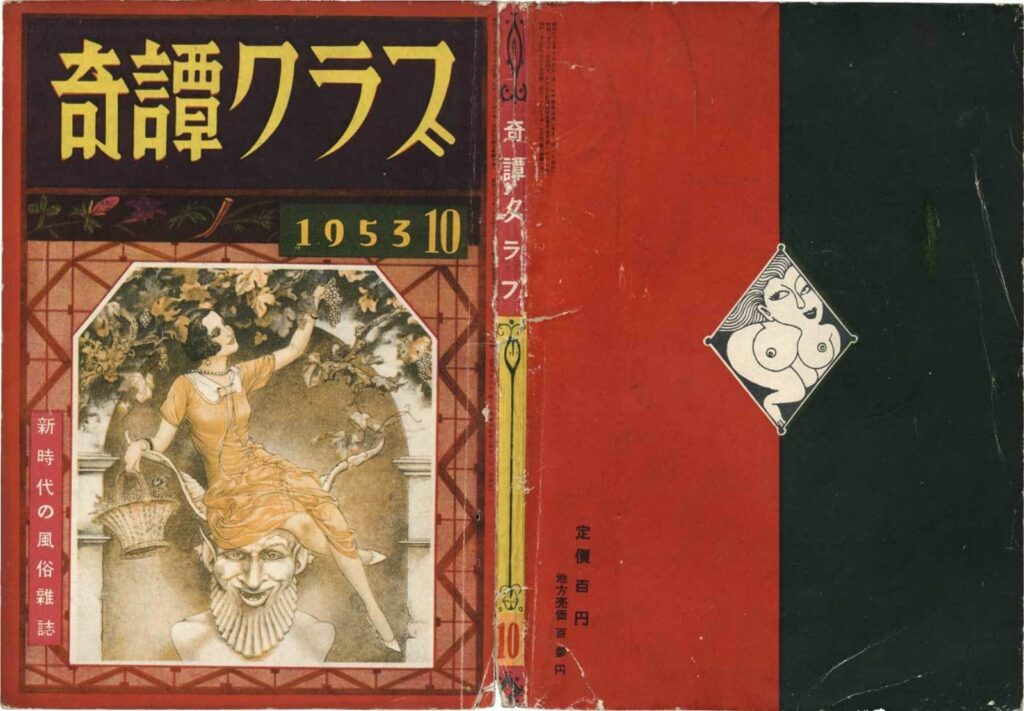
- The cover transforms female authority into a decorative tableau, placing the composed woman above a grotesque subordinate figure (PDF p. 1).
- A Woman Pierced by Needles arranges multiple compact poses as a comparative study of bodily distortion and sharp-point restraint (PDF p. 5).
- Itō Seiu’s female-body drawings emphasize hair, collapse, and disordered clothing, turning emotional exhaustion into a visual subject (PDF pp. 7–9).
- The Dying White Swan aestheticizes restraint through a metaphor of tragic performance and graceful decline (PDF pp. 10–13).
- At an Outdoor Punishment Ground uses forest isolation, costume changes, and progressive restraint to create staged visual reportage (PDF pp. 14–17).
- Gymnasium Warehouse relocates domination into a modern institutional setting populated by students and improvised equipment (PDF pp. 20–22).
- Modern Sadism attempts to define sadism as a contemporary psychological and social phenomenon rather than only a historical cruelty (PDF pp. 24–27).
- Research into Hatsuhana Village borrows the tools of geography and local history to give unusual desire an ethnographic frame (PDF pp. 28–29).
- The Temptation of Sacred Paintings examines how culturally sanctioned images of suffering can acquire erotic significance through spectatorship (PDF pp. 36–44).
- My Clothes, Bound Clothes treats clothing as an active component of rope aesthetics, shaping concealment, exposure, and narrative meaning (PDF pp. 45–47).
- Love Slave, Part Ten demonstrates how serialized submissive identity had become part of the magazine’s recurring reader culture (PDF pp. 48–57).
- The Binding Curse uses official crime documentation, creating an ethically difficult overlap between evidentiary violence and erotic framing (PDF pp. 78–83).
- Spider and Butterflies condenses pursuit and entrapment into an allegory of predator, victim, fragility, and capture (PDF pp. 84–91).
- An Illustrated Tale of a Beautiful Punishment Ground treats architecture and equipment as designed elements in an erotic stage rather than passive scenery (PDF pp. 106–117).
- Itō Seiu’s article on constructing a punishment-ground stage makes explicit the issue’s central insight: rope, bodies, furniture, and sight lines form a complete apparatus of representation (PDF pp. 158–167).
Contributors
Named contributors represented in this issue:
- Chikami Reiko
- composition by Tsujimura Takashi; photography by Tsukamoto Tetsuzō
- Hamura Kyōko
- Itō Seiu
- Itō Seiu; commentary by Murata Seiichi
- Iwahori Hiroshi; illustrations by Sanjō Haruhiko
- Kawamura Tetsuo; illustrations by Taki Reiko
- Kitō Kōichirō
- Komiya Kiyoshi
- Kuruki Sakae
- Maejima Yoshio
- Matsui Kōko
- Minamikawa Kazuko
- Mizukami Ryūtarō
- Murata Seiichi
- Nomura Emiko
- Numa Shōzō
- Okada Mashirō
- Okada Sakiko; illustrations by Hidawaki Kaoru
- Tobita Ryōji
- translated by Samukawa Midori
- Tsujimura Takashi
- Tsuzuki Mineko