Sun & Moon
November 1977
← Back to magazine archive
Issue Details
- PDF pages
- 118
Summary
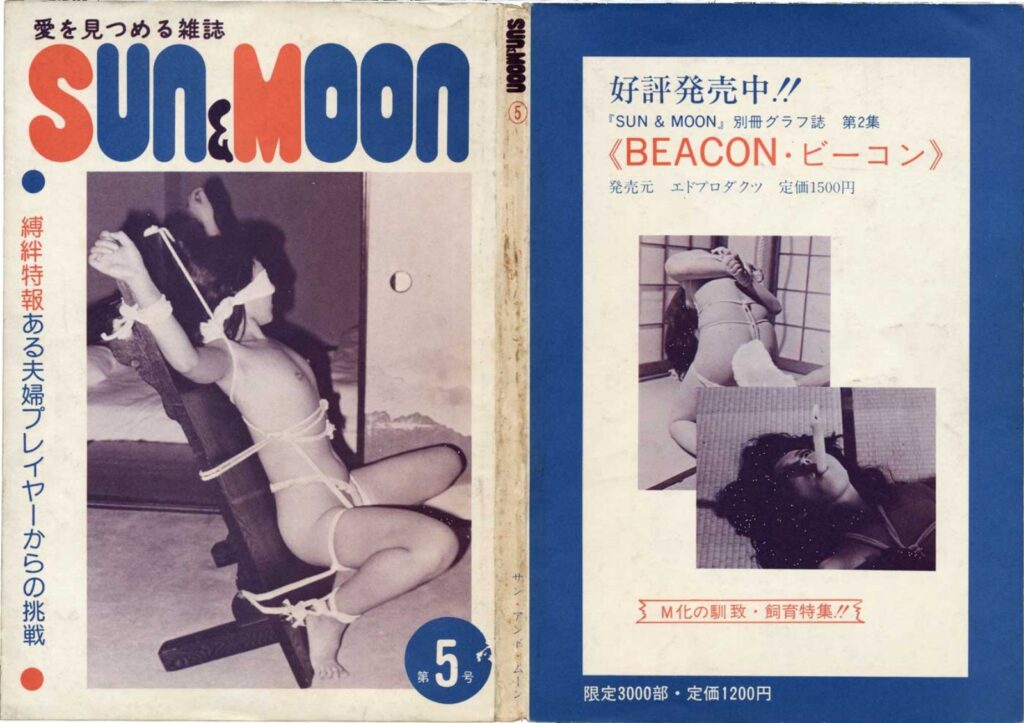
Issue No. 5 of Sun & Moon presents Japanese SM culture as a world increasingly organized around ordinary couples, amateur photographers, reader correspondence, private collections, and self-described practitioners. Unlike magazines built primarily around professional fiction or studio illustration, this issue repeatedly emphasizes material supplied by readers: photographs taken in bedrooms and tatami rooms, accounts of marital play, technical reflections on suspension, descriptions of personal erotic development, and appeals for compatible partners.
Read full summary Close full summary
Table of Contents 30 items
-
I Am Miko
Summary
A photographic feature presenting Miko in a series of staged rope-bondage scenes, including standing, seated, and floor-bound positions. The images emphasize elaborate restraint arrangements and the subject’s physical submission.
-
The Woman Who Came from the North Like a Wild Goose
Summary
A photographic feature depicting a woman in striped clothing being bound and posed with rope in several seated, kneeling, and reclining scenes. The sequence presents stylized kinbaku restraint as a staged visual performance.
-
A Challenge from a Married Couple Who Play
Summary
An erotic reportage and photographic portfolio documenting the Tamaki married couple’s shared SM life and a staged session of consensual bondage. The feature describes their relationship, negotiation of roles, rope restraint, sensory restriction, corporal play, and enema-focused scenes, with the husband shown in submissive situations and the wife directing or participating in the play.
-
Miscellaneous Thoughts on Sadism
Summary
Sakuma Kazuyuki reflects on his long-standing interest in sadism, tracing its development from reading fetish magazines and private fantasies to experimentation with bondage, discipline, and other erotic practices. He distinguishes consensual, controlled sadistic play from cruelty and abuse, considering the psychological motives, limits, and interpersonal dynamics involved.
-
The Woman Who Awakened My Sadistic Nature
Summary
A first-person account of how an encounter with Chizuko led the narrator to discover and develop his sadistic desires. The narrative describes escalating sexualized rope restraint, humiliation, coercion, and staged bondage scenes, accompanied by explicit photographic illustrations.
-
The Woman Who Came from the North Like a Wild Goose
Summary
An erotic reportage piece recounting the unexpected correspondence and meeting with a female reader from northern Japan, leading to a documented bondage photography session. The article emphasizes the relationship between reader participation, editorial discovery, and the creation of publishable kinbaku images.
-
Diary of Erotic Bondage
Summary
A photographic diary documenting an extended domestic bondage session involving a married couple, with staged scenes of rope restraint, blindfolding, gagging, positional control, and self-conscious performance for the camera. The accompanying narration presents the session as an ongoing marital SM practice and photographic production.
-
Sano Misako: Substitute Wife
Summary
A photographic feature presenting Sano Misako in staged “substitute wife” bondage scenarios. The images depict blindfolding, gagging, rope restraint, and submissive poses in a domestic setting.
-
Record of Bondage and Erotic Torment
Summary
Ichinose Sōshi’s photographic record of elaborate rope bondage and erotic torment. The sequence shows gagging, bound limbs, constrained floor positions, and frame- or apparatus-assisted restraint.
-
Hamura Shigeki Survey Album, Part Two
Summary
The second installment of Hamura Shigeki’s survey album presents photographic scenes of nude women bound in domestic or staged settings. The feature emphasizes the visual documentation of bondage poses and restrained bodies.
-
The Bound Woman of Memory
Summary
Ōizumi Kazuya’s “The Bound Woman of Memory” is a photographic feature depicting women in varied states of nude bondage, including standing, reclining, and visibly restrained poses. The images frame bondage as a remembered and erotically staged visual experience.
-
Roppongi Kaoru Bondage Portfolio
Summary
A photographic portfolio by Roppongi Kaoru presenting several staged rope-bondage scenes involving a bound female subject in varied floor and seated positions. The emphasis is on the visual display of intricate restraint and bodily positioning.
-
Birth of a Slave Wife
Summary
A staged photographic sequence titled “Birth of a Slave Wife,” depicting a restrained and blindfolded subject in domestic bedroom settings alongside bondage-related implements. The imagery presents the transformation into a submissive marital role as an erotic fantasy.
-
M-Woman T Living in the West, Part Three
Summary
A photographic continuation of “M-Woman T Living in the West,” depicting a person undergoing varied rope-bound, blindfolded, and constrained positions in domestic settings and with simple suspension or restraint apparatus.
-
Reader-Submitted Photograph Collection
Summary
A reader-submitted collection of erotic bondage photographs showing individuals restrained with ropes, blindfolds, and apparatus in staged domestic scenes, including elevated and immobilized positions.
-
I Am Miko, Part Two
Summary
A photographic feature centered on Miko in a sequence of staged bondage scenes. The images depict varied restrained positions, including spread-eagle and suspended or elevated arrangements, emphasizing visual presentation and bodily vulnerability.
-
My SM Play Technique, Part Two: Inverted Suspension
Summary
Roman-ha Sei presents practical instructions for inverted suspension using rope, covering positioning, knotting, padding, equipment, and safety precautions. Illustrated demonstrations show different suspension arrangements and ways to support and control the suspended body.
-
Pseudo-Childbirth
Summary
An account of “pseudo-childbirth” that stages a medicalized childbirth scenario through pregnancy imagery, obstetric equipment, vaginal insertion, and simulated labor. The article blends erotic role-play with clinical procedure and restraint imagery.
-
Miscellaneous Impressions of SMP
Summary
A wide-ranging essay on SMP that discusses the psychology and practice of restraint, including rope materials, tying methods, positional bondage, blindfolding, and related photographic demonstrations. It also reflects on personal experience and invites readers to contribute material to the magazine.
-
Training a Female Member into an M-Woman
Summary
Utsunomiya Esuo recounts an S-club experiment in which a female member is gradually trained and conditioned into an “M-woman,” using staged bondage, sensory restriction, positional restraint, and disciplined submission. The account is accompanied by photographs documenting the subject’s successive restraint positions and reactions.
-
Birth of a Slave Wife: Submitted Account
Summary
Wada Eiji presents a submitted narrative about Ryoko, a married woman whose relationship with her husband develops into an increasingly elaborate slave-wife arrangement. The account emphasizes domestic authority, bondage routines, sexual submission, bodily control, and the couple’s negotiation of a sustained SM relationship.
-
Confession: My Ideal Partner
Summary
A first-person confession about an ideal BDSM partner, describing the narrator’s relationship with Yuuko and her gradual introduction of him to bondage, erotic discipline, nudity, and other submissive scenarios. The illustrated account emphasizes her dominant role and the narrator’s developing acceptance of rope restraint and sexual submission.
-
Echoes from the City
Summary
An essay presenting the viewpoint of readers who identify with enema-based erotic punishment, reflecting on the practice’s representation in SM publishing and its place within contemporary fetish culture. The piece also invites further reports and contributions, linking the subject to the magazine’s participatory editorial community.
-
The Urge to Promote M-Infection
Summary
A personal essay about the author’s desire to introduce his wife to masochistic and bondage practices. Drawing on marital experimentation, bondage photography, and reflections on sexual responsiveness, it describes attempts to cultivate an ongoing SM relationship within marriage.
-
My Pornographic Library
Summary
A collector’s account of building a private library of SM and pornographic books, magazines, photographs, and related materials. The article discusses rare and imported publications, specialist shops and mail-order sources, changing availability, and the value of preserving this erotic print culture.
-
Starving for the Real Thing
Summary
Nagoya Kenji critiques contemporary SM magazines for relying on attractive covers and thin, commercial content rather than presenting convincing or challenging material. He compares recent publications with earlier SM culture, discusses bondage and fetish photographs—including nose-restraint imagery—and calls for more substantial editorial and photographic work.
-
My Wife Is Indifferent
Summary
A personal reader account describing a wife who is indifferent to SM and unwilling to be tied, while the husband hopes that exposure to SM photographs or participation in a photo session might change her attitude. The accompanying imagery presents a staged female bondage scene.
-
Toward the World of M
Summary
A reader describes discovering Sun & Moon, developing an interest in SM and erotic imagery, and discussing these interests within his marriage. The personal letter also reflects on finding partners, exchanging correspondence, and the role of the magazine in connecting people with similar interests.
-
Aurora
Summary
“Aurora” presents an editorial meditation on sexual consciousness, S/M roles, mutual relationships, and the value of individual sexual self-expression. It introduces or promotes a magazine space for readers’ writings and imagery, accompanied by erotic bondage illustrations and a call for contributions.
-
Transformative Arousal
Summary
An editorial reflection on the magazine’s transformation from a privately circulated coterie publication into a commercially distributed SM magazine. It discusses the response of hidden practitioners and readers, reviews featured reporting and photography in the issue, and outlines plans for expanded reader participation and future submissions.
Highlights
- “I Am Miko” opens the issue with a domestic amateur sequence of kneeling restraint, blindfolding, furniture bondage, and floor positions (PDF pp. 3–5).
- “The Woman Who Came from the North Like a Wild Goose” charts a mature woman’s movement from ordinary dress into private rope photography (PDF p. 6).
- “A Challenge from a Married Couple Who Play” documents marital SM through leather straps, rope, alcohol, bodily exposure, and the husband’s controlling photographic gaze (PDF pp. 9–30).
- The married-couple feature demonstrates how consensual practitioners borrowed the visual vocabulary of punishment and fictional coercion (PDF pp. 10–29).
- Sakuma Kazuyuki’s “Miscellaneous Thoughts on Sadism” treats sadistic desire as a personal disposition to be described rather than merely diagnosed (PDF pp. 31–34).
- Shima Shikō’s “The Woman Who Awakened My Sadistic Nature” links erotic autobiography to photographs of kneeling, restraint, and submission (PDF pp. 35–45).
- Ichinose Sōshi’s “Diary of Erotic Bondage” transforms an ordinary domestic interior into a private SM stage (PDF pp. 48–54).
- “Record of Bondage and Erotic Torment” presents folded, suspended, and spread positions as a compact visual catalogue of restraint (PDF pp. 57–58).
- Roppongi Kaoru’s portfolio demonstrates the compositional possibilities of curling, compression, and simple rope restraint (PDF p. 62).
- “Birth of a Slave Wife” frames submission as an identity produced through instruction, repetition, photography, and the husband’s narration (PDF pp. 63 and 90–97).
- The reader-submitted photo section makes amateur participation central to the magazine’s construction of an SM public (PDF pp. 66–67).
- “My SM Play Technique, Part Two: Inverted Suspension” offers the issue’s most sustained technical discussion of upside-down positioning (PDF pp. 71–77).
- “Pseudo-Childbirth” expands SM fantasy beyond punishment by eroticizing medical vulnerability, labor, and simulated delivery (PDF pp. 78–80).
- “Training a Female Member into an M-Woman” provides evidence of organized club activity and the period’s language of cultivated submission (PDF pp. 87–89).
- The short closing essays reveal readers who remain collectors, frustrated husbands, solitary fantasists, or seekers of an unavailable “real thing” (PDF pp. 106–118).
Contributors
Named contributors represented in this issue:
English Translations from This Issue
- The Woman Who Awakened My Sadistic Nature — Shima Shikō