Uramado
November 1957
← Back to magazine archive
Issue Details
- PDF pages
- 288
Summary
The November 1957 issue of Uramado is presented as an “abnormality and mystery special.” It combines supernatural transformation, Gothic suspense, crime reporting, sexual pathology, fetishistic fiction, historical adventure, Western pulp, and photographs of women. Compared with the November 1956 issue, it gives more space to explicitly pathological and transgressive sexuality, although these materials remain embedded in a general sensational magazine.
Read full summary Close full summary
Table of Contents 27 items
-
A Woman Struggling in a Trap
Summary
A woman is discovered bound and struggling in a trap, while the surrounding narrative develops a threatening, coercive encounter involving restraint and physical vulnerability. The accompanying illustrations emphasize rope bondage and the captive woman’s distress.
-
The Spirit of the Abandoned House
Summary
A serialized erotic crime narrative follows investigators and other characters through an abandoned-house mystery involving a missing or endangered woman, drugging, restraint, violence, and interrogation. Its episodes combine detective-story suspense with scenes of captivity, coercion, and sadomasochistic threat.
-
Transformation of the Demon Princess, Part Eight of the Secret Memorandum
Summary
The eighth installment of a serialized historical erotic fantasy follows the Demon Princess and her associates through espionage, disguises, pursuit, capture, and violent confrontations in an Edo-period setting. The richly illustrated narrative combines supernatural transformations with scenes of confinement, tying, interrogation, and escape.
-
The Demon’s Exorcist
Summary
A serialized occult-crime narrative follows journalist Kato as he investigates a bizarre murder involving a married couple, a mysterious hospital, unusual photographs, and the suspected hypnotic or supernatural influence of Dr. Kuki. The story combines investigative questioning with scenes of coercion, nudity, captivity, and ritualized erotic menace, accompanied by dramatic illustrations.
-
The True Nature of Cholera
Summary
A serialized erotic narrative follows Toshirō’s obsessive attraction to Yumi, whose beauty and unusual behavior draw him into a psychologically charged sequence of pursuit, fantasy, and sexual confrontation. The story develops through recurring scenes of rope restraint, captivity, coercion, and shifting control between the two protagonists, with “cholera” functioning as a metaphor for erotic fever and compulsion.
-
The Shuriken
Summary
A serialized erotic period drama centered on Wakana and Sasuke, involving jealousy, pursuit, deception, and violent confrontations around a theatrical and pleasure-quarter setting. The narrative includes coercive restraint, humiliation, and scenes of sexualized domination, accompanied by erotic illustrations.
-
We Buy Corpses
Summary
A serialized historical-grotesque crime narrative about Dr. Knox’s Edinburgh anatomy school and the body snatchers Burke and Hare, who procure corpses for dissection and payment. The story develops through murder, corpse trafficking, clandestine investigation, and sensational scenes involving the men and their wives.
-
Tattooed Benten, Part One
Summary
The first installment of a historical erotic adventure follows rival ninja figures and their pursuit of a heavily tattooed woman amid theft, disguise, capture, and repeated confrontations. The narrative combines sensational crime plotting with scenes of bondage, coercion, humiliation, and fetishized tattooed bodies.
-
The Intruder
Summary
This illustrated serialized fiction depicts a rainy-night intruder forcing his way into a young woman’s room and subjecting her to threats, coercion, and physical assault. The episode develops into a violent pursuit and confrontation, ending with police involvement and the woman in a traumatized aftermath.
-
The Man Who Came from Hell to Kill
Summary
A serialized crime-and-captivity story about a violent man whose escape from prison leads to pursuit, revenge, abduction, and murder. The narrative combines prison intrigue with sadistic threats, coercive encounters, and illustrated scenes of restraint and terror.
-
Record of Wandering
Summary
A first-person record of the author’s wandering encounters and relationships with young men in postwar Japan, including reflections on same-sex desire, emotional attachment, sexual experience, and the tensions between idealized love and physical longing. The narrative moves through Osaka, Kyoto, and other settings while considering memory, loneliness, and the author’s uncertain place within contemporary society.
-
A Letter to a Wayward Married Woman
Summary
An erotic fantasy presented as a letter to a married woman, in which the male narrator offers himself as a submissive object for her affection, control, and punishment. The accompanying illustrations reinforce themes of female authority, male submission, restraint, and the erotic use of the whip and bodily discipline.
-
Jealousy of the Index Finger
Summary
A serialized erotic mystery follows a police investigation into the suspicious death of a woman connected to several men, whose conflicting accounts reveal jealousy, illicit desire, drugs, and possible murder. The narrative combines detective-style questioning with scenes of sexual domination and restraint.
-
Friday Terror
Summary
A serialized erotic crime thriller follows Ema through a series of disturbing Friday-night encounters involving a mysterious woman, fetishistic photographs and drawings, abduction, bodily injuries, and a murder investigation. As the mystery deepens, scenes of captivity, restraint, psychological disorientation, and recurring visions blur the boundary between actual events and frightening fantasy.
-
Curious Conversations
Summary
A lively essay recounts backstage stories from gambling halls, describing professional gamblers, wagers, cheating, bluffing, money management, and the social codes of gambling contests. The author uses anecdotes and imagined conversations to examine gambling as a competitive performance shaped by nerve, calculation, deception, and reputation.
-
The Window
Summary
A short illustrated narrative follows a young man’s encounter with a household and its occupants after responding to a newspaper advertisement. The story develops an atmosphere of secrecy, psychological unease, dependency, and eroticized restraint around the characters’ negotiations and relationships.
-
Love Doll
Summary
A serialized erotic mystery in which a writer investigates a disturbing household history involving a dead woman, suspicious diaries and drawings, psychological disturbance, and possible murder or suicide. The narrative combines bondage imagery and uncanny visual clues with an investigation into the relationships among the household members.
-
The Black and White of Murderous Intent
Summary
A serialized crime and SM thriller follows Masami and her accomplices as they abduct, restrain, interrogate, and murder victims, while investigators and witnesses gradually piece together the perpetrators’ identities. The narrative combines sensational criminal plotting with scenes of captivity, rope bondage, gagging, blindfolding, and coercive violence.
-
Slug Fantasia
Summary
A surreal erotic fantasy in which a man and woman encounter giant slugs and undergo grotesque bodily transformations. The illustrated narrative combines hypnotic, coercive encounters with imagery of crawling, sticky bodies, restraint, and metamorphosis.
-
The Mermaid Covered in Scars
Summary
An erotic crime-and-captivity narrative follows Yuka and her associates through suspicion, murder, interrogation, escape, and violent confrontations, with recurring motifs of coercion, restraint, and sadistic threat. The concluding pages are accompanied by posed erotic photographs and illustrations of women in lingerie and fetish-oriented settings.
-
Demon Insect
Summary
A serialized erotic fiction narrative involving Kyōko and other women caught in a web of family conflict, deception, pursuit, and coercive encounters. The story includes captivity, psychological tension, and vividly illustrated restraint scenes.
-
The Man Who Targeted Stalin
Summary
A sensational historical account of a German special-operations plot to assassinate Stalin during the final years of World War II. It follows the recruitment and training of the operatives, their parachute infiltration, disguises and forged documents, and the mission’s eventual failure amid Soviet security and battlefield conditions.
-
The Woman with Black Manicure
Summary
A serialized erotic crime narrative centered on a mysterious woman with black-painted nails, whose presence is linked to seduction, abduction, violence, and threats against Reiko. The story moves through encounters in an apartment and elsewhere, combining suspenseful investigation with scenes of restraint, coercion, and psychological fear, accompanied by dramatic bondage illustrations.
-
A Woman’s Fiery-Fat Hell
Summary
A serialized historical erotic crime narrative set in Edo-period Japan, centered on Shizu, Yoshitarō, and the women and men around an oil merchant’s household. Jealousy, coercive sexual encounters, murder, concealment of bodies, and arson progressively entangle the characters in a violent domestic tragedy.
-
The Curse of the Jewel
Summary
A historical erotic fiction narrative centered on Miyo, a female performer entangled in the pursuit of a valuable jewel. The story combines theatrical intrigue, coercive encounters, captivity, and elaborate binding scenes involving ropes, gagging, and immobilization.
-
Darkness
Summary
A serialized erotic mystery follows businessman Enami and the increasingly ominous encounters surrounding Yūko, Asabuki, and Horikoshi. The story combines nightclub intrigue, deception, murder investigation, captivity, and sadistic threat within a dark urban setting.
-
Publication Information
Summary
A publication-information page for the magazine gives ordering and subscription instructions, submission guidelines, issue details, pricing, and publisher information. It also promotes the magazine’s fiction and illustration contents and its reader-facing editorial services.
Highlights
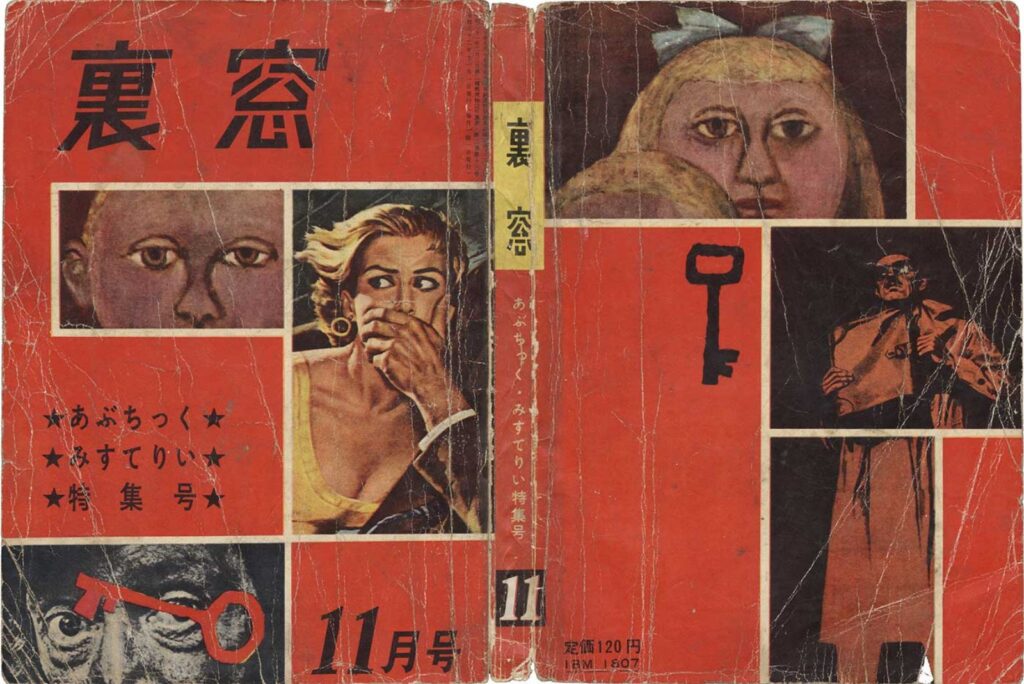
- The cover’s eyes, key, frightened woman, and shadowed figure announce a special issue devoted to abnormality, fear, secrecy, and mystery (PDF p. 1).
- “The Spirit of the Abandoned House” combines Gothic architecture, disappearance, threatened women, and detective investigation (PDF pp. 6–12).
- The opening fiction uses imported Western illustration styles to give postwar Japanese sensationalism an international Gothic appearance (PDF pp. 6–12).
- “The Woman Enveloped in Punishment” links captivity and erotic danger through foreign or adapted pulp fiction (PDF pp. 14–21).
- “Demon-Princess Transformation” begins the issue’s major historical-supernatural serial (PDF p. 23).
- The serial repeatedly turns a beautiful woman into a captive, fugitive, accused criminal, or supernatural object (PDF pp. 23–44).
- “The Woman Tied Upside Down” is an especially clear early use of inversion and helpless posture as illustrated spectacle (PDF pp. 25–26).
- Other episodes include theft, imprisonment, execution threats, a sealed coffin, a death well, tattooing, and a snake pit (PDF pp. 27–39).
- The repeated episode titles convert female suffering into an ordered visual catalogue of punishments (PDF pp. 25–39).
- “Night of Error” combines erotic obsession with darkness, confusion, and psychological disturbance (PDF p. 40).
- “The Prayer Master” presents ritual, hypnotism, fraud, and sexual manipulation through an investigative-report style (PDF pp. 41–44).
- “The Secret Room of Infection” joins sexuality to medical contamination, secrecy, and confinement (PDF pp. 43–44).
- “The True Form of This” promises to expose hidden identity and deception beneath ordinary appearances (PDF pp. 53–61).
- Historical adventure features such as “Sword in the Sleeve” use hidden weapons, threatened women, and concealed motives (PDF pp. 63–69).
- The issue demonstrates how bondage-like imagery remained distributed across horror, crime, historical punishment, and sexual pathology rather than existing only inside a dedicated SM genre (throughout).
Contributors
Named contributors represented in this issue:
- Akiyoshi Mitsu
- Asayama Seiji
- Fushimi Kazuo
- Hato Yō
- Iwahori Yasumitsu
- Jinkō Kyōichi
- Kawaguchi Eiji
- Kihara Yasuo
- Kuroki Shinobu
- Kyōgoku Miki
- Mano Rei
- Matsui Raiko
- Misaki Yōnosuke
- Miyake Ichirō
- Nakabayashi Setsuzō
- Nakano Mitsuo
- Narumi Genkichi
- Ōkōchi Jōhei
- Saka Minoru
- Sayama On
- Shimamoto Haruo; illustrations by Nakajima Kimi
- Suyama Mitsu
- Tai Ryōei
- Toba Eiko
- Ujigawa Ryū
- Yagyū Wataru