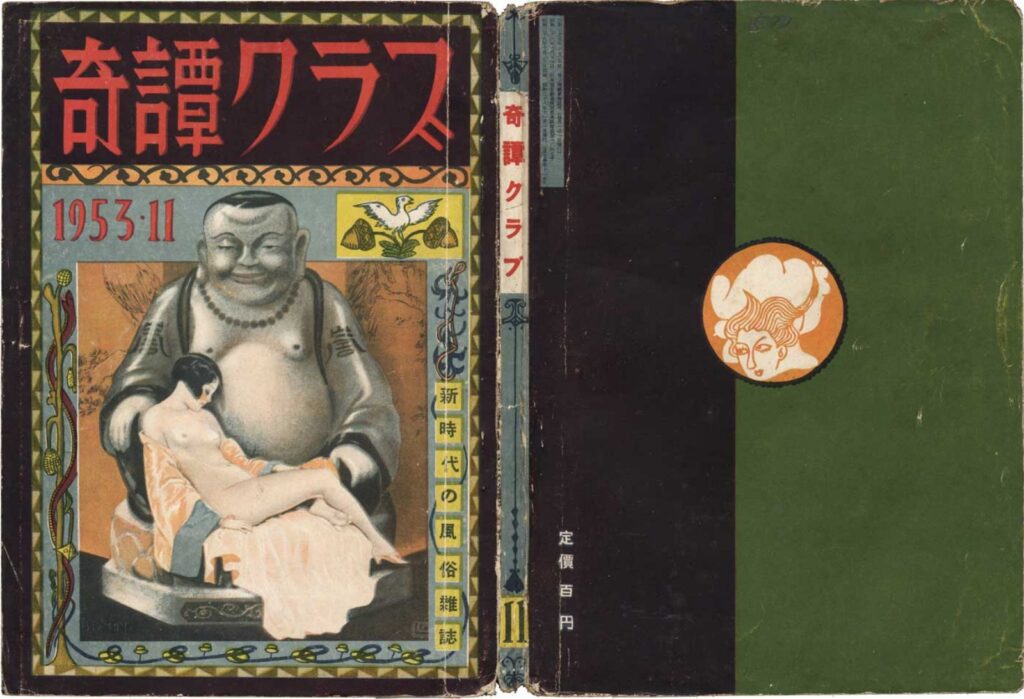
Kitan Club
November 1953
← Back to magazine archive
Issue Details
- PDF pages
- 181
Summary
The November 1953 issue of Kitan Club is a revealing mixture of rope instruction, staged bondage photography, confessional writing, erotic fiction, sexological discussion, autobiographical testimony, queer narrative, and translated Western sadomasochistic material. The issue’s 150 scanned PDF pages show the magazine moving beyond the broad “curiosity” format of its earlier years toward a more recognizable community of readers interested in bondage, sadism, masochism, fetishism, and sexual difference. At the same time, the issue remains heterogeneous. Practical rope material sits beside melodrama, medical classification, political memoir, literary criticism, and serialized fiction.
Read full summary Close full summary
Table of Contents 33 items
-
Ways of Binding a Woman to a Pillar or Pole
Summary
An illustrated practical guide presents seven ways to bind a woman to a pillar or pole, showing different rope arrangements and restrained positions.
-
Covered in Sand
Summary
An erotic photographic feature depicts a nude woman lying partially covered in sand in an outdoor setting.
-
Until a Woman Is Bound
Summary
A photographic instructional feature demonstrating how to bind a woman with rope, including wrist restraints, cross-body wrapping, seated and reclining positions, and methods for tightening and securing the finished arrangement.
-
Torture Chamber
Summary
An illustrated captivity-and-torture narrative in which Kaoriko is restrained by several men, subjected to coercive handling and humiliation, and pushed through escalating scenes of physical and psychological distress.
-
Bound in the Ravine
Summary
A photographic feature depicts a woman bound with rope in a rocky ravine and stream, using outdoor terrain and fixed positions as part of the staged restraint scenes. The accompanying text presents the images as an exploration of bondage in a natural setting.
-
My Five Punishments
Summary
An illustrated portfolio presents five staged punishment scenes involving women tied with rope in settings including a piano, a railing, and other interior or architectural spaces. The drawings emphasize immobilization, exposure, and punitive bondage imagery.
-
Fantasy of the Snake Man
Summary
An illustrated erotic fantasy follows a physically unimpressive man who abducts a young woman to an abandoned mountain temple, where he imagines dominating and abusing her. The accompanying drawings portray the snake-man motif and scenes of coercion, captivity, and sexualized domination.
-
Abnormal Group: Female Seppuku Fantasy
Summary
A photographic feature presents staged images of a woman enacting a seppuku fantasy, with accompanying text explaining that the scenes are simulated and discussing safer methods for future photography. The sequence combines eroticized execution imagery with theatrical bodily poses and restraint-like scenarios.
-
Male Artistic Nudes and Male Nude Studies
Summary
A photographic feature presenting posed male nude studies, including studio-style artistic portraits and images of a man shown in a restrained pose. The emphasis is on male form, pose, and eroticized visual presentation.
-
Tight-Binding Photo Parade, Part Five
Summary
The fifth installment of a photographic parade of male bondage scenes, arranged as a large grid of sequential images. The photographs show nude or lightly clothed men in varied rope-bound, immobilized, and sometimes outdoor poses.
-
Confession of a Self-Tormenting Demon
Summary
A first-person confession describing an intense fixation on anal sexuality, humiliation, and submission to women. The narrator recounts and imagines elaborate abusive, restrictive, and fetishistic scenarios, including chained or otherwise constrained male bodies.
-
A Perverse Erotic Letter
Summary
An erotic letter addressed to a woman, combining romantic address with highly transgressive fantasies of sexual domination, anal penetration, bodily exposure, restraint, and pain. The accompanying illustrations reinforce the text’s staged, sensational imagery of female control and male vulnerability.
-
Nostalgia for White
Summary
An autobiographical essay tracing the author’s lifelong fascination with the whiteness of women’s skin, from childhood impressions and erotic fantasies to adult encounters, marriage, and domestic sexual life. The narrative links this fetishized ideal of whiteness with voyeurism, memory, and changing sexual expectations.
-
Bewitched by Rope
Summary
A first-person erotic memoir about becoming obsessed with rope bondage, describing the discovery, practice, and intensification of tying and restraint in domestic and workplace-related settings. The account also refers to bondage imagery and the circulation of photographs and letters within specialist erotic publishing.
-
Spiders and Butterflies, Part Two
Summary
The second installment of a serialized erotic novel follows a film-studio scenario in which performers and assistants manipulate a woman through staged bondage, restraint devices, forced poses, and escalating humiliating performances. The narrative combines backstage film production with coercive fantasy and sadomasochistic spectacle.
-
Abnormal Fairy
Summary
A short sexological essay considers “abnormal” sexual behavior through the relationship between bodily impulses, mental life, desire, shame, and gendered expectations. It presents sexual psychology as a way of interpreting unusual erotic interests and interpersonal conduct.
-
Mistaken for a Writer of Torment
Summary
In this humorous autobiographical essay, Matsui Kayoko describes repeatedly being mistaken for an expert or author of sadistic bondage because of her association with erotic magazines. The account develops through conversations, awkward social encounters, and illustrated scenes depicting women being tied and physically restrained.
-
Record of Abuse: Notes of a Repatriate from Communist China, Part One
Summary
A first-person account by a Japanese repatriate describing detention in Communist China, interrogation, forced labor, beatings, humiliation, and other forms of mistreatment. The piece is presented as sensational documentary testimony about captivity and political abuse.
-
The Allure of Women’s Feet
Summary
An illustrated essay on the erotic fascination with women’s feet, combining personal anecdotes, imagined scenes, and observations about stockings, bare feet, and men’s responses to foot imagery. It treats the foot as a fetishized body part within mid-century erotic visual culture.
-
The Life of Kinezumi Kichigorō
Summary
A sensational historical account of Kinezumi Kichigorō, an Edo-period thief whose capture is followed by repeated interrogations and severe corporal punishment. The narrative emphasizes his extraordinary physical endurance, the authorities’ escalating methods, and his eventual death, accompanied by dramatic illustrations of torture and execution.
-
Methods for Constructing a Torment Stage, Part Two
Summary
A practical guide to constructing and presenting a “torment stage” for theatrical or photographic scenes. It discusses stage dimensions, backdrops, props, lighting, color, paint, and scenic composition, with diagrams showing how to create a convincing Japanese-style setting.
-
Smoldering Fire, Part Eleven
Summary
This installment of the serialized erotic fiction follows a tangled conflict involving jealousy, deception, photographs, money, and marital betrayal. The plot escalates into abduction, violent coercion, and elaborate rope restraint before the characters move toward confrontation and escape.
-
Dr. Kangyoku’s Sexuality Consultation
Summary
A sexuality-consultation column answers a young female university student who is intensely attracted to women’s bodily scent and worries that the preoccupation is disrupting her studies and relationships. The response frames the interest as a possible fetishistic tendency, while distinguishing unusual desire from illness and encouraging perspective and broader social development.
-
From the Notebook of a Certain Sexual Masochist, Part Two
Summary
A first-person masochistic memoir describing participation in a secret club where leather-clad women and male attendants stage scenes of domination, humiliation, whipping, and forced submission. The episode emphasizes the narrator’s fascination with female authority, fetish clothing, and ritualized punishment.
-
Amphibious Animal, Part Three: A Tale of Male Homosexuality
Summary
A serialized epistolary tale centered on male homosexual desire, correspondence, fantasy, and encounters between men. Its letters and accompanying illustrations develop themes of same-sex attraction, erotic longing, secrecy, and emotionally charged relationships across changing social settings.
-
Cursed Rope
Summary
Presented as a police statement concerning the death of Nishida Kotoe, this crime-centered narrative recounts a husband’s escalating rope bondage, humiliation, coercive sexual abuse, and sadistic violence against his wife, culminating in lethal injury. Its case-file framing and accompanying illustration give the piece a sensational documentary character.
-
The Traveling Actor of Ecstatic Cruelty
Summary
A serialized erotic narrative follows a traveling theatrical troupe whose performances and backstage life revolve around coercive bondage, punishment, humiliation, and sexual domination of its actresses. The troupe’s increasingly elaborate staged scenes blur theatrical spectacle with sadistic abuse, while the accompanying illustrations visualize its rope-bound performers and eroticized cruelty.
-
Torment in Modern Literature
Summary
An essay examining representations of torment, cruelty, and eroticized suffering in modern literature. It surveys literary works and authors to consider how sadistic and masochistic impulses, desire, and psychological conflict appear in modern narrative.
-
Masochist and Sadist
Summary
A fictional narrative about a relationship structured by sadistic and masochistic desire, escalating physical control, humiliation, and coercive sexual encounters. The story is accompanied by erotic illustrations depicting the characters’ scenes of restraint and domination.
-
The Sweet Surrender of Alice, Part Four
Summary
Part four of the serialized erotic narrative follows Alice as she is repeatedly tied to chairs and poles, gagged, exposed, and subjected to coercive sexual teasing and punishment by the male narrator. The installment escalates through elaborate rope restraints, immobilization, humiliation, and Alice’s eventual reluctant submission, accompanied by bondage illustrations.
-
Love Slave, Part Eleven
Summary
The eleventh installment of a serialized erotic narrative follows a tense hospital-centered confrontation involving injured characters, nurses, deception, financial pressure, and escalating control. Its scenes of capture, binding, humiliation, and coercive sexual power are presented as fictional fantasy.
-
Women’s Trousers: A Final Answer
Summary
An essay presents a concluding discussion of women’s trousers, tracing their historical and social significance through changing fashions, military and occupational dress, and debates over gender roles. It argues that clothing reflects broader shifts in women’s status, mobility, autonomy, and equality.
-
A Secret History of Beautiful Princesses149–150, incomplete in scan
Summary
A historical-style erotic narrative about a beautiful princess whose relationships with young men and warriors are framed through contrasting sadistic and masochistic desires. Set against warfare, siege, surrender, and ritualized violence, the story culminates in bloodshed and self-sacrificial death.
Highlights
- A numbered illustrated plate demonstrates seven ways of binding a woman to a pillar, pole, or chair, turning restraint into a comparative technical repertoire (PDF p. 5).
- The color frontispiece “Covered in Sand” places a nude bound woman outdoors and uses landscape as part of the bondage composition (PDF p. 6).
- “Until a Woman Is Bound” documents the progression from ordinary clothing to behind-the-back restraint, chest binding, exposure, and gagging (PDF pp. 7–9).
- “Torture Chamber” presents a multi-page illustrated progression of rope, furniture restraint, and coercive handling (PDF pp. 10–13).
- “Bound in the Ravine” photographs a woman tied beside a stream in several crouching and seated positions (PDF pp. 14–15).
- “My Five Punishments” depicts women whipped, inverted, and restrained under female authority (PDF pp. 16–17).
- “Fantasy of the Snake Man” joins rope, criminal fantasy, implements, and serpentine imagery (PDF pp. 18–19).
- “Confession of a Self-Tormenting Demon” uses first-person testimony to explore compulsive masochistic desire (PDF pp. 25–30).
- “Bewitched by Rope” presents bondage through an apparently female confessional voice and foregrounds the receptive subject’s sensations (PDF pp. 40–44).
- “Mistaken for a Writer of Torment” examines the unstable relationship among erotic authorship, reputation, persona, and presumed experience (PDF pp. 54–62).
- “The Allure of Women’s Feet” turns a specific bodily fetish into sustained autobiographical and analytical writing (PDF pp. 67–70).
- Itō Seiu’s “Methods for Constructing a Torment Stage,” Part Two explains how rooms, beams, platforms, furniture, and landscape can frame the restrained body (PDF pp. 79–82).
- “Amphibious Animal,” Part Three gives extended narrative form to male homosexual desire, secrecy, and social isolation (PDF pp. 97–100).
- Nureki Chimuo’s “The Traveling Actor of Ecstatic Cruelty” uses etsugyaku as a literary category linking pleasure, performance, cruelty, and bodily display (PDF pp. 107–118).
- “Torment in Modern Literature,” “Masochist and Sadist,” “The Sweet Surrender of Alice,” and “Love Slave” connect literary criticism, erotic classification, translation, and serialized submission fantasy (PDF pp. 119–144).
Contributors
Named contributors represented in this issue:
- Amadoro Seiei
- Araki Tamotsu, Takizawa Reiko
- Azuma Shin
- Gyōda Kazuko, Tsuzuki Shigeru
- Hida Kinryōji
- Hōkizan; illustrations by Kanayama Kinshaku
- Itō Seiu
- Jōshiki Sensei
- Kameoka Genichirō
- Kanemaru Sōkichi
- Kawamada Shirō
- Kawamura Tetsuo
- Maejima Yoshio
- Matsui Eiko; illustrations by Kurihara Shin
- Matsui Kayoko
- Midori Takehiko; illustrations by Sanjō Haruhiko
- Mishima Toshio
- Mitomi Senshō
- Muramura Takashi, Okada Shigeo
- Murata Seiichi
- Nureki Chimuo; illustrations by Tsuzuki Hachiko
- Oka Shinshirō; illustrations by Kiuchi Tsunekawa
- Sugiura Nijiko
- Tokiyama Kayoko
- Tomioka Haruo
- translated by Samukawa Midori
- Tsujimura Takashi
- Tsukamoto Tetsuzō