Yomikiri Romance
November 1952
← Back to magazine archive
Issue Details
- PDF pages
- 265
Summary
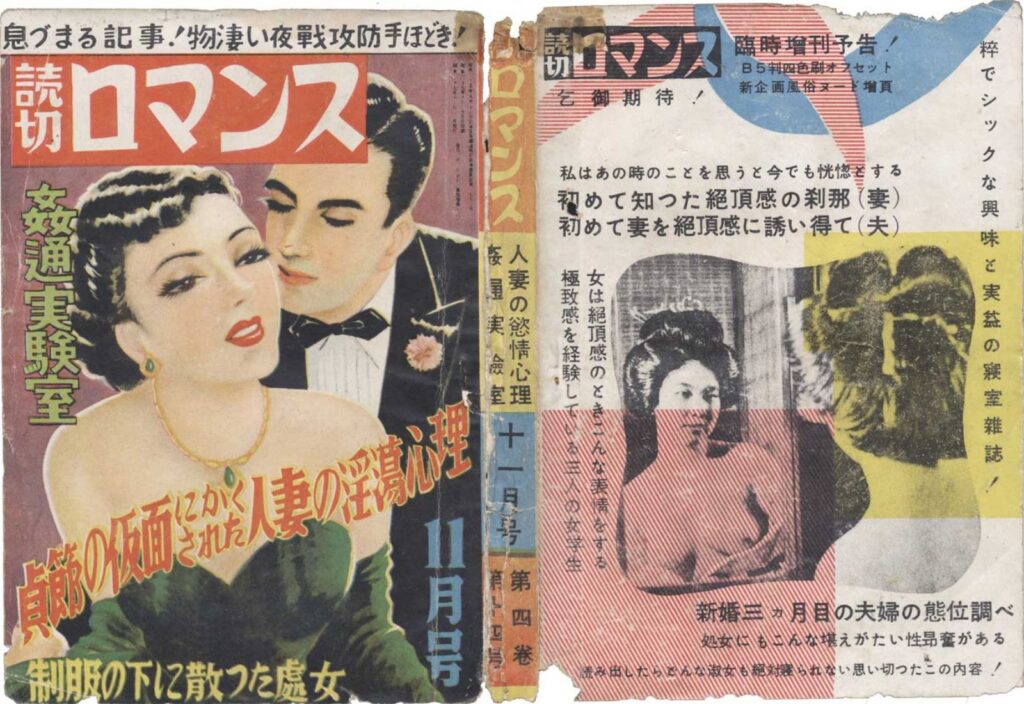
The November 1952 issue of Yomikiri Romance is a sprawling popular-erotic magazine built around the hidden desires, dangers, and contradictions of modern sexual life. Its 150 PDF pages combine color illustration, staged nude photography, bondage imagery, marital confession, adultery narratives, crime reportage, wartime atrocity stories, medicalized discussion of sexuality, humor, and pulp fiction. The issue is not yet an SM magazine in the focused sense that Fūzoku Sōshi or later Uramado would become. Instead, it offers a crowded cultural marketplace in which rope, coercion, female desire, crime, voyeurism, and sexual psychology appear as neighboring forms of “secret knowledge.”
Read full summary Close full summary
Table of Contents 17 items
-
A Walk Through the Back Streets of Life
Summary
A multi-page illustrated social satire follows a husband and wife in an increasingly crowded household, depicting marital intimacy, repeated childbearing, infant care, and the exhaustion of supporting a large family. The sequence uses humorous exaggeration and dialogue to portray the pressures and absurdities of ordinary domestic life.
-
The Woman Who Delights in the Torments of Erotic Cruelty
Summary
A sensational illustrated sexological narrative about a woman who experiences pleasure through humiliation, physical punishment, and other forms of erotic cruelty. Combining fictionalized scenes, dialogue, and explanatory commentary, it follows her relationships with domineering men and frames her desires as a form of abnormal sexual psychology.
-
Probing the Psychology of a Married Woman’s Desire
Summary
A serialized, illustrated popular-psychology feature examines the desires and frustrations of married women through sensationalized fictionalized case histories. Its vignettes portray extramarital attraction, sexual dissatisfaction, seduction, jealousy, and the tension between domestic respectability and private impulses, often framed as reported consultations or testimonies.
-
The Night Visitor
Summary
An illustrated serialized erotic narrative about a married woman whose dissatisfaction and emotional restlessness lead to clandestine encounters with other men. Through dialogue, seduction, jealousy, and domestic deception, the story presents adultery as a form of psychological and sexual conflict within marriage.
-
My Secret Record of Sexual Crime
Summary
A sensational confession-style crime narrative in which a male offender recounts repeated sexual assaults against women, describing coercion, pursuit, concealment, and attempts to evade detection. Illustrated scenes and police-investigation passages frame the account as a reconstructed criminal case.
-
Live Report on the Condemnation of a Razor-Wielding Rapist
Summary
A sensational illustrated crime report reconstructing the assault of Japanese women by a razor-wielding foreign soldier and the ensuing efforts to identify, condemn, and apprehend him. Combining dramatized scenes, dialogue, and reportage, it emphasizes victims’ vulnerability and resistance amid postwar urban disorder and the presence of occupation troops.
-
The Maid Driven Mad by Abstinence and Seppuku
Summary
An illustrated historical-sexual feature examines the secluded women’s quarters of Edo Castle, portraying the strict prohibition on male contact and the resulting frustration, clandestine relationships, same-sex encounters, and use of sexual substitutes among palace attendants. It combines anecdotal scenes of erotic disorder, coercion, violence, and desperate acts with commentary on the customs and social organization of the Ōoku.
-
The Machine That Detects a Woman’s Erogenous Zones
Summary
A sensational pseudo-scientific feature presents a supposed machine for detecting women’s erogenous zones, using fictional demonstrations, measurements, electrical instruments, and dialogue between male investigators and female subjects. The accompanying claims compare male and female sexual responses while the comic illustrations frame the topic as provocative popular entertainment.
-
The Man Who Makes the Female Body Bloom
Summary
An illustrated popular-sexology feature about a man who claims to distinguish women by their bodily scents. Through anecdotes, staged demonstrations, dialogue, and comic scenes, it discusses body odor, menstrual and other bodily smells, perfumes, sexual attraction, and attempts to explain scent perception through physiology and psychology.
-
A Question-and-Answer Study of Contemporary Sexual Behavior
Summary
A sensationalized question-and-answer study of contemporary sexual behavior examining rape, sexual sadism, and rape-murder through fictionalized or reported case scenarios. It discusses perpetrators’ motives and behavioral patterns alongside forensic examination, bodily evidence, police investigation, and legal-medical interpretations of sexual violence.
-
The Body of the Masochistic Woman Is Drenched in Sweetness
Summary
An illustrated sexological essay examines female masochism, arguing that some women may experience sexual arousal amid pain, humiliation, domination, or coercive-looking situations. It discusses psychological and physiological explanations, contrasts women’s and men’s responses, and presents staged drawings of bondage, beating, and other sadomasochistic scenarios.
-
Adultery Laboratory
Summary
An illustrated erotic fiction serial about an adulterous relationship involving Shimazu, Yamasaki, and Shigeko. The story moves through seduction, secret sexual encounters, jealousy, deception, and a final confrontation as the affair destabilizes the characters’ marriages and social lives.
-
A Kaleidoscope of Maid Eroticism
Summary
An illustrated serialized erotic narrative portraying household maids in flirtatious, adulterous, and coercive sexual encounters with employers and other men. Through melodramatic dialogue, comic panels, and recurring scenes of domestic service, the feature explores unequal gender and class relations within the household.
-
Let the Location Become Field or Mountain
Summary
A humorous, episodic account of film-location work follows actors, actresses, directors, assistants, and local crews through chaotic shoots in rural and resort settings. The piece satirizes production logistics, mismatched expectations, romantic entanglements, unruly performers, and the comic hardships of making films away from the studio.
-
Motion-Picture Erotic Slang
Summary
A humorous illustrated glossary of erotic and vulgar slang used in Japan’s motion-picture industry, explaining terms, their meanings, usage, and supposed origins. The article presents backstage anecdotes and conversations involving actors, actresses, studio workers, photographers, and other film-world figures.
-
The True Form of the Red Erotic Offensive
Summary
A sensational illustrated exposé portraying the supposed “red erotic offensive” as a communist strategy of sexual corruption, social infiltration, and political subversion. Presented through dramatized conversations, case narratives, and cartoons, it links erotic manipulation and promiscuity with recruitment, espionage, coercion, and the undermining of workplaces, families, and public morality.
-
A Private Edition of The Carnal Prayer Mat
Summary
An illustrated erotic-comic fiction in which ambitious men and women pursue romance, money, status, and sexual advantage through flirtation, deception, and social maneuvering. The episodes follow characters including 好太 and 澄江 through encounters involving offices, travel, nightlife, and transactional relationships.
Highlights
- The color opening establishes the issue’s focus on marriage, seduction, alcohol, jealousy, and the supposedly hidden erotic life of wives (PDF pp. 2–7).
- The illustrated contents spread presents the issue as a mixture of marital psychology, erotic confession, crime, photography, and sensational reportage (PDF p. 8).
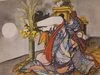
- A dramatic color plate depicts a kimono-clad woman confronted by a forceful male figure, blending domestic melodrama with sexual threat (PDF p. 9).
- The special nude-photo section introduces the body as an object of photographic study before the issue turns explicitly to rope (PDF p. 10).
- “Two Studies in Binding” presents two tightly restrained nude poses emphasizing wrists, shoulders, back tension, and bodily compression (PDF pp. 11–12).
- “Garden of Hell” begins as a sailor-uniform fantasy and gradually transforms a domestic Japanese interior into a scene of exposure and restraint (PDF pp. 13–17).
- A satirical illustrated sequence titled approximately “The Wandering Backstreets of Life” depicts prostitution, voyeurism, and sexual commerce through grotesque humor (PDF pp. 18–25).
- The major feature on married women’s sexual psychology opens with the image and headline “The Woman Who Delights in the Torment of Sexual Cruelty” (PDF pp. 26–28).
- The feature repeatedly frames female pleasure as a secret revealed through violence, humiliation, watching others, or the collapse of ordinary restraint (PDF pp. 29–46).
- A second major group of articles examines husbands who test their wives’ desires, wives drawn to strangers, and marriages destabilized by hidden fantasies (PDF pp. 47–58).
- “The Adulterous Psychology of the Wife Hidden Behind a Mask” introduces a long series of purported case histories involving affairs, hotels, travel, and secret encounters (PDF pp. 59–78).
- The crime-reportage section opens with the illustrated “Record of Crimes Against Women” and an account of women killed during bombing and wartime chaos (PDF pp. 79–83).
- Stories involving occupation personnel, soldiers, refugees, and sexual violence turn postwar history into a sensational archive of female danger (PDF pp. 84–96).
- “A Cross-Section of Urban Vice” surveys black markets, prostitution, violence, and sexual disorder within the modern city (PDF pp. 97–122).
- The closing sections move from Edo and Ōoku sexual intrigue to a fetishistic account of a man who claims to distinguish women through bodily scent (PDF pp. 123–150).
Contributors
Named contributors represented in this issue: