Fuzoku Kitan
May 1960
← Back to magazine archive
Issue Details
- Issue
- 5
- PDF pages
- 155
Summary
The May 1960 issue of Fūzoku Kitan presents an unusually concentrated examination of homosexuality alongside the magazine’s customary mixture of sadomasochistic photography, sexual folklore, criminology, fiction, confession, historical miscellany, and erotic visual culture. Its substantial opening section begins with Japanese erotic-print reproductions, photographs of sexually suggestive natural forms, a signed foreign comic illustration, a color fantasy image, and an extended sequence of staged bondage photography. Most of these gravure portfolios are editorial features without printed photographer, model, writer, or director credits. The identifiable opening artists include Suzuki Harunobu for the bathhouse print and Hérouard for “The Swing.” A concluding art portfolio reproduces European paintings, including works identified in captions with Rubens, while leaving the magazine compilation itself uncredited.
Read full summary Close full summary
Table of Contents 42 items
-
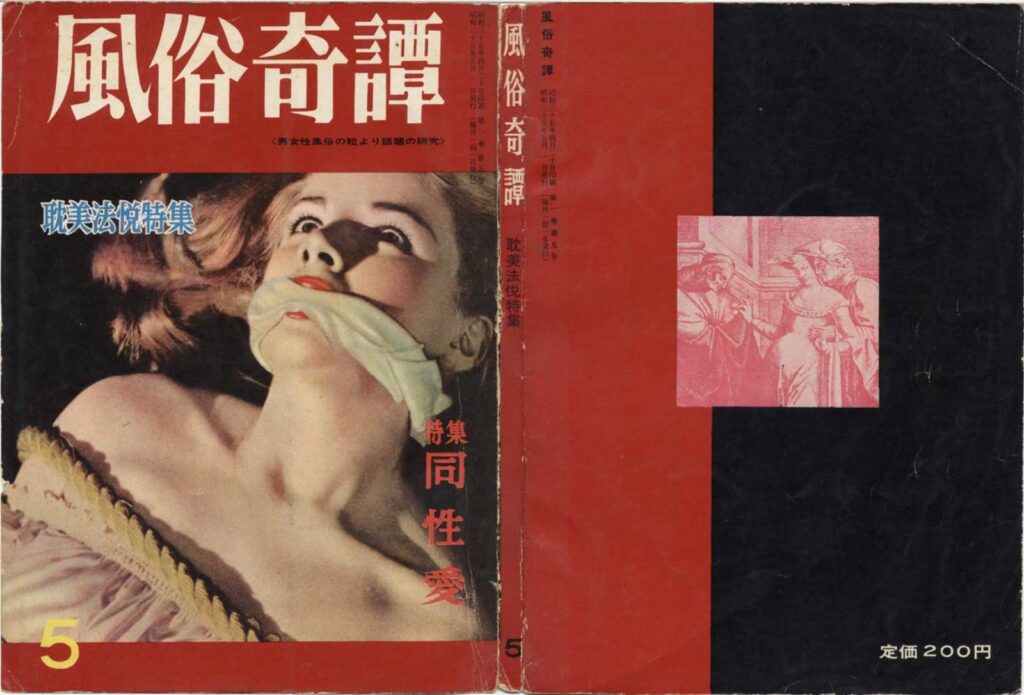
May 1960 Cover: Special Issue on Homosexuality and Pleasurable Humiliation
Summary
The May 1960 cover announces a special issue devoted to homosexuality and pleasurable humiliation, pairing the theme with a staged erotic photograph of a woman.
-
Meeting on a Boat
Summary
A shunga-style illustration depicts an intimate encounter between two women aboard a boat, emphasizing privacy, voyeuristic absence, and the transgressive pleasure of being away from public eyes.
-
At the Bathhouse
Summary
A shunga-style bathhouse illustration portrays erotic touching between women after bathing, using the private bathing space as a setting for same-sex intimacy.
-
Male Tree and Female Avenue
Summary
A photographic feature contrasts a single male-designated tree with a female-designated avenue of trees, identified as scenes from gardens in Britain.
-
Formal Table of Contents
Summary
The formal contents page enumerates the issue’s essays, fiction, visual features, and special material concerning same-sex desire, sexual psychology, fetishism, and humiliation.
-
The Swing
Summary
Hérouard’s two-panel erotic illustration depicts a woman swinging so that her skirt rises and her exposed body descends toward an entranced gentleman below.
-
Captured Mermaid
Summary
An erotic illustration depicts a nude woman presented as a captured mermaid, bound with ropes among wooden beams and posed as an object of captivity.
-
Women and Animals
Summary
This visual feature assembles erotic images of women alongside animals, drawing on both illustrative and photographic representations of human–animal fantasy and spectacle.
-
Captured Mermaid
Summary
A photographic sequence shows a woman staged as a captured mermaid, repeatedly restrained with rope, gagged, and posed in submissive positions while awaiting further punishment.
-
Nude Tight Binding
Summary
A photographic portfolio depicts a nude woman in tightly bound poses, emphasizing full-body rope restraint and contorted positioning.
-
When a Woman Is Bound
Summary
This photographic feature presents a woman being bound in a series of staged scenes, accompanied by text about desire, submission, whipping, abuse, and erotic intoxication.
-
Painful Sacrifice
Summary
A staged photographic sequence shows a woman in checked clothing tied and forced into painful, humiliating positions on the floor and against furniture.
-
Bound Glossy Skin
Summary
A photographic portfolio presents a woman in lingerie bound with rope in a series of reclining, seated, and contorted poses, emphasizing the erotic visual appeal of restrained skin and bodies.
-
Chair Torment
Summary
This photographic feature explores “chair torment” through staged scenes of a woman gagged and rope-bound to or around a chair in various strained positions.
-
Beauty in Darkness
Summary
A darkly poetic photographic vignette portrays a young “mermaid” captured in a fisherman-like net, bound so tightly that she discovers sensual pleasure beyond her former watery world.
-
Night of Pleasurable Cruelty
Summary
A photographic feature depicting a woman subjected to staged restraint and pleasurable cruelty, emphasizing bound positions and the visual drama of domination.
-
Abnormal Sexuality in Famous Paintings
Summary
An illustrated survey of erotic and allegedly abnormal sexual motifs in famous paintings, including seduction, coercion, voyeurism, and nude encounters drawn from classical art.
-
May 1960 Issue Title Page
Summary
The May 1960 title page for Fuzoku Kitan, presenting the issue as a special feature edition devoted to erotic and sexological themes.
-
Types and Realities of Homosexual Love
Summary
A sexological essay classifies forms of same-sex desire and discusses their psychological, bodily, behavioral, and social manifestations, including gendered presentation and relationships between male and female same-sex partners.
-
Romantic Memoir of a Feminine Man
Summary
A first-person romantic memoir recounts the experiences of a feminine-presenting man, including his attraction to men, efforts to pursue relationships, and tensions between personal desire and social expectations.
-
How a Homosexual Youth Came to Commit Murder
Summary
Sensational reportage reconstructs how a homosexual youth’s romantic fixation, family isolation, emotional distress, and escalating plans culminated in the murder of several people, presenting the case through investigative detail and psychological interpretation.
-
Homosexual Love Among the Warriors of the Warring States
Summary
A historical essay surveys same-sex desire among Warring States warriors, focusing on relationships between powerful warlords and their attractive male companions and using anecdotes about figures such as Oda Nobunaga, Mori Ranmaru, Akechi Mitsuhide, and Toyotomi Hideyoshi.
-
The Sodomy-Loving Head Clerk
Summary
An erotic narrative about a head clerk centers on male-male anal desire, sexual pursuit, and the social tensions surrounding clandestine homosexual relations.
-
Ecstasy Between White-Skinned Women
Summary
An erotic narrative follows two white-skinned women whose mutual attraction develops into explicit sexual intimacy, including restraint, spanking, and other disciplinary play, accompanied by illustrated scenes of their encounters.
-
Pictorial Fetishism
Summary
An essay examines the erotic fetishization of pictorial representations, discussing idealized female imagery in Japanese art and the psychological response such images evoke in male viewers.
-
Sacher-Masoch’s Contract of Abuse
Summary
A biographical and literary discussion of Leopold von Sacher-Masoch and Venus in Furs explores the relationship between masochistic desire, female authority, and the written contract of marital abuse, including reconstructed contractual rules and their implications.
-
The Masochist’s Fine Wine
Summary
A first-person erotic narrative portrays an encounter with a commanding woman and a masochistic male partner, escalating through coercive sexual play, physical punishment, humiliation, and anal-focused acts.
-
People Who Fell in Love with Ghosts and Married Them
Summary
A folkloric and historical survey of people who formed romantic relationships with ghosts and, in some accounts, married them, recounting supernatural unions and their tragic consequences across East Asian stories.
-
Tortures Inflicted Only on Women
Summary
A sensational historical account of torture inflicted on women, describing interrogation, bodily abuse, humiliation, and sexualized violence through reported cases, documentary references, illustrations, and photographs.
-
A Woman’s Seppuku
Summary
A sensational historical feature on women’s self-disembowelment and forced or attempted seppuku, presenting several case narratives alongside discussion of the social, emotional, and bodily circumstances surrounding these deaths.
-
The Beauty Who Became a Sadist’s Prey
Summary
A sensational crime report surveys American cases in which women were abducted, sexually abused, tortured, and sometimes murdered by sadistic offenders, followed by discussion of investigations, trials, and punishments.
-
A Study of Sexual Tattoos
Summary
This illustrated study examines sexual tattooing across cultures and periods, discussing tattoos placed on or associated with sexualized parts of the body, their meanings, and their roles in erotic display and sexual psychology.
-
A Tangled Marriage
Summary
An erotic fictional narrative follows a tangled marriage in which a brother and sister exchange or assume bridal and groom identities, creating family confusion, coercive expectations, and sustained gender-role reversal.
-
A History of Sexual Curiosities in the Meiji Period, Part 4
Summary
A historical survey of Meiji-era sexual curiosities recounts sensational newspaper cases and popular erotic amusements involving prostitution, bathhouse and entertainer culture, illicit sexuality, and unusual crimes, illustrated with period images and clippings.
-
The Man Who Ate Women’s Flesh
Summary
A sensational crime narrative follows a man whose obsessive desire for women culminates in sexual violence, murder, and the consumption of human flesh, blending investigative reportage with grotesque erotic imagery.
-
Night of the Beast
Summary
A dark erotic story depicts a married woman drawn into coercive sexual encounters and voyeuristic observation before her husband responds with humiliation, domination, and physical punishment.
-
Cruel Tales of the Harem
Summary
A sensationalized historical account of Ottoman harem life, focusing on sultans, powerful favorites such as Roxelana, palace intrigue, sexual domination, and stories of confinement, violence, and execution.
-
The Allure of Belts
Summary
A first-person fetish memoir centered on the erotic allure of belts, including scenes of spanking, restraint, voyeuristic observation, and humiliating domestic sexual play across wartime and postwar settings.
-
Midnight Murder Show
Summary
A sensational erotic murder-show narrative presented through staged interviews and dramatic scenes involving a woman on an operating table, knives, blood, screams, restraint, and repeated mock or imagined killings.
-
Razor-Blade Writing on a Woman’s Skin
Summary
A sensational erotic narrative in which Kawasaki restrains Yaechiko and carves written messages into her skin with a razor, combining captivity, bodily punishment, and humiliating domination before the story’s criminal consequences unfold.
-
A Dangerous Conversation
Summary
A dialogue-centered erotic story about newlyweds whose seemingly ordinary conversation exposes troubling sexual fantasies, forbidden desires, and the psychological tensions within their relationship.
-
The Abnormal Sexual History of Fukiage Satarō
Summary
A sensationalized criminal case history follows Fukiage Satarō from childhood and adolescent sexual misconduct through repeated assaults, abductions, murders, prison escapes, and eventual conviction, presenting his conduct as an abnormal sexual biography.
Highlights
- The opening visual section combines Japanese erotic-print reproductions, photographs of sexually suggestive trees, signed foreign comic art, women-and-animals imagery, and a long sequence of staged bondage photography. (PDF pp. 2–23).
- The right-hand erotic print on PDF page 2 is explicitly credited to Suzuki Harunobu, while the attribution beneath the left-hand print remains difficult to read. (PDF p. 2).
- Hérouard’s signed comic illustration “The Swing” uses accidental exposure and slapstick eroticism, contrasting with the more severe bondage imagery that follows. (PDF p. 5).
- The staged gravure sequence presents women restrained with rope, chairs, fabric, and household architecture, with captions emphasizing capture, exposure, humiliation, pain, and pleasure. (PDF pp. 8–23).
- A visual survey of allegedly abnormal sexuality in European painting reproduces works attributed in the captions to Rubens and other artists as evidence for voyeurism, bestiality, fetishism, and sexual excess. (PDF pp. 24–27).
- Ōtachi Kinji’s lead essay classifies homosexuality into psychological and behavioral types and discusses gender presentation, bisexuality, male and female homosexual conduct, and contemporary social attitudes. (PDF pp. 29–36).
- A criminal case study follows a youth’s emotional attachment to another boy and the development of jealousy, isolation, and obsessive desire into planned homicide. (PDF pp. 39–44).
- The article on Sengoku warriors surveys traditions of male-male intimacy associated with military elites and famous historical figures, treating such relationships as culturally embedded rather than purely modern. (PDF pp. 45–49).
- The feature on Sacher-Masoch examines his biography, marriages, erotic imagination, and written contracts governing submission, domination, and punishment. (PDF pp. 59–63).
- The final third includes Meiji sexual curiosities, cannibalistic murder, harem cruelty, fetishistic attraction, nocturnal homicide, razor mutilation, sexual autobiography, contributor information, and the colophon. (PDF pp. 109–155).
Contributors
Named contributors represented in this issue:
- Asakawa Hisashi
- Bill Marcus
- Hanajima Seiji
- Hérouard
- Jinbo Kenzō
- Kamiyama Kōkichi
- Kashiwamura Midori
- Kido Giichi
- Klaus Arnaud
- Kosen Kyōta
- Masaki Shin’ichi
- Mase Teruo
- Nanamura Jirō
- Ōtachi Kinji
- Sano Kazuhiko
- Sengoku Sentarō
- Shinkawa Yūji
- Sō Shunzō
- Somei Keiichirō
- Suzuki Harunobu
- Takabayashi Shingo
- Takashima Shinroku
- Tsuki Kyōsuke
- Wakatsuki Yasuaki
- Yuasa Shigeji
English Translations from This Issue
- Sacher-Masoch’s Contract of Abuse — Mase Teruo