Article Summary
Mase Teruo presents Leopold von Sacher-Masoch as the historical source of the term “masochism” and interprets his literary career, marriages, and sexual relationships through a mid-twentieth-century Japanese sexological framework of “perverse sexuality.” The article moves from a short biographical sketch and discussion of Venus in Furs to three purported documents illustrating psychological as well as physical masochism: a six-month slavery contract with Fanny von Pistor, an extreme contract of submission attributed to Wanda von Zunaeff, and an anonymous X/Y contract associated with Krafft-Ebing. The contracts emphasize obedience, punishment, whipping, fur or velvet clothing, jealousy, humiliation, and the surrender of personal autonomy. Historically, the piece is notable as an example of how European masochism and Sacher-Masoch were explained to Japanese readers of Fuzoku Kitan in 1960, combining biography, popular sexology, translated documentary material, and sensational editorial framing.
Translation
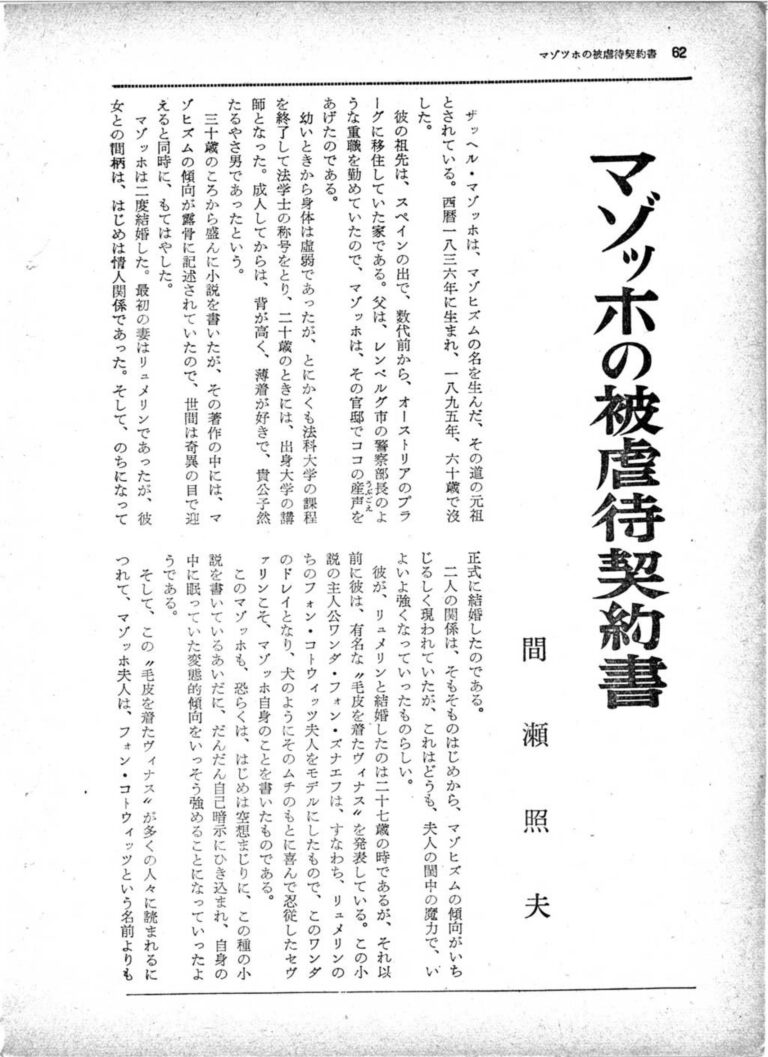
Sacher-Masoch’s Contract of Abuse
Mase Teruo
Sacher-Masoch, whose name gave rise to the term “masochism,” is regarded as the originator of that tendency. He was born in 1836 and died in 1895 at the age of sixty.
His ancestors were of Spanish origin and had moved several generations earlier to Prague in Austria. His father held an important post comparable to chief of police in Lemberg, and Masoch first cried out as a newborn in that official residence.
Although physically frail from childhood, he nevertheless completed the law course at university and received a law degree. At the age of twenty he became a lecturer at his alma mater. As an adult he was tall, lightly bearded, and reportedly a delicate-looking man with the air of a young aristocrat.
From around the age of thirty he wrote novels prolifically. Because masochistic tendencies were described openly in his works, the public regarded them as strange while at the same time making much of them.
Masoch married twice. His first wife was Rümelin. Their relationship began as that of lovers, and only later did they formally marry.
Masochistic tendencies were conspicuous in their relationship from the very beginning. It seems that the power his wife exercised in the bedchamber made those tendencies grow ever stronger.
Masoch married Rümelin when he was twenty-seven, but before then he had published the famous Venus in Furs. The novel’s heroine, Wanda von Zunaeff, was modeled on Rümelin, later Madame Wanda von Kotowitz. Severin, who becomes Wanda’s slave and joyfully submits beneath her whip like a dog, is a depiction of Masoch himself.
Masoch too, it seems, may at first have written this kind of fiction partly as fantasy, but in the course of writing it he was gradually drawn into self-suggestion, intensifying the perverse tendencies that had lain dormant within him.
As Venus in Furs came to be widely read, Madame Masoch came to be known to the public less by the name von Kotowitz than by the name Wanda, the heroine of the novel.
One might speculate that if Wanda had been a somewhat more cultivated woman with ideals, and had managed her husband more skillfully, Masoch might perhaps never have become the possessor of such pathologically perverse sexuality. Wanda appears to have been inwardly amused by Masoch’s submission to her like a slave and by his willingness to take any whipping with pleasure, and thus to have encouraged his perverse sexual inclinations more and more.
As a result, merely receiving physical pain no longer satisfied Masoch. Just as in his fiction, he wanted his wife deliberately to commit adultery with another man and then, together with her lover, to abuse him.
It is somewhat doubtful whether Wanda committed adultery reluctantly merely because Masoch wished it. In any event, she had relations with Rosenthal and repeatedly abused Masoch. But when Wanda and Rosenthal quarreled, Masoch too apparently lost interest in Wanda, and they divorced.
Masoch then married his second wife, whose name is printed here as “Fielder Meister.” Whatever method this woman used in governing their marriage, after this second marriage Masoch’s masochistic tendencies are said to have disappeared, and no amusing anecdotes of the same sort are left. He did, however, apparently retain his “fetishism toward fur.”
Viewed this way, the development and persistence of perverse sexuality can be greatly influenced by the manner in which one’s partner or spouse responds to it. Masoch, too, did not spend every moment pursuing perverse practices; he apparently also lived a normal sexual life. One indication is that he and Wanda had children. According to Wanda’s writings, Masoch soon divorced this second wife as well.
Masoch displayed his tendency not only in physical masochism but also on the psychological level. As examples, I will introduce three representative unilateral contracts of abuse said to have been written by Masoch.
The first is said to have been given by Masoch, when he was thirty-three, to his friend Madame von Pistor. It is said to have been made public by a person whose name is printed here as “Schlichtegroll.”
CONTRACT CONCLUDED BETWEEN MADAME FANNY VON PISTOR AND SACHER-MASOCH
Leopold von Sacher-Masoch solemnly promises here that he shall become the slave of Madame von Pistor and shall obey absolutely every demand and every command she may make. The period of this arrangement shall, however, be six months.
Madame Fanny von Pistor must not order Leopold to perform any dishonorable act. That is, she may not compel him to do anything that would cause him to lose his honor as a human being or as a citizen. She shall also grant Leopold six hours of freedom each day so that he may attend to matters belonging to his own sphere. She may not read Leopold’s diary or incoming letters. For negligence, failure to perform his duties, and especially for entertaining rebellious feelings toward her, Fanny von Pistor may punish her slave Leopold severely and entirely at her discretion.
In short, he must serve his mistress with absolute slavish obedience, regarding even the smallest kindness from her as the highest delight. He may neither demand his mistress’s love nor invoke any supposed rights arising from being her lover.
In return, Fanny von Pistor promises that, as often as possible, and particularly whenever she is to treat Leopold cruelly, she will wear fur.
(When six months have elapsed, this slave contract shall automatically become void, and neither party shall make any claim for compensation on account of it. Everything that has happened shall be washed away, and they shall return to their former romantic relationship.) This passage was later struck out.
The “six months” mentioned here does not mean six months of uninterrupted consecutive days. The arrangement may be suspended whenever circumstances require. In other words, at the lady’s discretion she may stop it on any day she wishes and, after an interval, begin it again on whatever day she chooses.
Beginning December 8, 1869
Fanny von Pistor Bagnov
Leopold Ritter von Sacher-Masoch
CONTRACT EXCHANGED BETWEEN MADAME WANDA VON ZUNAEFF AND MASOCH
My slave, in accepting you as my slave and keeping you near me, you must strictly observe the following articles:
1. Cast aside your ego absolutely.
2. Apart from serving me, you may possess no will of your own.
3. You are nothing but an instrument that obeys me. You must obey every one of my commands without answering back. If you forget that you are my slave or neglect your duty of obedience, I have the right to punish and chastise you in whatever manner I desire. You may not utter a single word of complaint about this.
4. If I should ever grant you pleasure or happiness, regard it as the greatest possible favor and receive it with the deepest gratitude. I, however, bear no obligation or responsibility toward you.
5. To me you are neither a child nor a friend. You are only a slave prostrate at my heel.
6. Not only your body but your mind belongs to me. Accordingly, I may make your sensations and emotions suffer as I please.
7. Every act of cruelty is permitted to me. Even if my abuse should leave you disabled, you must never resent it. You must continue to labor as my slave no matter what. Even if I trample you underfoot, you must not resent it but must kiss the foot that trampled you.
8. At times I may grant you freedom. But without my permission you may not leave my side for even an instant. If you attempt to escape me, I possess the privilege of imposing the cruelest and most severe punishment, even if in doing so I should cause your death.
9. You have no rights of your own. Everything about you is mine: your life, your future, your happiness, your unhappiness, your pain, your pleasure. I hold the keys to all of them.
10. Whatever I demand, whether good or bad, you must carry out immediately. If I order you to commit a crime, then for my sake you must even violate the law.
11. Your honor, like your blood, your mind, and your labor, is entirely subject to me. I hold the power of life and death over you.
12. If you cannot endure my rule and feel the slave’s chain to be too heavy, kill yourself. Under no circumstances will I grant you release from your bondage.
POSTSCRIPT
I hereby swear, as the slave of Madame Wanda von Zunaeff, that I shall never resist or disobey any demand whatsoever.
Doctor Leopold Ritter von Sacher-Masoch
This too is said to have been made public by “Schlichtegroll,” and is said to have been exchanged between Masoch and his first wife, Wanda.
AN UNADDRESSED CONTRACT
On this day, the following contract is concluded between Woman X and Man Y.
1. Man Y declares that he loves Woman X sincerely and respects her.
2. If Man Y should cease to love Woman X, he must declare this openly and respectfully to Woman X.
3. So long as Man Y loves Woman X, he may not leave City A without Woman X’s permission.
4. Whenever Man Y is at her side, Woman X shall always wear a velvet jacket.
5. Even if Woman X should enter into carnal relations with another man, she shall not separate from Man Y.
6. Woman X has the right to associate intimately with any man she likes. While Woman X is taking pleasure with that man, she shall treat Man Y as a friend or worshipper. If Man Y becomes jealous, she shall punish him especially by whipping him.
7. If Woman X should cease to love Man Y, she shall tell him so openly and respectfully. Man Y must then choose one of two alternatives: either abandon all future relations with Woman X, or remain near her as her slave.
8. Man Y shall never again be reconciled with Woman X.
9. Man Y shall compose a poem in which he praises Woman X, and shall dedicate the poem to her.
X Y Signatures
This document was obtained by Krafft-Ebing. Ebing says that it was probably a draft Masoch had prepared in advance while considering making such an agreement with some woman. Even so, one suspicious point is that the text uses the expression “velvet jacket” in place of fur.
Translation Notes
The Japanese title マゾッホの被虐待契約書 literally means something close to “Masoch’s Contract of Being Abused/Maltreated”; the supplied English title “Sacher-Masoch’s Contract of Abuse” has been retained. The article consistently uses period sexological language such as 変態性欲 (“perverse sexuality”) and ドレイ/奴隷 (“slave”). These terms are translated historically rather than modernized. “毛皮を着たヴィナス” is rendered as Venus in Furs. The printed Japanese form ワンダ・フォン・ズナエフ is retained in transliteration as Wanda von Zunaeff rather than silently correcting it to another historical spelling. The name シュリヒテゴロル is difficult to resolve from the printed form; “Schlichtegroll” is used provisionally. The second wife’s name appears as フィルダー・マイステル and is translated only as the printed form “Fielder Meister”; this should be checked against an external biographical source before publication. The phrase 夫婦統法 on PDF page 60 is unusual and may be a print or reading problem; the translation renders its apparent sense as the wife’s way of governing or managing the marriage. The parenthetical gloss after フェチシズム on page 60 is small and uncertain. In the first contract, several awkward Japanese constructions appear to reflect a translated source text. In the Wanda contract, the printed wording of the postscript after 抵抗または is unclear; it plainly conveys a pledge not to resist or disobey. ビロード on page 63 means velvet. The article ends on PDF page 63; PDF page 64 begins a different article.
Uncertain readings:
- PDF page 59: 「薄鬚が浮き」 — the description of Masoch’s appearance is faint; this reading is probable but not fully certain.
- PDF page 60: 「フィルダー・マイステル」 — the second wife’s name is difficult to read and may represent a different Japanese spelling.
- PDF page 60: 「夫婦統法」 — the printed compound is unusual and may be a typographical or reading issue.
- PDF page 60: 「節片淫乱症」 — the small parenthetical gloss following フェチシズム is difficult to verify character by character.
- PDF page 60: 「シュリヒテゴロル」 — Japanese transcription of a European surname; exact original-language spelling is uncertain from the page alone.
- PDF page 61: 「ファンニー・ピストル・バグノフ」 — the signature-line surname or appended name is printed in katakana, but its original-language spelling is uncertain.
- PDF page 63: 「抵抗または追背したない」 — the postscript is visibly awkward or unclear in print; it appears to mean that Masoch promises neither to resist nor disobey.