Kitan Club
May 1953
← Back to magazine archive
Issue Details
- PDF pages
- 173
Summary
The May 1953 issue of Kitan Club brings together translated European masochistic literature, Japanese rope analysis, autobiographical writing, serialized fiction, fetish studies, queer and gender-related material, wartime memory, historical cruelty, and staged bondage photography. More clearly than the preceding issues, it imagines masochism not only as an individual pathology or literary fantasy but as a possible social identity shared by people with compatible desires.
Read full summary Close full summary
Table of Contents 25 items
-
Women’s Punishment Grounds in Postwar Popular Prints
Summary
An illustrated survey examines depictions of women’s punishment and restraint in postwar popular fiction and erotic publishing. It compares scenes by different artists, publications, and narrative settings, presenting them as evidence of changing postwar erotic visual culture and its borrowings from earlier punishment imagery.
-
The Society of Masochists
Summary
A Japanese translation of Sophie Widemann’s French erotic novel Une Société de Masochistes, introduced by the translator and illustrated with scenes of domestic domination. The narrative follows Sofia as she trains Jan into an obedient household subordinate through commands, service, humiliation, corporal punishment, and foot-focused rituals, extending into an organized masochist society.
-
Various Forms of Punishment
Summary
A practical and psychological discussion of varied punishment scenarios, focusing on rope binding, restrictive positions, sensory discomfort, spanking, and the dynamics of sadistic and masochistic response. Illustrated examples show different ways of tying subjects, including prone restraint, limb binding, and suspension-related positions.
-
Miscellaneous Thoughts on Capture and Binding
Summary
An illustrated historical and technical survey of Japanese capture-rope methods, describing rope materials, lengths, knots, and numerous named patterns used to restrain arrested persons. The article connects traditional torinawa techniques with contemporary erotic bondage and emphasizes the practical effects of different forms of restraint.
-
My Record, Final Chapter
Summary
The final chapter of Kuroi Chinpei’s autobiographical record recounts his longstanding sexual fantasies, fetishistic interests, bondage-related imagination, and conflicted relationships with women and his wife. It also follows his encounters with Christianity, guilt, confession, and the tension between religious ideals and recurring erotic impulses.
-
Love Slave, Part Five
Summary
The fifth installment of Kitō Kōichirō’s serialized erotic fiction follows a married couple whose relationship develops into an elaborate “queen” role-play. The wife assumes increasingly dominant control over her husband through staged commands, humiliation, sensory play, and ritualized erotic discipline, blending domestic intimacy with fantasy submission.
-
At the Queen’s Feet
Summary
An erotic dominance fantasy centered on a submissive figure at the feet of a commanding queen, emphasizing hierarchy, surrender, and ceremonial submission.
-
The Martyr Who Is Imitated
Summary
Naruse Akira examines the recurring cultural image of the Christian martyr and its imitation in sadistic and masochistic imagination. The essay discusses Tokugawa anti-Christian persecution, torture and execution, religious sacrifice, authoritarian violence, and the psychological relationship between sadism and masochism.
-
Glass Toilet
Summary
A first-person erotic narrative centered on urination, public toilets, and the narrator’s increasingly intense fascination with women’s bodies and bodily functions. The story combines voyeuristic observation, fetishistic imagery, and scenes of private sexual fantasy.
-
A Dramatic Animal Tale
Summary
A satirical erotic story presented as a supposedly moralistic tale, following a widow and a younger man through sexual attraction, pursuit, marriage, and domestic life. Its comic dialogue and exaggerated plot use romance, economic calculation, and sexual desire to critique conventional moral judgments.
-
An Interlude Addressed to Kawabata
Summary
A reader writes to Kawabata about the beauty of bound bodies and asks about his personal history with bondage, including when his interest began, memorable experiences, and the circumstances behind his work and photographs for K.K. publications. The piece functions as an appreciative inquiry and informal interview request.
-
Boys and Women’s Seppuku
Summary
This historical-sexological essay surveys accounts of seppuku by boys and women, drawing on chronicles, literary works, theater, illustrations, and modern reports. It emphasizes the gendered symbolism, bodily spectacle, emotional drama, and eroticized presentation of abdominal cutting and self-sacrifice across Japanese history.
-
In the Laboratory
Summary
A first-person erotic confession recounts how a man becomes subject to a female physician’s laboratory experiments and increasingly submits to her authority. He is medically examined, injected, stripped, restrained in specialized apparatus, and subjected to humiliating and painful procedures that he experiences as masochistic pleasure.
-
Diary of a Female Beast
Summary
A serialized first-person SM narrative in which a woman recounts her abduction, confinement, and repeated rope bondage, gagging, and physical punishment by a dominant man. The melodramatic account intertwines captivity, humiliation, emotional dependency, and a continuing relationship framed through confession and fantasy.
-
The Hanged Swan
Summary
A first-person diary-style erotic narrative recounts the binding and suspension of a woman, detailing rope placement, posture, physical sensation, and the shifting interaction between the participants. The piece presents suspension as an intense scene of submission, control, and spectacle.
-
Snapshots of Tight Binding with Rough Rope
Summary
A photographic feature demonstrates tight binding with coarse hemp rope, showing multiple configurations involving the torso, breasts, arms, legs, and wrists. The accompanying text discusses rope selection, pressure, bodily sensation, and the visual presentation of different restraint positions.
-
Memories of Shanghai
Summary
Himeumi Shirō recalls his experiences in Shanghai, describing the city’s wartime and postwar transformation through its parks, cinemas, streets, theaters, and entertainment districts. The memoir pays particular attention to prostitution, public erotic performances, sexualized spectacle, and changing relations between Chinese and Japanese urban culture.
-
The Slave’s Rest
Summary
A first-person erotic narrative about a woman treated as a slave and subjected to elaborate bondage, humiliation, corporal punishment, and coercive sexual control. The story emphasizes her enforced submission and the sadistic fantasies of the men who restrain and discipline her.
-
The Bound Wife
Summary
A serialized erotic narrative recounting Sachiko’s transformation from a married woman into a bound and controlled wife. Through captivity, rope restraint, forced nudity, domestic discipline, and escalating abuse, the story develops a slave-wife fantasy centered on coercion and submission.
-
A Bitter Hand
Summary
A first-person erotic narrative recounts a woman’s short, destructive marriage to Onoda, a double-amputee war veteran whose physical dependence becomes the basis for her control and sexual revenge. Their domestic life is marked by humiliation, role reversal, coercive intimacy, and the narrator’s increasingly obsessive domination of him.
-
An Episode from the Vacuum Zone
Summary
A fictional wartime military anecdote set in the barracks world of the Japanese army, depicting soldiers’ sexual frustrations, intimate entanglements, and the disruptive presence of domestic relationships and desire during the final years of the war.
-
Diary of a Puritan
Summary
A first-person diary records a young man’s voyeuristic fascination with male beauty, including his intense response to a nude male photograph and his conflicted reflections on sexuality, desire, and a repressive upbringing.
-
The Criminal History of the Tyrant Ivan
Summary
A sensational historical account of Ivan the Terrible, portraying his reign through stories of political violence, torture, executions, massacres, and arbitrary cruelty toward nobles, servants, and ordinary people. The article emphasizes the tyrant’s sadistic character and the atmosphere of terror surrounding the Russian court.
-
Fire, Part Five
Summary
The fifth installment of Matsui Kōko’s serialized erotic novel follows a married couple whose encounters with artists and other outsiders awaken forbidden desires, jealousy, and shifting sexual roles. The narrative develops through adulterous intrigue, psychological conflict, and increasingly coercive scenes of restraint and domination.
-
Publication Notices and Advertisements
Summary
A cluster of editorial and publication notices for Kitan Club and KK Tsūshin explains submission guidelines, editorial policies, back-issue availability, subscription and direct-purchase arrangements, and the recruitment of special members and readers. It also includes a call for fiction and other reader contributions, emphasizing the magazine’s ongoing participatory publishing and distribution activities.
Highlights
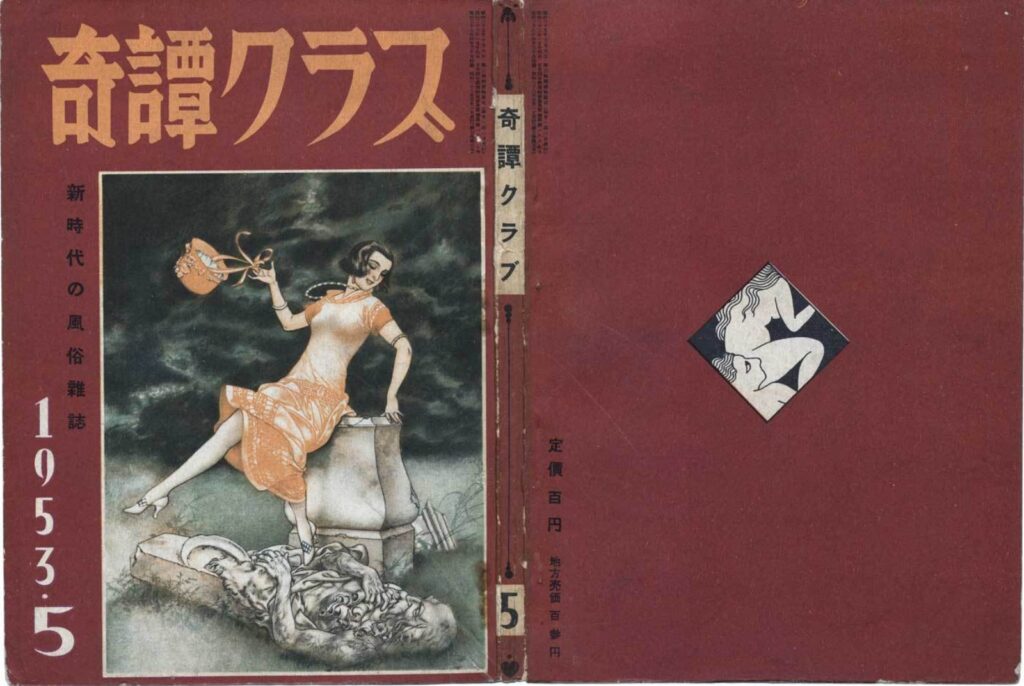
- The cover establishes female authority through fashion, posture, and spatial hierarchy, placing the fallen male figure literally beneath the woman’s feet (PDF p. 1).
- The opening punishment and grotesque illustrations use historical and foreign imagery to turn cruelty into both archival evidence and erotic spectacle (PDF pp. 2–5).
- Women’s Punishment Grounds in Postwar Popular Prints collects recurring scenes of restraint and humiliation into a visual archive of contemporary popular fantasy (PDF pp. 6–9).
- The Society of Masochists imagines submission as a collective culture organized around female authority, ritual service, and shared recognition (PDF pp. 11–23).
- The bourgeois interiors in The Society of Masochists relocate domination from exceptional violence into the routines and etiquette of domestic social life (PDF pp. 11–23).
- Various Forms of Punishment classifies different modes of seme, showing the magazine’s movement toward a specialized comparative vocabulary (PDF pp. 24–28).
- Miscellaneous Thoughts on Capture and Binding uses rear-view rope diagrams to detach binding structures from narrative and present them as transferable technical knowledge (PDF pp. 29–32).
- My Record gives masochism a recurring first-person voice, although its degree of autobiographical truth or editorial reconstruction cannot be determined (PDF pp. 33–47).
- Love Slave, Part Five continues the serialized submissive identity through which private fantasy becomes an ongoing relationship with the magazine’s readership (PDF pp. 48–54).
- Glass Toilet demonstrates the publication’s willingness to devote sustained attention to abject and bodily fetishes rather than limiting itself to rope or conventional sadism (PDF pp. 65–75).
- Boys and Women’s Seppuku uses ritual death and gendered bodies to connect queer curiosity, historical violence, and erotic spectatorship (PDF pp. 77–86).
- In the Laboratory adopts scientific authority as a frame for bodily scrutiny, though its pseudo-clinical presentation should not be treated as reliable medical evidence (PDF pp. 87–92).
- Snapshots of Tight Binding with Rough Rope concentrates on texture, indentation, pressure, and the local interaction of rope with flesh rather than an unfolding captivity narrative (PDF pp. 106–109).
- The Bound Wife places restraint inside marriage and domestic continuity, while leaving the distinction between reciprocal desire and coercive fantasy conceptually unresolved (PDF pp. 127–134).
- The complete closing sequence moves through postwar disorder, religious discipline, the cruelty of Ivan, and Fire, Part Five, extending the issue’s literary and historical arc through PDF page 172 (PDF pp. 144–172).
Contributors
Named contributors represented in this issue:
- Azuma Minoru
- Fujiyasu Setsuko
- Goku Osamu
- Hano Mayumi
- Hayakawa Shinjirō
- Hida Ryōji
- Himeumi Shirō
- Kawabata Tanako
- Kitō Kōichirō
- Kondō Keizō
- Kurishima Hiroshi
- Kuroi Chinpei
- Matsui Kōko
- Nakayasu Kōdō
- Naruse Akira
- Sasada Ei
- Sasaki Tadashi
- Sophie Widemann; translated by Numa Shōzō
- Takatori Nagaharu
- Takatsuki Daizō
- Tsunoda Heihachi
- Yano Sakusei