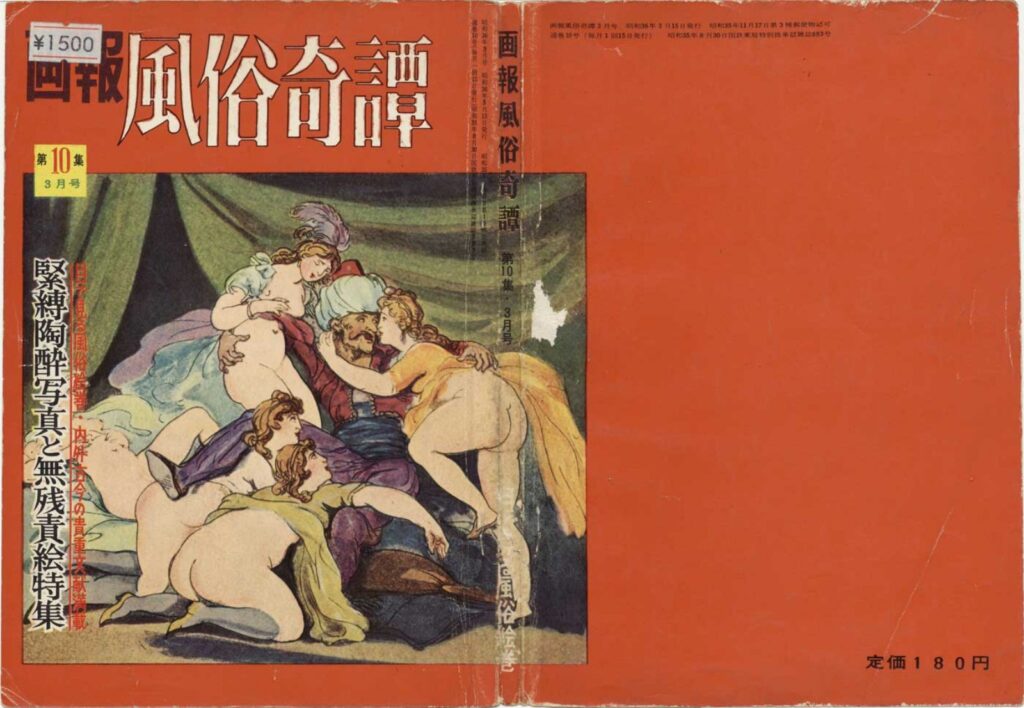
Gaho Fuzoku Kitan
March 1961
← Back to magazine archive
Issue Details
- Issue
- 10
- PDF pages
- 104
Summary
The March 1961 issue of Gaho Fuzoku Kitan is organized as a densely illustrated survey of bondage imagery, staged punishment, erotic fantasy, and sensational fiction. Its opening pages establish the magazine’s visual identity through color and monochrome photographic portfolios in domestic Japanese interiors. The models are posed with rope against mirrors, folding screens, windows, tatami, bedding, and snow-covered landscapes, producing a sequence that alternates between formal kinbaku poses and short narrative tableaux. Captions repeatedly frame restraint as a progression from embarrassment and resistance toward pain, surrender, or ambiguous pleasure.
Read full summary Close full summary
Table of Contents 35 items
-
The Bound Figure Reflected in the Mirror
Summary
A photographic study shows a nude figure tightly bound in a seated pose, viewed directly and through a mirror to emphasize the restrained body from multiple angles.
-
Crouching Bound Woman
Summary
A nude woman is photographed crouching on a rope arrangement, with her limbs and torso secured in a staged bondage pose.
-
One-Legged Pose
Summary
A photographic portrait presents a nude woman balancing in a one-legged standing pose while rope crosses and restrains her torso and limbs.
-
The Sorrow of Rope
Summary
A color photographic feature presents a rope-bound nude woman in a stark architectural setting, emphasizing the melancholy and poetic imagery suggested by the title.
-
Placed on the Kotatsu
Summary
A sequence of staged photographs shows a woman restrained with rope in a domestic room, particularly around a kotatsu and bedding, in a variety of seated, reclining, and folded positions.
-
Bound Woman in the Snow
Summary
A photographic feature depicts a woman bound outdoors in deep snow and in snow-themed interior scenes, combining winter landscape imagery with rope restraint and captivity poses.
-
Outside Are Snow and Ice
Summary
A photographic bondage feature contrasts a woman bound indoors with the snow and ice visible outside, emphasizing the isolation and sensory drama of winter restraint.
-
A Moment of Bound Ecstasy
Summary
A photographic sequence presents women tied in varied rope-bound positions, framing restraint as an ecstatic and stylized erotic experience.
-
Cruel Ear Torment
Summary
Photographs depict a bound woman undergoing deliberate ear torment, including close manipulation and pulling of the ear as a sadistic punishment scene.
-
The Captured Little Bird
Summary
A photographic sequence depicts a young woman in a sailor-style school uniform being bound with rope, gagged, and posed in various restrained positions as the “captured little bird.”
-
Stripped of Her School Uniform
Summary
A staged photographic feature presents a woman being stripped from her school-uniform attire, emphasizing the contrast between the uniform and exposed skin and breasts.
-
Tormenting the Breasts
Summary
A photographic sequence focuses on the forced exposure and handling of a woman’s breasts within a staged bondage scene, accompanied by images of restraint and distress.
-
The Captive Beauty
Summary
A photographic feature presents a kimono-clad woman bound with rough rope in a series of staged seated and standing captivity poses, accompanied by text describing her sorrow and helplessness.
-
The Naked Woman Cries Out
Summary
This visual feature depicts a nude or partially nude woman bound against a shōji-screen setting, emphasizing lament, exposure, and helplessness through staged rope-restraint photographs.
-
Elegant Suspension Pose
Summary
A photographic portfolio titled “Elegant Suspension Pose” shows a kimono-clad woman restrained by ropes attached overhead, including standing, kneeling, and close-up compositions that foreground suspension and bodily submission.
-
Woman in Tribulation
Summary
A photographic feature depicting a woman in distressed and submissive poses, reclining, kneeling, and moving across an interior setting while wearing minimal clothing.
-
Bound on a Chair
Summary
A photographic sequence shows a woman tightly bound to and around a chair with rope, including seated, reclined, gagged, and contorted positions.
-
Standing Bound Figure
Summary
A photographic feature presents a woman standing while extensively rope-bound across the torso, hips, and legs, with additional images emphasizing her gagged and immobilized posture.
-
During the Enema
Summary
A staged photographic feature depicts a woman undergoing an enema, presenting the procedure, equipment, bodily reactions, and changing restrained positions as eroticized medical play.
-
Black Underwear
Summary
A photographic model feature titled “Black Underwear” combines black lingerie or swimwear with rope restraint and posed erotic display.
-
Seven Scenes of Women Subjected to Pitiless Torment
Summary
A sequence of seven staged scenes portrays women subjected to elaborate forms of restraint and punishment, including rope bondage, confinement, steam, mechanical devices, animal-threat imagery, and candle-related torment, framed as erotic fantasy rather than documentary reportage.
-
The Shy Pose
Summary
A photographic feature presents a nude model bound with rope in a shy, rear-hand restraint pose, emphasizing posture and visual presentation.
-
Suffering Under Restraint
Summary
A multi-page photographic feature depicts a nude model in several tightly bound positions, including curled, seated, and floor-based poses, presenting restraint as a source of physical discomfort and emotional tension.
-
Rear-Hand Pose
Summary
A concluding visual feature combines photographs of a fully nude model tied with her hands behind her back with Japanese commentary on embarrassment, exposure, and bodily posture.
-
The Bound Prisoner
Summary
A photographic feature depicting a woman posed as a bound prisoner, restrained with rope across her torso and limbs.
-
What Are You Going to Do to Me?
Summary
A two-page photographic sequence presents a woman in successive rope-bound poses, emphasizing immobilization, vulnerability, and submission.
-
A Substitute for Horns
Summary
A photographic bondage vignette set in a tiled bathing space shows a woman restrained in several poses, with accompanying text describing her inability to resist what is done to her.
-
Diaper
Summary
A photographic fetish feature centered on a woman wearing a diaper, presented through posed rear and side-view images.
-
The Mysterious World
Summary
A visual feature combining stylized erotic illustrations and photographs of women in lingerie, ropes, posed restraint, and other theatrical bondage tableaux, framed as an imaginative or “mysterious” world of erotic spectacle.
-
Strange Tale of the Tendō White Snake Sect
Summary
Mimura Jirō’s illustrated supernatural crime tale follows the White Snake Sect, a secretive new religious group whose female followers are drawn into an underground sanctuary, ritualized coercion, captivity, and violent sacrifice.
-
Bondage Model Kaleidoscope
Summary
A photographic portfolio presents multiple bondage models in varied rope-bound poses, accompanied by brief captions and model profiles emphasizing appearance, physicality, and the visual appeal of restraint.
-
The Woman Who Wagered on Chō-han
Summary
This illustrated historical erotic narrative follows a woman caught in a chō-han gambling wager in an Edo-period setting, leading to coercive encounters, captivity, and escalating restraint by male characters.
-
Readers’ Forum
Summary
A multi-page readers’ forum gathers correspondence, reactions, requests, and criticism concerning the magazine’s bondage, erotic photography, fiction, and editorial direction, while also providing publishing and ordering information for readers.
-
The World of Buttock Beating
Summary
A two-page visual feature titled “The World of Buttock Beating” presents spanking-themed fetish illustrations by John Willie, including elaborately dressed women in restrained or submissive poses and a suited man interacting with a posed woman. The feature is explicitly framed as illustrated material for spanking enthusiasts.
-
Itō Seiu Punishment Photograph Collection
Summary
A memorial feature on Itō Seiu presents a photographic portfolio of staged punishment and bondage scenes, including snow punishment, rope restraint, blindfolding, burning-at-the-stake imagery, and outdoor hands-behind binding, alongside a brief tribute to his pioneering role in Japanese “torture” art and photography.
Highlights
- A formal two-page table of contents organizes the issue into color photography, gravure, illustrated fantasy, fiction, reader material, and an Itō Seiu photographic collection. (PDF p. 8).
- The opening color portfolio presents rope poses against mirrors, folding screens, and modern domestic interiors, establishing the issue’s mixture of staged kinbaku and captioned erotic narrative. (PDF pp. 3–6).
- The extensive gravure sequence develops numerous restraint situations, including snow scenes, school-uniform bondage, suspension, ear torment, chains, enema imagery, and chair-bound poses. (PDF pp. 10–41).
- “Seven Scenes of Women Subjected to Pitiless Torment” is a sustained illustrated portfolio of religious, mechanical, animal, wilderness, steam, and insect-related punishment fantasies. (PDF pp. 42–49).
- A group of photographic studies examines compact rope positions, shame poses, confinement, and the visual contrast between the restrained body and traditional Japanese rooms. (PDF pp. 50–60).
- The red-tinted “Rope Fantasy” portfolio treats rope as both restraint and graphic design, emphasizing loops, diagonals, and body contour. (PDF pp. 61–69).
- “Strange Tale of the Tendō White Snake Sect” combines cult ritual, supernatural suggestion, bondage, and illustrated pulp fiction. (PDF pp. 70–75).
- “The Woman Who Wagered on Chō-han” uses an Edo-period gambling setting to frame a narrative of capture, punishment, and female peril. (PDF pp. 80–85).
- The readers’ section and surrounding notices document the magazine’s participatory culture, correspondence, collecting interests, and commercial network. (PDF pp. 86–96).
- The issue closes with an archival photographic collection attributed to Itō Seiu, showing theatrical bondage, gagging, suspension, and hooded restraint. (PDF pp. 97–104).
Contributors
Named contributors represented in this issue: