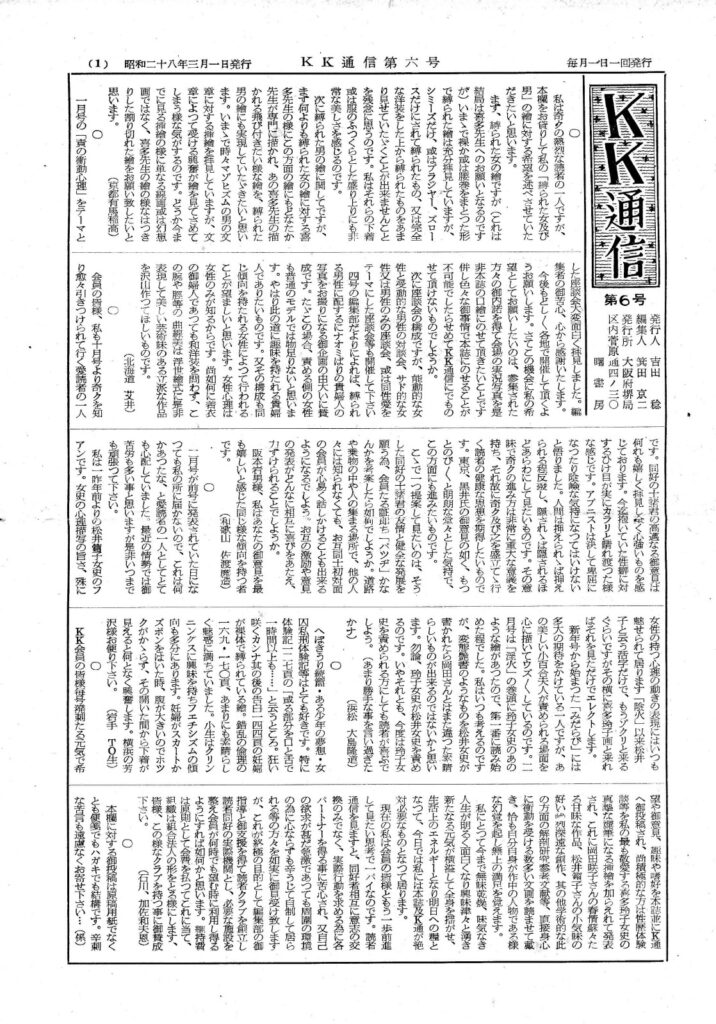
The first page consists largely of reader correspondence. Contributors react to previous issues, describe private desires, comment on stories and photographs, and discuss the difficulty of finding people who understand them. The letters vary in tone, from intellectual reflection to personal confession, but together they create a striking sense of recognition. Readers who had experienced their interests as secret or isolating could see them answered, criticized, or echoed by others.
This correspondence culture is the issue’s central historical importance. The newsletter does not simply publish erotic content. It stages an ongoing conversation about how erotic cruelty should be represented and understood. Readers debate whether scenes are convincing, whether illustrations are too theatrical or insufficiently realistic, and whether the magazine gives adequate attention to the feelings of the person being restrained. In doing so, they begin to produce a shared critical vocabulary.
The serialized fiction “The Red Room” continues on PDF page 2. Its confined setting, threats, restraint, and atmosphere of danger belong to the familiar pulp language of coercion. Yet its placement beside reader letters changes its function. Fiction becomes material for communal judgment rather than a sealed fantasy. Readers are invited to respond to narrative plausibility, emotional intensity, and the depiction of bodily subjection.
A short editorial column on the same page answers questions and clarifies the magazine’s position. These editorial interventions are crucial because they mediate between private fantasy and public circulation. Editors decide which desires can be printed, how they should be described, and when warnings or distinctions are necessary. KK Communication therefore acts as a negotiation chamber between readers, publishers, and the boundaries of what could be said openly.
PDF page 3 contains one of the issue’s most important features, a reader forum or research column devoted to reactions toward erotic bondage photographs. The discussion examines why such images appeal to viewers and what distinguishes erotic restraint from ordinary violence. It considers visual composition, the viewer’s imagination, bodily expression, and the ambiguity of the restrained woman’s apparent feelings. This is evidence that readers were not simply consuming images instinctively. They were attempting to theorize their response to them.
The same page contains advertising and notices for bondage photographs, special publications, and related material. These advertisements reveal an expanding commercial network surrounding Kitan Club. Photographs, special editions, stories, and visual portfolios could be ordered separately, allowing readers to build private collections. The emerging culture was therefore sustained through both correspondence and commodity exchange.
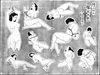
The most remarkable practical feature begins on PDF page 4: “Report on a Self-Binding Experiment.” The contributor describes attempting to bind themself and includes diagrams showing the placement and route of the rope. The account discusses bodily position, pressure, movement, and the practical difficulty of creating restraint without another person. This shifts rope from fiction and illustration into experimentation.
The self-binding report is historically significant because it presents a reader as investigator rather than passive spectator. The writer tests a technique, observes the results, records problems, and submits the experience for others to evaluate. The diagrams transform private experimentation into transferable knowledge. Rope is treated as something that can be studied through repeated trial.
The report also exposes the ethical and physical problems involved in translating fantasy into practice. A self-bound person must consider release, circulation, balance, and the possibility of becoming trapped. Although the article does not employ a developed modern vocabulary of safety, its attention to bodily consequences suggests the beginnings of practical reflection.
PDF page 5 contains an extended review titled approximately “Critique of the February Issue.” The writer evaluates stories, illustrations, editorial decisions, and the quality of particular contributions. Rather than praising the magazine automatically, the review identifies weaknesses, inconsistencies, and missed opportunities. This demonstrates that the readership had developed standards and expected the publication to improve.
The review also treats the monthly issue as a coherent editorial object. Individual stories and images are judged in relation to one another, and the reviewer considers whether the issue as a whole represents readers’ interests successfully. The magazine is becoming accountable to the public it has helped create.
PDF page 6 includes “How I Torment” or “My Way of Seme,” a reader contribution describing preferred methods or fantasies of torment. The piece classifies bodily areas, instruments, and emotional effects. Its numbered or segmented structure turns personal preference into a rudimentary taxonomy. What begins as individual fantasy is reorganized as knowledge that another reader might compare with their own desires.
The page also contains discussion of censorship and material rejected or altered for publication. These notices provide a glimpse of the limits within which the magazine operated. Editors had to balance readers’ demand for explicitness with legal, postal, and commercial restrictions. The shape of early SM print culture was therefore determined not only by desire but by what could survive publication.
PDF page 7 returns to short correspondence. Readers seek replies, correct misunderstandings, discuss earlier contributions, and address one another through pseudonyms. These short messages are perhaps the clearest evidence that the newsletter functioned as a social medium. The page resembles a bulletin board through which otherwise isolated readers could attempt to establish recognition and sustained contact.
Editorial notices on the same page correct errors in the February issue, explain omissions, and ask readers for cooperation. This transparency reinforces the impression of a publication being made collaboratively. The editor does not appear as an invisible authority but as a participant managing a complicated flow of manuscripts, letters, images, and reader expectations.
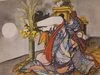
The final page contains the fourth installment of “Pictures of Hell” or “Hell Picture,” by Yukita Kazuko. The illustrated story returns to the magazine’s familiar world of captivity, exposure, and female suffering. Yet its placement at the end of a correspondence newsletter is telling. Fantasy remains present, but it is enclosed within a publication primarily devoted to conversation, critique, experimentation, and exchange.
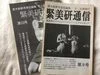
The back page also advertises the March issue of Kitan Club, linking the newsletter directly to the monthly magazine. KK Communication functions as the connective tissue between issues. It sustains reader interest, carries debate forward, corrects errors, advertises new material, and converts the monthly rhythm of publication into an ongoing social relationship.
For readers of Kinbaku Today, this issue is especially valuable because it shows early Japanese SM culture being made in real time. The key historical material is not only the fiction or the rope diagram. It is the interaction among them. A story produces a response; a photograph prompts theoretical discussion; private experimentation becomes a report; editorial limits provoke explanation; and readers begin to recognize themselves as members of a dispersed but responsive public.