Kitan Club
March 1953
← Back to magazine archive
Issue Details
- PDF pages
- 173
Summary
The March 1953 issue of Kitan Club combines historical punishment imagery, erotic illustration, serialized confession, prison narrative, essays on sadism and homosexuality, military reminiscence, fetish psychology, queer fiction, reader-oriented commentary, and several long literary works. Across the complete issue, the magazine treats unusual desire as something that can be historicized, classified, narrated, answered, and circulated among readers.
Read full summary Close full summary
Table of Contents 27 items
-
A Comparison of Eastern and Western Torture
Summary
A historical illustrated comparison of Eastern and Western torture, focusing on four interrogation punishments used under the Edo shogunate: beating, stone-holding, water torture, and suspension. The text describes the procedures, equipment, bodily effects, and evidentiary context of these punishments, accompanied by dramatic scene illustrations.
-
The Essence of Sadism
Summary
An extended essay examining sadism as a psychological and erotic disposition, contrasting bodily pain, humiliation, fear, and domination with masochistic pleasure. It discusses marital and domestic scenarios, restraint devices, whipping, blindfolding, and other methods as examples of how sadistic desire is staged and experienced, while also reflecting on historical and cultural differences in sexual attitudes.
-
Love Slave, Part Three
Summary
The third installment of Kito Koichiro’s serialized erotic narrative follows the narrator’s increasingly obsessive relationship with Harumi, a married woman whose confidence and sexual authority reshape his domestic life. Their affair develops through jealousy, erotic role reversal, bodily fetishism, and the narrator’s eventual decision to abandon his existing family in pursuit of her.
-
Inside the Prison Bars
Summary
Kosaka Tamie’s extended account of life inside a women’s prison describes inmate hierarchies, surveillance, routines, and disciplinary practices. It focuses especially on corporal punishment, forced undressing and exposure, humiliation, sexualized abuse, and the harsh control exercised by wardens and guards.
-
Meiji Historical Tales
Summary
A historical survey of Japanese seppuku, explaining its ritual forms, techniques, and changing social meaning through anecdotes from the samurai era. The article recounts cases involving battlefield defeat, loyalty, punishment, family duty, and demonstrations of honor, accompanied by illustrative scenes.
-
The Mystery of Male Homosexual Love
Summary
A historical and sexological survey of male same-sex desire, tracing terminology, changing social attitudes, literary and medical discussions, and examples from Japan and other cultures. The article also considers related concepts such as boy-love, pederasty, gender variance, and the boundaries between same-sex desire and gendered behavior.
-
Erotic Correspondence
Summary
A reader-correspondence feature presenting erotic letters and requests concerning imagined encounters, erotic illustrations, and bondage scenarios. The exchange demonstrates the magazine’s participatory community function and readers’ use of correspondence to seek erotic material and contact.
-
Sadistic Tendencies in Literature and History
Summary
An essay tracing sadistic impulses through Western and Japanese literature, theater, legend, and history. It discusses figures and episodes including Salome, Judith, Japanese ghost and demon tales, violent historical rulers, executions, cruelty, and the relationship between erotic desire, domination, punishment, and social behavior.
-
Pain and Pleasure
Summary
An extended essay examines the psychological and physiological relationship between pain and pleasure, contrasting sadistic and masochistic responses and discussing how stimulation, restraint, punishment, religious ritual, hypnosis, and social conditioning can transform suffering into gratification. It uses historical, anthropological, clinical, and personal-observational examples to consider gender, sexual desire, and the limits of conscious control.
-
A Dream of the Seventh Heaven
Summary
A reader-style appreciation of selected works from recent Kitan Club issues reflects on erotic images, films, illustrations, and imagined scenes involving female power, bodily display, punishment, and fetishistic suggestion. The writer discusses how unusual visual compositions and narratives stimulate fantasy and personal taste.
-
An Answer to Itō Seiu
Summary
Kuroi Chinpei replies to Itō Seiu in a debate over erotic art, beauty, and the representation of the nude. He defends the artistic and emotional value of frank depictions of the body while criticizing moralistic objections and reflecting on sexuality, beauty, and artistic judgment.
-
My Memories of Military Service
Summary
Morihara Taichi recounts memories of his military-service years, including barracks life, fellow soldiers, discipline, training, wartime routines, and postwar recollections. The memoir combines humorous anecdotes with reflections on military masculinity, hardship, hierarchy, and changing civilian life after the war.
-
Miscellaneous Thoughts on the Grotesque
Summary
An essay on grotesque erotic experience, illustrated through a disturbing first-person account of workplace relations, sexual manipulation, and a woman’s control over men. The narrative emphasizes fetishistic attention to the female body, especially the feet, and the psychological tensions of desire, shame, and exploitation.
-
The Value of Erotic Curiosity
Summary
A concluding reflection on the destructive value and consequences of erotic curiosity, in which the narrator recognizes that his desires led him to exploit and harm a woman. The piece links sexual obsession with guilt, self-reproach, and the breakdown of ordinary social relationships.
-
Fantasy of a White Toilet
Summary
The supplied pages present an illustrated-text feature on actresses portrayed bound in Japanese films and stage productions. It surveys named performers and describes scenes involving rope restraint, suspension, gagging, and other forms of staged captivity.
-
Reading Itō Seiu’s Answer
Summary
The continuation catalogs additional actresses and dramatic scenarios involving capture, tying, punishment, and forced posing, emphasizing the visual and theatrical conventions of bound-woman scenes. The feature concludes with further examples drawn from period cinema and popular performance culture.
-
The Torn Diary
Summary
A diary-style erotic narrative recounting an encounter that develops into forced undressing, immobilization, pain, and humiliation between partners. The first-person account emphasizes conflicted desire, vulnerability, and the psychological tension of restraint.
-
Unusual Psychology Centered on the Eyes
Summary
An illustrated physiognomic essay claiming that the shape, color, position, and movement of the eyes and eyebrows reveal sexual temperament, emotional character, and relationship tendencies. It presents eye diagrams and categories as a form of popular sexual psychology and sexological interpretation.
-
Thoughts on Double Suicide
Summary
An essay reflecting on double suicide through romantic relationships, omens, bodily signs, and the social pressures surrounding illicit or desperate love. It combines observations on sexual psychology with commentary on changing modern attitudes toward passion, death, and social judgment.
-
Bound Actresses
Summary
A historical supernatural erotic tale set amid warfare and rural religious life, in which a woman associated with theft and sexual transgression is captured, bound, abused, and ultimately subjected to grotesque postmortem transformations. The accompanying illustrations reinforce the story’s emphasis on female captivity, restraint, violence, and corporeal horror.
-
A Woman’s Confession
Summary
A first-person account follows a rural woman working in Tokyo who is drawn into a lodging house and subjected to escalating coercion by a man and woman. Her ordeal includes rope binding, gagging, immobilization, humiliation, and psychological distress, presented as an extended personal confession.
-
The Lamp of Adonis
Summary
A tragic literary narrative about Shinkichi, an older man who finds intense companionship and erotic attachment with the younger Matsuo, then suffers anxiety and heartbreak when their relationship is threatened by separation and social constraints. The story explores longing, dependency, reunion, and the pain of forbidden male same-sex desire.
-
A Conversation Between Two Men
Summary
A dialogue presents the aftermath of a married woman’s earlier confession of infidelity. The speakers discuss her unhappy marriage, emotional and sexual attachment to another person, possible divorce, and the guilt, secrecy, and uncertainty surrounding their relationship, accompanied by an erotic illustration.
-
The Sexual Life of a Spy
Summary
A historical-sexological essay on the sexual customs of Romani communities, discussing courtship, marriage, gender roles, sexual behavior, clothing, adornment, color symbolism, erotic beliefs, and magical practices. The account reflects the period’s comparative and often ethnographically generalized approach to sexuality and culture.
-
A Tragic Comedy
Summary
An illustrated comic dialogue depicting an escalating domestic quarrel involving accusations, deception, money, and strained marital or household relationships. Its eroticized humor is built around sexual jealousy, social embarrassment, and the breakdown of trust between the characters.
-
Fire, Part Three
Summary
The third installment of Matsui Kōko’s serialized erotic fiction follows a married couple whose encounter with an intimidating man develops into an elaborate scenario of restraint, humiliation, jealousy, and coercive sexual fantasy. The narrative shifts between domestic scenes and imagined or staged episodes involving ropes, confinement, voyeuristic observation, and the wife’s conflicted responses.
-
Publication Notices and Advertisements
Summary
A publisher’s notices page solicits unpublished writing, illustrations, photographs, cartoons, fiction, and other contributions, while outlining editorial guidelines and payment practices. It also announces back issues, subscriptions, direct reader orders, publisher information, and a recruitment appeal for readers and contributors.
Highlights
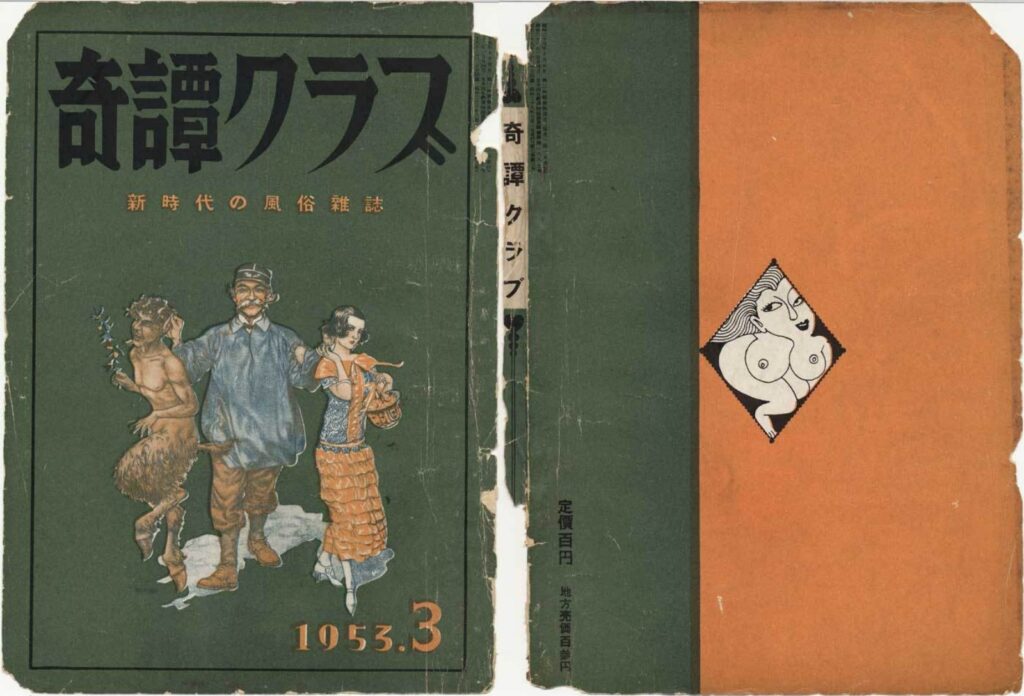
- The cover organizes its three figures through contrasting costume and social type, introducing the issue’s interest in classification before explicit bondage appears (PDF p. 1).
- The opening drawing of women bound to posts presents restraint as a posed visual arrangement, emphasizing posture and display over narrative explanation (PDF p. 3).
- A Comparison of Eastern and Western Torture constructs an international visual archive of burning, suspension, water torture, judicial beating, and execution (PDF pp. 6–13).
- The comparison of European religious persecution with Japanese punishment practices gives cruelty historical distance while preserving the bound body as spectacle (PDF pp. 6–13).
- The Essence of Sadism attempts to turn domination, humiliation, and restraint into an organized psychological category for the magazine’s readers (PDF pp. 15–26).
- Love Slave, Part Three continues the diary format through which erotic fantasy is presented with the intimacy and apparent authority of private testimony (PDF pp. 27–36).
- Inside the Prison Bars uses confinement, surveillance, and institutional hierarchy as both narrative setting and model of domination (PDF pp. 37–48).
- The Mystery of Male Homosexual Love places male same-sex desire within the issue’s larger system of historical, psychological, and literary explanation (PDF pp. 54–62).
- Erotic Correspondence demonstrates how letters and responses could turn private desire into material circulating among a dispersed readership (PDF pp. 63–64).
- Sadistic Tendencies in Literature and History supplies historical and literary precedents that allow sadism to appear as a recurring cultural phenomenon rather than a solitary aberration (PDF pp. 65–74).
- Pain and Pleasure directly examines the relationship between suffering and erotic gratification, though its interpretation of bodily response does not amount to a modern account of consent (PDF pp. 75–84).
- The exchange involving Itō Seiu and Kuroi Chinpei shows writers answering one another across articles and issues, creating an ongoing intellectual and erotic conversation (PDF pp. 85–88, 104–106).
- My Memories of Military Service places institutional discipline and masculine autobiography beside fetish and queer material, widening the magazine’s confessional field (PDF pp. 89–96).
- The Lamp of Adonis uses the classical male body as a cultural frame for modern queer desire and leads into the issue’s late sequence of male-centered fiction (PDF pp. 135–142).
- The complete ending contains The Sexual Life of a Spy, A Tragic Comedy, and Fire, Part Three, extending the issue’s literary conclusion through PDF page 172 rather than ending at the earlier tool limit (PDF pp. 149–172).
Contributors
Named contributors represented in this issue:
- Arima Masaaki
- Azuma Minoru
- Hatano Shin
- Kameoka Kyōko
- Kawabata Tanako
- Kitō Kōichirō
- Kosaka Tamie
- Kuroi Chinpei
- Matsui Kōko
- Morihara Taichi
- Nakayasu Kōdō
- Nanajō Miki
- Nibiyama Hitoshi
- Niuoka Kinkichi
- Okada Satsuko
- Sasada Ei
- Sasajima Seiko
- Takano Sumiko
- Tsunoda Heihachi
- Umei Shinji
- Wada Natsue
- Yanagida Kōgen
- Yoshino Yōzaburō