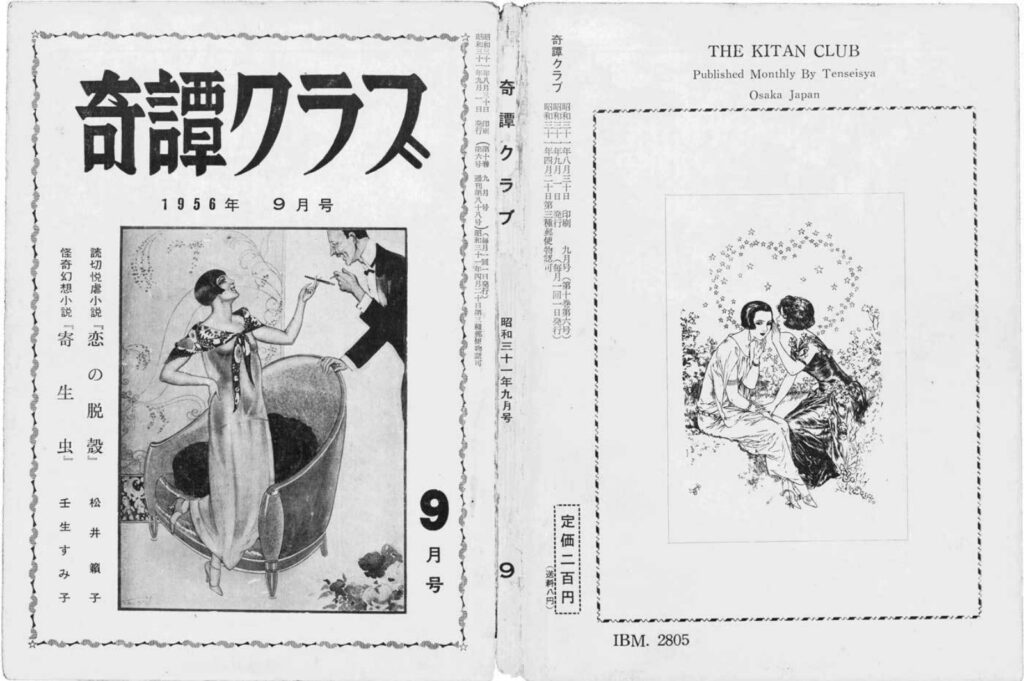
Kitan Club
September 1956
← Back to magazine archive
Issue Details
- Volume
- 10
- Issue
- 6
- PDF pages
- 165
Summary
The September 1956 issue of Kitan Club combines confessional writing, erotic fiction, cultural criticism, literary history, film commentary, collecting, reader testimony, and specialist publishing information. Its opening contents spread, decorated with mermaid illustrations, presents a densely organized issue whose primary articles begin with accounts of psychological compulsion and bodily control. Tamao Sumiko’s “Parasites” uses a disturbing laboratory and domestic narrative to explore dependency, manipulation, illness, and eroticized degradation. It is followed by Tsukioka Eiko’s intimate account of enemas and diapers and Matsui Raiko’s illustrated “The Shell of Love,” a long story of frustrated attachment, jealousy, bondage, performance, and violence.
Read full summary Close full summary
Table of Contents 32 items
-
Parasites
Summary
A dark erotic fiction narrative in which a researcher’s fascination with parasites entangles students and lovers in schemes of jealousy, coercion, drugging, and experimental bodily invasion.
-
Incontinence: Enemas and Diapers
Summary
A first-person account of enema use, bowel incontinence, and diapering that combines bodily confession with practical strategies for managing accidents and privacy in daily life and travel.
-
The Shell of Love
Summary
An erotic romantic narrative of frustrated and forbidden desire, jealousy, confession, and imagined or enacted restraint involving a married woman and her younger admirer.
-
Raid on the Labor Camp
Summary
A first-person narrative recounts a violent raid and confrontation at a wartime labor camp, where coal miners and supervisors use threats, beatings, knives, and humiliation to enforce authority and settle grievances.
-
Welcoming the Appearance of Domestication Fiction
Summary
This critical essay welcomes the emergence of “domestication fiction,” examining literary works that imagine humans treated as livestock and linking the genre to slavery, gender hierarchy, sexual domination, and the history of masochistic literature.
-
The White Mouse
Summary
A theatrical backstage fiction follows Senjirō, Namie, Hatsuko, and others through drinking, jealousy, sexual rivalry, and increasingly severe scenes of tying, gagging, whipping, and bodily humiliation, with performance and backstage spectatorship shaping the erotic drama.
-
Red Lotus
Summary
A wartime erotic fiction narrative follows the violent relationship between a military officer and a subordinate, escalating through domination, corporal punishment, captivity, torture, and death. The story uses military discipline and battlefield violence to frame sadistic desire and fatal submission.
-
Through the Light, Part Two: Record of My Suicide Attempt
Summary
A first-person autobiographical account recounts a suicide attempt, the narrator’s physical collapse and hospitalization, and the subsequent struggle toward recovery amid poverty, family pressures, illness, and precarious postwar life. The narrative emphasizes despair, bodily suffering, medical intervention, and renewed attachment to life.
-
Homosexuality as It Appears in Literature
Summary
This literary-critical essay surveys representations of same-sex desire in Japanese fiction, discussing male and female homosexuality, literary characterization, erotic relationships, and the social psychology of forbidden desire. It considers how novels portray same-sex relationships within marriage, domestic life, and changing modern society.
-
Editorial Afterdrops
Summary
An editorial commentary reviews entries in the magazine’s fiction-prize competition, reflects on the judging process and literary qualities of the submissions, and invites readers to continue contributing.
-
My Fundoshi
Summary
In this personal essay, Matsubara Michiyo describes her longstanding preference for wearing fundoshi, discussing its appearance, comfort, practicality in everyday life and swimming, and the reactions of her husband and friends.
-
Report
Summary
This report surveys newspaper and magazine coverage of sensational sexual and medical incidents, including a fatal enema case, alongside related books, periodicals and publication notices.
-
Joys and Sorrows of Masochism: Afterward
Summary
A sequel essay reflecting on the author’s masochistic identity and experiences recounts escalating self-punishment, bondage, service, and endurance, while also discussing social and legal constraints surrounding such practices.
-
Memoir of a Schoolgirl Nude Enthusiast
Summary
A first-person memoir by a schoolgirl nude enthusiast describes her growing pleasure in nudity and exhibition, including transparent clothing, nude swimming, and deliberately displaying her body to others, accompanied by erotic illustrations.
-
On Nako's Love
Summary
Nako recounts her emotional and sexual development, focusing on attraction and rivalry involving her older sister M and a later coercive encounter with teacher K, while examining self-love, jealousy, and psychological conflict.
-
Numa Shōzō's Notebook
Summary
A literary and cultural miscellany in Numa Shōzō’s notebook, combining historical and fictional accounts with reflections on fetishistic interests, footwear, servitude, punishment, and bondage, alongside commentary on contemporary erotic publications and films.
-
Miscellaneous Notes on Photographing Women
Summary
A first-person essay on women administering moxibustion to men, describing the pain, bodily marks, emotional tension, and eroticized disciplinary dynamics associated with repeated treatments and related fantasies.
-
Torture Scenes Appearing in Films
Summary
A detailed survey of torture scenes in Japanese and foreign films, examining depictions of restraint, beating, hanging, burning, gagging, and other abuses while discussing their staging, acting, camera work, and dramatic effect.
-
Modern Masochism Art Review, Part Two
Summary
Hara Tadamasa reviews several American films, including Backlash, The Swan, and White Bird, examining their depictions of sexually charged cruelty, female power, masochistic desire, and psychologically coercive relationships. The essay evaluates how acting, atmosphere, dialogue, and visual style shape modern cinematic representations of masochism.
-
New Studies in Detective Fiction, Part Two
Summary
Azuma Ichirō continues a critical study of detective fiction, discussing the construction of crime plots, clues, disguises, forensic investigation, criminal psychology, and the balance between rational detection and sensational or fantastic effects. The article also surveys representative mystery stories and considers how detective fiction engages readers through suspense and puzzle-solving.
-
Behind the Theater: Red Dish, Missing Dish
Summary
Kida Magarō reviews a theatrical production centered on the intertwined “Red Dish” and “Missing Dish” episodes, describing its cast, staging, dramatic conflicts, and scenes of pursuit, restraint, punishment, and threatened violence. The review treats the play as a stylized historical drama in which eroticized coercion and theatrical spectacle drive the narrative.
-
From Recent Films
Summary
A survey of recent films summarizes plots involving murder, captivity, punishment, supernatural menace, and other sensational or cruel situations, with particular attention to films featuring eroticized violence and restraint.
-
A Consideration of Etsugyaku
Summary
This extended essay examines human cruelty, sadism, and the relationship between cruelty and morality, then considers how eroticized cruelty is represented in literature, visual art, photography, theater, and film. It concludes by proposing a more systematic framework for discussing and staging such material.
-
From My Collection
Summary
A collection of reprinted and narrated materials ranges from a historical account of Japanese seppuku techniques to accounts of a snake-handling woman and a woman’s gradual descent into fox-possession imagery, combining punishment history, fetishistic spectacle, superstition, and sensational personal narrative.
-
The Slug
Summary
A serialized erotic novel following postwar characters moving between impoverished rural life and affluent urban society, where class tensions, gendered power, seduction, coercion, and restraint shape their relationships.
-
Gyokusei Gleanings
Summary
An editorial feature soliciting and discussing reader-submitted manuscripts, including erotic fiction and bondage-related ideas, while explaining the editorial department’s selection and publication practices.
-
From Recent Bondage Films
Summary
A review and commentary section surveying recent Japanese bondage films, describing their staged restraint scenes and connecting the genre to sensational reportage, wartime violence, and postwar sexual culture.
-
Illustrated Reference on Compositions of Female Seppuku
Summary
An illustrated reference guide presents staged compositions of female seppuku across historical and modern settings, including female warriors, servants, courtesans, samurai daughters, theatrical swordswomen, and farm women, with detailed descriptions of clothing, posture, weapons, wounds, and dramatic presentation.
-
Introduction to New Foreign-Language Publications
Summary
The editorial department introduces and advertises several foreign-language erotic publications, describing serialized scenarios of female-directed punishment, bondage, humiliation, captivity, and sadistic play while listing chapter counts, formats, and prices.
-
Tenseisha Publication Catalogue
Summary
A Tenseisha publication catalogue advertises illustrated and photographic erotic works, including themed bondage and punishment portfolios, female-cutting imagery, body-focused scenes, and special photographic collections, with ordering information, prices, and agency notices.
-
Kitan Club Cumulative Contents Index
Summary
A cumulative contents index lists the principal articles, features, photographs, fiction, and special issues published in earlier Kitan Club numbers.
-
Reader Communications and Editorial Correspondence
Summary
An extended reader-correspondence section presents letters about the magazine’s erotic fiction, photography, bondage and fetish features, reader experiences, subscriptions, submissions, and requests for future editorial content.
Highlights
- The formal contents spread uses paired mermaid illustrations and organizes a broad mixture of fiction, confession, criticism, film writing, collecting, and editorial material. (PDF p. 4).
- “Parasites” blends scientific experimentation, domestic intrigue, erotic dependency, and grotesque bodily imagery in one of the issue’s most psychologically elaborate opening narratives. (PDF pp. 7–16).
- “The Shell of Love” is an extensively illustrated narrative of theatrical life, jealousy, restraint, sexual coercion, and destructive obsession. (PDF pp. 19–28).
- “Raid on the Labor Camp” shifts the issue toward social realism through its depiction of coal mining, labor exploitation, violent enforcement, and resistance. (PDF pp. 29–32).
- Numa Shōzō’s essay welcomes the emergence of fiction about human domestication and explicitly situates it within the history and theory of masochistic literature. (PDF pp. 33–34).
- “Red Lotus” follows a physically vulnerable military-school student through hazing, disciplinary violence, combat training, and wartime destruction. (PDF pp. 43–50).
- Fujimi Kaoru’s essay surveys representations of homosexuality in literature and connects classical, historical, and modern examples. (PDF pp. 59–63).
- The cluster of essays on cinema, photography, theater, and modern masochist art examines how erotic cruelty is staged, recorded, illustrated, and judged across different media. (PDF pp. 95–108, 115–118, 143–144).
- Sugawara Haruo’s “A Consideration of Etsugyaku” attempts a theoretical account of pleasure, cruelty, psychology, and social interpretation. (PDF pp. 119–124).
- The closing section combines foreign-publication notices, visual reference material, catalogues, indexes, correspondence, and editorial communications, documenting the infrastructure of Kitan Club’s reader community. (PDF pp. 145–165).
Contributors
Named contributors represented in this issue:
- Aoba Shin'ichi
- Aoyama Miekichi
- Azuma Ichirō
- Editorial Department
- Fujimi Kaoru
- Futaki Yoshio
- Hara Tadamasa
- Ikeda Fumiko
- Kadoma Sōkichi
- Kadota Nako
- Kida Magarō
- Kondō Kikuya
- Makane Kyōjirō
- Matsubara Hajime
- Matsubara Michiyo
- Matsui Raiko
- Numa Shōzō
- Ōtani Ayako
- Saga Miyako
- Sazamaki Hiroshi
- Shima Naoki
- Shiraishi Hiromu
- Sugawara Haruo
- Tamao Sumiko
- Tsukioka Eiko