Kitan Club
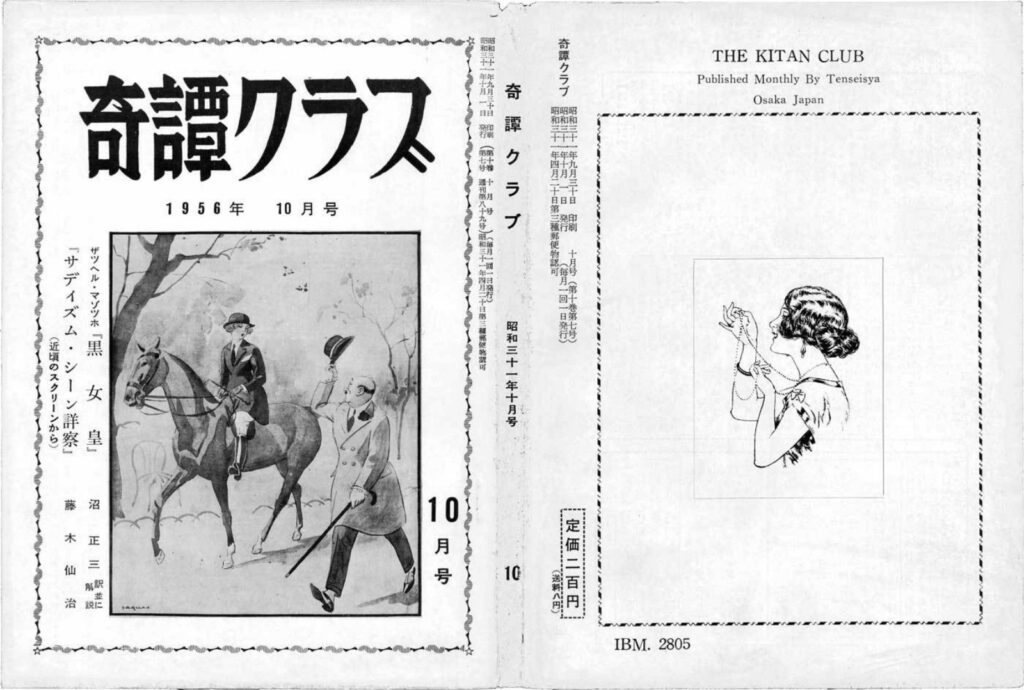
October 1956
← Back to magazine archive
Issue Details
- Volume
- 10
- Issue
- 7
- PDF pages
- 173
Summary
The October 1956 issue of Kitan Club is a large, densely organized publication combining visual portfolios, film and art criticism, autobiographical testimony, medical and institutional narratives, psychological fiction, cultural commentary, reader communication, and editorial miscellany. Its opening pages establish the issue’s visual identity through Kitahara Junko’s illustrations of historical captivity and punishment, reproductions of foreign bondage imagery, photographs of restraint, and a formal illustrated contents spread. These images are followed by Fujiki Senji’s extended survey of sadistic scenes in contemporary cinema, which examines how restraint, threat, humiliation, and violence are staged across Japanese and foreign films.
Read full summary Close full summary
Table of Contents 31 items
-
October Collection: Fragile Prey
Summary
An illustrated October feature presents a series of stylized scenes in which women are overpowered, restrained, or handled by men in domestic and intimate settings.
-
Reference Materials
Summary
A reference-materials page assembles reprinted erotic illustrations, foreign magazine imagery, and film stills, linking Japanese fetish culture to imported visual sources and cinema.
-
Procession
Summary
A photographic film-style scene titled “Procession” shows two women outdoors, with one apparently being bound or handled against a tree in a staged erotic tableau.
-
Bondage Photographs Seen in an American Magazine
Summary
A photographic feature reproduces a bondage image sourced from an American magazine, showing a person tightly restrained and presented as an example of imported bondage imagery.
-
New Euro-American Style, Part Three
Summary
La Bonda’s third installment of “New Euro-American Style” presents an erotic illustration of two women posed in elaborate rope restraints against a stark geometric backdrop.
-
Detailed Examination of Sadism Scenes: From Recent Films
Summary
Fujiki Senji examines bondage and sadistic scenes in recent films, comparing their restraint devices, poses, violence, acting, visual composition, and emotional effects while discussing examples from Japanese cinema and contrasting sensational presentation with more convincing dramatic staging.
-
Moxa Queen Contest
Summary
A sensational report describes a “Moxa Queen” contest in which seven women are judged on beauty and their ability to endure moxa burns while restrained in painful positions, accompanied by an erotic illustration of the contestants tied to rails.
-
Heaven Knows
Summary
This fictional account follows an eccentric young man whose fetishistic interest in restraint shapes his job interview, office relationships, and increasingly coercive encounters with a female colleague.
-
Through the Light, Part Three: A Patient’s Record
Summary
Part three presents a patient’s extended record of tuberculosis hospitalization, describing overcrowded and poorly maintained wards, inadequate nursing and medical care, welfare dependence, poverty, and the varied hardships of long-term patients. The accompanying illustrations reinforce the contrast between institutional suffering and the patients’ efforts to preserve dignity and hope.
-
Popular Magazines and Punishment Pictures
Summary
An essay examines the growing presence of punishment-themed pictures in postwar popular magazines, discussing their visual styles, reader appeal, and relationship to commercial editorial culture.
-
Abandoned Dog
Summary
A dark erotic story follows a young man drawn into encounters with rough male figures and increasingly coercive situations involving pursuit, captivity, physical punishment, humiliation, and sadistic control.
-
My Enema Play
Summary
A first-person account describes the author’s enema fetish, including specialized irrigation equipment, large-volume enemas, repeated use, and the erotic sensations associated with the practice.
-
Memories of Prison Life
Summary
A former prisoner recalls his years in Japanese prisons, describing institutional routines, forced labor, contraband tobacco, discipline, escape attempts, and the complex camaraderie and hardships of life among inmates.
-
Modern Masochism Art Review, Part Three
Summary
This installment reviews modern masochistic and related erotic representations in films, illustrated works, and international popular culture, discussing female domination, sadomasochistic imagery, violence, and the social meanings attached to such depictions.
-
Parasites, Part Two
Summary
A serialized grotesque erotic fantasy follows a couple whose lives become entangled with parasitic organisms, experimental drugs, bodily transformation, medical investigation, and increasingly disturbing forms of sexual and psychological domination.
-
I Do Not Know
Summary
A theatrical feature and plot synopsis for Honda Yoshirō’s Toho musical mystery “I Do Not Know,” depicting treasure-seeking intrigue, captivity, staged punishment, drowning, and elaborate underwater scenes.
-
In Sympathy with the Praise of Domestication Fiction
Summary
Asō Kazuo’s extended open letter endorses and expands on Numa Shōzō’s domestication-fiction ideas, examining fantasies of treating humans as livestock through racial hierarchy, colonial and wartime violence, sexual domination, animal training, and representations in literature and film.
-
An Open Letter Concerning Domestication Fiction
Summary
A sensational crime report about a male domestic servant who adopted a feminine sexual role, formed a same-sex relationship with his employer, and became involved in a violent child-abduction and drowning case, framed through contemporary psychiatric and moral commentary.
-
A Story of Being Bound by a Thief
Summary
A sensational crime report recounts a teenage burglar’s invasion of a Tokyo home, where a sleeping girl was tied up and robbed before police pursued the offenders.
-
From the Notebook of a Dreamer
Summary
This extended critical essay examines masochism, sadism, and shifting power within two- and three-person relationships, using literary works, fictional scenarios, and psychological interpretation to discuss dominance, submission, jealousy, and sexual fantasy.
-
Report Concerning Enemas
Summary
A report assembled from newspaper and educational sources discusses enemas through medical instruction, hospital and nursing contexts, and eroticized accounts involving intimate care and sexualized power relations.
-
Seiu Miscellany: Punishment Pictures, Past and Present
Summary
Itō Seiu surveys historical and contemporary representations of women being bound, punished, or otherwise restrained, comparing ukiyo-e, illustrated erotica, film imagery, newspaper reports, and modern staged scenes. He discusses the visual construction of bodily posture, rope placement, realism, and the changing conventions of erotic punishment imagery.
-
New Studies in Detective Fiction
Summary
This essay surveys postwar Japanese detective-fiction magazines and their stories, tracing how sensational murders, grotesque erotic episodes, occult imagery, and elaborate illustrations shaped the genre. It also comments on representative writers and works, the commercial and editorial conventions of specialist magazines, and the changing tastes of readers after the war.
-
Record of a Homosexual Man
Summary
A first-person confession by a homosexual man recounts his same-sex desires, fantasies, relationships, and struggles with social stigma and secrecy.
-
The Slug
Summary
This serialized erotic narrative follows 保 and the women around him through adultery, seduction, jealousy, and increasingly coercive sexual encounters involving marital and domestic power struggles.
-
Local Report
Summary
The local-report section surveys Sade’s literary and cultural significance, discusses translations and changing evaluations of his work, and includes reports and commentary on erotic films, performers, and fetish-oriented visual culture.
-
A Half-Life of Suspense
Summary
An autobiographical account traces the writer’s sadistic inclinations from childhood through family experiences, sexual development, and adult life in postwar Tokyo.
-
The Black Empress
Summary
This illustrated historical erotic fiction follows the Black Empress as she exercises violent authority over servants, soldiers, and captives amid court intrigue, warfare, punishment, and sexual domination.
-
Continuation: The Woman in Riding Breeches and Female Seppuku
Summary
A serialized erotic-historical narrative follows two women in riding breeches who are captured amid wartime conflict and subjected to elaborate coercion, humiliation, torture, and ultimately female seppuku imagery.
-
Female Seppuku Composition Reference
Summary
A textual and visual reference feature outlines compositions for erotic female-seppuku illustrations, describing staged scenes involving female warriors, domestic and modern women, weapons, restraint, blood, and ritualized bodily display.
-
Reader Documents and Editorial Communications
Summary
A lengthy reader-correspondence and editorial section presents letters about the magazine’s erotic fiction, illustrations, photography, bondage themes, and production, alongside publication notices, film and literature recommendations, reader requests, and editorial responses.
Highlights
- The opening visual portfolio combines Kitahara Junko’s scenes of historical captivity with foreign bondage photographs and illustrations, establishing the issue’s international and historical visual frame. (PDF pp. 6–13).
- Fujiki Senji’s “Detailed Examination of Sadism Scenes” surveys restraint, humiliation, threat, and violence in contemporary films and considers how cinematic technique shapes their emotional effect. (PDF pp. 15–21).
- “Through the Light” provides an unusually detailed patient’s account of Japanese hospital life, including overcrowding, sanitation, food, tuberculosis treatment, staff shortages, and the economics of care. (PDF pp. 25–33).
- “Abandoned Dog” uses male companionship, criminal underworld settings, injury, dependency, and physical coercion to construct a bleak urban melodrama. (PDF pp. 35–41).
- “My Enema Play” describes instruments, quantities, procedures, and fantasy scenarios in a rare first-person account of specialized bodily play. (PDF p. 42).
- Fukumura Mitsuharu’s prison memoir documents food, tobacco, labor, searches, punishment, smuggling, and relations between inmates and guards. (PDF pp. 43–46).
- Hara Tadamasa’s “Modern Masochism Art Review” examines European and American films, actresses, magazines, fashion, politics, and the international circulation of fetish imagery. (PDF pp. 47–50).
- Tamao Sumiko’s “Parasites” joins biological observation to a domestic narrative of sexuality, dependency, and bodily abnormality. (PDF pp. 51–58).
- The later illustrated fiction includes extended scenes of domination, confinement, social degradation, and historical or quasi-historical punishment. (PDF pp. 135–151).
- The closing editorial and correspondence pages preserve exchanges among readers, contributors, collectors, and editors and document the magazine’s function as a subcultural network. (PDF pp. 157–173).
Contributors
Named contributors represented in this issue: