Kitan Club
November 1955
← Back to magazine archive
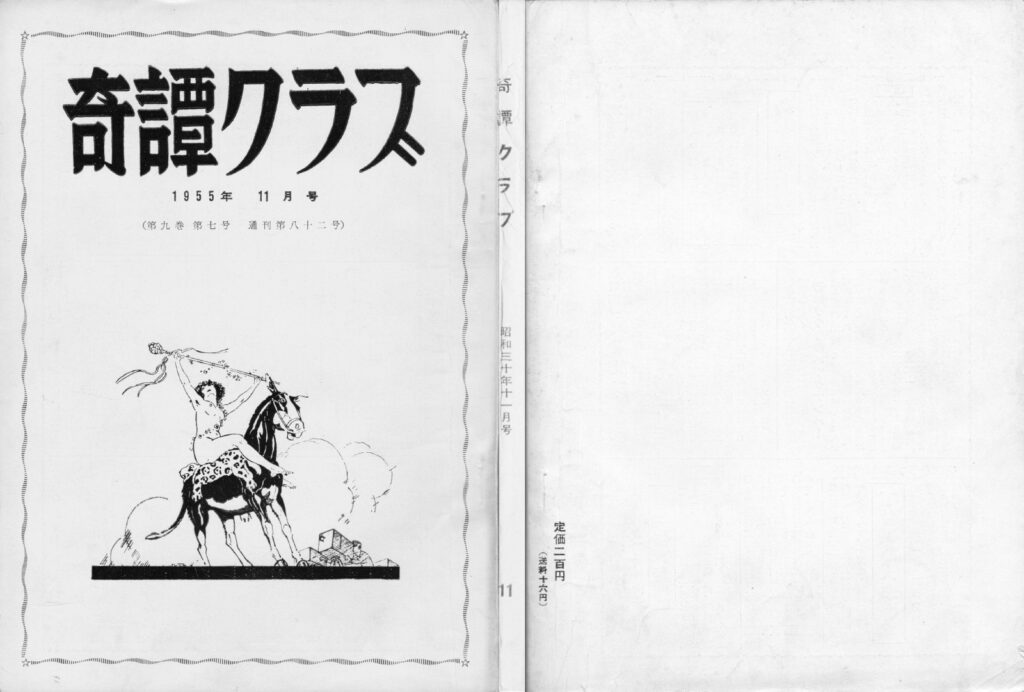
Issue Details
- PDF pages
- 86
Summary
The November 1955 issue of Kitan Club is a visually and textually dense publication combining bondage illustration, historical fantasy, confessional fiction, sexological commentary, medical and bodily case studies, prison memoir, translated European material, film and literary criticism, reader correspondence, and extensive publishing back matter. Its editorial identity depends on the close association of erotic spectacle with purported documentation. Images of restraint and punishment are placed beside autobiographical testimonies, historical investigations, clinical discussion, cultural criticism, and serialized narratives, creating a magazine that treats unconventional desire as fantasy, personal experience, artistic subject, and field of inquiry.
Read full summary Close full summary
Table of Contents 47 items
-
Bagworm
Summary
An erotic illustration depicts a woman tightly bound and hoisted into the air like a bagworm, presented as a spectacle for onlookers and as an imagined form of public display.
-
A Small Athletic Meet
Summary
An erotic illustration and accompanying text portray a woman struggling through a small athletic meet while restrained and urged to run, turning physical exertion into a scene of coercion and humiliation.
-
Drifting Woman
Summary
A pair of erotic illustrations presents women in stylized drifting or reclining poses, emphasizing vulnerable bodily positioning and visual spectacle.
-
Spoils of the Gambling House
Summary
An illustrated erotic narrative depicts women seized after a gambling-house episode, gagged and rope-bound before being carried into a storehouse as sacrificial victims.
-
The Captive of the Little Island
Summary
A captivity fantasy recounts a woman awakening naked and tied on the shore of the Little Island, where miniature officials and a royal procession inspect and display her body.
-
A Scene from Gulliver's Travels
Summary
A two-panel erotic adaptation of Swift’s Gulliver’s Travels shows a nude giant woman restrained and surrounded by Lilliputian people, with the miniature society examining her body.
-
Female Missionary
Summary
An illustrated erotic fantasy depicts a female missionary or trainer captured and restrained in a fantastical Lilliput-like setting, combining narrative captions with staged bondage imagery.
-
Farewell
Summary
This extended fictional work follows Yūko through troubled romantic and sexual relationships, confessional exchanges, fantasies of isolation, and episodes of coercion, restraint, humiliation, and domination. The narrative repeatedly examines the psychological conflict between desire, shame, independence, and surrender.
-
Theory of the Abnormal Novel
Summary
Satō Masuo offers a literary-critical theory of the “abnormal novel,” classifying its treatments of sadism, masochism, fetishism, and erotic transformation while discussing the genre’s narrative techniques, psychological appeal, and social significance.
-
Ten Months in Captivity
Summary
A first-person captivity memoir recounts ten months spent in a prison environment, focusing on the medical department, inmates, guards, institutional routines, illness, food, and the narrator’s shifting relationships with staff and fellow prisoners.
-
How I Punish Him
Summary
An illustrated practical feature presents a woman’s methods of punishing and disciplining a male partner through commands, bondage, restraint, corporal punishment, teasing, humiliation, and staged erotic role-play.
-
Lesbianism and Enemas
Summary
A sexological advice article examines a woman’s same-sex desire and relationship with a female partner, particularly the erotic and relational significance of enemas, while considering how the situation affects her marriage and future choices.
-
Female Belly-Cutting in Training Clothes
Summary
A short erotic narrative depicts a woman in training clothes undergoing belly-cutting as a stylized act of violent punishment and sexualized submission.
-
Playing with Life
Summary
This serialized erotic story follows Sumie and Nobuo through a volatile relationship involving marital conflict, coercive sexual games, bondage, humiliation, and escalating danger, accompanied by erotic illustrations.
-
From the Notebook of a Certain Masochist
Summary
A first-person notebook-style account describes a masochist’s fantasies, desires, sexual experiences, and reflections on fetishistic relationships, punishment, social stigma, and the search for sympathetic companionship.
-
The Woman Who Laughs Under Torture
Summary
A first-person erotic narrative follows an artist’s increasingly sadistic experiments with a female model, who endures elaborate restraints and torture while laughing, accompanied by an erotic illustration of a woman bound to a guillotine-like apparatus.
-
Landing Before the Enemy
Summary
A dark erotic narrative depicts a boy or young man subjected to authoritarian captivity, interrogation, forced exposure, physical punishment, and humiliating restraint in a prison- or institutional setting.
-
Okyū and the Loincloth
Summary
This autobiographical fetish account traces the author’s long-standing erotic fascination with women’s loincloths and moxa treatment, recalling domestic and school-age encounters in which clothing, bodily inspection, and therapeutic pain become sexualized.
-
Confusion
Summary
An extended first-person erotic essay describes the author’s fixation on tying women, recounting fantasies and experiences involving rope wrapping, waist binding, concealment, and the visual appeal of restrained female bodies.
-
Let Me Wear Your Underwear
Summary
A personal erotic confession and reader-style exchange centers on the desire to obtain, wear, and imagine women’s underwear, discussing cross-dressing, intimate clothing, secrecy, and fetishistic fascination.
-
Praise of Bodily Beauty
Summary
This essay praises the erotic and aesthetic qualities of the traditional Japanese fundoshi, describing its fit, tying, bodily contours, and heightened sensual effect in everyday and bathing contexts.
-
Fireside Talk
Summary
A conversational erotic anecdote set around a rural social gathering describes flirtation, drinking, sexual pursuit, and the manipulation of appearances and reputation, accompanied by a staged image of a woman in traditional dress.
-
Jealousy and Woman
Summary
This fictional account follows a hostess whose relationships with male customers become entangled with money, sexual access, jealousy, secrecy, and competing expectations of affection and marriage.
-
Cruel Women
Summary
A translated case-based essay examines allegedly cruel women through historical and contemporary examples of female violence, domestic abuse, punishment, sadism, and social responses to women who inflict suffering.
-
From Cruelty to Sadism
Summary
A first-person sadomasochistic narrative traces a woman’s experiences of abuse, coercion, and punishment as she moves from the position of victim toward sadistic control, accompanied by illustrations of violent restraint and corporal domination.
-
Notes on Meiji-Period Newspapers, Part Four
Summary
This historical column surveys sensational Meiji-era newspaper reports involving domestic conflict, sexual scandal, violence, female resistance, and unusual crimes, presenting them as evidence of changing social and sexual attitudes.
-
The Dawn of the City of Sodom
Summary
Framed as the confession of a male sodomist, this erotic narrative recounts a night at a Japanese hot-spring city involving the pursuit of male companionship, clandestine desire, and sexual encounters in public and private spaces.
-
Complete Submission
Summary
A first-person erotic narrative portrays a young man’s intense submission to his father’s harsh discipline, especially through scenes involving horse riding, clothing, and corporal punishment.
-
A Certain Sodomite's Confession
Summary
An autobiographical confession traces the narrator’s developing attraction to men from childhood through military service, describing same-sex longing, fantasy, and emotionally charged encounters with male comrades.
-
Longing for Sadism
Summary
This short illustrated essay explores the narrator’s fascination with sadism, presenting sadistic desire as a psychologically compelling erotic impulse.
-
Corncob Stories
Summary
An editorial miscellany on fetishism surveys unusual fixations involving body parts—especially ears and earwax—and also presents imaginative erotic anecdotes and reader-contributed fantasies.
-
The Actress's Bare Feet
Summary
This essay examines actresses’ bare feet in detail, discussing their shapes, toes, size, and the erotic fascination they can provoke in spectators and photographers.
-
Record of Yuriko
Summary
Yuriko recounts her life and sexual exploitation in a first-person record, moving from her upbringing into nude photographic modeling, nude performance, and other forms of commercialized erotic display and service.
-
To a Certain Model
Summary
A love-letter-style piece addressed to model Nagase Akiko, reflecting on her published image, physical presence, posing, and the charged relationship between model and male observer.
-
The Screen of Film Magazines and Theater
Summary
An illustrated survey of bondage scenes in films, magazines, and theater, discussing how restraint, danger, eroticism, and dramatic staging are represented across popular media.
-
Blowing Pool
Summary
A long experience-based narrative set around a hospital ward, portraying impoverished and institutionalized patients, harsh treatment, sexual tensions, and the patients’ collective efforts to demand humane reforms. It culminates in formal demands and an agreement concerning nursing, restraint, sanitation, and patient rights.
-
The Acrobat Troupe
Summary
An observational essay on a Chinese acrobat troupe and circus performers, focusing on their extraordinary feats, bodily discipline, costumes, and the spectators’ fascinated response to their bodies in performance.
-
A Faint Masochism Seen in Film, Continued
Summary
A continuation of the author’s survey of films that portray faint or muted forms of masochism, discussing female characters, eroticized vulnerability, humiliation, and the suggestive emotional power of cinematic scenes.
-
Ideas for the Third Album
Summary
A proposal soliciting reader ideas for the magazine’s third album, listing possible photographed bondage compositions and inviting contributions to shape the next collection.
-
Thoughts on Women's Professional Wrestling
Summary
An essay on the rapid popularity of women’s professional wrestling examines its performers, match techniques, bodily presentation, audience appeal, and prospects for future development.
-
Secret Obscenity
Summary
An erotic fantasy narrated from a woman’s perspective depicts a frightening nighttime encounter involving pursuit, captivity, physical restraint, and conflicted sensations of fear and desire.
-
Blooming in the Soil of Shared Bedding
Summary
This reflective essay considers same-sex desire, arguing that homosexual inclinations can emerge naturally and criticizing social prejudice, ignorance, and restrictive moral judgments.
-
Reader Correspondence
Summary
A reader-mail section presents personal accounts, questions, requests, and editorial replies concerning erotic experiences, relationships, bondage, and sexual concerns.
-
Latest Kitan Club Books
Summary
A multi-page promotional catalog advertises recent Kitan Club and related erotic publications, including illustrated and photographic works focused on bondage, fetishism, bodies, and sexual scenarios.
-
Editorial and Publication Information
Summary
The closing publication page combines a preview of the forthcoming issue with reader-exchange information and practical editorial or subscription notices.
-
Ancestral Female Belly-Cutting
Summary
An anecdotal historical account examines the practice of women cutting their own abdomens, presenting family lore and testimony about a woman who performed or threatened such an act with a small knife.
-
Advertisements and Subscription Notices
Summary
A densely packed advertising and subscription section promotes Kitan Club and related publications, erotic books, photographic collections, model-photo contests, illustration and writing opportunities, and mail-order purchasing.
Highlights
- The formal contents page organizes the issue's visual features, fiction, prize-selected manuscripts, memoirs, historical essays, translation, criticism, and correspondence departments. (PDF p. 2).
- The opening visual portfolio presents suspension, outdoor restraint, historical capture, public punishment, and exoticized captivity scenes. (PDF pp. 2–5).
- Farewell is a long psychological narrative centered on separation, secrecy, unstable attachment, and emotional estrangement. (PDF pp. 6–11).
- Theory of the Abnormal Novel considers how literature represents unconventional sexuality and the relationship between fiction and lived experience. (PDF pp. 12–13).
- Ten Months in Captivity continues the prison memoir's account of discipline, institutional authority, surveillance, and bodily hardship. (PDF pp. 14–16).
- How I Punish Him develops an extended scenario of female authority, male submission, commands, humiliation, and controlled punishment. (PDF pp. 17–20).
- The article on lesbianism and enemas combines same-sex desire with medicalized bodily treatment. (PDF p. 21).
- Female Belly-Cutting in Training Clothes examines a historical account of ritualized cutting and gendered bodily violence. (PDF p. 22).
- Playing with Life is a long illustrated narrative involving coercion, bodily danger, confinement, medical intervention, and threatened loss of autonomy. (PDF pp. 23–29).
- From the Notebook of a Certain Masochist combines personal reflection, cultural history, foreign sources, medicine, and psychological interpretation. (PDF pp. 30–33).
- The Woman Who Laughs Under Torture links acrobatic performance, bodily endurance, public spectacle, and punishment. (PDF pp. 34–36).
- Landing Before the Enemy presents a juvenile-detention experience shaped by discipline, institutional authority, danger, and vulnerability. (PDF pp. 37–39).
- Let Me Wear Your Underwear treats intimate clothing as a vehicle for fetishistic identification, longing, and cross-gender imagination. (PDF pp. 44–45).
- Jealousy and Woman is a substantial prize-selected narrative about rivalry, possessiveness, betrayal, humiliation, and sexual dependency. (PDF pp. 47–50).
- The translation of Das Grausame Weib surveys European historical and literary representations of cruel women. (PDF pp. 51–52).
- From Cruelty to Sadism considers the distinction between nonsexual cruelty and sadism as an erotic or psychological orientation. (PDF pp. 53–55).
- Notes on Meiji-Period Newspapers, Part Four, gathers historical reports concerning crime, punishment, gender transgression, sexuality, and unusual customs. (PDF pp. 56–57).
- The Dawn of the City of Sodom presents male same-sex experience through memory, secrecy, stigma, and the search for community. (PDF p. 58).
- Complete Submission is an extended prize-selected narrative of domination, dependency, humiliation, and psychological surrender. (PDF pp. 59–60).
- A Certain Sodomite's Confession traces male same-sex desire through autobiographical recollection and social concealment. (PDF pp. 61–62).
- The Actress's Bare Feet explores foot fetishism through theater, spectatorship, bodily detail, and personal fascination. (PDF p. 65).
- Record of Yuriko is a sustained narrative of intimacy, observation, and sexual development. (PDF pp. 66–67).
- The film and theater columns examine how performance and visual media transform bodily suffering and submission into spectacle. (PDF pp. 69, 73–74).
- The discussion of women's professional wrestling treats costume, strength, staged aggression, and gendered performance as erotic spectacle. (PDF pp. 76–77).
- Reader correspondence collects personal experiences, questions, comments on earlier articles, and editorial replies. (PDF pp. 79–80).
- Book catalogs, publication advertisements, contributor notices, subscription details, and a final historical note form the issue's closing back matter. (PDF pp. 81–86).
Contributors
Named contributors represented in this issue:
- Amadoro Kansai
- Aoba Jun'ichi
- Asaji Noboru
- Azuma Shin
- Editorial Department
- Furukawa Hiroko
- Furukawa Shinsuke
- Futamata Shizuko
- Haruki Toshio
- Haruta Ichirō
- Itō Susumu
- Izuta Osamu
- Johannes R. Birlinger
- Kaji Shin'ichi
- Kajimura Kyōsuke
- Kameyama Hideo
- Kawashita Jun'ichi
- Kitahara Sumiko
- Kiyama Shinsaku
- Kondō Kikuya
- Kyōmachi Shin'ichirō
- Mikine Kōji
- Mori Tadashi
- Nagaharu Osamu
- Narumi Fumio
- Numa Shōzō
- Okinoya Sumiko
- Sakata Shinji
- Satō Masuo
- Sugihara Kōji
- Takahara Masao
- Takarazuka Fumio
- Tsujiura Takashi
- Watanabe Yō
- Watashiba Den'ichirō
- Yamada Makoto
- Yoshino Mayumi