Kitan Club
August 1956
← Back to magazine archive
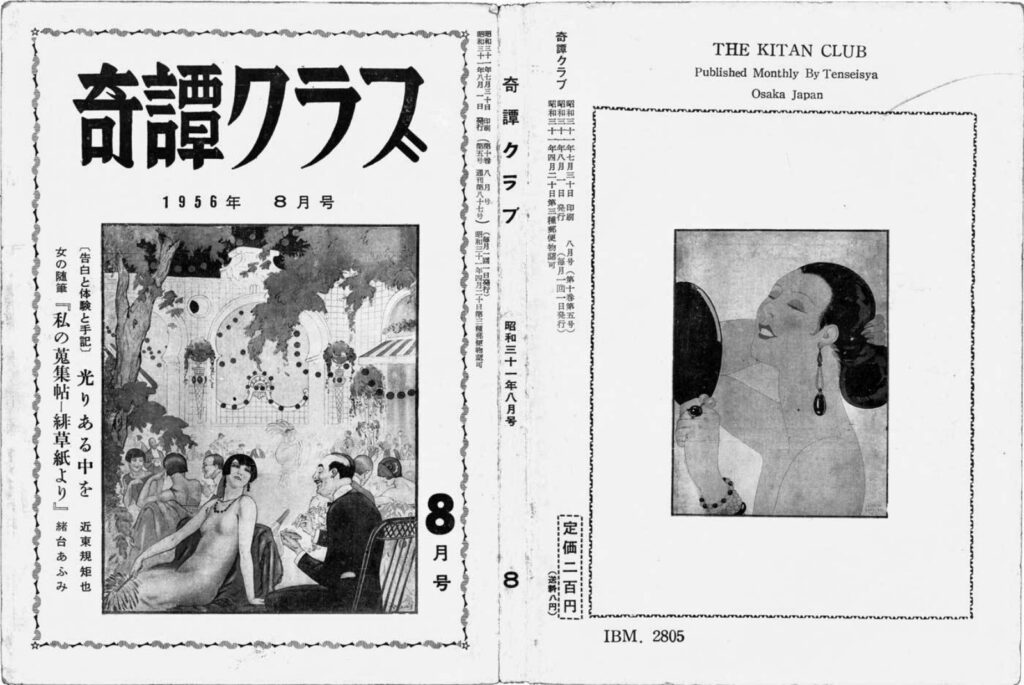
Issue Details
- Volume
- 10
- Issue
- 5
- PDF pages
- 172
Summary
The August 1956 issue of Kitan Club presents the magazine as a hybrid of illustrated erotic literature, personal testimony, cultural criticism, historical inquiry, serialized fiction, reader debate, and specialist publishing news. Its opening pages establish a visual vocabulary of restraint and punishment through Shima Takashi’s traditional-room illustration, outdoor bondage photographs featuring model Hagi Chieko, an illustrated story of female punishment, and an imported image identified as W. M. Francis’s “The Brass Monkey.” This mixture of Japanese settings, staged photography, pulp illustration, and foreign source material situates the issue between domestic literary culture and an expanding transnational archive of fetish imagery.
Read full summary Close full summary
Table of Contents 41 items
-
A Beautiful Tokonoma
Summary
An erotic illustration presents a woman bound and gagged within a Japanese tokonoma, transforming the traditional alcove into a stylized scene of restraint.
-
The Slide
Summary
A photographic feature stages the restraint of a female model on an amusement-park slide, emphasizing outdoor bondage and posed erotic spectacle.
-
Illustrated Story: A Splendid Private Punishment
Summary
This illustrated erotic story follows two academically competitive female classmates whose jealousy and rivalry escalate into reciprocal abduction, bondage, and elaborate private punishment.
-
Bondage Pictures Seen in an American Magazine
Summary
A visual feature reproduces bondage imagery from W. M. Francis’s “The Brass Monkey,” published in Esquire in September 1949, showing a nude woman restrained in an interior setting.
-
Depictions of Torment in Popular Literature
Summary
Fujimi Kaoru examines depictions of torment, coercion, punishment, and sexualized violence in Japanese popular literature, discussing works and scenes alongside accompanying illustrations.
-
The Wretched-Picture Maniac
Summary
Kyōraku-sei surveys the tradition of cruel and gruesome erotic imagery, discussing illustrated scenes of violence, bodily injury, nakedness, and sadistic domination in Japanese popular visual culture.
-
Memories of My Days as a Private Second Class
Summary
An autobiographical military memoir recounts the author’s conscription, barracks life, harsh discipline, hazing, and humiliating encounters with superiors during service as a private second class.
-
Bondage Complex, Part Two
Summary
The second installment of a bondage narrative describes elaborate restraint scenes involving a woman, including tied limbs, forced positions, photographic staging, and the psychological dynamics between captive and participants.
-
Correspondence: Recollections of a Bondage-Picture Enthusiast
Summary
A reader’s memoir recalls his longstanding fascination with bondage pictures and reflects on the images, artists, and personal experiences that shaped his interest.
-
Through the Light: Record of My Suicide Attempt
Summary
An autobiographical account of a suicide attempt shaped by chronic illness, marital breakdown, family difficulties, and profound emotional crisis, followed by hospitalization and a gradual return toward life. The narrative presents survival as a painful but possible recovery from despair.
-
An Old Man’s Soliloquy
Summary
A satirical old man’s monologue reflecting on women, gender relations, and the supposedly proper use of restraint, reprimand, and punishment in intimate relationships.
-
An Open Letter to the Editor from a Reader
Summary
A reader’s open letter congratulates Kitan Club on its revival while critically assessing its sales, editorial policies, visual presentation, and treatment of sadistic and masochistic material. It advocates stronger reader participation, more effective photographs and illustrations, and bolder but better-organized specialist erotic publishing.
-
Chūshingura Secret Tale: The Woman Who Cut Open Her Abdomen in the Genroku Era
Summary
A historical erotic tale set in the Genroku era and connected to the Chūshingura tradition, in which a woman’s secret, marital intrigue, and violent abdominal cutting unfold amid samurai honor and revenge.
-
Slashing “The Season of the Sun”
Summary
A critical essay examines the novel and film versions of Shintarō Ishihara’s The Season of the Sun, comparing their treatment of youth, sexuality, violence, disability, censorship, and postwar commercial culture.
-
Three Beautiful Youths Who Appeared in History
Summary
This historical-literary essay profiles three celebrated beautiful youths—Rokudai, Mori Ranmaru, and Taira no Atsumori—drawing on chronicles, war tales, and later cultural memory to discuss youthful male beauty, eroticized devotion, and tragic death.
-
Twelve Months in Confinement, Part Two
Summary
A first-person prison memoir recounts a prisoner’s escape, recapture, confinement, parole, institutional routines, and eventual return to ordinary life, with detailed observations of prison staff, fellow inmates, food, work, and rehabilitation. The narrative also reflects on the emotional and social difficulties of reintegration after prolonged imprisonment.
-
A Former Military Nurse’s Suicide
Summary
A wartime account describes Japanese military nurses trapped during the Saipan campaign who choose collective suicide rather than surrender, including the battlefield circumstances, the group’s deliberations, and the lethal injections administered by a military doctor. The piece presents the episode as a tragic historical testimony shaped by wartime ideology, fear, and coercion.
-
On Haruko’s Sensation of Pleasure
Summary
This sexological and autobiographical essay examines Nako’s developing awareness of anal pleasure through bodily sensation, self-observation, sexual fantasy, and repeated experimentation, including references to enemas and rectal stimulation. It presents anal sensation as a distinctive form of erotic experience connected to psychological change, self-love, shame, and bodily self-knowledge.
-
The Staked Enema
Summary
An erotic SM fiction depicts young men wagering over an enema contest, with the loser subjected to escalating restraint, humiliation, and painful punishment in a drinking establishment.
-
From Recent Bondage Films
Summary
A film-review feature surveys recent Japanese bondage films, discussing their plots, performers, staged restraint scenes, and sensational appeal.
-
The Red Flowers Are Weeping, Final Installment
Summary
The final installment of Matsui Rōko’s serialized SM novel follows jealousy and marital suspicion into confrontations involving infidelity, coercive control, bondage, and punishment, culminating in a highly melodramatic resolution involving the recurring red flowers.
-
From a Kitan Club Reader’s Collection
Summary
An essay defending Kitan Club’s cultural and research value, arguing that its distinctive materials preserve otherwise neglected facts and create a shared field of inquiry for readers, writers, and scholars.
-
From My Collection
Summary
A bibliographic essay introducing collected writings and biographical materials on writers such as Maupassant, Baudelaire, and Strindberg, emphasizing their unusual personalities, sexuality, psychological conflicts, and literary achievements.
-
Record of a Youth Soldier
Summary
An autobiographical continuation recalling the author’s adolescent fascination with boys’ bodies, loincloths, swimming and sumo wrestling, and the secret pleasure of observing, imagining, and collecting images of male physicality.
-
A Word About the Editorial Policy of K Magazines
Summary
An editorial statement explains Kitan Club’s publishing policy, acknowledges changes in distribution and content, and asks readers to judge the magazine against their expectations while reaffirming a commitment to distinctive specialist material.
-
The Eve of Black-Wave Gorge
Summary
A serialized erotic bondage thriller follows Reiko and other characters through captivity, coercive sexual domination, physical punishment, humiliation, and escalating abuse against a backdrop of espionage, institutional intrigue, and imagined wartime crisis.
-
Recent Bondage-Film News
Summary
A news and review column surveys recent Japanese bondage films, describing plots, performers, restraint scenes, and production details, with accompanying illustrations and notices about forthcoming film coverage.
-
Bondage-Film Report
Summary
A survey of contemporary Japanese films, organized by production company, describes plots featuring rope bondage, captivity, restraint, crime, and sensational sexual situations.
-
My Various Torments
Summary
A reader correspondence feature presents a woman’s account of romantic frustrations, age differences, and her attraction to pantyhose, followed by an advice-oriented response.
-
From My Collection: Scarlet Paper
Summary
An illustrated literary essay from a collection of erotic pulp material reflects on changing erotic tastes while recounting scenes of women being captured, bound, and tormented with rope.
-
Selected Contributions and Gleanings
Summary
An editorial selection of previously unpublished or omitted manuscripts discusses the magazine’s treatment of reader submissions and presents excerpts involving personal confession, criminality, and unusual domestic relationships.
-
A Seppuku Incident Reported in the Newspapers
Summary
Fujimori Kazuo recounts a sensational newspaper-reported incident in which a man violently killed a woman and then attempted or committed suicide by seppuku, framing the episode as crime reportage.
-
New Detective Fiction
Summary
This essay examines detective fiction through the author’s notebook of quotations, discussing murder mysteries, sensational crime narratives, literary technique, and extended scenes of captivity, bodily violence, and eroticized threat.
-
A Dream of Bondage
Summary
A first-person erotic medical narrative describes a wife’s asthma treatment with moxa cautery and related procedures, which leave healing scars that the couple discover can be sucked and incorporated into their intimate life.
-
Completion of a Queen Bee
Summary
This illustrated feature discusses creating an extreme “wasp waist” through prolonged corset or waist-nipper use, describing the appearance, bodily sensations, and practical effects of intensive waist training.
-
A New Gate
Summary
A newspaper-and-magazine news column surveys contemporary media stories, focusing on intense fan culture surrounding film star Kubo Akira and a sensational voyeurism case involving a university student caught spying in a women’s restroom.
-
The Deluded Hero: Oda Nobunaga
Summary
A historical-psychological essay on Oda Nobunaga portrays the warlord as a contradictory, violent, and sexually unconventional “hero,” linking his military conduct, personal relationships, and authoritarian ambition to the turbulent culture of the Sengoku era.
-
The Captive
Summary
An illustrated captivity narrative depicts a white woman held and bound by an indigenous or frontier captor, emphasizing eroticized restraint, vulnerability, and visual spectacle.
-
Publishing Catalogue and Back-Issue Information
Summary
A multi-page publishing catalogue advertises illustrated fetish and bondage titles, including photographic portfolios and special collections, with prices, order information, and back-issue listings; the final page also presents reader correspondence and editorial notices.
-
Reader Contributions and Communications
Summary
A multi-page reader correspondence section presents readers’ reactions to recent issues, requests for photographs, illustrations, stories, and practical bondage material, and exchanges about erotic interests, visual preferences, and magazine participation.
-
Editorial Notices and Publication Information
Summary
Editorial notices announce the forthcoming September issue, provide ordering and publication information, and discuss editorial policies, reader submissions, circulation, and the magazine’s future direction.
Highlights
- The opening visual sequence combines a traditional Japanese interior, outdoor rope photography, illustrated female punishment, and an imported image from Esquire, revealing the magazine’s blend of domestic and foreign visual sources. (PDF pp. 6–12).
- Fujimi Kaoru’s essay analyzes depictions of bound, stripped, threatened, and humiliated figures in modern popular literature, with particular attention to the interaction of prose and illustration. (PDF pp. 14–20).
- “Bondage Complex, Part Two” gives a detailed first-person account of arranging and undergoing a bondage photographic session, including costume, posing, direction, embarrassment, and the transformation of fantasy into recorded images. (PDF pp. 26–31).
- Kondō Kikuya’s “Through the Light” is a sustained autobiographical narrative of journalism, postwar disillusionment, tuberculosis, friendship, bereavement, and psychological collapse. (PDF pp. 32–41).
- Hatanaka Toshio’s open letter to the editor debates censorship, commercial pressure, reader responsibility, imported erotic material, and the editorial obligations of a specialist magazine. (PDF pp. 42–44).
- “The Woman Who Cut Open Her Abdomen in the Genroku Era” reworks the Chūshingura setting through a woman’s bodily sacrifice, loyalty, deception, and violent death. (PDF pp. 45–47).
- Onizuka Kensaku’s critique of “The Season of the Sun” places Kitan Club within contemporary literary controversy and attacks the novel’s treatment of sexuality, violence, and postwar youth. (PDF pp. 48–49).
- Nishimura Kōnan’s study of three beautiful youths links male beauty to historical memory, political tragedy, loyalty, and literary idealization. (PDF pp. 50–57).
- “Twelve Months in Confinement, Part Two” offers an extended account of military and prison discipline, surveillance, punishment, hierarchy, deprivation, and relationships among inmates. (PDF pp. 58–65).
- The final third combines the conclusion of a serialized melodrama with collectors’ columns, military recollection, fantasy and detective fiction, seppuku narratives, reader submissions, indexes, catalogues, and editorial notices. (PDF pp. 82–172).
Contributors
Named contributors represented in this issue:
- Editorial Department
- Fujimi Kaoru
- Fujimori Kazuo
- Hatanaka Toshio
- Higashida Ichirō
- Higashida Nako
- Kadoki Chūnosuke
- Kadota Nako
- Kasagi Toshirō
- Kawano Kyōsuke
- Kondō Kikuya
- Kyōraku-sei
- Maki Senjirō
- Matsui Rōko
- Naniwa Rōjin
- Nishimura Kōnan
- Ō Shōgo
- Ogata Ayumi
- Onizuka Kensaku
- Satō Maiichi
- Shima Takashi
- Takamura Tamiko
- Tsuchiji Sōichi
- W. M. Francis
- Watanabe Nōsuke
- Yamaguchi Kōichi
- Yamazaki Kiyoya
- Yazaki Ryūichi