Beautiful Bondage
June 1964
← Back to magazine archive
Issue Details
- Issue
- 2
- PDF pages
- 14
Summary
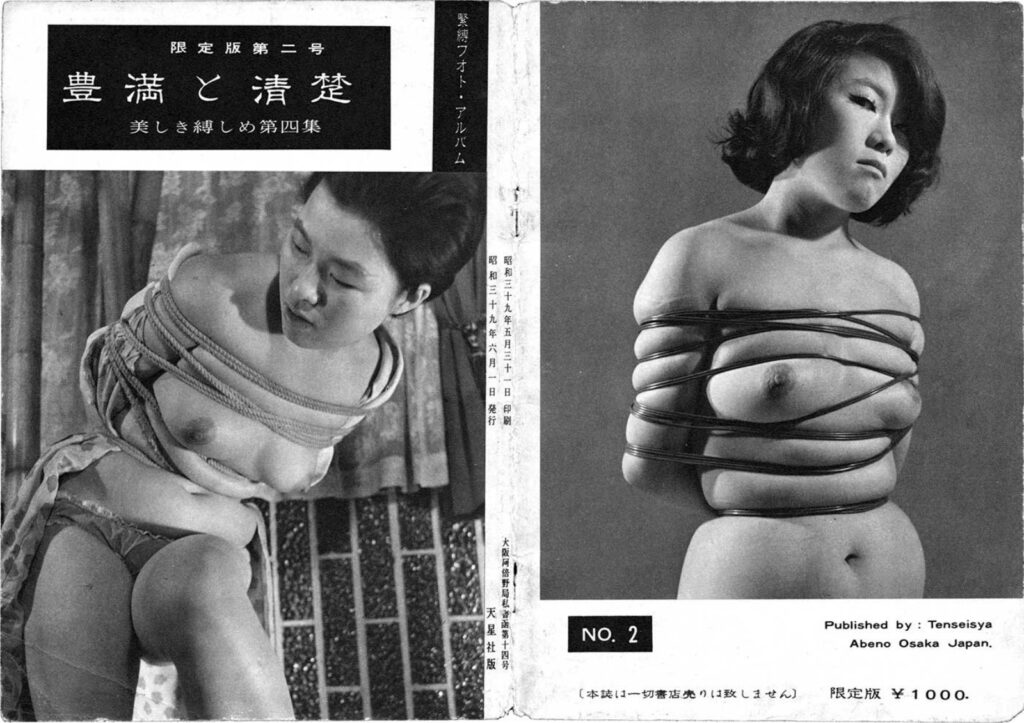
The June 1964 installment of Beautiful Bondage is a compact limited-edition photographic portfolio devoted entirely to a sustained bondage study. The cover identifies it as Limited Edition No. 2 and as the fourth collection of 美しき縛しめ, while prominently giving the thematic title 豊満と清楚, approximately Voluptuousness and Purity. In contrast to the preceding collection’s broad catalog of models and restraint configurations, this installment has a much more concentrated visual structure. It follows a small number of models, with one woman dominating much of the portfolio, through successive variations of upper-body and full-body rope restraint.
Read full summary Close full summary
Loading PDF…
Highlights
- The cover identifies the publication as Limited Edition No. 2, gives the thematic title Voluptuousness and Purity, and describes it as the fourth Beautiful Bondage collection. It also provides the June 1, 1964 publication date, Tenseisya's Abeno, Osaka imprint, a 1,000-yen price, and the statement that the edition is not sold through bookstores. (PDF p. 1).
- The opening portfolio establishes the issue's concentrated approach through rear and frontal views of upper-body bondage, contrasting conventional rope with broad patterned cord wrapped tightly around the shoulders, breasts, and torso. (PDF pp. 1–3).
- Several photographs explicitly include the binder's hands adjusting rope, positioning the model's head, or tightening the upper-body restraint, documenting the physical construction of the pose as part of the photographic performance. (PDF pp. 3–6).
- The central sequence develops increasingly complex relationships between torso restraint and folded or crossed legs, including ties that connect the upper body to the wrists or ankles and force the model into compact kneeling and reclining positions. (PDF pp. 5–9).
- Close framing repeatedly emphasizes facial expression, neck extension, arching, and the bodily response to tightened chest ropes, giving the portfolio a stronger performative and affective emphasis than a purely technical bondage manual. (PDF pp. 3–9).
- A later sequence introduces cloth gagging combined with dense horizontal chest binding, contrasting the soft fabric around the mouth with coarse rope compression around the torso. (PDF pp. 10, 12).
- The concluding photographs shift toward overhead wrist restraint, including nude and gagged poses in front of Japanese sliding screens, ending the portfolio with vertically extended rather than compact folded-body configurations. (PDF pp. 11, 14).