Uramado
June 1958
← Back to magazine archive
Issue Details
- PDF pages
- 286
Summary
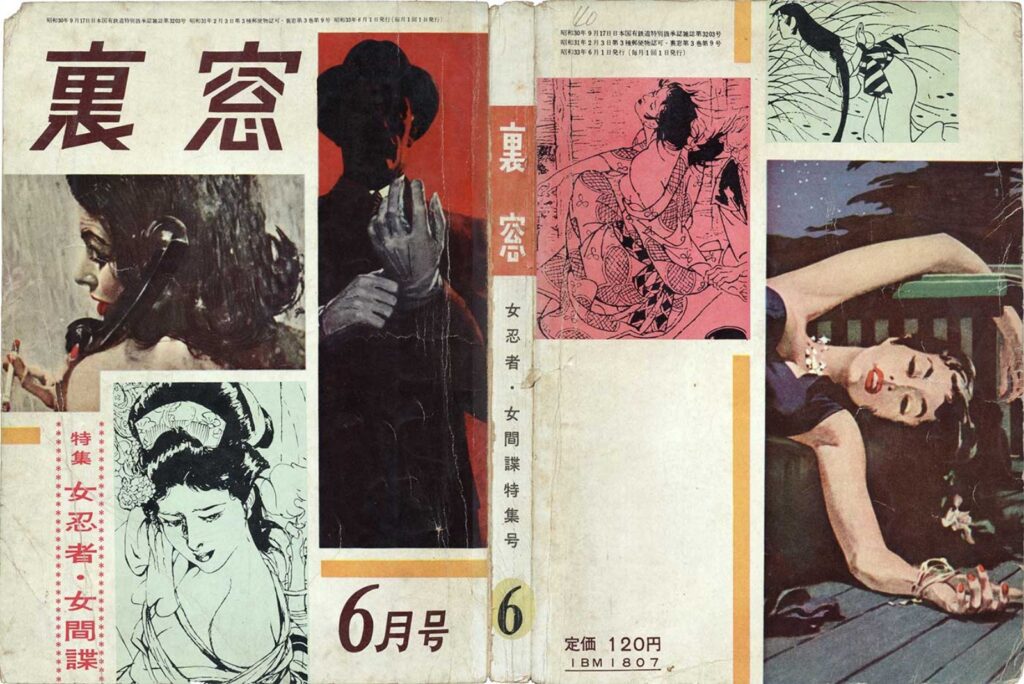
The June 1958 issue of Uramado is a large special number devoted to female ninja and female-spy stories. It combines historical adventure, supernatural revenge tales, espionage thrillers, prison reportage, execution history, crime fiction, translated suspense, illustrated serials, and an atmospheric photographic portfolio.
Read full summary Close full summary
Table of Contents 24 items
-
Hell at Tsurumaki Castle
Summary
A historical erotic adventure set during the assault on Tsurumaki Castle, in which the resourceful female ninja 妙女 uses deception, seduction, and violence amid battles, captivity, and shifting loyalties.
-
The Night Hourglass
Summary
A staged photographic portfolio uses an hourglass, darkness, rope-like forms, and the nude female body to evoke confinement, sensuality, suspension, and release at daybreak.
-
Sophie Disappeared
Summary
A serialized erotic crime thriller follows the disappearance of Sophie amid mysterious intruders, espionage, murder orders, seduction, captivity, and a planned revenge operation.
-
The Bewitching Mirror of Strange Incantations, Episode Fifteen
Summary
Episode fifteen of this serialized supernatural erotic mystery follows the geisha Koito and other characters through deceptive mirrors, secret identities, abduction, violent confrontations, and occult intrigue, with scenes of coercive restraint and sexualized humiliation. The episode moves between urban pleasure quarters and haunted or concealed spaces as the characters pursue hidden documents, treasure, and revenge.
-
Secret Document of Snake-Forest Cave
Summary
An illustrated historical erotic adventure follows a female ninja trained in the mountain wilderness, whose missions, rivalries, captivity, and encounters unfold amid secret caves and feudal intrigue.
-
The Spy Vanishes at Dawn
Summary
An illustrated espionage thriller follows international agents through surveillance, deception, abduction, drugging, and coercive sexual encounters as a spy attempts to escape pursuit and disappear.
-
Legend of the Vengeful Spirit Marsh
Summary
An illustrated historical erotic serial follows travelers, treasure seekers, ninjas, and abducted women whose struggles center on the haunted marsh of the title and the vengeful spirit associated with it. The narrative features captivity, pursuit, rope restraint, gagging, humiliation, and supernatural menace amid a period adventure plot.
-
The Man Who Manufactured Counterfeit Money in Prison
Summary
An illustrated crime report recounts how two technically skilled brothers produced counterfeit banknotes inside prison, detailing their improvised printing methods, concealment, detection, arrest, and eventual punishment.
-
Blood-Stained Mandala
Summary
A serialized Edo-period erotic adventure follows the encounters of a beautiful artisan and several retainers, involving secret medicines, disguises, captivity, coercion, escapes, and conflicts between feudal households. The accompanying illustrations depict stylized historical scenes of seduction, restraint, drugging, and physical struggle.
-
Secret Notes on Extreme Punishments
Summary
An illustrated historical survey of severe punishments in Edo-period Japan, describing execution methods, penal procedures, criminal cases, and the social spectacle surrounding them.
-
The Spy’s Scattered Blossoms
Summary
A serialized espionage adventure follows the glamorous Meika through surveillance, pursuit, abduction, torture, escape attempts, and sexually charged confrontations involving several captors and accomplices.
-
The Unfertilized Egg
Summary
Hori Kyōko’s erotic fiction follows Toshiki’s obsessive attraction to Yumiko, blending memories of youthful beauty, fetishistic looking, emotional dependency, and increasingly troubling fantasies of possession and loss.
-
The New Early-Modern Tale: The Egg Flower Remedy
Summary
Ōkado Masato’s illustrated historical erotic tale is set in an early-modern Japanese world of bathhouses, samurai, merchants, and courtesans, where encounters, disguises, erotic bargaining, and violent reversals unfold around the titular egg-flower remedy.
-
The Southern-Barbarian Ship of the Women’s Hall
Summary
An illustrated historical erotic adventure in which characters become entangled with a mysterious Southern-Barbarian ship and women’s hall, amid abduction, confinement, deception, and violent struggles for escape and rescue.
-
The Snake-Charmer Princess
Summary
A serialized fantasy-adventure follows the enigmatic snake-charmer princess and her encounters with explorers and outsiders, combining exotic travel, hypnotic or supernatural control, treasure-seeking, captivity, violence, and shifting power between women and men.
-
Secret Letter of Snow-White Skin
Summary
A serialized historical erotic adventure follows rival warriors, retainers, and women caught in political intrigue, secret missions, abduction, interrogation, and coercive sexual encounters around Himeji Castle and the Tokugawa-era world.
-
The Dead Return to Life
Summary
A serialized erotic crime story follows Shizuko, a young woman whose jealousy and troubled marriage lead to murder, concealment, pursuit, and eventual police intervention. The narrative combines domestic sexual tension with sensational scenes of restraint, violence, and psychological breakdown.
-
Binding with a Red Cord
Summary
This serialized historical erotic adventure shifts between a modern framing situation and a period tale of ninjas, abduction, interrogation, and violent erotic domination centered on a woman bound with a red cord. Its illustrations emphasize rope restraint, captivity, coercion, and sadistic struggle.
-
New-Book Listings and Publisher Advertisements
Summary
This back-matter section lists erotic books, magazines, special issues, and visual materials, with titles, brief descriptions, prices, and mail-order purchasing information from publishers and distributors.
-
The Courtesan Ninja
Summary
An illustrated historical erotic serial follows a female ninja operating undercover amid rival houses, whose missions lead to capture, interrogation, coercion, and scenes of bondage and sexualized punishment in an Edo-period setting.
-
The Devil Was Watching
Summary
A serialized mystery follows a reporter investigating a disturbing set of erotic photographs whose hidden clues connect a series of murders, suicides, and illicit relationships. Illustrated scenes of surveillance, coercion, and bound or imperiled women heighten the story’s sensational atmosphere.
-
The Murderer Was There
Summary
This serialized crime thriller centers on a murderer who abducts and restrains a woman while police and reporters reconstruct the crime through interviews, clues, and forensic investigation. The narrative combines suspenseful pursuit with illustrated scenes of bondage, threats, and captivity.
-
The Keian Female Ninja Path
Summary
This illustrated historical erotic serial follows the female ninja Hagino and her allies through Edo-period intrigue involving a hidden inheritance, secret maps, pursuit, infiltration, combat, captivity, and repeated escapes.
-
Breasts of Hell
Summary
A serialized SM crime thriller follows reporter Chiharu and others as they investigate the murder, abduction, and torture of Yumeko, whose trail leads through Tokyo underworld figures, secret rooms, and a mysterious woman known as Masami. The narrative is accompanied by lurid illustrations depicting rope bondage, captivity, torture, and threatened execution.
Highlights
- The cover and contents page explicitly identify the issue as a female-ninja and female-spy special, with twenty-plus major features spanning historical and modern settings.
- The Night Hourglass is an unusually abstract photographic portfolio, using blurred bodies, rope, bare feet, jewelry, and an hourglass to suggest waiting and danger rather than illustrate a conventional narrative (PDF pp. 14–19).
- Sophie Disappeared uses a hybrid layout of film-like images and text to create the atmosphere of an imported international crime serial (PDF pp. 20–28).
- The Bewitching Mirror of Strange Incantations is the issue’s first major female-ninja epic and fills twenty PDF pages with occult devices, ambushes, restraints, and sword violence (PDF pp. 29–48).
- The Spy Vanishes at Dawn shifts the issue from feudal Japan to transnational espionage and treats female identity as a problem of disguise and uncertain allegiance (PDF pp. 60–72).
- Legend of the Vengeful Spirit Marsh combines ninja adventure with folkloric horror, family revenge, and a haunted landscape (PDF pp. 73–90).
- The Man Who Manufactured Counterfeit Money in Prison provides a documentary-crime interlude centered on penal administration and technical ingenuity (PDF pp. 91–100).
- Secret Notes on Extreme Punishments contains illustrated classifications of Edo-period executions, including crucifixion, beheading, burning, and public display (PDF pp. 117–128).
- The Southern-Barbarian Ship of the Women’s Hall uses dense illustrated-history layouts to combine piracy, foreign religion, captivity, and overseas adventure (PDF pp. 156–163).
- The Dead Return to Life fuses detective fiction with gothic resurrection and medical uncertainty (PDF pp. 191–202).
- The Courtesan Ninja turns the social performance expected of a courtesan into a toolkit for espionage, disguise, and political manipulation (PDF pp. 217–236).
- The Devil Was Watching converts surveillance into psychological horror, making everyday interiors feel permanently observed (PDF pp. 237–249).
- The Keian Female Ninja Path ties the female-ninja fantasy to a recognizable seventeenth-century political conspiracy (PDF pp. 261–270).
- Breasts of Hell is the issue’s true final feature, occupying PDF pages 271–286 and ending the magazine with modern supernatural noir rather than publication matter.
Contributors
Named contributors represented in this issue:
- Enjōji Tatsu; art by Nakajima Masami
- Fujikoto Nariya, romanization uncertain
- Fujimi Iku; art by Minomura Kou
- Hashizume Hikoshichi; art by Nakajima Masami
- Hatada Mitsumitsu, romanization uncertain
- Hori Kyōko
- Iida Toyokichi
- Jingyō Kyōichi; art by Yamada Sugiaki
- Kuroba Shin; translated by Nakagawa Ayako
- Magari Nijūhachi; art by Yanagi Shunjō
- Mikunisawa Takashi; translated by Miyata Keijirō
- Misaki Yōnosuke; art by Akiyoshi
- Nanjō Shin’ichi; art by Usa Mitsutake
- Odagiri Sō; art by Kuromori
- Ōkado Masato; art by Kihara Mitsuki
- photography by Fujisawa Osamu; composition by Minomura Kou
- Shimamoto Haruo; art by Yamada Sugiaki
- Suzuki Kazuo; art by Katsura Tōshi
- Takagi Ryūji; art by Nakajima Masami
- text and art by Utagawa Taiga
- text by Iwahori Mitsu; art by Shibatani Kōjirō, romanization uncertain
- Yagiri Shigehachi; translated by Okino Jirō
- Yanagiu Kō
English Translations from This Issue
- The Spy’s Scattered Blossoms — Fujimi Iku; art by Minomura Kou