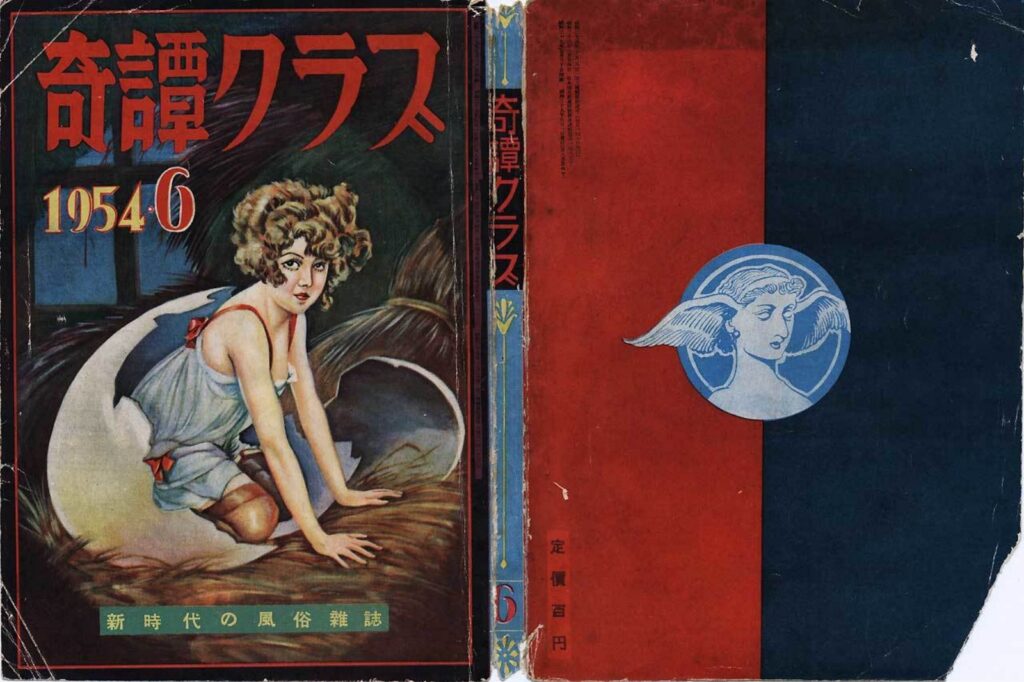
Kitan Club
June 1954
← Back to magazine archive
Issue Details
- PDF pages
- 221
Summary
The June 1954 issue of Kitan Club combines technical bondage studies, imported Western fetish imagery, staged photography, punishment illustration, prison and institutional memoir, female masochistic confession, queer and gender-variant testimony, literary and historical research, cross-dressing, fashion fetishism, female dominance, accounts of corporal punishment, and several substantial works.
Read full summary Close full summary
Table of Contents 49 items
-
The Madness of the Ise Pilgrimage
Summary
An illustrated account of the Oyama/Afuri Shrine area describes Ryōben Falls, reputed in the Edo period to cure madness. It recounts the legend of a madwoman being bound, taken beneath the freezing waterfall, and struck with a ritual 金剛杖, accompanied by Itō Seiu’s dramatic depiction of the scene.
-
Fear of Being Whipped
Summary
A photographic scene portrays a woman confronted with the frightening prospect of having a bit-like gag placed in her mouth, emphasizing apprehension, restraint, and controlled submission.
-
Western Binding and Pony Training
Summary
A photographic feature presenting Western-style binding, gagging, and pony-themed fetish imagery, with women shown in staged restraint scenes and costume.
-
On Restraint: Seven Positions
Summary
An illustrated instructional feature presenting seven rope-restraint positions using swings, ladders, bars, wooden structures, and other apparatus, accompanied by commentary on the importance of rope technique.
-
A Slave Beneath Her Lady’s Feet
Summary
A staged photographic scene depicts a submissive male prostrate beneath a dominant woman’s feet, accompanied by a second image of the woman compelling him to rise. The feature centers on female authority, male submission, and eroticized foot worship.
-
Male Beauty, Women’s Clothing, and Tight Foot Binding
Summary
A photographic feature presents an athletic nude male portrait alongside images of a woman in a patterned skirt and a woman bound at the feet and lower body. The visual sequence combines ideals of male beauty, women’s clothing, simulated seppuku imagery, and tightly bound feet and buttocks.
-
Two Female-Wrestling Scenes
Summary
A two-image photographic feature depicting women engaged in staged wrestling scenes, emphasizing physical struggle and posed domination.
-
Stockings: A Helpless Pose
Summary
A photographic feature showing model Itō Mieko in stockings and a restrained, helpless seated pose, with rope binding across her torso and arms.
-
American-Style Torment, Part Three
Summary
The third installment of “American-Style Torment” presents highly theatrical bondage scenes, combining illustrated tableaux with photographic imagery of multiple people tied in elaborate, uncomfortable positions and apparatus. The feature emphasizes spectacle, restraint, and staged torment.
-
The Woman in White
Summary
“The Woman in White” is a photographic feature featuring model Chiba Chizuko in white clothing, bound with rope in a series of staged reclining and suspended poses. The images foreground costume, immobilization, and the visual presentation of female submission.
-
Photographic Studies of Chest and Arm Binding
Summary
A photographic study documenting multiple rope-binding configurations around the chest, arms, and torso, shown from front, back, and side views. The sequential images emphasize the appearance and positioning of the restraints as a practical visual record of kinbaku technique.
-
Storehouse
Summary
An illustrated erotic narrative scene set in a storehouse, in which a woman is confronted and restrained after being discovered with a younger man. The accompanying text uses threats, betrayal, and criminal authority to frame the scene as coercive captivity and punishment fantasy.
-
Basement
Summary
An illustrated captivity scene depicts Tamiko bound with her hands behind her back and gagged in a dark, windowless basement or storage room. The accompanying text presents the image as a scene from Sakiko Okada’s story “Revenge.”
-
Pole Binding
Summary
An erotic illustration feature depicts three women restrained with ropes to wooden poles in different kneeling, crouching, and seated positions. The images focus on pole-based immobilization and the visual display of bound bodies.
-
Using a Chair
Summary
An illustrated feature presents several women tied to chairs in varied positions, emphasizing the chair as a means of restraint and display. The imagery focuses on rope binding and immobilized posture rather than accompanying procedural text.
-
Beheading
Summary
An erotic illustration titled “Beheading” depicts a kneeling nude woman threatened by an armed soldier, accompanied by Japanese text describing a girl stripped of family, property, clothing, chastity, and ultimately life. The scene combines sexualized captivity with execution imagery.
-
Execution by Firing Squad
Summary
An illustrated execution scene depicts a beautiful female spy calmly awaiting death by firing squad while a female officer photographs or observes her final moments. The presentation combines execution imagery with an explicitly staged, voyeuristic erotic spectacle.
-
Burning at the Stake
Summary
This illustrated historical punishment feature portrays a woman bound to a stake and burned, with accompanying text referring to Joan of Arc, Japanese fire executions, and the treatment of condemned women. The imagery emphasizes public punishment, bodily exposure, restraint, and death by burning.
-
Post-Mounted Restraint
Summary
An illustrated feature depicts a nude woman bound against a wooden post while a kimono-clad swordswoman stands nearby. The accompanying text presents binding as a historical form of disgrace or punishment associated with samurai culture.
-
The Construction of Tight Binding and Ideas for Torment
Summary
A practical and aesthetic guide to constructing bondage photographs and developing ideas for torment scenes. It discusses rope arrangements, poses, props, models, body presentation, hair and clothing, indoor and outdoor settings, and the balance between visual beauty, realism, cruelty, and photographic composition.
-
The Room of Evil, Final Installment
Summary
The concluding installment of Futamata Shizuko’s serialized erotic crime narrative follows a web of coercion, betrayal, and retaliation involving abducted and restrained women, violent men, and a dangerous household. Through shifting encounters in rooms, hotels, and domestic spaces, the story brings its bondage-centered conflicts and psychological tensions toward a violent resolution.
-
Tsuritobi: A Juvenile Reformatory Experience
Summary
A first-person account of life in a juvenile reformatory, focusing on the systematic abuse inflicted by a guard through beatings, forced nudity, inspections, rope binding, and other humiliating punishments. Photographs and illustrations reinforce the testimony’s depiction of coercive restraint and institutional violence.
-
ANUS Bullying
Summary
An erotic narrative centered on “ANUS bullying,” in which a male subject is dominated and tormented by women through forced positions, spanking, foot pressure, restraint, and anal-focused humiliation. The accompanying illustrations depict the staged scenes of female control and sexualized punishment.
-
Diary of My Selfish Heart: A Masochistic Woman’s Journal
Summary
Furukawa Yūko presents a first-person diary of her masochistic desires, marital bondage, fantasies of restraint and punishment, and the tensions between private erotic life and respectable postwar society. The extended confession also reflects on her psychological self-understanding, fetish interests, and the ways readers and editors interpret her unusual experiences.
-
The Beautiful Tyrant
Summary
An erotic first-person narrative about a man’s escalating fascination with Yuriko, a beautiful and imperious woman who subjects him to increasingly demanding acts of service, humiliation, and bodily submission. The story centers on her control over his movements and desires, especially his compelled worship of her feet, culminating in a sustained master–servant relationship.
-
Overseas Sadism Notes: Uses of Clothing
Summary
Azuma Shin surveys the erotic and sadistic uses of women’s clothing, discussing hobble skirts, corsets, high heels, long boots, and other garments as means of emphasizing the body, restricting movement, or symbolizing discipline. The article combines commentary on overseas fetish imagery with historical examples, illustrations, photographs, and anecdotes about clothing-based training and restraint.
-
Infatuation
Summary
A serialized erotic fiction narrative in which the narrator leads the forty-year-old Miki into an obsessive labyrinth of jealousy, voyeurism, and sexual manipulation involving Kiyomi and her domestic relationship. The successive episodes depict escalating psychological control, humiliation, and erotic fixation alongside Miki’s changing social and professional life.
-
Sexual Fluids, Part Five
Summary
The fifth installment of Itō Seiu’s “Sexual Fluids” presents an erotic nonfiction-style account of travel, theatrical entertainment, lodging, meals, and encounters involving performers and patrons. The narrative emphasizes backstage and pleasure-district culture, sexualized performance, bodily appearance, and intimate social relations.
-
My Record of Perversity: Beheading and Strangulation in Strange Punishments
Summary
This autobiographical record of the author’s fascination with unusual punishments examines staged or magical representations of crucifixion, beheading, and strangulation. Illustrated scenes of women bound to crosses and subjected to execution-like restraint frame the discussion as a personal account of an enduring macabre and erotic interest.
-
My Honeymoon
Summary
In this autobiographical account, a newly married man describes seeking a wife who could accommodate his sadistic and bondage-oriented desires. He recounts meeting and observing a young nurse, developing their relationship, introducing rope restraint and coercive sexual play into the marriage, and taking his wife on a honeymoon during which their erotic dynamic intensifies.
-
The Man I Sought, Part Six
Summary
The sixth installment of Matsui Raikō’s serialized SM narrative follows an emotionally volatile encounter involving Inoue and Ogata. The characters bind, restrain, and manipulate one another through rope, furniture, and bodily control, while jealousy, concealed desire, humiliation, and shifting sexual power intensify the relationship.
-
The Juvenile Reformatory’s Folding Bars
Summary
A first-person account set in a juvenile orphanage describes staff discipline and elaborate punishments, including tying children to beds or boards, striking them, and forcing uncomfortable positions. The illustrated feature presents these institutional correction practices as an eroticized confession.
-
Confession of an Effeminate Man
Summary
A male narrator confesses to adopting feminine dress, cosmetics, mannerisms, and domestic presentation, recounting how this gendered self-fashioning shapes his relationships and erotic encounters. The piece combines autobiographical testimony with reflections on effeminacy, sexual identity, and social performance.
-
Longing for Enema
Summary
Yamada Yoshie presents a personal confession about her growing fascination with enemas, recalling a hospitalized friend’s medical treatment and later persuading and administering an enema to another young woman. The account emphasizes bodily vulnerability, shame, observation, and the excitement of imposing an intimate medical procedure.
-
Sentimental Education
Summary
A serialized erotic narrative follows the troubled marriage of Shōzaburō and Kyōko amid poverty, debt, jealousy, and manipulation. Their relationship becomes entangled with coercive sexual encounters, bondage, humiliation, violence, and shifting control between spouses and outside figures.
-
The Portrait of Torture
Summary
A confessional narrative recounting the author’s impoverished childhood, his relationship with his mother, and episodes of suffering, coercion, and punishment. The text is accompanied by a photograph of his mother and an illustration dramatizing the article’s sadomasochistic imagery.
-
An Examination of the Navel: My Bodily-Fetish Record
Summary
An autobiographical examination of the author’s intense fetishistic interest in women’s navels. It classifies navel shapes and appearances, recalls personal encounters and formative influences, and discusses the fetish’s representation in photographs, films, illustrations, and other visual media.
-
Bound and Rebound
Summary
An editorial-style response to Takahashi Tetsu revisits arguments and terminology from the April issue, especially the definition and translation of “scatology.” The author disputes several dictionary, quotation, and bibliographic claims and criticizes careless editorial handling of sexual-language scholarship.
-
From a Masochist’s Notebook
Summary
A serialized masochist’s notebook presents confessional fantasies of male submission to aristocratic and financially powerful women, including servitude, humiliation, animalization, and the surrender of property and domestic authority. Chapters 54–56 combine narrative letters with illustrations depicting staged scenes of female dominance, slave-wife fantasy, and human-as-animal imagery.
-
The Buttocks Person
Summary
A first-person erotic confession about a woman’s marriage and her husband’s intense fixation on buttocks. The narrative follows marital tensions, relationships with other people, and the eventual emergence of a man whose unusual buttocks fetish reshapes the narrator’s understanding of desire and domestic life.
-
On the Beauty of Women’s Noses and Nasal Cavities
Summary
An illustrated essay on the aesthetic and erotic significance of women’s noses and nostrils, discussing admired examples and standards of facial beauty. It also recounts cosmetic efforts to reshape the nose and narrow the nostrils, including tape-based techniques and photographic documentation.
-
Rehabilitation of Former Juvenile Soldiers
Summary
A narrative about a former child soldier advancing through military training and serving in a remote frontier environment. It depicts harsh discipline, hierarchy, camaraderie, and the protagonist’s efforts to adapt to postwar military life.
-
Cruel Women
Summary
Morimoto Aizō translates and explains accounts of “cruel women” drawn from a 1901 German illustrated book, presenting historical anecdotes of women abusing servants, enslaved people, and other dependents. The article combines sensational descriptions of torture and punishment with reproduced or referenced foreign illustrations and source commentary.
-
From Husband to Wife
Summary
An exchange of letters between a separated husband and wife reflects on their marriage, jealousy, emotional dependence, and shared experiences of tying during their relationship. Framing bondage as a means of understanding rather than merely controlling one another, the piece presents intimate marital self-examination and confession.
-
My Model
Summary
A first-person erotic narrative follows a model trainer who recruits and develops a young woman, shaping her appearance, clothing, poses, and professional presentation for fashion and fetish imagery. The story increasingly centers on staged restraint, immobilization, and suspension as the model is transformed into the narrator’s ideal subject.
-
My Favorite Way of Being Bound
Summary
Kawabata Tanako responds to readers by describing her preferred forms of bondage and recounting intimate experiences of being tied in different positions and with varied rope arrangements. The article is accompanied by erotic photographic and illustrative material depicting restraint.
-
The Ceremony of the Straw Doll
Summary
Segawa Yasuko introduces and discusses a rare historical erotic text, The Ceremony of Marriage, which presents ritualized marital bondage, abdominal cutting, and violent sexual play through narrative passages, procedural descriptions, and graphic illustrations. The article frames these practices as part of an older sexual-cultural tradition while emphasizing their sadistic and fatalistic imagery.
-
Reader Correspondence
Summary
A multi-page reader-correspondence section presents letters responding to the magazine’s fiction, illustrations, photographs, and editorial choices, alongside requests, critiques, and discussion of reader interests. It also reflects the participatory culture surrounding Kitan Club through exchanges about submissions, clubs, and future contents.
-
Editorial and Publication Information
Summary
An editorial and publication-information page solicits manuscripts and artwork, explains submission and editorial policies, advertises subscriptions and back issues, and announces club or membership opportunities. It documents the magazine’s administrative and participatory infrastructure as a specialist erotic publication.
Highlights
- The opening Ise-pilgrimage illustration places bodily exposure within a chaotic public event rather than an isolated private scene (PDF p. 6).
- The numbered restraint diagrams use shutters, beds, ceilings, frames, ladders, and crossbars to make architecture an active component of bondage (PDF pp. 9–10).
- The chest-binding photographs provide multiple views of rope routing and torso compression, turning the body into a visual diagram (PDF pp. 19–20).
- Takiko’s Storehouse and Basement use chains, barrels, ladders, and dark rooms to make captivity environmental (PDF pp. 21–22).
- The Construction of Tight Binding and Ideas for Torment discusses bondage as a deliberately composed visual and bodily system (PDF pp. 31–40).
- Diary of My Selfish Heart gives masochism an extended female first-person voice grounded in domestic life, memory, jealousy, and fantasy (PDF pp. 59–72).
- Uses of Clothing treats corsets, hobble skirts, stockings, and heels as technologies that regulate movement and reshape the body (PDF pp. 89–96).
- My Record of Perversity traces fascination with beheading and strangulation from childhood images into adult erotic identity (PDF pp. 112–114).
- Confession of an Effeminate Man offers a substantial first-person account of gender nonconformity within the restrictive language of 1954 (PDF pp. 137–139).
- An Examination of the Navel turns one small bodily feature into a personal, aesthetic, anatomical, and photographic research subject (PDF pp. 157–160).
- Numa Shōzō’s From a Masochist’s Notebook constructs an international history of masochism through literature, medicine, biography, and European case studies (PDF pp. 163–168).
- On the Beauty of Women’s Noses and Nasal Cavities demonstrates the extraordinary specificity of the magazine’s developing fetish taxonomy (PDF pp. 173–175).
- My Model is the issue’s major late narrative, continuing for sixteen PDF pages and linking artistic observation, posing, restraint, and desire (PDF pp. 189–204).
- My Favorite Way of Being Bound centers the preferences and bodily experience of the person being tied rather than merely the appearance of the finished pose (PDF pp. 205–206).
- The four-page reader correspondence section confirms that the issue continues through PDF page 220 and reveals an active network debating terminology, articles, and personal experience (PDF pp. 217–220).
Contributors
Named contributors represented in this issue:
- Azuma Shin
- Azuma Shinsaku; illustrations by Kurihara Shin
- composition by Sugiura Kōji
- composition by Tsujimura Takashi
- composition by Tsujimura Takashi; model Chiba Chizuko
- Furukawa Yūko
- Futamata Shizuko
- Itō Seiu
- Kawabata Tanako
- Kazuhisa, artist credit uncertain
- Kimura Michiko
- Koshino Yoshio
- Kurume Eizō
- Maeda Shinji
- Masago Jūroku
- Matsui Raikō
- Mazoku Tamotsu
- model Itō Mieko
- multiple contributors
- Nonomura Yukio
- Numa Shōzō
- Numata Fusaji, romanization uncertain
- Numata Masami, romanization uncertain
- Oniyama Yakusaku, romanization uncertain
- Orihara Osamu, romanization uncertain
- Segawa Yasuko
- Shinohara Yukio
- Sudō Ritsuo
- Takiko
- Tobita Ryōji
- Tominaga Kazuo
- translated and explained by Morimoto Aizō
- Tsujimura Takashi
- Uemura Etsuhisa, romanization uncertain
- Yamada Yoshie