Fuzoku Soshi
July 1954
← Back to magazine archive
Issue Details
- PDF pages
- 248
Summary
The July 1954 inaugural issue of Gendai Tokuhon, issued as a special supplement to Fūzoku Sōshi, is a sprawling anthology of crime, punishment, erotic danger, abnormal psychology, urban vice, historical outlawry, cinema, and sensational reportage. The opening half emphasizes American gangsters, police brutality, execution technology, sadistic institutions, forensic murder investigation, and international crime. The second half turns increasingly toward sexual customs, abnormal desire, gambling, prostitution, gendered confession, torture history, hypnosis, strangulation, and extended pulp fiction.
Read full summary Close full summary
Table of Contents 39 items
-
Black Cat and Woman
Summary
A staged photographic portrait by André De Dienes showing a nude woman reclining beside a large black cat. The composition emphasizes the contrast between the woman’s body and the animal’s watchful presence.
-
Western Pulp Cover and Illustration Collection
Summary
A visual collection of Western pulp-fiction covers and interior-style illustrations featuring imperiled, reclining, or restrained women, masked or armed men, and sensational adventure scenes. The pages prominently identify authors and titles including Leslie Charteris, Joseph Shallit, Paul Ernst, and Saini, presenting imported popular erotic and crime imagery.
-
The Latest Electric Chair
Summary
An illustrated report on modern execution technology, focusing on the electric chair and execution-chamber procedures. The feature presents the apparatus and stages of a condemned prisoner’s electrocution alongside related execution imagery.
-
The Latest American Women’s Beauty Exercises
Summary
A photographic feature presenting American women performing purported beauty and body-shaping exercises, including partner-assisted poses and strenuous floor exercises. The accompanying text frames these routines as an imported form of indoor recreation and physical culture, while the imagery emphasizes bodily display and stylized poses.
-
Bull Politics, Second Generation
Summary
A serialized erotic crime narrative follows the troubled relationships and violent entanglements of the characters Masajirō and Masakichi, combining jealousy, coercion, captivity, and domestic sexual conflict. The accompanying illustrations dramatize the story’s intimate and threatening encounters.
-
Summary
An illustrated visual sequence titled “Murder in the Night Fog” depicts a nocturnal encounter that develops into violence, pursuit, and apparent murder. Its sequential panels function as a dramatized erotic-crime scene rather than documentary reportage.
-
Street of the Great Torrent
Summary
A serialized crime-and-erotic suspense story follows a male narrator investigating a mysterious woman linked to gangsters, a murder, and a series of threatening encounters. The illustrated narrative features abduction, physical restraint, pursuit, rescue attempts, and escalating confrontations in urban and riverside settings.
-
A Bloody History of American Gangsters
Summary
An illustrated historical account of American gang culture, tracing the rise of organized crime from nineteenth-century urban gangs through Prohibition-era bootlegging and later gang conflicts. It profiles notorious figures and episodes involving violence, robbery, alcohol smuggling, firearms, police repression, and sensational media coverage, alongside dramatic drawings.
-
Mask Theatre
Summary
An illustrated serialized erotic drama set in a Tokyo striptease theater, following backstage encounters among performers, managers, and visitors. The narrative develops through seduction, jealousy, coercive sexual situations, and staged displays of bodily control and restraint.
-
The Blood Festival of Akiba
Summary
A serialized historical erotic narrative depicting a violent confrontation among rival gangs and swordsmen at Akiba. The story combines combat, murder, abduction, captivity, and coercive sexualized domination, accompanied by dramatic illustrations of the battles and defeated figures.
-
The Ace of Spades
Summary
A first-person male narrator recounts a series of encounters with vulnerable or intoxicated women, escalating into coercion, bodily violence, apparent killings, and attempts to evade discovery. The episodic illustrated narrative combines sexualized domination with a lurid crime-suspense plot and unresolved questions surrounding the narrator’s motives and responsibility.
-
American Police Interrogation
Summary
A translated exposé of American police interrogation practices, focusing on the coercive “third degree,” physical abuse, electric shocks, intimidation, and forced confessions. It also recounts case examples involving murder investigations, suspicious deaths, and police misconduct to depict the violence and unreliability of such methods.
-
Japanese Master Thief Legends, Part One: Nippon Saemon
Summary
The first installment of a historical erotic crime narrative about the master thief Nippon Saemon and his associates, including Shōbei and Akiko. Set amid Edo-period households and robberies, the story combines theft, seduction, coercion, captivity, and illustrated erotic scenes.
-
Rebel Dillinger, Part One
Summary
The first installment of a sensationalized account of American gangster John Dillinger, tracing his troubled youth, turn to robbery, prison escapes, armed bank raids, relationships with women, and escalating confrontations with police and the FBI. Illustrated portraits and dramatic scenes reinforce the narrative of Dillinger as a rebellious, violent outlaw.
-
Sadism, Inc.
Summary
An illustrated serialized SM fiction following Tanaka, the head of a supposedly respectable company, as he recruits attractive young women and manipulates them into increasingly coercive sexual situations. The episode depicts staged seduction, humiliation, domination, and bodily restraint within the company’s exploitative private world.
-
The Mysterious Death of Kiriko Yamagiri
Summary
An illustrated sensational crime investigation examines the mysterious death of Kiriko Yamagiri, whose body was found in a wooded area. Through interviews with investigators and forensic discussion of bloodstains, wounds, hair, semen, footprints, blood types, and other traces, the article reconstructs competing theories about the killing and identifies the husband as the principal suspect.
-
Secrets of the Dark Continent
Summary
A sensational erotic adventure set in French West Africa follows encounters among European traders, a Pygmy woman named Mika, and other figures amid tales of exotic perfumes, aphrodisiacs, jungle travel, and colonial mystery. The narrative develops into coercive sexual power struggles involving captivity, shackles, humiliation, and violent confrontation.
-
The Faces of Screen Villains
Summary
An illustrated survey of screen villains and gangster-film stars, tracing the development of cinematic criminal archetypes through performers such as Paul Muni, Edward G. Robinson, James Cagney, Humphrey Bogart, Peter Lorre, and others. It discusses how distinctive faces, physiques, acting styles, and star personas shaped portrayals of gangsters, killers, and other threatening figures in American and British films.
-
Eight Hundred Years of Boxing Secrets
Summary
An illustrated sensational account of boxing match-fixing, describing corrupt promoters, manipulated bouts, gambling interests, and the physical dangers faced by boxers. The article presents boxing as a violent commercial spectacle shaped by deception and exploitation.
-
The Hundred-Thousand-Dollar Finger
Summary
A crime-adventure narrative about an attempt to rob a fortune from a shipboard or seabed vault, involving elaborate planning, diving equipment, technical ingenuity, and dangerous underwater operations. The story follows the scheme’s escalating risks and the characters’ pursuit of a hundred-thousand-dollar prize.
-
The Wandering Rogue
Summary
A serialized period erotic adventure following the wandering rogue Yasugorō through encounters involving travel, loyalty, romance, violent conflict, and women caught in coercive situations. The narrative combines chivalric drama with eroticized danger and captivity motifs.
-
Wounded Love
Summary
A modern-setting continuation centered on strained romantic relationships, pursuit, betrayal, and physical violence. Illustrated scenes emphasize erotic coercion, wounded bodies, confrontation, and the vulnerability of women within the story’s sadomasochistic fantasy.
-
A Perfumer’s Wandering Record
Summary
A nonfiction account of itinerant perfume vendors, street hawkers, and fairground entertainers distinguishes the historical yashi from ordinary open-air merchants. It describes deceptive medicine sellers, hustlers, gambling and performance tricks, and sexualized encounters in cheap lodging houses.
-
American Women’s Professional Wrestling
Summary
An illustrated feature presents American women’s professional wrestling as a sensational imported spectacle, showing posed and staged wrestling scenes involving female performers. The accompanying text emphasizes the sport’s novelty, bodily display, and erotic appeal to Japanese spectators.
-
Bathing Scenes During Motion-Picture Production
Summary
A photographic feature presents bathing scenes involving performers during motion-picture production, combining behind-the-scenes images with staged cinematic tableaux and captions. The photographs emphasize the eroticized spectacle of actors bathing and being observed.
-
Unexpected Criminals
Summary
Nakajima Kawatarō surveys memorable “unexpected criminals” in classic detective fiction, discussing concealed identities, doubles, staged deaths, impersonation, and ingenious investigative reversals. The article analyzes how writers construct surprise perpetrators and psychologically compelling crime plots, with examples from works associated with Gaston Leroux, Edogawa Ranpo, and other detective-fiction traditions.
-
The Ecology of Gamblers
Summary
An illustrated essay on the “ecology” of gamblers, examining their desire for money and excitement, the psychology of winning and losing, and the contrasting types of amateur and professional players. It includes anecdotes and practical observations about mahjong and card gambling, deceptive techniques, marked cards, and the social behavior of gamblers.
-
A Male Abnormalist Reader: Four Forms of Play
Summary
An instructional and imaginative survey of male masochist and fetishistic play, organized around several scenarios involving female dominance, needle play, armpit and body-part fetishism, and shoe polishing. The article combines psychological commentary, erotic dialogue, practical suggestions, and illustrated scenes of submissive men serving or being controlled by women.
-
My Debauchery Diary
Summary
A first-person erotic memoir recounting the author’s developing fascination with restraint, erotic experimentation, and the psychological atmosphere surrounding bondage encounters. The narrative includes scenes of women being bound and blindfolded, accompanied by staged erotic illustrations of cloth and rope restraint.
-
The Woman’s Door
Summary
A serialized erotic story follows Ts mur a Shūzō, an English teacher who becomes a discreet male sex worker serving married women and widows. The installment portrays his encounters with female clients, their concealed desires, and the increasingly mysterious circumstances surrounding his work.
-
Memorable Gangster Movies
Summary
A historical survey of gangster and crime films, tracing their development from early American productions through later sound-era films. It discusses recurring criminal archetypes, violent and sensational imagery, notable actors and directors, and the genre’s relationship to social anxieties and audience fascination.
-
Light-Mania Miscellany
Summary
An essayistic and humorous examination of the triangular wooden horse, an erotic apparatus associated with stage performances and fetish practices. The author describes its construction, bodily effects, possible uses, and the mixture of curiosity, discomfort, and sexualized spectacle surrounding it.
-
The Strangler of Terror
Summary
A sensational true-crime report follows a sexually motivated attacker known as the “Strangler of Terror,” who stalks young women in Tokyo’s suburban districts and assaults them with a knife or other weapon. It reconstructs the attacks, suspect descriptions and alibis, witness testimony, and the painstaking police and forensic investigation that leads toward identifying and apprehending the offender.
-
Chattering Hell
Summary
An illustrated crime report on sexual assaults against girls, the psychology of sex offenders, and the difficulties of police investigation. It recounts how policewoman Fujii was used as undercover bait near a shrine festival, leading to the pursuit and arrest of a suspected serial assailant.
-
A Study of Western Torture Instruments
Summary
A historical survey of Western torture instruments and coercive techniques, illustrated with depictions of devices such as racks, restraints, wheels, and other apparatus. The article compares their construction and use in interrogation, punishment, and execution with Japanese practices and discusses the psychological and bodily effects of prolonged restraint and pain.
-
Sodomia Correspondence Record
Summary
A practical and anecdotal guide to sodomitic social and romantic interaction, discussing masculine and feminine roles, appearance, eye contact, conversation, gestures, and approaches to potential partners. The article also considers the emotional insecurity and social constraints surrounding male same-sex desire.
-
The Weeping Enka Singer
Summary
A dramatized profile of an enka singer tracing his upbringing, rise through Tokyo’s nightlife and entertainment districts, performances, and relationships with companions and patrons. The narrative combines the singer’s concealed sadness and romantic or sexual entanglements with observations on the history and marginal social world of enka performers.
-
The Laughing Murderer
Summary
A translated detective mystery adapted from Dashiell Hammett follows private investigator Spade as he investigates a brutal murder in a wealthy household. Interviews, suspicious family relationships, inheritance motives, hidden identities, and physical clues gradually expose the killer in a tense, illustrated narrative.
-
Editorial Notices and Publication Information
Summary
An editorial afterword promotes the magazine as accessible entertainment and highlights the issue’s fiction, visual features, and special sections. It also provides publication, pricing, ordering, and publisher information for readers.
Highlights
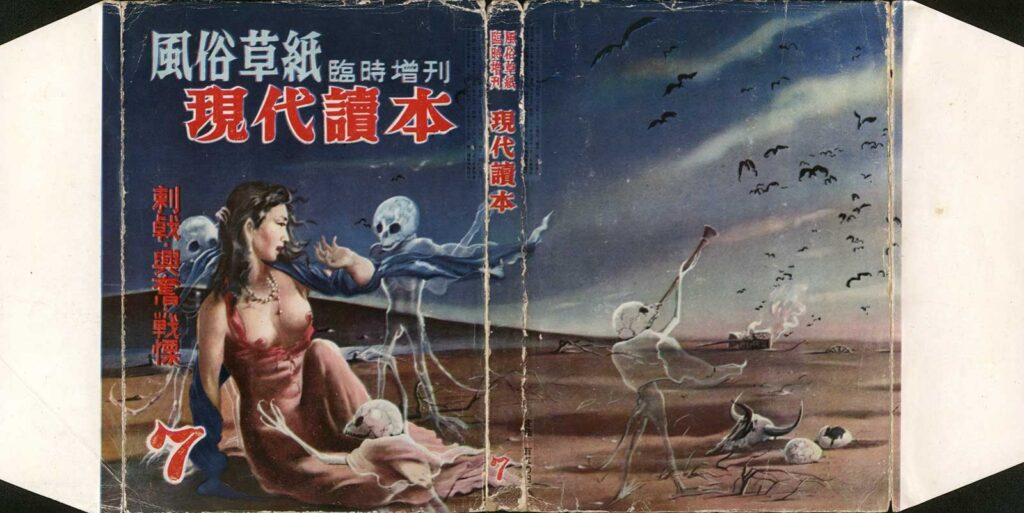
- The cover places a bloodied woman among skeletons, masks, birds, and bones, joining erotic display to death and supernatural danger (PDF p. 1).
- “Black Cat and Woman” turns the nude female figure into a miniature decorative body beside an enormous animal (PDF p. 3).
- “The Latest Electric Chair” transforms state execution into technological spectacle through photographs, diagrams, restraints, and witness arrangements (PDF p. 6).
- “Street of the Great Torrent” creates a noir underworld of hotels, cars, guns, nightclubs, criminals, and endangered women (PDF pp. 15–22).
- “A Bloody History of American Gangsters” presents Prohibition, organized crime, weapons, corruption, and murder as illustrated history (PDF pp. 24–34).
- “American Police Interrogation” documents beating, electrical coercion, deprivation, forced confession, and deaths in custody (PDF pp. 64–72).
- “Rebel Dillinger” turns a historical bank robber into a cinematic antihero of escape, disguise, pursuit, and betrayal (PDF pp. 81–88).
- “Sadism, Inc.” imagines cruelty as a bureaucratic system built from recruitment, hierarchy, training, manipulation, and exploitation (PDF pp. 89–102).
- “The Mysterious Death of Kiriko Yamagiri” converts the female corpse into forensic evidence through wounds, insects, soil, stains, and footprints (PDF pp. 103–110).
- “Unexpected Criminals” examines unlikely offenders and cases in which ordinary appearances conceal criminal acts (PDF pp. 154–160).
- “The Ecology of Gamblers” treats gambling as an organized social world with its own psychology, language, and professional identities (PDF pp. 161–166).
- “A Male Abnormalist Reader: Four Forms of Play” classifies masochistic, fetishistic, and other unusual male erotic practices (PDF pp. 167–173).
- “My Debauchery Diary” presents exhibitionism, clothing, desire, and transgression through an apparently female first-person voice (PDF pp. 174–180).
- “A Study of Western Torture Instruments” turns historical restraint and punishment devices into objects of technological and antiquarian analysis (PDF pp. 216–222).
- “The Laughing Murderer” carries the issue’s final sustained crime narrative through the true end of the scan, followed by closing notices on PDF page 248 (PDF pp. 235–248).
Contributors
Named contributors represented in this issue:
- A. G. Hopkins; translated by Itō Shizuo
- André De Dienes
- Editorial Department
- Hayashi Kyōnosuke
- Hida Yoshiro; illustrations by Yutani Toshiaki
- Hinatsu Yukio; illustrations by Mizusawa Miyuki
- Hirai Isao; translated from Daniel Hammett
- Hirose Yū
- Hoshi Hideo
- Iga Itsuma
- Iwaki Taizō
- Iwasaki Sakae; illustrations by Nozaki Kōsaku
- Kaneko Ryūji
- Kita Reiko
- Kiyama Kōsaku
- Kurata Ippei
- Kuroki Tetsuyuki; illustrations by Yamashita Shūhei
- Miyamoto Mikiya
- Nakajima Kawatarō
- Numata Kiyoshi; illustrations by Kanzaki Tsutomu
- Ogata Itsuma; illustrations by Sano Hiroshi
- Ōtsuki Kyūryō
- Sekikawa Shūboku
- Shima Jirō
- Soeda Satsuki
- Takahashi Susumu
- Takeno Tōsuke