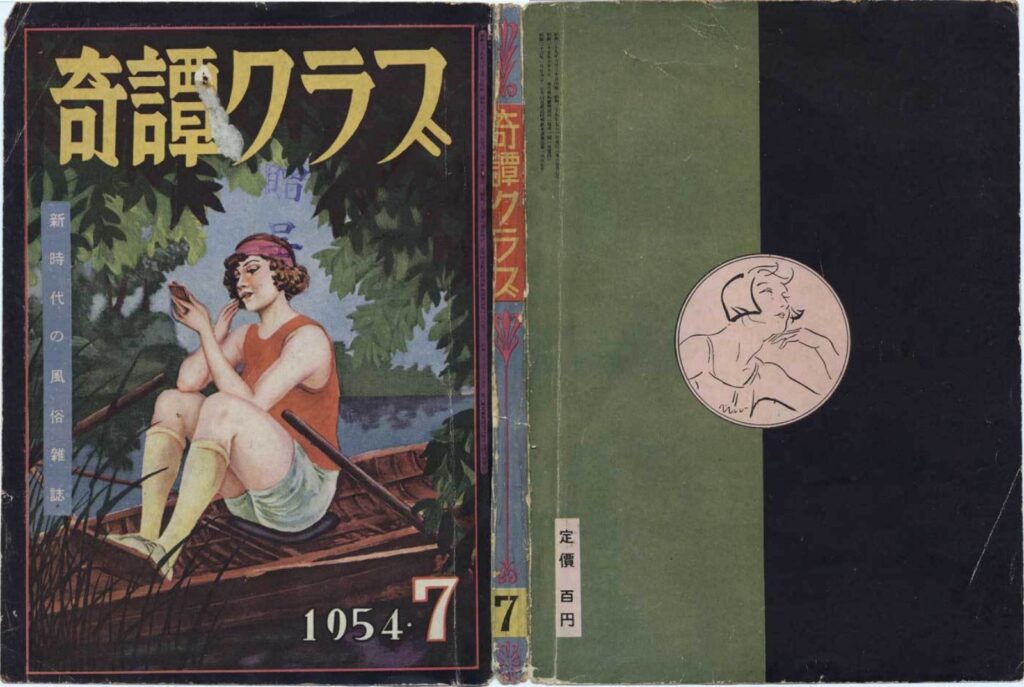
Kitan Club
July 1954
← Back to magazine archive
Issue Details
- PDF pages
- 140
Summary
The July 1954 issue of Kitan Club is a dense mixture of bondage illustration, staged photography, female-dominance imagery, confessional writing, queer testimony, fetish studies, institutional memoir, historical punishment research, translated European material, and anniversary retrospectives. Its central thread is the conversion of private desire into systems of classification. Rope positions, clothing, masks, body parts, gender roles, punishment practices, and masochistic identities are all sorted into recognizable categories.
Read full summary Close full summary
Table of Contents 40 items
-
The Woman Anchin: Dōjōji Legend
Summary
An erotic illustration reimagines the Dōjōji legend of Anchin and the woman who becomes a serpent, emphasizing supernatural transformation, bondage, and fatal passion.
-
A Delightful Western Dominatrix
Summary
A Western-style erotic illustration portrays a confident dominatrix in corsetry, stockings, high heels, and holding a whip.
-
Pet Training: The Cat and the Whip
Summary
A photographic feature presents Miss Beck in fetish attire using a whip while staging a circus-like pet-training performance involving a human figure presented as a cat.
-
Crucifixion
Summary
An erotic illustration depicts a woman bound spread-eagled to an ornate cross, framing crucifixion as both a brutal historical punishment and a visually seductive spectacle.
-
Ox Splitting
Summary
An erotic historical-punishment illustration shows a woman bound to a powerful ox in a scene evoking the execution method of ox-splitting, accompanied by a condemnation of wartime brutality.
-
Water Punishment
Summary
A submerged woman is bound to an anchor and helplessly dragged underwater, presenting water punishment as a fatal scene of captivity and restraint.
-
Leopard
Summary
An erotic illustration depicts a woman amid leopards, chains, and bones, accompanied by a dramatic caption suggesting captivity and peril.
-
Disordered Hair
Summary
A staged monochrome photograph presents a kimono-clad woman in a distressed, inwardly folded pose, emphasizing her elaborate disordered hair and costume.
-
Island of Tsubushi
Summary
A monochrome photograph features a kimono-clad woman posed low to the ground while displaying the traditional flattened Shimada hairstyle known as tsubushi shimada.
-
While I Count to One Hundred
Summary
A photographic bondage scene shows model Haruhi Rumi restrained with rope while tormentor Itabuki Makiko counts to one hundred, emphasizing sustained restraint and endurance.
-
Until the Binding Is Complete: Photographic Explanation
Summary
A step-by-step photographic explanation demonstrates how to bind a model’s wrists, arms, torso, and legs with rope, including wrapping the rope across the chest and securing the body in a completed restraint.
-
Do Not Hurt Me Too Much
Summary
A staged photographic scene depicts Haruhi Rumi physically restraining Itabuki Makiko in a wrestling-like hold while the captive protests against excessive pain.
-
My Lady! A Rope-Free Torment Game
Summary
A photo sequence demonstrates a rope-free torment game in which a dominant woman physically restrains and overpowers a pleading male participant through positional control.
-
Awaiting the Captive Model
Summary
A staged portrait presents model Kasuga Rumi in a characteristic pose, holding a long cane while awaiting the appearance of a captive or subjected model.
-
The Threatening Pose
Summary
A tense staged photograph shows Kasuga Rumi poised to swing a whip, emphasizing the anticipation and threat of imminent corporal punishment.
-
Humiliation Toward a Human Husband
Summary
A photographic scene depicts a dominant woman disciplining and humiliating a male “human dog” who has failed to learn his tricks.
-
Triumphant Song
Summary
A photographic scene shows a woman taunting and triumphing over a bound male submissive while contemplating his further punishment.
-
Newlywed Game: Dance
Summary
An illustrated domestic scene presents a newlywed quarrel in which the wife is tied up and threatened with being made to drink salt water as her husband reacts to her appearance.
-
Newlywed Game: Cat
Summary
An erotic illustration shows a newlywed dressed for housework bound upright while a household cat plays around her feet in the morning light.
-
Binding with a Folding Ladder
Summary
A sequence of erotic illustrations presents nude figures tied into varied positions on and around a folding ladder, emphasizing the ladder as a bondage apparatus.
-
Fantastic Dream
Summary
A surreal erotic dream illustration depicts a nude woman amid candle wax, a knife, a snake, and chain-like restraint imagery, creating an atmosphere of danger and fantasy.
-
Romantic Sadism: Notes of a Woman Who Loves to Be Tormented
Summary
A first-person essay reflects on romantic sadism through observations of couples, jealousy, literary and cinematic images, and the author’s own attraction to eroticized domination and suffering.
-
Scattered Flowers of the Crotch-Rope Split
Summary
This historical erotic tale set in the Tokugawa period follows intrigue within a samurai household, forbidden desire, abduction, interrogation, and escalating restraint and corporal punishment culminating in violent sexualized retribution.
-
Blindfolds and Masks
Summary
An illustrated essay examines blindfolds and masks as devices of sensory restriction and erotic stimulation, discussing their psychological and aesthetic effects through photographic examples and a reader contribution.
-
Confession of a Certain Masochistic Man
Summary
A personal confession traces a man's masochistic development from adolescent fantasies through adult relationships, describing his attraction to female control, bondage, humiliation, and sadomasochistic domestic encounters.
-
The Secret of the Beautiful Boy
Summary
An erotic narrative follows a beautiful adolescent whose unusual appearance and vulnerability make him the object of classmates' curiosity, coercive undressing, physical inspection, and voyeuristic fascination.
-
From Husband to Wife
Summary
Presented as an exchange between husband and wife, this erotic correspondence reflects on marital intimacy, mutual bondage, role reversal, and the couple's effort to incorporate restraint into everyday married life.
-
Confession of a Woman Mad About Young Women’s Feet
Summary
A first-person confession traces the author’s lifelong fixation on young women’s feet, including collecting, smelling, stealing, and seeking opportunities for intimate contact with footwear and feet.
-
My Seppuku Game
Summary
A woman recounts a marital erotic role-play centered on seppuku, involving ritualized violence, knife play, restraint, and the dangerously blurred boundary between staged fantasy and real injury.
-
Infatuation
Summary
This extended erotic narrative follows Miki’s obsessive relationship with Kiyomi through jealousy, domination, sexual coercion, punishment, restraint, and recurring fascination with her feet and body.
-
In Memory of My Foster Mother
Summary
A memoir of the author’s foster mother recalls her devoted care during his childhood, intimate domestic routines, and the lasting grief and gratitude surrounding her death.
-
Corset Mania
Summary
A first-person account of an intense fascination with corsets describes corset wearing, tight-lacing, bodily display, and erotic encounters centered on the garment, accompanied by fetish-oriented illustrations.
-
Sexual Fluids, Part Six
Summary
The sixth installment presents a nonfiction-style erotic account of regional performances and sexual entertainments involving women, ropes, binding, and suspension, while reflecting on their historical precedents and techniques.
-
From a Masochist’s Notebook
Summary
A reflective masochist’s notebook that examines masochistic psychology through literary discussion and sensational historical anecdotes involving colonial violence, military discipline, punishment, and fetishistic garments.
-
The Story of Shirakiya Okoma
Summary
A dramatized historical account of Shirakiya Okoma, an Edo-period sexual and criminal scandal involving servants, illicit desire, conspiracy, murder, judicial judgment, and harsh execution.
-
Letter to Dr. Nakaguma
Summary
A reader’s letter responding to Dr. Nakaguma’s discussion of seppuku play, describing an elaborate erotic fantasy of ritualized abdominal cutting, spectatorship, and staged violence.
-
Memoir of Pleasurable Cruelty: Confession of a Male Masochist
Summary
An autobiographical confession by a male masochist recounts his developing desire for female domination and his elaborate experiences of bondage, restraint, punishment, pain, and humiliation. The narrative presents these practices as both psychologically compelling and erotically pleasurable.
-
Cruel Women
Summary
A translated and annotated survey of “cruel women” draws on a 1901 German illustrated book to present historical and ethnographic examples of female cruelty, slavery, corporal punishment, sexual domination, and specialized restraint devices. It combines sensational reportage with reproduced illustrations and commentary on the social and psychological meaning of these practices.
-
Illustrated Suspension and Restraint Positions
Summary
An illustrated instructional feature presents women in a series of bound, suspended, inverted, and apparatus-assisted restraint positions, with numbered figures showing varied configurations.
-
A Man’s Secret Diary Hidden in Illustrations
Summary
Presented as a man’s secret diary, this illustrated first-person narrative recounts cross-dressing for a stage performance and subsequent humiliating, physically restrained experiences during group activities.
Highlights
- Itō Seiu’s The Woman Anchin transforms the Dōjōji legend into a turbulent punishment tableau of smoke, flame, exposure, and supernatural descent (PDF p. 6).
- The early historical portfolio places crucifixion, ox splitting, water punishment, and animal danger into a single comparative archive (PDF pp. 9–12).
- The Itō Seiu photographs use kimono, loosened fabric, compact posture, and bound arms to create an intimate contrast with the surrounding execution imagery (PDF pp. 13–14).
- Until the Binding Is Complete shows the tying process step by step, including the hands of the person applying the rope (PDF pp. 17–18).
- The extended Haruhi Rumi and Itabuki Makiko sequence makes female-on-female dominance one of the issue’s central photographic subjects (PDF pp. 19–24).
- Fantastic Dream abandons realism and arranges candle wax, knife, chain, and body as fragments of a fetish dreamscape (PDF p. 29).
- Romantic Sadism pairs a female masochistic confession with drawings of pulleys, stools, wheelchairs, and suspension frames (PDF pp. 31–38).
- Blindfolds and Masks studies concealment, altered identity, anticipation, and sensory control as a distinct fetish field (PDF pp. 48–52).
- Confession of a Certain Masochistic Man traces adult submission back through school, family discipline, humiliation, and domestic memory (PDF pp. 53–61).
- The Secret of the Beautiful Boy gives male same-sex desire and bodily fascination a sustained literary form (PDF pp. 62–66).
- Confession of a Woman Mad About Young Women’s Feet turns footwear, school memories, bodily observation, and female desire into an autobiographical fetish archive (PDF pp. 73–76).
- Corset Mania treats fashion as bodily engineering, linking pressure, narrowness, posture, transformation, and compulsion (PDF pp. 92–94).
- The Story of Shirakiya Okoma presents punishment as public theater through arrest, procession, interrogation, and execution imagery (PDF pp. 107–111).
- Memoir of Pleasurable Cruelty is the issue’s major late work, using female-on-male discipline to connect masochism with war, clothing, memory, and domestic hierarchy (PDF pp. 113–129).
Contributors
Named contributors represented in this issue:
- Aoyagi Kenshi, romanization uncertain
- demonstration by Tsujimura Takashi; model Itabuki Makiko
- Furumi Kaoru
- Haruhi Rumi
- Haruhi Rumi and Itabuki Makiko
- Itō Seiu
- Kawai Itsuko
- Kawano Kyōsuke
- Kazuhisa, artist credit uncertain
- Kishii Yōsaku
- Kurume Eizō
- Majima Yoshitoshi
- model Haruhi Rumi; tormentor Itabuki Makiko
- model Itabuki Makiko; tormentor Haruhi Rumi
- Numa Shōzō
- Oniyama Yakusaku, romanization uncertain
- photographed by Itō Seiu
- Saishōgo, romanization uncertain
- Sakai Mahō
- Sugihara Nijiko
- Taki Reiko
- Tayama Akira
- translated and explained by Morimoto Aizō
- Yamaguchi Kōichi
- Yamaoka Shirō
- Yanagihara Sunako